
I’ve hired, managed, and audited dozens of software development agencies over the years. The difference between a reliable partner and a money pit usually comes down to one thing: what you ask before you sign.
What To Ask a Software Development Agency: Key Findings
- Confirm if the agency’s team includes senior developers or key specialists, and whether work is outsourced or white-labeled. 61% of organizations cite talent gaps as their top risk.
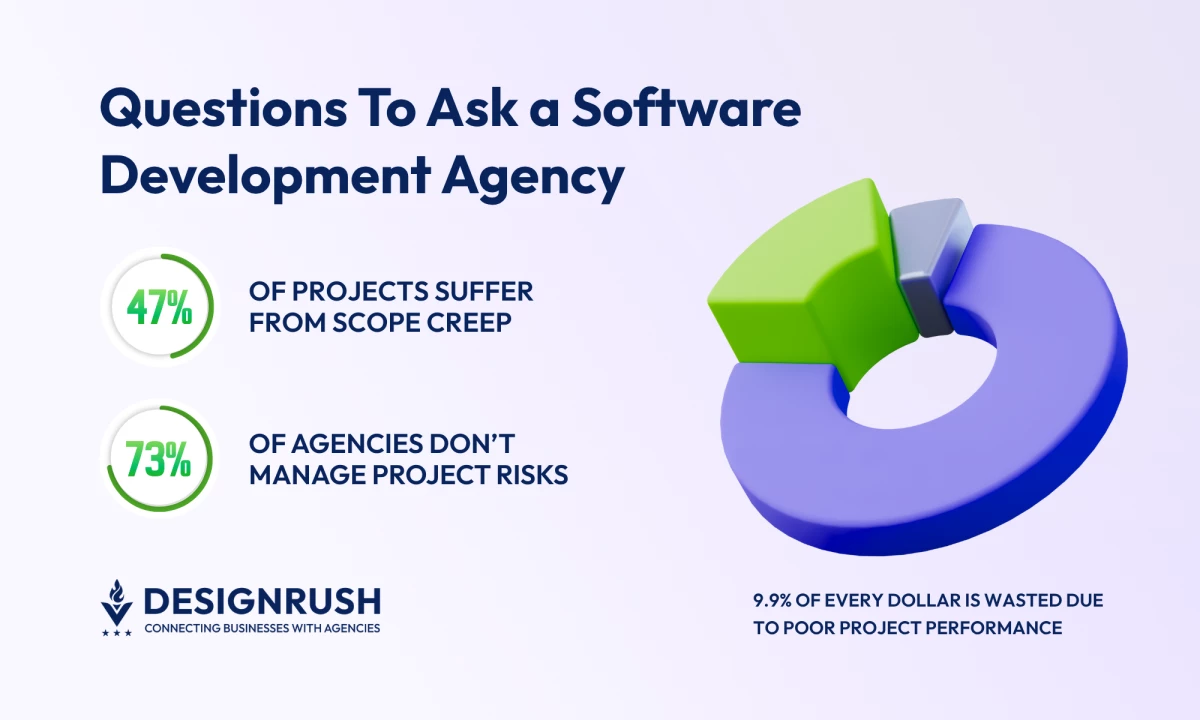
- Ask how they handle feature updates, timeline adjustments, or shifting priorities. Nearly 47% of projects face scope creep.
- Ask how the agency manages and mitigates technical, security, and operational risks. Only 27% of companies actively track risks.
What To Ask a Software Development Agency: Executive Summary
When you’re sitting across the table from a software development agency, remember this: they’re selling you their best version.
I’ve led enough vendor evaluations to know the real danger is in answers that sound reasonable, even reassuring, but hide the very risks that blow up budgets and timelines.
That’s why I recommend using a structured set of questions, not just to test technical competence, but to surface how an agency manages risk, handles change, and keeps you in control of your own product.



1. Who Will Actually Work on Our Project, and What’s Their Seniority?
In every failed project I’ve audited, the first red flag was team substitution. Agencies bring their A-team to the pitch, then hand off to juniors once the ink is dry.
A Qubit-Labs study shows that 76% of companies face a tech-talent shortage, and over 70% report project delays due to lack of qualified expertise.
- Ideal Answer:
Your core team will include a senior architect (15 yrs), mid-senior backend (7 yrs), mid frontend (5 yrs), senior QA (10 yrs), and DevOps (12 yrs).
We’ll send full CVs and LinkedIn bios, and if someone leaves, we guarantee a replacement of equal or better seniority within 2 weeks.
That’s an agency that understands risk continuity.
- Red Flag Answer:
We’ll assign a strong team and let you know who after contract signing. Our bench is flexible, so we’ll pull from available talent.
In other words, you’re getting whoever is free, not necessarily who’s best.
2. Can You Share an Example of an Industry-Specific Solution You’ve Built?
This question separates builders from storytellers. Generic talk about “custom platforms” means they’ve never solved your exact business problem.
When I ask this question, I expect to hear a concrete example relevant to my industry, complete with measurable outcomes.
- Ideal Answer:
For a logistics client, we built a real-time fleet management system integrating GPS, route optimization, and warehouse inventory. The solution reduced delivery times by 18% and cut operating costs by 12%. We can walk you through the architecture and lessons learned.
- Red Flag Answer
We’ve worked with companies similar to yours and built platforms that helped them operate more efficiently. Every project is unique, so we don’t want to give a cookie-cutter example.
3. Can You Walk Us Through Your First 90 Days?
A structured ramp sets expectations and builds momentum.
According to the PMI's Maximizing Project Success research, continuous reassessment and stakeholder alignment early is essential to avoid wasted effort.
I’ve personally watched projects burn half their budget rewriting features because no one aligned on scope early.
- Ideal Answer:
Days 1-30: Discovery, stakeholder mapping, success metrics, risk register.
Days 31-60: Wireframes, architecture, proof-of-concept.
Days 61-90: Deliver first working slice, run UAT, calibrate roadmap.
We’ll also set up baseline metrics (performance, quality) and freeze version 1 scope after 90 days.
- Red Flag Answer:
We don’t rigidly define the first 90 days, we prefer to stay agile and start coding immediately.
4. How Do You Handle Change Requests?
Scope creep kills timelines and budgets. According to PMI, uncontrolled changes are among the top causes of failure: nearly 47% of projects experience scope creep, and those projects see an average 15% budget increase.
I’ve seen it firsthand: a CEO approves one “small” feature tweak, and three sprints later the project is 25% over budget.
- Ideal Answer:
Every change is logged, impact-assessed by scope, cost, and timeline, and implemented only after written approval. If it adds 10%+ to budget or 2+ weeks to timeline, it triggers a change order.
- Red Flag Answer:
If the change is small, we take it; if it’s big, we’ll tell you when it matters.
5. Who Pays for Third-Party Tools or Services?
Hidden costs are where CEOs get blindsided. Many projects incur extra expenses for things like software licenses, hosting, APIs, or third-party services.
Third-party tools can add 10-25% (or even more) overhead to your total cost. And indeed, 9.9% of every dollar invested in projects is wasted due to poor project performance and oversight.
- Ideal Answer:
Here’s what we need: database hosting, monitoring, CI/CD tools, third-party APIs for payments. You will hold direct licenses, so they live in your name. We’ll include these costs as a line-item in the budget (no markup).
- Red Flag Answer:
We typically cover common tools and let you know if anything extra comes up later.
6. What Criteria Do You Use When Choosing a Tech Stack?
Technology choices outlive contracts. If an agency picks an obscure or overly niche tech stack, you might struggle to maintain the product or hire developers for it later.
In the Empirical Reality of IT Project Cost Overruns, the overruns follow a power-law distribution: extreme outliers often stem from deep architectural mistakes.
So, I want to hear that the agency chooses technology contextually, not ideologically.
They should consider scalability, the talent pool, ecosystem maturity, cost, and any specific constraints of your industry.
- Ideal Answer:
We evaluate based on scalability, hiring market, ecosystem maturity, cost, and your industry constraints. For example, we might recommend Node.js + TypeScript + PostgreSQL for maintainability and talent supply.
- Red Flag Answer:
We always use [favorite stack]. It works for most clients.
7. What’s Your Approach to Risk Management or Escalations?
If I know something, it’s that IT projects are fat-tail risk machines, meaning a small issue, if unmanaged, can snowball into a major disaster.
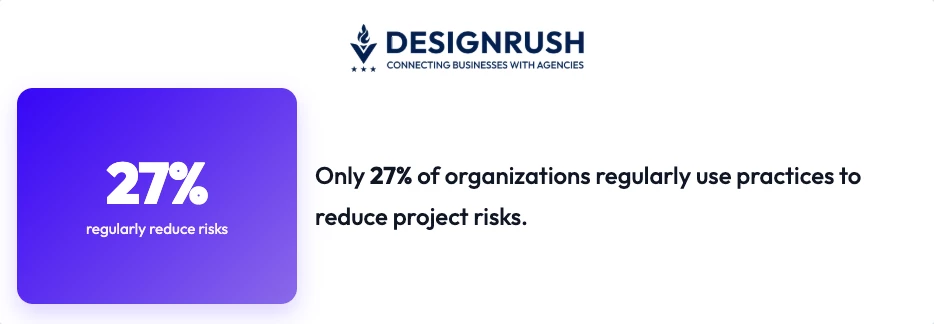
Alarmingly, only 27% of organizations regularly use practices to reduce project risks, according to PMI’s Pulse of the Profession survey.
I want to make sure my agency is in that 27%, not the 73% that just “hope for the best.”
I’m listening for a tiered escalation structure and guaranteed response times at each level.
- Ideal Answer:
We maintain a project-risk register, rate risks by severity and probability, and update weekly. For escalations:
- Tier-1: Developer → Tech Lead (same day)
- Tier-2: Tech Lead → Project Manager (4-hour response)
- Tier-3: Project Manager → Executive Sponsor (1 business-day response)
We simulate scenario drills quarterly and build contingency buffers. If a risk triggers, we issue a “Recovery Plan” with decision options.
- Red Flag Answer:
If anything big comes up, we’ll talk it through with you and adapt.
8. How Do You Transfer Knowledge To Our Team?
I’ve seen companies double their costs because agencies left with the knowledge.
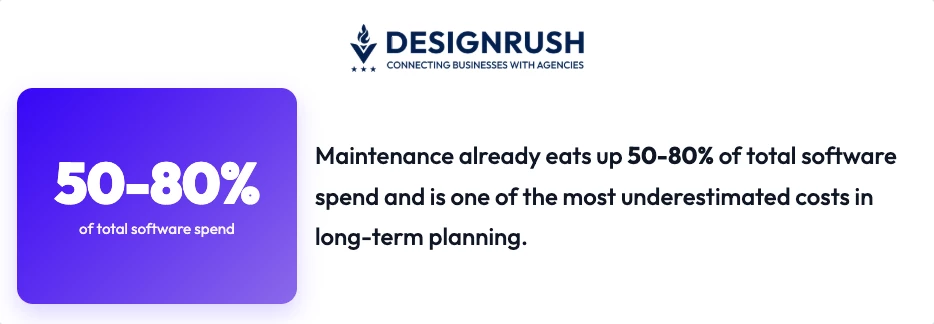
Maintenance already eats up 50-80% of total software spend, and without documentation or training, you’ll keep paying others to fix what you can’t touch.
You should ask how the agency will enable your team to own and run the product after launch. This includes documentation, training, and a transition period.
- Ideal Answer:
We’ll deliver:
- Comprehensive architecture docs
- Runbooks and operations playbooks
- Training sessions with your engineers (K-days)
- Recorded demos and transitions
- Code walkthroughs and office-hours drop-in sessions
For 3 months we’ll pair your devs 1:1 with ours until you reach competency.
- Red Flag Answer:
We’ll do a knowledge transfer session at the end, usually a couple of hours.
9. How Will You Keep Us Updated on Progress and Budget?
As per the PMI study, poor communication is cited as the primary contributor to project failure one-third of the time.
I’ve learned that having concrete status dashboards and reports is far more useful than vague weekly calls where everyone says “we’re on track.”
Meanwhile, Cliff Skelliter, Founder and Creative Director of Sky Story Creative, emphasizes the human side of communication:
“I end up like a psychologist for my clients sometimes. Being high-touch builds friendships, and that’s when the most creative ideas flow.”
Good agencies pair data with dialogue: structured reporting keeps budgets aligned, and high-touch communication builds trust that drives better outcomes.
- Ideal Answer:
Every Friday you’ll get a dashboard: burn rate vs. budget, forecast to completion, scope changes, blockers, quality metrics. We hold a 30-min status call. We’ll flag any 10% overrun risk immediately and propose mitigation options.
- Red Flag Answer:
We’ll show you updates during sprint demos.
10. What Kind of Post-Launch Support Do You Offer?
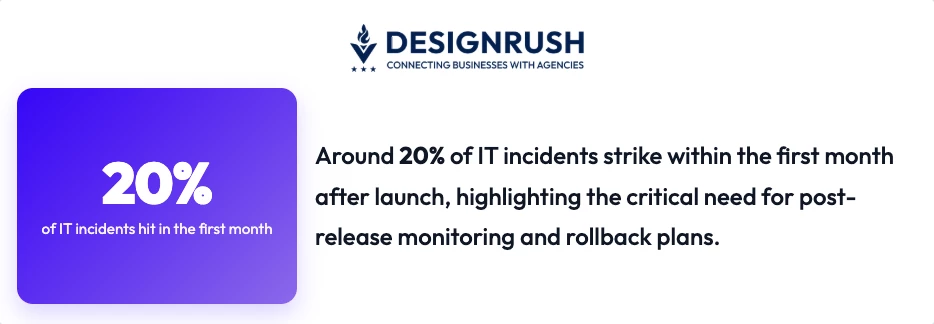
In my experience, around 20% of IT incidents hit in the first month after launch, which is right when real users start pushing the system.
Without a clear support plan or SLA, those early bugs turn into downtime, lost revenue, and finger-pointing.
And with the average cost of downtime exceeding $300,000 per hour for most mid-to-large enterprises, you can’t afford to improvise post-launch.
- Ideal Answer:
We offer a 3-month warranty period where we fix bugs at no extra cost. After that, we provide support packages with SLA tiers: response within 2 hrs, resolution in 24 hrs, with uptime guarantees. We also monitor logs, performance, do patch updates, and code refreshes based on usage metrics.
- Red Flag Answer:
We’ll be around to help if you need us, just reach out.
Find More Agency Hiring Resources:
1. In-House vs. Outsourcing Software Development
2. How To Plan a Software Development Budget
3. Building a Practical Budget for Mobile App Development
Last Points Before You Sign
Before you commit to a software agency, pause.
The last five minutes before signing are where I’ve seen the most expensive mistakes made:
- I’ve seen agencies show “previous work” that wasn’t theirs, just cloned templates or mockups from Dribbble. I now ask to see the live product or speak directly with a past client. If they hesitate, they didn’t build it.
- I once reviewed a project that had seven developers from four different time zones. None had met. The code looked like seven people built seven products. I never sign without knowing who writes the code and where they are.
- The senior architect from the pitch never appeared again. Replaced by a junior a week later. I started putting every promised name in the contract. It stopped happening.
- I have read timelines that would require people to code in their sleep. The same agencies later ask for extensions. I only trust schedules that show testing, review, and correction time from day one.
- The best teams ask questions before answering. The worst never pause. I trust the ones who admit what they need to verify.
- I have rebuilt products that were sold as “scalable.” They weren’t. I now ask for proof in the form of architecture diagrams, not adjectives.
Our team ranks agencies worldwide to help you find a qualified partner. Visit our Agency Directory for the top software development companies, as well as:
- Top Enterprise Software Development Companies
- Top Custom Software Development Companies for Small Business
- Top Mobile App Development Companies
- Top AI Development Companies
- Top Software Testing Companies
Our design experts also recognize the most innovative design projects across the globe. Given the recent uptick in app usage, you'll want to visit our Awards section for the best & latest in app designs.
Questions To Ask a Software Vendor FAQs
1. How do I know if a software development agency is the right fit?
Check their track record in your industry, confirm team credentials, and make sure their process aligns with your goals and communication style.
2. What’s the most common mistake when hiring a software agency?
Signing before scope, deliverables, and ownership are defined in writing. Clarity upfront prevents budget overruns later.
3. How can I maintain control once the project starts?
Demand weekly progress and budget reports, keep access to repos and tools, and track deliverables against milestones.