
After hiring a digital marketing agency, I have seen businesses realize too late that they never truly controlled their own marketing infrastructure, with the consequences showing up during transitions or underperformance when access tightened, data retrieval slowed, and momentum began to slip.
The questions below are the ones I rely on to protect leverage, continuity, and long-term control before budget, performance, and strategic flexibility are already at risk.
Questions To Ask a Marketing Agency: Key Findings
- Many businesses regret not securing admin ownership of their ad accounts from day one, only realizing during transitions that control was never fully theirs.
- Paid media accounts for 30.6% of marketing budgets, which makes billing transparency and direct control over ad spend non-negotiable.
- Agency transitions are common, and without a defined 30-day exit plan, account access, tracking logic, and campaign history can become difficult to recover.
The Mistakes Most Businesses Only Discover After It Is Too Late
Marketing budgets are holding at 7.7% of company revenue in 2025, and 59% of CMOs report that they do not have sufficient budget to execute their strategy, according to Gartner’s 2025 CMO Spend Survey.
Growth expectations remain high, scrutiny has intensified, and agency relationships are evaluated far more critically when performance wavers or priorities shift.
Under those conditions, weaknesses that seemed minor during onboarding tend to surface at the worst possible time.
I have seen companies move to change agencies or respond to underperformance only to discover that primary ad accounts were not fully owned internally, that billing lacked clear separation, or that historical data could not be easily exported without relying on the agency’s cooperation.
None of these issues appear urgent when results are steady, yet they quickly become costly when flexibility and speed are required.
Let’s avoid that.
1. Will We Be Admin Owners of All Accounts From Day One?
I ask this before I sign anything.
If the agency creates or owns my Google Ads, Meta, Analytics, or other marketing accounts, they control access. And I have seen what happens when that is not clarified early.
In Google Ads, a client account can have only one owner. If a manager account creates a new account, the manager automatically becomes the owner.
If the agency sets it up under their manager account without transferring ownership, they hold the keys by default.
In one Google Ads discussion, a business owner realized too late that the agency had set up and controlled the account.
When the relationship changed, ownership became unclear and access became a problem. The common theme in replies was simple: if the account is not under your business from the start, you are exposed.
I do not want to fight for access to my own campaigns. I do not want to rely on someone else to retrieve my historical data, audiences, or billing details.
Even when everything is going well, admin ownership protects me long term. It makes transitions clean, leverage balanced, and reduces unnecessary risk.
The ideal answer:
“All accounts will be created under your company email and business manager. You’ll be the admin owner, and we’ll manage them through partner access.”
Red flag answer:
“We usually create and manage the accounts under our system because it keeps everything streamlined. You’ll still get full reporting, so you won’t need direct ownership.”
Easier for them. Riskier for you.



2. Do We Get Direct Logins and Exportable Reports?
Some agencies send clean dashboards and polished screenshots.
That looks fine when performance is steady, but if I ever want to double-check numbers, investigate a drop, compare attribution models, or move to a new partner, screenshots are useless.
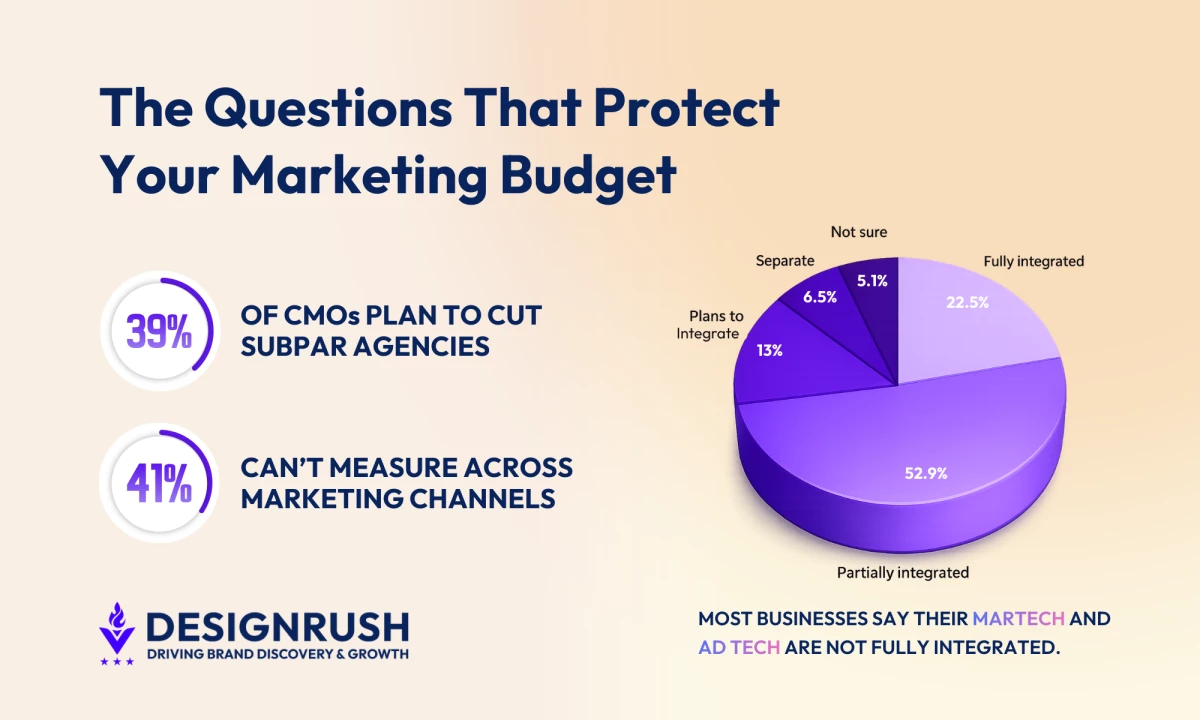
Cross-channel measurement is still a known gap, as 41% of marketers say they can’t effectively measure marketing across channels, so direct access becomes a basic safeguard.
If I cannot log in myself, I cannot independently verify spend, conversions, audience data, or campaign changes. If I cannot export raw data, I cannot properly audit performance or transition smoothly.
When I am investing real budget, I should not be relying on curated views of my own marketing.
The ideal answer:
“You’ll have direct login access to all platforms, and we’ll provide raw, exportable reports in addition to summaries.”
Red flag answer:
“We manage everything inside our system. You’ll receive monthly performance reports, and if you need specific numbers, just let us know and we can pull them for you.”
That sounds helpful and even service-oriented.
But it means I am dependent on them to see my own data, and dependency is not transparency.
3. If We End the Contract, What Happens in the First 30 Days?
I ask this before I sign because I have seen what happens when no one defines the exit.
In one SEO discussion, a business owner shared how they had to “reclaim” their own Google and social accounts after working with an agency. Logins were unclear, ownership was messy, and access recovery became a project on its own.
When agencies change, I do not want to be hunting for passwords, guessing how tracking was set up, or trying to decode campaign logic that only lived in someone’s head.
And this is not a rare edge case. According to Gartner’s CMO Spend research, 39% of CMOs plan to cut back on agency budgets, often by eliminating underperforming agency relationships and streamlining their rosters.
The first 30 days after ending a contract can either protect momentum or destroy it, and the difference lies in whether the exit plan was defined before the relationship began.
The ideal answer:
“If we part ways, you keep full account access. We’ll provide documentation, campaign history, assets, and a structured handoff within 30 days.”
Red flag answer:
“We’ve never really had issues before. If it comes up, we’ll coordinate something.”
This may sound reassuring, but it is not.
If the exit plan is undefined before I sign, it will be improvised when stakes are higher.
4. In a Dispute, Can You Ever Restrict Our Access?
I ask this because I’ve seen situations where access to critical accounts becomes leverage, and it kills momentum fast.
Most partnerships never reach a dispute, but if one does, that is not the moment you want to discover who truly controls your accounts.
There are real cases in business communities where disputes over payment or direction led to agencies restricting access, pausing campaigns, or changing passwords.
Even if they think they’re protecting themselves, the result is the same: ads stop, leads stop, and revenue slows.
Your marketing accounts should never be used as leverage in a disagreement. If access can be pulled at any time, you are exposing your business to unnecessary operational risk.
The ideal answer:
“No. Your accounts are yours. We never restrict access. If there’s a dispute, we resolve it through the contract, not by touching your accounts.”
Red flag answer:
“If invoices aren’t paid or accounts are inactive, we may need to pause access until things are sorted.”
That sounds practical, but in reality it means your marketing becomes a pressure point.
Access should not be contingent on billing disagreements, and if they see your own accounts as something they can hold, that’s a risk you do not need.
5. Can We Limit What You Access in Our CMS or Other Systems?
I always ask this now because it’s one of those things businesses often regret after giving blanket access.
Companies hand over full admin rights to their CMS, CRM, or hosting simply because it seems easier in the moment.
Later, they find changes were made they didn’t approve, plugins or extensions were altered, or sensitive areas were exposed without clear need.
The Identity Theft Resource Center’s 2025 annual data breach report notes that data breaches are now near universal and specifically recommends that small businesses implement Least Privilege access, meaning each role should only have the access required to do its job.
In real WordPress forum discussions, site owners pointed out that agencies sometimes request wide-ranging access even when they only need specific permissions to do marketing work.
That creates operational risk that could have been avoided with a simple conversation up front.
If roles and permissions aren’t defined early, you’re giving away more control than necessary, and without a good reason.
The ideal answer:
“We only request access required for marketing tasks. We’re comfortable working with restricted roles and approval workflows.”
Red flag answer:
“We need full admin access to everything. It just makes things faster and avoids back and forth.”
If “speed” is the only reason they want full control, that is not a good justification. Convenience for them should not come at the cost of exposing your entire system.
6. How Do You Adapt Strategy if Results Aren’t Meeting Expectations?
I advise always asking this before you sign because I know proposals always look strong, but the reality is different.
In digital marketing discussions, one recurring theme is business owners realizing too late that they never clarified what happens if performance stalls. They assumed the agency had a plan.
When results dipped, the response was vague. “Let’s give it time.” “It’s probably seasonality.” “The algorithm needs to learn.”
What they regretted was not asking what the corrective process actually looks like.
If there is no defined adjustment framework, underperformance can quietly stretch from weeks into months, all while budget keeps flowing and optimism replaces action.
The ideal answer:
“If performance drops below agreed targets, we diagnose within a set timeframe. We review targeting, creative, bidding, funnel friction, and tracking. Then we test changes quickly and report back with a clear action plan.”
Red flag answer:
“Marketing takes time. We usually give it a few more months before making major changes.”
Patience is not a strategy. If waiting is the only response to underperformance, I am not funding growth, but drift.
7. How Do You Prevent Channels From Working in Silos?
In digital marketing discussions, a common regret is hiring an agency for “SEO” or “ads” without clarifying how everything connects.
Business owners later realize traffic increased, but conversions did not.
- Paid was driving clicks, but email was not nurturing.
- Social was running campaigns that sales never referenced.
- Each channel had its own report, its own KPIs, and its own logic.
On paper, everything looked active, but in reality, nothing was aligned.
That disconnect is more common than you’d think. eMarketer shows that only 22.5% of organizations say their advertising and marketing technologies are fully unified, which means the majority are operating with fragmented systems and disconnected data.
What people often regret is assuming coordination was automatic, when in fact it isn’t. If integration is not defined upfront, each team optimizes in isolation.
When channels operate in silos, performance looks busy but growth stalls.
The ideal answer:
“We start with one funnel strategy. Each channel has a defined role across awareness, consideration, and conversion. Data is shared across platforms, and messaging is aligned. We report on combined impact, not isolated metrics.”
Red flag answer:
“Our paid, SEO, and social teams each focus on their own area, and we report separately on each.”
If no one connects the dots, no one is accountable for the outcome.
8. Will Ad Spend Run Directly Through Our Credit Card?
I separate this question from the account ownership one for a reason. Paid media now accounts for 30.6% of total marketing budgets, according to Gartner’s survey.
That is nearly a third of overall spend flowing through ad platforms. When that much budget is involved, structure matters, as it should.
Even if I technically have access, I want to know where the money actually flows.
In PPC discussions, there are recurring cases where clients later discover campaigns were run through the agency’s master account or billing setup. That creates confusion around real spend, platform fees, and sometimes even markups.
The regret usually sounds the same: “We thought we were paying Google directly.”
If my ad budget runs through someone else’s account or payment method, I lose financial clarity, I cannot independently verify exact platform spend, and I cannot easily separate media costs from management fees.
And transitioning later becomes more complicated than it should be.
The ideal answer:
“All campaigns will run inside your own ad account, and media spend will be charged directly to your company’s billing profile. We only request manager access to manage campaigns.”
Red flag answer:
“We typically run ad spend through our master account because it’s easier for reconciliation and reporting. You’ll still see totals in your reports.”
Easier for them usually means less transparency for you.
9. Do You Work With Direct Competitors in Our Market?
In PPC discussions, agency owners openly debate whether it is acceptable to serve competing businesses in the same vertical and region at the same time.
Some say it is normal.
Others admit it creates tension, especially when strategies and insights overlap.
The regret from the client side usually comes later.
It sounds like this: “We realized our competitor’s ads started looking very familiar.” Or, “It felt like the same strategy was being recycled.”
Even if data is technically separated, knowledge is not. Audience insights, messaging angles, bidding learnings, and seasonal tactics can easily transfer in subtle ways.
If my agency is running campaigns for the company across the street, I want to know that upfront and not discover it halfway through the contract.
The ideal answer:
“We do not serve direct competitors in the same market at the same time. If that ever changes, we disclose it immediately. We also have strict data separation and conflict policies.”
Red flag answer:
“We work with several businesses in your space. It’s pretty common and hasn’t been a problem.”
That may be true for them, but if competitive overlap is treated casually, so is differentiation.
10. Are You Reporting Blended ROAS Across Brand and Non-Brand?
Blended ROAS often looks strong on paper, but if brand and non-brand campaigns are combined, I cannot tell what is actually driving growth.
- Brand campaigns target people already searching for you.
- Non-brand campaigns are meant to generate new demand.
If they are reported together, performance almost always looks better than it truly is. And I cannot see whether the agency is expanding the business or simply harvesting existing interest.
This is one of the simplest ways results can look impressive without being incremental.
The ideal answer:
“We break out brand and non-brand clearly in every report. You’ll see each separately, and we’ll measure incremental growth, not just overall ROAS.”
Red flag answer:
“We usually focus on overall ROAS. At the end of the day, the total return is what matters.”
If they resist breaking it down, they may be protecting the optics, but definitely not your growth.
Find More Agency Hiring Resources:
- In-House Marketing vs. Agency: Key Pros and Cons
- Digital Marketing Objectives That Drive Real Business Outcomes
- How To Strategically Plan Your SEO Budget
Use these questions to cut through noise, spot red flags early, and build a relationship that drives measurable, lasting growth.

Our team ranks agencies worldwide to help you find a qualified partner. Visit our Agency Directory to find top-rated digital marketing companies, as well as:
Questions To Ask a Digital Marketing Agency FAQs
1. What should businesses prioritize when hiring a digital marketing agency?
Beyond creative ideas and projected results, businesses should prioritize structural clarity, including account ownership, data access, billing transparency, reporting standards, and clearly defined exit terms. Long-term control matters as much as short-term performance.
2. How can companies reduce risk in agency partnerships?
Risk is reduced by defining responsibilities, access levels, performance benchmarks, and transition procedures before signing a contract. Clear documentation and shared expectations prevent misunderstandings later.
3. How often should agency performance and structure be reviewed?
Agency relationships should be reviewed regularly, not only for performance outcomes but also for operational alignment, reporting accuracy, and strategic integration across channels. Ongoing evaluation prevents small structural gaps from becoming larger issues.
4. What makes an agency partnership sustainable long term?
Sustainable partnerships are built on transparency, shared accountability, open access to data, and clear communication around strategy shifts. When both sides understand roles and controls, collaboration becomes more effective.
5. Is switching digital marketing agencies common?
Agency changes are a normal part of business evolution as strategies shift, budgets adjust, or performance expectations change. Companies that define ownership and transition processes early are better positioned to move without disruption if a change becomes necessary.