India's web design industry is one of the most competitive in the world, which means more options and more risk. Explore our vetted list to find companies with proven portfolios, verified credentials, and experience in your industry.
Organic rankings are determined by five factors: top services, reviews, portfolio, awards/press, and team expertise. Sponsored listings pay for a placement that appears above organic positions. Sponsorship does not affect star ratings or review content - read more on our methodology page.
AGENCY LISTING COMING SOON.
Related Services
Web Design Companies by City
Popular Services
How to Hire Web Design Companies in India
What should you prepare before approaching web design companies in India?
Before approaching web designers in India, outline your goals, tech stack, target audience data, budget, timeline, content, and internal decision-making structure.
By having all these details ready, you receive proposals that better align with your needs rather than padded, generic quotes. Moreover, being prepared helps you compare designers and filter from the 1,700+ global capability centers that do not have the experience or skills to meet your requirements.
Here are 9 items to prepare before contacting a web design agency in India:
- The primary purpose of the website, such as an eCommerce platform or a lead generation driver
- Available information on your target audiences, such as demographics, user personas, or user behavior data
- Existing tech stack, including hosting provider, CRM, payment gateway, and ERP integrations
- The approximate number of pages or sections you need
- Compliance requirements, stating the policies your website needs to follow, such as the Americans with Disabilities Act (ADA) or the General Data Protection Regulation (GDPR)
- Content expectations, specifying whether the copy, graphic design, photography, and other elements will be created internally or by the agency
- Realistic budget range, which will help produce a more accurate proposal rather than one built on guesswork
- Timeline anchor, such as a hard launch date or a funding announcement
- Internal decision-making structure, including who approves what and how many stakeholders are involved in feedback rounds
How do you compare web design companies in India that look equally qualified on paper?
When web design companies in India have nearly identical websites, portfolios, client reviews, and hourly rates, compare them based on their design processes, team members, client references, and approach to ambiguity.
These four factors help you uncover operational weaknesses and behavioral problems that could affect website outcomes.
| Factor | Strong web design company | Weak web design company |
| Design process | Explains the discovery sessions, wireframing rounds, stakeholder feedback management, and handover process | Describes tools without explaining the reasoning behind design decisions |
| Team members | Willingly schedules an introductory call with the lead designer and developer | Avoids giving names or holding a meeting with the team working on your website |
| Client references | Provides client references in a similar sector, target market, project scope, and integration complexity | Provides client references that are irrelevant to your specific business and situation |
| Ambiguity resolution | Asks strategic and clarifying questions when receiving an incomplete or ambiguous brief | Sends a quote that ignores the gaps in the brief |
What warning signs specific to web designers in India should make you walk away?
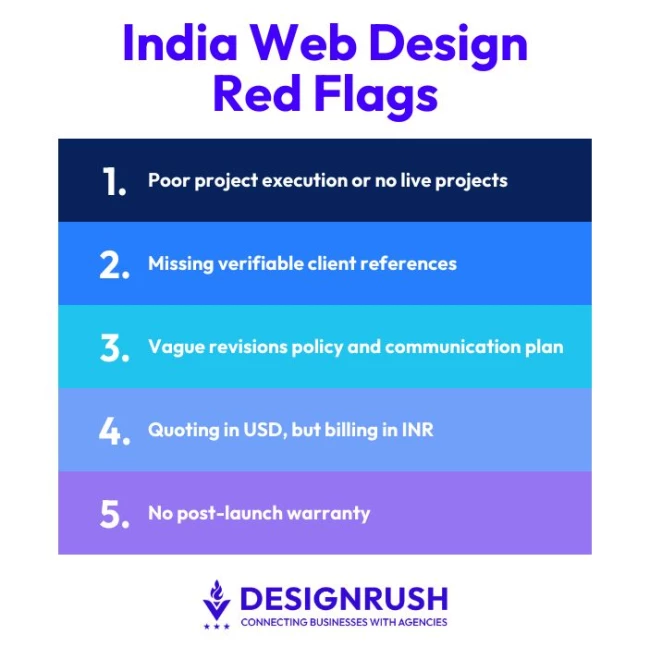
Watch for three categories of red flags: agencies that cannot prove their work, agencies that use vague contracts to protect themselves at your expense, and agencies with no accountability once the project ends. If you see more than two of these in a single agency, walk away, regardless of how competitive the pricing is.
- Poor execution
If the live websites of the agency’s past projects are slow, broken, or difficult to navigate, it may indicate poor QA protocols and an aesthetics-over-usability approach. - No live projects
An agency that only shows mockups or prototypes has not proven it can take a design through full production. Portfolio screenshots without working URLs are not evidence of delivery. - Missing client references
Portfolios and reviews can be curated. A reference call cannot. If an agency cannot produce a contactable past client within a week, treat that as a deliberate omission. - Vague revisions policy
A design contract that does not distinguish a revision from a new scope item and does not specify the number of revision rounds leaves you exposed to budget overruns. - No established communication plan
If the agency cannot commit to named contacts, fixed meeting cadences, and a single project management platform, transparency will deteriorate the moment the project gets difficult. - Currency ambiguity
Contracts that quote in USD but bill in INR at a rate the agency sets expose you to hidden markups and unpredictable invoices. - No named team members
Indian agencies operating at scale sometimes allocate designers based on availability rather than best fit. If "the team" is as specific as it gets, the structure is built for throughput, not for quality. - No post-launch warranty
Without a defined support window after launching, a visually complete but functionally broken site becomes your problem to fix at the agency's hourly rate.
What contract clauses matter most when hiring across borders?
When hiring a web design company in India, your contract should include clauses on IP ownership, data privacy, jurisdiction and dispute resolution, source code escrow, and access control.
Without these five clauses, you have limited legal recourse if the engagement goes wrong, as the default terms will favor the agency's jurisdiction, not yours. Disputes become expensive, ownership becomes contested, and sensitive data sits outside your regulatory framework.
| Contract clause | What it should include | Why it is important |
| Intellectual property (IP) ownership and work-for-hire clause | Explicit statement that you own all source code, design files, hosting credentials, theme licenses, domain names, and deliverables upon final payment | The Indian Copyright Act and Designs Act 2000 do not automatically assign IP to the client. Without this clause, the agency can claim ownership of the work you paid for |
| Security and privacy | NDA provisions covering business and customer data, and explicit compliance with the data protection laws governing your business (GDPR, CCPA, HIPAA, or equivalent) | India's Digital Personal Data Protection Rules may not meet the standards your business is legally required to uphold |
| Jurisdiction and dispute resolution clause | Your home country's governing law, or neutral international arbitration (e.g., ICC or Singapore's SIAC) | Without this, disputes default to Indian courts, leaving you with limited practical recourse from overseas and significantly raising the cost of any legal action |
| Source code escrow | Named third-party escrow agent and defined release triggers | Ensures you receive all source files even if the agency closes, is acquired, or becomes unresponsive after launch |
| Access control | Named individuals who can access your systems, their roles, and a process for revoking access upon project completion | Limits exposure of sensitive business and customer data to only the people who genuinely need it. You also get a clear offboarding process when the engagement ends |
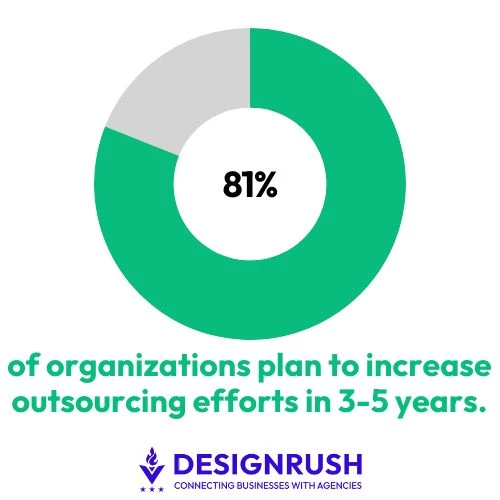
According to Deloitte's report, 81% of organizations plan to increase outsourcing efforts in 3-5 years, driven by cost pressures and the need for advanced technical and specialized expertise.
However, service quality, knowledge retention, and business continuity are the top concerns businesses cite when outsourcing overseas. The five clauses above directly address each of those risks, not by eliminating them, but by giving you documented leverage if any of them materialize.
How should you structure the first 30 days of engagement to avoid communication and time zone breakdowns?
Within 30 days of your engagement with a web design company in India, you should have established a communication protocol, overlapping schedule, project roadmap, and an initial process evaluation.
This structure lets you manage the time zone gap proactively and course-correct early, before delays and misalignments become expensive to fix.
#1 Communication protocol
Place in writing the following details before the first day of the project:
- The agency’s named point of contact with decision-making authority
- Your named point of contact that has decision-making authority
- Response time SLAs for routine messages (e.g., 24 hours for standard turnaround and 48 hours for complex feedback)
- Routine check-in meeting schedules (e.g., 2 weekly video calls during design phase)
- Project management platform, where all files, feedback, and decisions are documented
#2 Overlap hours
Require a minimum 2-4-hour daily overlap with your business hours for real-time discussion, particularly during design-intensive phases. Factor India Standard Time (UTC +5:30) into your standing call schedule before the project starts, not after the first missed deadline.
#3 Project roadmap
Your kickoff call should produce three documented outputs before any design work begins:
- Written project brief signed off by both parties
- Milestone map with dates and payment triggers
- Defined feedback process that names who on your team submits feedback and how conflicting input gets resolved
#4 Two-week process evaluation
At the two-week mark, evaluate process quality alongside deliverable progress. Specifically ask:
- Are scheduled calls happening on time and with the right people present?
- Is the agency incorporating feedback from the previous round accurately and completely?
- Are the agency’s questions getting more specific over time, or remaining vague?
Sources
DesignRush sustains a directory of over 40,000 agencies categorized by service category, location, expertise, and reviews. We build our database in two ways:
- Our dedicated team of agency experts actively searches the web for top-performing companies. We then pull information from their websites, online presence, and client testimonials to verify their status and qualifications prior to listing.
- The agencies listed get notified of their profiles on the website and they can choose to claim it or not, which suggests their availability for more collaborations.
Agencies can also reach out to DesignRush and must go through the verification process prior to being listed.
Latest Trends Related to Web Design