
WordPress has grown from a basic blogging tool into the backbone of the modern web. These 2026 stats reveal how it's being used, where it's exposed, and why understanding these trends matters for anyone shaping digital strategy.
WordPress Statistics: Key Findings
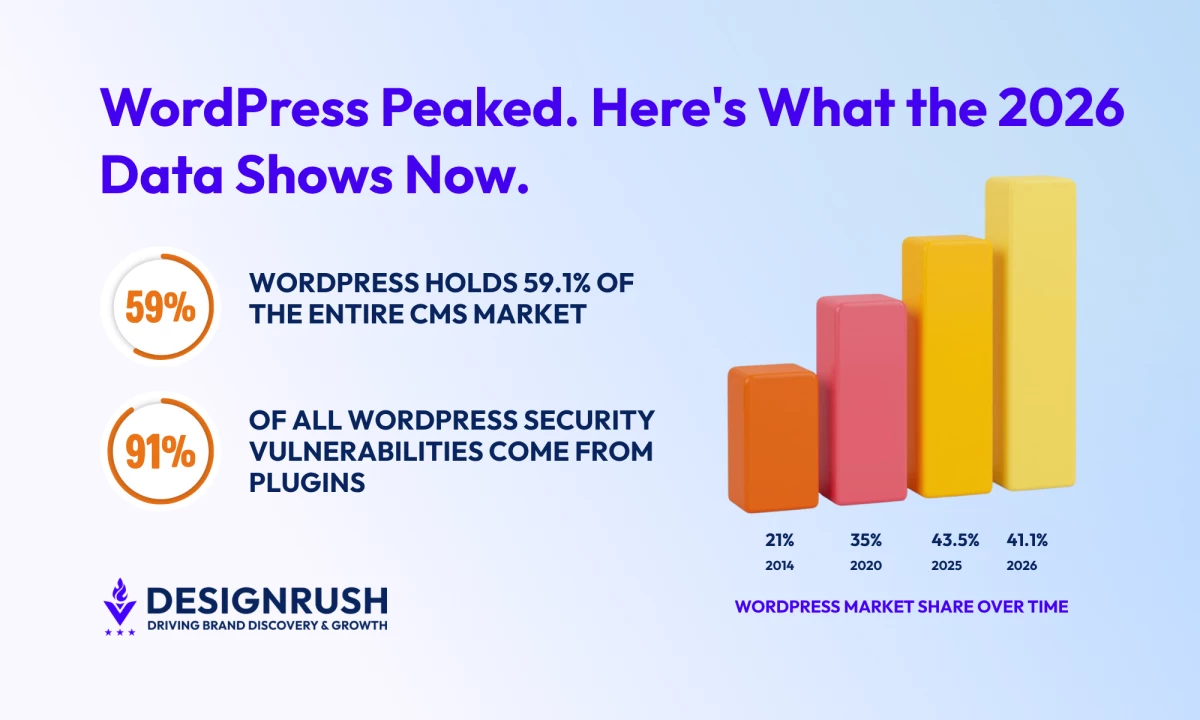
- In 2026, WordPress powers 41.1% of all websites and 59.1% of the CMS market – still more than every competitor combined, but down from 43.5% in May 2025, its first sustained decline in a decade.
- With 208 officially supported locales and most installations running in non-English languages, WordPress remains the default choice for organizations managing content across multiple markets.
- While 91% of disclosed vulnerabilities originate in third-party plugins, not WordPress core, regular updates and careful plugin selection are critical to mitigating risks in larger deployments.
WordPress Usage and Market Share Stats
As of August 2026, WordPress powers 41.1% of all websites and holds 59.1% of the CMS market – still larger than every other CMS combined (W3Techs).
Over the past decade, WordPress grew from roughly 21% of the web in 2014 to a peak above 43%, but has now recorded six consecutive months of decline.
How many WordPress sites are there? Published figures vary widely because they use different methods to count WordPress sites:
- BuiltWith detects roughly 37.9 million live WordPress sites, based on sites its crawler can confirm are active.
- Netcraft's July 2026 survey counted nearly 1.5 billion sites across 305 million domains. Applying WordPress's share to that broader population produces estimates above 600 million.
- W3Techs measures the top 10 million sites by traffic, excluding parked domains and empty pages. As mentioned previously, it puts WordPress at 41.5% of all websites and 59.3% of sites with a known CMS.
Here are several other WordPress stats:
- WordPress runs 49.2% of the top 1 million sites and 51.9% of the top 100,000 (W3Techs).
- Among the top 10,000 sites, WordPress accounts for about 58% of CMS usage, while Drupal takes 6-7% against a 1% share overall. Wix and Shopify are almost absent at that level (Web Almanac).
- Shopify, its nearest competitor, holds 7.6% of the CMS market (5.3% of all websites) and Wix 6.1% (4.3%). Both are gaining.
- CMS-driven sites now account for more than 54% of the web, up from roughly 42% in 2021 (Web Almanac).
- Sites running no CMS at all account for 30.4% of the web, and that share is rising with AI-generated static sites.
Practitioners were describing this shift before the data confirmed it.
"We're finding that our clients are becoming less focused on specific platforms and more concerned with whether the site is easy to update, reliable, and scalable," says Paul Hanna, Creative Director at Craft Marketing.
"There isn't the same kind of CMS loyalty that existed in the past, largely because there are so many great options available now. For a long time, WordPress dominated that space that sat between DIY and enterprise systems."
WordPress Global Reach and Content Statistics
WordPress is widely adopted across continents, localized in hundreds of languages, and supports a massive amount of content generation at scale. These statistics reflect its expansive footprint and cultural adaptability.
Global adoption by country
WordPress is used across virtually every country, with especially strong presence in major economies:
The United States leads in total number of WordPress websites, with 17 million+ sites, followed by Germany, the UK, France, and Brazil (BuiltWith Trends).
The blog also reveals that in certain markets, adoption is even more dominant than others. In Japan, it powers approximately 58.5% of all websites and a striking 83% of CMS-based sites – far above the global average (WordPress, State of the Word 2025)
Multilingual support
Originally built for English-language blogging, WordPress has become a global multilingual tool:
- It’s now available in over 200 languages, with 208 officially translated locales.
- The majority of WordPress installations now run in non-English languages, reflecting its wide international user base.
- 56%+ of WordPress sites now use a language other than English (WordPress, State of the Word 2025).
- This extensive language support enables businesses to operate in virtually any market around the world.
Content volume and reach
WordPress powers one of the most active publishing environments on the web, evidenced by the over 70 million new posts and 77 million comments published each month across WordPress sites.
According to Automattic's WordPress.com activity page, 409 million people view more than 20 billion WordPress-powered pages monthly.
WordPress for Multi-Market Operations
WordPress is disproportionately represented among higher-traffic sites, where organizations need to manage more content, teams, and workflows without splitting everything into separate systems.
The Web Almanac finds that high-traffic sites tend to favor platforms built for complex workflows and long-term scale, while smaller sites are more likely to choose hosted all-in-one tools that reduce overhead.
That shows up in the architecture organizations choose:
- Web Almanac puts WordPress at ~58% of CMS usage among the top 10,000 sites.
- BuiltWith detects more than 1.13 million live websites using WordPress Multisite, roughly 3% of the live WordPress sites it tracks.
- Multisite ranks second among technologies in BuiltWith's WordPress Plugins category for both the top 1,000 and top 10,000 sites, and fourth in the top 100,000.
Multisite lets organizations run multiple sites from a single WordPress installation while keeping content and permissions separated by subsite. IT Monks' work for EC English shows why that matters across many markets.
IT Monks rebuilt the global platform for EC English, a Malta-based language-education group. The nine-month project replaced an outdated platform with slow performance and fragmented content management across regional websites.
“Two capabilities made the decision: full site editing and multisite,” says Alex Osmichenko, CEO at IT Monks. “FSE unblocked the marketing teams — they build and ship landing pages 5-7x faster than before, without a developer in the loop.
Multisite lets us separate each language into its own subsite, so every market keeps a distinct regional identity while marketing access stays scoped to the people who own that market."
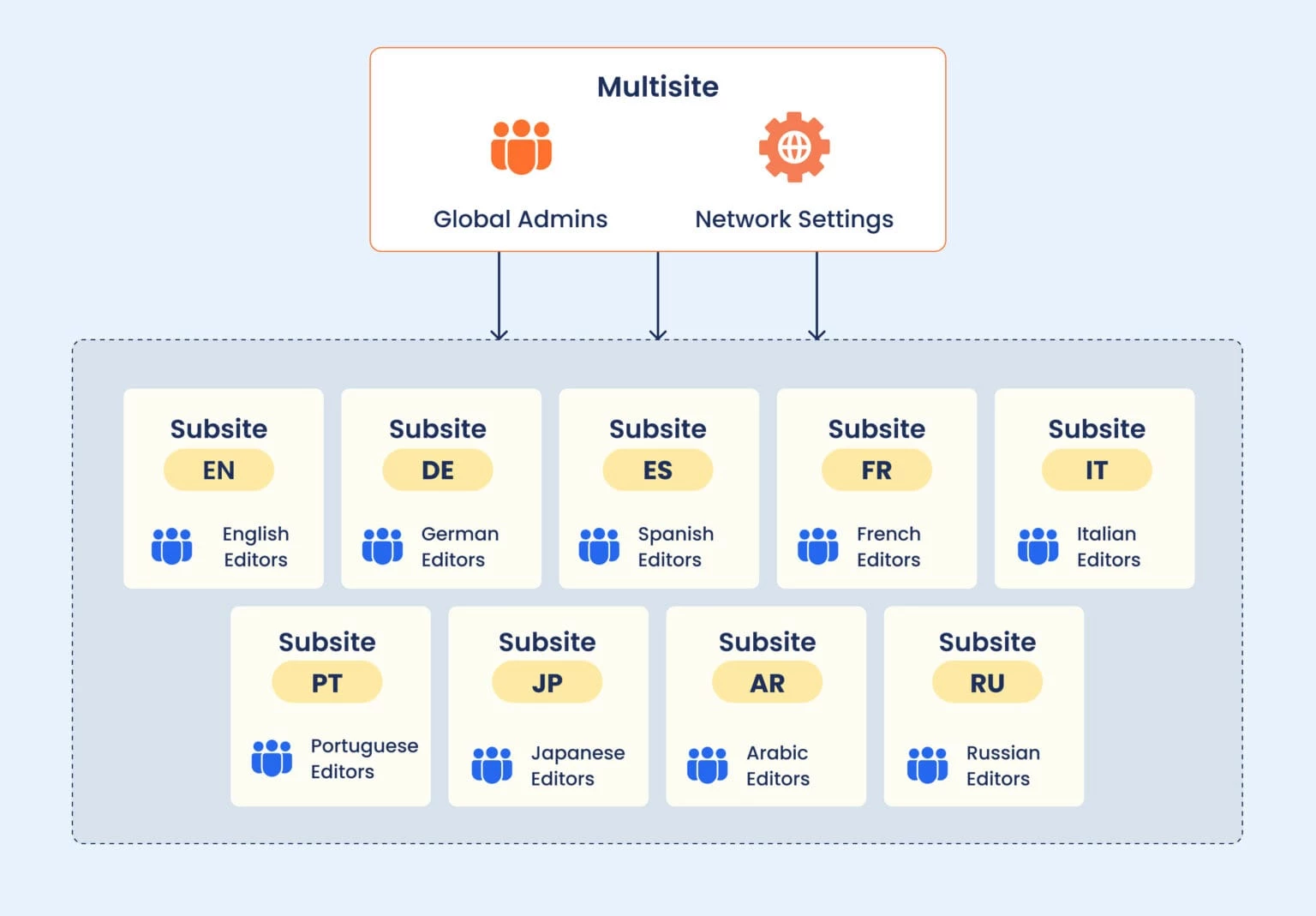
IT Monks addressed the fragmentation by giving each regional website and language version its own space within a shared WordPress platform.
"We built a Gutenberg pattern library, so page creation for non-technical staff is assembling approved blocks rather than designing from scratch,” Osmichenko says.
“Combined with multisite, every language has one clear owner and one subsite – no shared editing surface, no ambiguity about who publishes what."
Local marketing teams could then run their own content and campaigns without affecting other regions, while the overall experience stayed connected.
The broader point is that localization at scale is less about translation and more about giving local teams enough control to manage their markets while keeping the wider organization coordinated.
WordPress Multisite provides that balance: each market gets its own editorial surface, and the organization keeps a single platform to maintain.



WordPress Themes and Plugins Ecosystem
One of WordPress’s greatest strengths is its rich ecosystem of themes and plugins, which allow users to customize design and functionality.
Around 60% of WordPress sites use a page builder, which shows how heavily site owners rely on third-party tools for visual editing and faster publishing (Web Almanac).
This flexibility has fueled WordPress’s popularity by enabling everything from simple blogs to complex websites, often without needing any coding.
- Themes: Design flexibility at scale
- Plugins: Extending WordPress functionality
- Most popular plugins
- Continuous platform evolution
- AI arrives in WordPress Core
1. Themes: Design flexibility at scale
WordPress’ visuals breadth allows businesses of any size to quickly find or adapt a theme that matches their brand, industry, and audience expectations. Here’s what the platform offers:
- Over 14,000 free themes are available in the WordPress.org theme directory.
- Counting premium marketplaces such as ThemeForest alongside independent shops, the total exceeds 30,000 themes.
- BuiltWith detects Divi on more than 2.29 million live websites, making it one of the most widely deployed commercial WordPress themes and accounting for roughly 6% of the live WordPress sites it detects
In the context of themes, Beverley Delay, the founder of Beverley Designs notes:
“WordPress themes can be a more economical choice upfront because they're pre-made and often come with a lot of built-in functionality.”
She also cautions that while WordPress themes are convenient and budget-friendly, they can sometimes limit your flexibility and personalization options.
2. Plugins: Extending WordPress functionality
The plugin ecosystem is a major reason why WordPress can adapt to so many different use cases. Namely:
- 60,000+ free plugins are listed on WordPress.org, with new ones added weekly.
- When including premium options from commercial vendors and marketplaces, the total plugin count likely exceeds 70,000.
These plugins range from SEO tools to contact forms to security scanners – essentially any feature imaginable. For many projects, that breadth can reduce the need for custom development.
"Because of the vast number of plugins available, it is easy to satisfy almost every wish that a client has from the get-go of a project," says Irene Hartfield, founder and CEO of Web Goddess.
"In the past, each requirement outside of content required scripting and planning of a scope that added time and money to a project that often is now easily satisfied with a plugin."
3. Most popular plugins
There are several plugins that boast over 10 million active installations, a testament to their reliability and widespread trust. These include:
Plugin | Active installations | Function |
Elementor | 10+ million | Website builder |
Yoast SEO | 10+ million | SEO |
Contact Form 7 | 10+ million | Contact forms |
Classic Editor | 10+ million | WordPress editor |
WooCommerce | 7+ million | eCommerce |
LiteSpeed Cache | 7+ million | Site performance |
Akismet | 5+ million | Spam protection |
WPForms | 5+ million | Form builder |
All-in-One WP Migration | 5+ million | Site migration |
Site Kit by Google | 5+ million | Analytics and Search Console |
Wordfence Security | 5+ million | Website security |
4. Continuous platform evolution
WordPress has released 54 major versions. Naming after jazz musicians began with 1.0 "Miles" in January 2004; the pre-1.0 releases were unnamed. Including minor and security updates, the platform has seen over 760 core releases.
Two earlier releases mattered most:
- WordPress 4.7 (December 2016) introduced the REST API, expanding WordPress beyond traditional websites.
- WordPress 5.0 (December 2018) introduced Gutenberg, beginning the shift to block-based building that WordPress 7.0's full site editing now completes.
However, the native Block Editor and Site Editor combination appears on just 0.2% of pages, suggesting the shift to block-based building is still a long-term migration rather than a completed transition (Web Almanac).
The current major version is WordPress 7.0 "Armstrong," released 20 May 2026. It was the work of more than 875 contributors, over 200 of them contributing for the first time, and shipped 420+ enhancements and fixes.
This steady pace of updates demonstrates a strong commitment to innovation and security, community-driven development, and the ability to adapt to evolving web standards and user needs.
5. AI arrives in WordPress Core
WordPress 7.0 "Armstrong", released 20 May 2026, is the first version to build AI directly into WordPress rather than leaving it to plugins. And as of August 2026, 55.2% of WordPress sites were already on WordPress 7 (W3Techs).
Four things arrived:
- A built-in way to connect to AI models, so a site isn't tied to a single AI vendor.
- A single dashboard screen for managing those connections, with three ready-made options.
- A way for plugins to advertise what they can do, so AI tools can find and use those features.
- The same capability on the front end, with a built-in interface and a quick-command shortcut.
WordPress is positioning itself as the thing AI tools work on. If you're already on WordPress, that weakens the case for buying separate AI tooling. If you're considering moving off it, it removes one of the common reasons to switch.
WordPress in eCommerce
Beyond powering content-driven sites, WordPress also plays a major role in eCommerce, largely through its WooCommerce plugin.
Acquired by Automattic (the parent company of WordPress.com), WooCommerce enables any WordPress site to become a fully functional online store.
The following statistics highlight the scale of WordPress’s presence in online retail through WooCommerce:
- As of July 2026, W3Techs reports WooCommerce powers 48.4% of websites using a tracked eCommerce system, appearing on 8.2% of all websites.
- The platform boasts nearly 5.7 million active stores (BuiltWith).
- WooCommerce averages approximately 30,000 daily downloads from WordPress.org, indicating a sustained demand and relevance across the eCommerce niche.
- Among the top 1 million eCommerce sites, WooCommerce holds 18.2%, behind Shopify's 28.8% (BuiltWith).
The competitive picture changes by market segment. WooCommerce leads in overall store count, but among the top 1 million eCommerce sites, it holds 18.2% versus Shopify's 28.8% (BuiltWith).
For digital leaders, WordPress is strong for complex content operations but faces tougher competition in high-volume commerce.
Other popular WordPress eCommerce plugins
Several other plugins turn up frequently on WooCommerce sites, covering digital delivery and analytics:
- Download Manager – 100,000+ active installations
- Download Monitor – 90,000+ active installations
- Matomo Analytics – 90,000+ active installations
- Easy Digital Downloads – 50,000+ active installations
These tools cater to everything from digital file delivery to in-depth analytics, rounding out the eCommerce ecosystem for WordPress users.
WordPress Security Statistics
As WordPress powers such a large portion of the web, its popularity makes it a common target for attackers.
WordPress itself has a strong security record. Almost all the risk comes from the plugins installed on top of it.
Patchstack's State of WordPress Security sheds light on critical WordPress security trends. Here are some of the key stats and takeaways:
- 1,334 new security flaws were found across the WordPress ecosystem – 42% more than the year before.
- 91% were in plugins and 9% in themes. Only six were in WordPress itself, and all were minor.
- The WordPress Plugins Team reviewed 12,713 plugin submissions during 2025 and was handling around 700 submissions a week by May 2026.
- 1,966 (17%) were serious enough to be worth attacking at scale – more than the previous two years combined, and more than double the year before.
- 4,124 (36%) posed a real enough threat to need active protection.
- 76% of flaws found in paid plugins could be used in real attacks.
- Paid plugins were three times more likely to be actively exploited than free ones.
- Patchstack's researchers found 33 critical flaws in paid plugins, against 12 in free ones.
Speed also matters more than volume:
- The flaws attackers care most about are typically being attacked within five hours of becoming public.
- Around half of serious flaws are attacked within 24 hours.
- 46% had no fix available when they were made public – nearly half became public knowledge before the plugin maker had patched them.
Patchstack also tested the security tools hosting companies typically rely on. Against WordPress flaws already known to be under attack, those tools stopped 12%. Across a wider set, it was 26%. Results varied widely between hosts using similar tools.
The most-attacked category was broken access control, which are flaws that let someone reach pages or data they shouldn't. These are hard to catch because the traffic looks like a normal logged-in user going about their business.
WordPress can be highly secure when maintained properly, but poor upkeep leaves sites exposed, as is true for any platform.
WordPress Website Statistics: Final Thoughts
With 41.1% of the web under its belt and a commanding lead in the CMS market, WordPress has evolved far beyond its blogging origins.
Yet, these numbers point to more than just scale — they reflect the strategic momentum the platform has managed to endure in an increasingly competitive ecosystem.
If you seek to capture the full potential of WordPress, partnering with a specialized agency can offer a distinct advantage.

Our team ranks agencies worldwide to help you find a qualified partner. Visit our Agency Directory for top-rated WordPress web design companies, as well as: