
Four interlocking rings. No wordmark, no embellishment, no explanation required. The Audi logo is one of those rare marks that has earned the right to stand entirely on its own. The story of how it got there stretches back nearly a century — through economic collapse, world war, corporate mergers, and a complete rethinking of what a brand identity needs to do in a digital age.
Audi Logo History: From Auto Union to Four Rings
The rings were created out of necessity — not design ambition.
In 1932, four independent German automakers — Audi, DKW, Horch, and Wanderer — merged to form Auto Union AG at the suggestion of the State Bank of Saxony. The global economy was in a freefall, and pooling resources was the only realistic path forward.
The new company chose four interlinked rings as its emblem, each representing one of the founding companies. In the first version of the Audi logo, each ring contained its respective company's brand mark — a solution too complex for the long term but effective at communicating what mattered most: that four companies had become one.
After World War II, leading company executives made their way to Bavaria and, in 1949, established Auto Union GmbH, continuing the tradition of the four-ring emblem. The rings survived the war, the Iron Curtain, and the loss of the original factories.
Volkswagen bought a controlling stake in 1964, then merged NSU with Auto Union in 1969, placing the Audi name at the forefront while retaining the four-ring logo. Short-lived iterations dropped the rings in favor of wordmarks. None of them stuck. By 1985, the four rings were back as the primary mark and haven't been seriously questioned since.
Audi Logo Meaning: What the Four Rings Represent
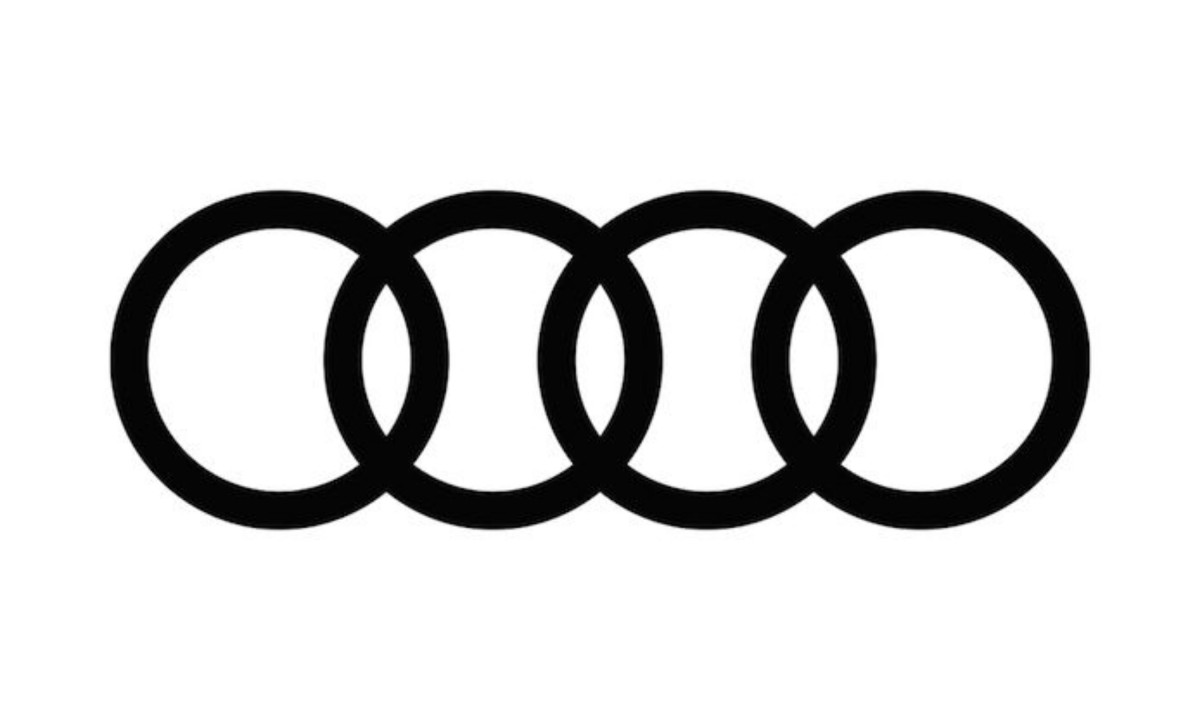
Many people ask why Audi has four rings, and the answer is more grounded than the myths suggest. The Audi badge goes back to one specific moment in history. Each ring represents one of the four founding companies that formed Auto Union AG in 1932.
Within the group, each brand served a distinct market segment:
- DKW focused on motorcycles and small cars
- Wanderer produced midsize cars
- Audi operated in the deluxe midsize segment
- Horch manufactured cars in the luxury segment.
The interlocking geometry carries specific meaning beyond the visual. The overlap signifies the legal and economic union of these entities into a single corporate body. No ring sits higher or larger than another — the symmetry communicates equal partnership, which was the founding principle of the merger.
The Olympic rings comparison that sometimes surfaces is a misconception worth putting to rest. The four rings badge represents Audi, DKW, Horch, and Wanderer — nothing more.
That they were created to solve a specific problem and have remained visually coherent for over ninety years says everything about the strength of the original concept.
The Audi New Logo: The 2016 Digital Redesign
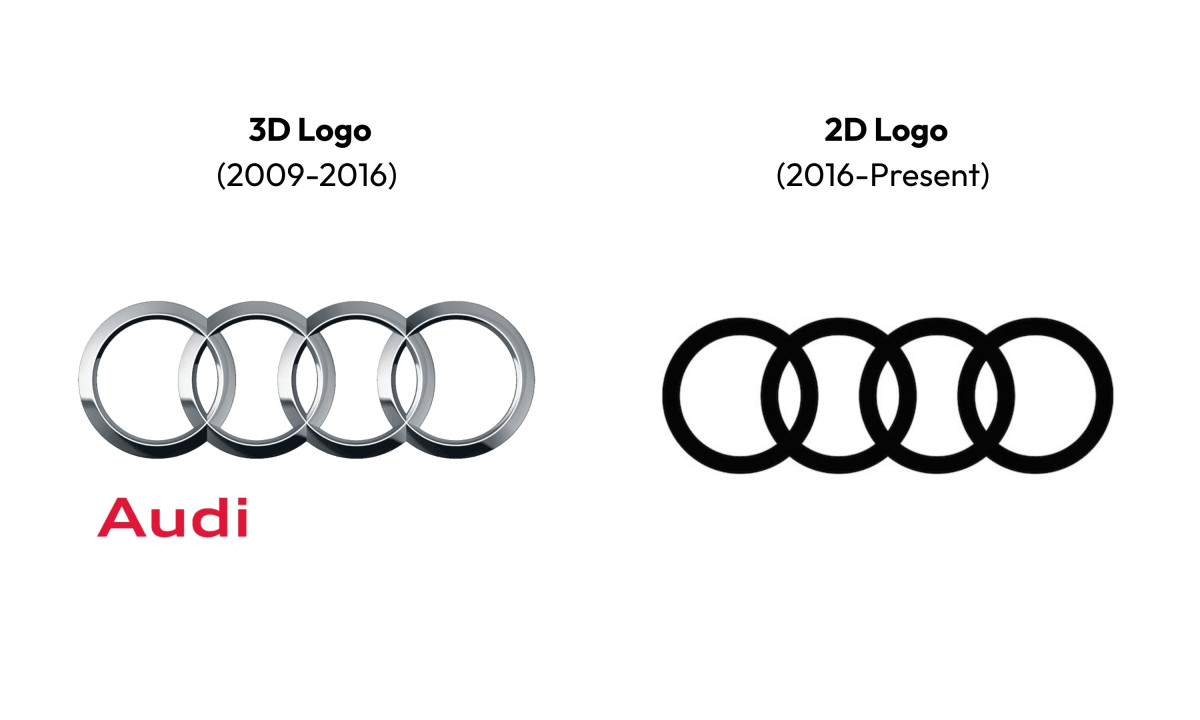
The three-dimensional chrome version of the Audi logo, introduced in 2009, was built for a world where physical products dominated. By the mid-2010s, the world had shifted considerably.
In 2016, Audi stripped away the chrome, the shadows, and the 3D depth. Strichpunkt Design, the agency behind the shift, identified that the 3D logo was failing on mobile devices and digital dashboards. A logo with gradients requires more data to render and loses its edge when scaled down to a small favicon.
Simone Labonte, Audi's Head of Corporate Identity and User Interface, framed the decision plainly:
"The transition from 3D design to 2D design is unmistakable. The trend towards flat design is not an end in itself but due to digitisation; it's simply aimed at technically implementing the brand in digital media and making it clearly perceivable."
The project was a collaboration between Stuttgart and Berlin-based Strichpunkt and Munich-based KMS Team. Strichpunkt aimed for the new logo to be simple, clear, and intuitive, making the full design guidelines freely accessible online, from typography and icons to HTML code for digital components.
Labonte described the Digital First principle as being geared toward the smallest technical device: the CI, the brand's core elements, and the branding must all work on a smartwatch. Starting with the smallest device, the design principles then transfer to all other touchpoints.
The flat Audi logo dropped the wordmark entirely, leaving the rings to carry the brand on their own. As Audi head of design André Georgi put it:
"We want the four rings to look the same everywhere in the future: whether in a magazine, on your smartphone, or a billboard, and on or inside the car."
In 2022, Audi extended that logic to its vehicles, rolling the flat two-dimensional rings out across its model lineup as the standard physical badge.
See how other automotive brands have approached identity in our breakdown of the best luxury logo designs.
Audi Font and Visual Identity
Alongside the flattened logo, Strichpunkt introduced a custom typeface called Audi Type, which replaced the older Audi Sans.
The Audi font uses geometric letterforms with humanist details, clean lines that hold up at any size from a tiny app icon to a large-format billboard. It was designed to work as part of a broader system rather than as a standalone element, ensuring consistency across every touchpoint the brand occupies.
The color palette that accompanies it is equally restrained: white, black, red, aluminum silver, and warm silver. Five colors, each with a specific role, kept consistent across digital platforms, print, and in-car displays. Nothing competes for attention, and nothing is decorative for its own sake.
Why the Audi Logo Works
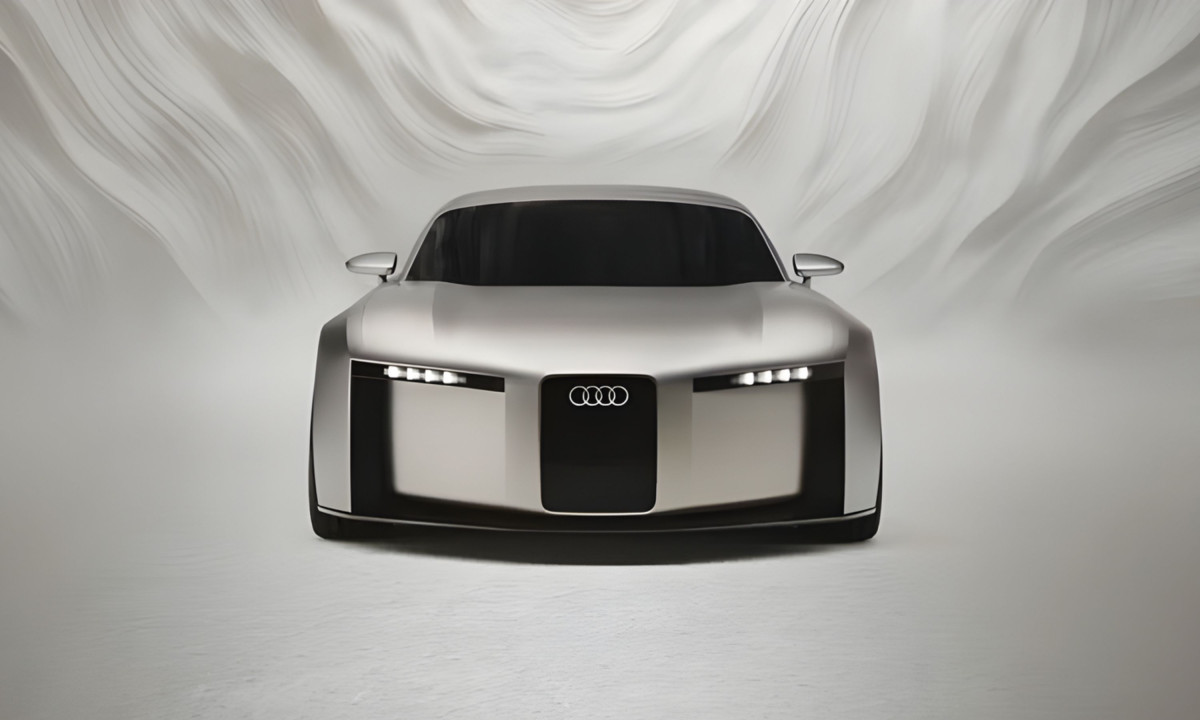
The Audi logo has lasted because every design decision compounds on the one before it. A few principles explain why:
- It scales across every surface without losing its shape. The rings read clearly on a grille, a favicon, a smartwatch face, and a billboard. The geometry is simple enough to function at any size without losing legibility.
- It removes any dependence on color. The black and white palette means the mark holds up on dark backgrounds, light backgrounds, colored grilles, and digital screens without modification. Color is never a requirement for recognition.
- It was built to be flexible from the start. Strichpunkt deconstructed and reassembled the brand to exist in its simplest form so it could flexibly accommodate any touchpoint. That kind of thinking is a useful model for anyone working in automotive branding.
- It is rooted in a historical fact that doesn't date. The core symbol represents a real event: four companies becoming one. A symbol tied to something concrete tends to outlast ones built around aesthetic trends.
- It has been validated by over ninety years of recognition. The Audi logo earned the Red Dot Brand of the Year award in 2017, the fifth time the company had received the honor. The more meaningful measure is simpler: when most people see four interlocking rings anywhere in the world, they think of one brand.
This is what longevity in logo design looks like — an identity that endures not by chance, but through clarity, purpose, and the ability to adapt without losing its core meaning.