
Twenty-eight days. That's all that stands between us and the largest FIFA World Cup the sport has ever staged.
On June 11, the whistle blows in Mexico City, kicking off 38 days of football across three countries, 16 cities, 48 nations, and 104 matches.
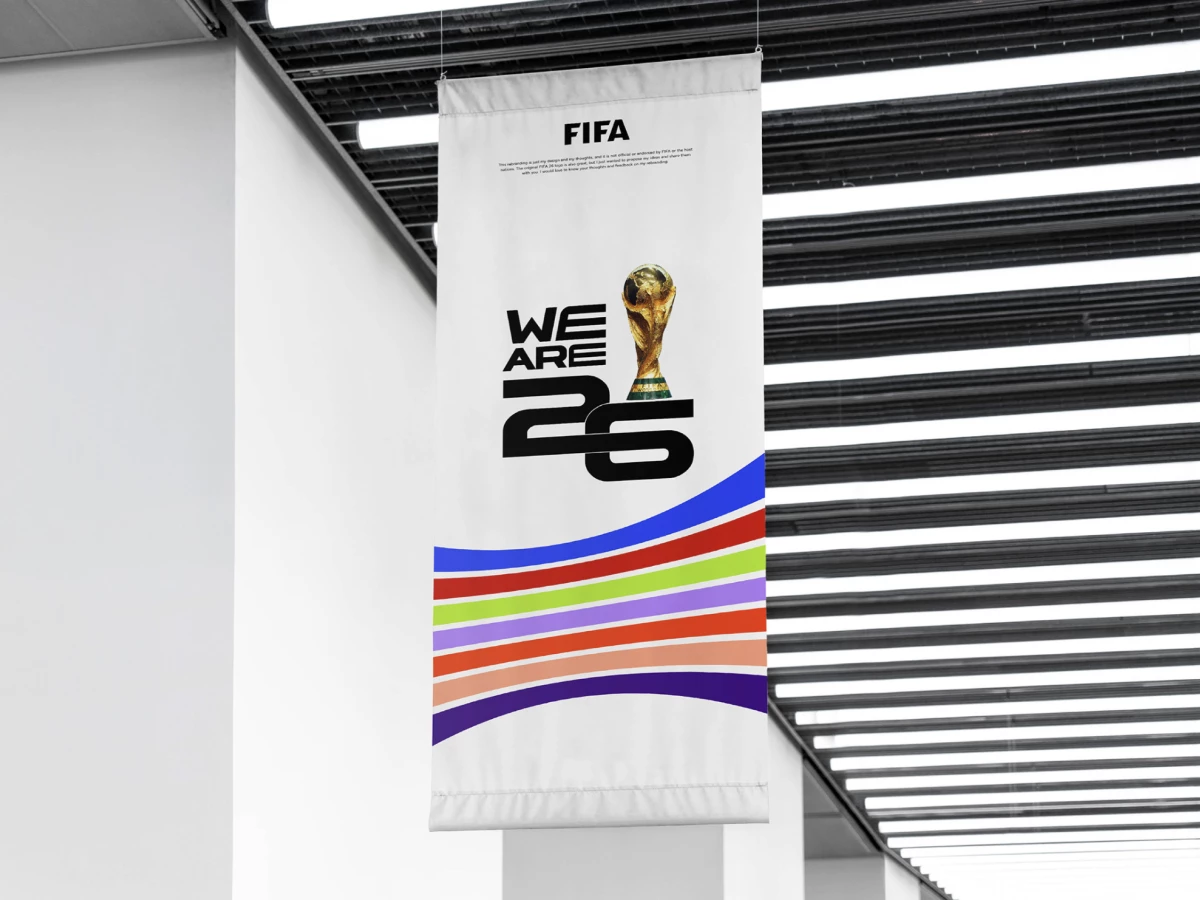
The visuals are already everywhere: murals, bus wraps, posters, agency spec work flooding design feeds by the hour. Qurics Design is one of the studios in the mix. Their unofficial banner doesn't whisper. It cranks the volume, paints the room in festival color, and lets the trophy do the talking.
Standout Features
- FIFA World Cup 2026 trophy
- Vibrant colors
- Merged numbers 2 and 6
How It Compares to the Official FIFA Identity
FIFA's official brand for the FIFA World Cup 2026 takes a deliberately restrained approach. The official logo and brand identity was unveiled on 17 May 2023 at the Griffith Observatory in Los Angeles, California.
The reveal itself was a production in its own right, culminating in a drone show that blazed the official logo and the names of all 16 host cities above the Hollywood Hills. The mark was created by the Toronto-based agency Public Address, who are also responsible for the logo of the 2023 FIFA Women's World Cup and one of the designers of the LA28 logo.
The mark places a photo-realistic World Cup trophy on a stacked "2" and "6," set against a default black-and-white palette with gold accents.
Squares and quarter circles make up the number 26 in reference to the squared edges of the pitch and the circle of the ball, and the number is made up of 48 units of these shapes, representing the 48 competing nations. Each of the 16 host cities then layers in its own color variation.
Qurics comes at it from the other end of the spectrum. Founded in 2020, Qurics is a brand design agency specializing in logos, brand identities, and other visual assets, with a portfolio that leans into identity and editorial work rather than the kind of large-scale event branding Public Address built its reputation on.
That difference shows in the output. Where the Olympics-and-World-Cup veterans chose minimalism and modularity to leave room for host-city customization, the smaller studio turned up the saturation and committed to a single, festival-loud expression.
Both designs land on the trophy and the stacked "26," but the philosophies split there. The official mark is built for global adaptability across 104 matches and 16 cities.
The Qurics banner is built for impact in a single moment of attention.
This split matters because the official 2026 visual identity has been characterized as a minimal, adaptable monolithic mark that has received mixed reviews from supporters and critics alike. Qurics' version reads almost like a response, showing what the same core concept can look like when emotion is prioritized over neutrality.
Design Choices Worth Studying
Visual hierarchy lands cleanly: trophy first, numerals second, typography third. The eye has no question about where to look.
Color psychology supports the brief, since saturated reds, yellows, and blues read globally as celebration and energy across cultures, useful for an event with viewers in nearly every country.
Composition stays balanced through symmetry and a centered focal point, which prevents the bright palette from feeling chaotic. The typographic weight matches the subject matter, since thin or decorative type would have undermined the seriousness of the trophy itself.
Takeaway
Effective sports event branding has to do two things at once: signal the magnitude of the moment and stay flexible enough to live across screens, stadiums, signage, and merchandise.
The official FIFA World Cup 2026 mark prioritizes flexibility. Qurics' banner prioritizes magnitude. Neither is wrong, and the contrast is a useful case study for anyone working on event identity, whether for a global tournament or a local league championship.
For more on this kind of work, see DesignRush's sports branding agency rankings and best print banner design collections.