
Roughly 90% of startups crash and burn over time, and that rate has held steady for decades. So, what makes survival so rare? Let's break down the data.
Startup Failure Rate Statistics: Key Points
- 34% of founders cite lack of product–market fit as the main reason startups fail.
- 75% of venture-backed startups fail, and nearly half never reach profitability, indicating that funding isn’t a guarantee of survival.
- Startups with cofounders are 3x more likely to succeed than those led by solo founders, reinforcing the impact of shared leadership.
Startup Failure Rate Stats Overview
Starting a company is like setting sail into stormy waters — big rewards, but even bigger risks.
The stark reality is that most startups don’t make it. Not because of one fatal flaw, but a perfect storm of challenges that can derail even the most promising ventures.
Startup Success and Failure
Understanding the factors behind startup outcomes helps reveal why some succeed while many others fail. The following sections explore key statistics and common challenges faced by startups:
- 3x higher success rate for startups with cofounders
- Misalignment between product, people, and market drives most failures
- Failure remains common, even with funding
3x Higher Success Rate for Startups With Cofounders
Startups with cofounders are 3x more likely to succeed than those led solo.
According to the Founders Forum Group:
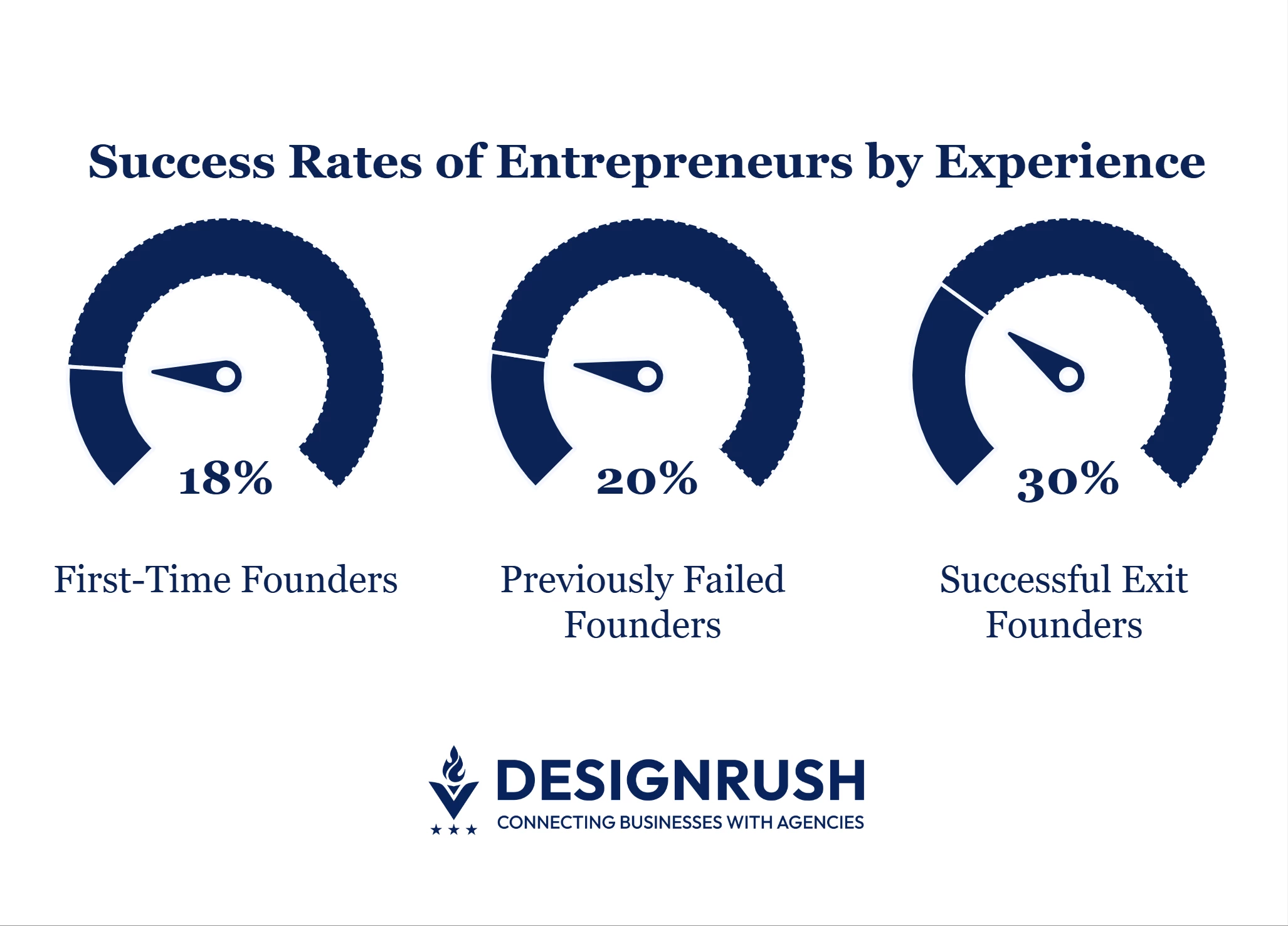
- First-time founders have 18% chance of success.
- Those who’ve previously failed fare slightly better at 20%.
- Entrepreneurs with a successful exit behind them reach a 30% success rate.
What’s striking is how little the success rate has changed since the 1990s. Despite new business models, advanced technology, and evolving markets, the fundamental challenges of building a successful company remain the same.
Among all the variables in building a startup, timing is often the most decisive. A great idea launched too early or too late can miss its window. True success hinges on aligning product demand, market readiness, and technological maturity.
Misalignment Between Product, People, and Market Drives Most Failures
 While every startup story is different, the reasons for failure tend to follow familiar patterns across industries and stages.
To better understand why, Failory interviewed more than 80 founders of failed startups. The findings point to a clear set of common causes:
34% of startups fail due to a lack of product-market fit, often building something the market doesn’t actually need or want.
22% cite ineffective marketing, where poor visibility and weak go-to-market strategy prevent customer acquisition.
18% fail from team misalignment, with leadership gaps or internal conflict undermining execution.
16% struggle with cash flow issues, usually caused by poor planning, premature scaling, or misjudged revenue cycles.
6% are brought down by technical limitations, such as unstable infrastructure or poor scalability from weak early decisions.
2% run into legal complications, including IP disputes, unclear founder agreements, or regulatory missteps that stall growth.
2% fail due to operational inefficiencies, where lack of structure, process, or execution discipline slows momentum.
Failure Remains Common, Even With Funding
It’s a common myth that getting funded means you've made it. In reality:
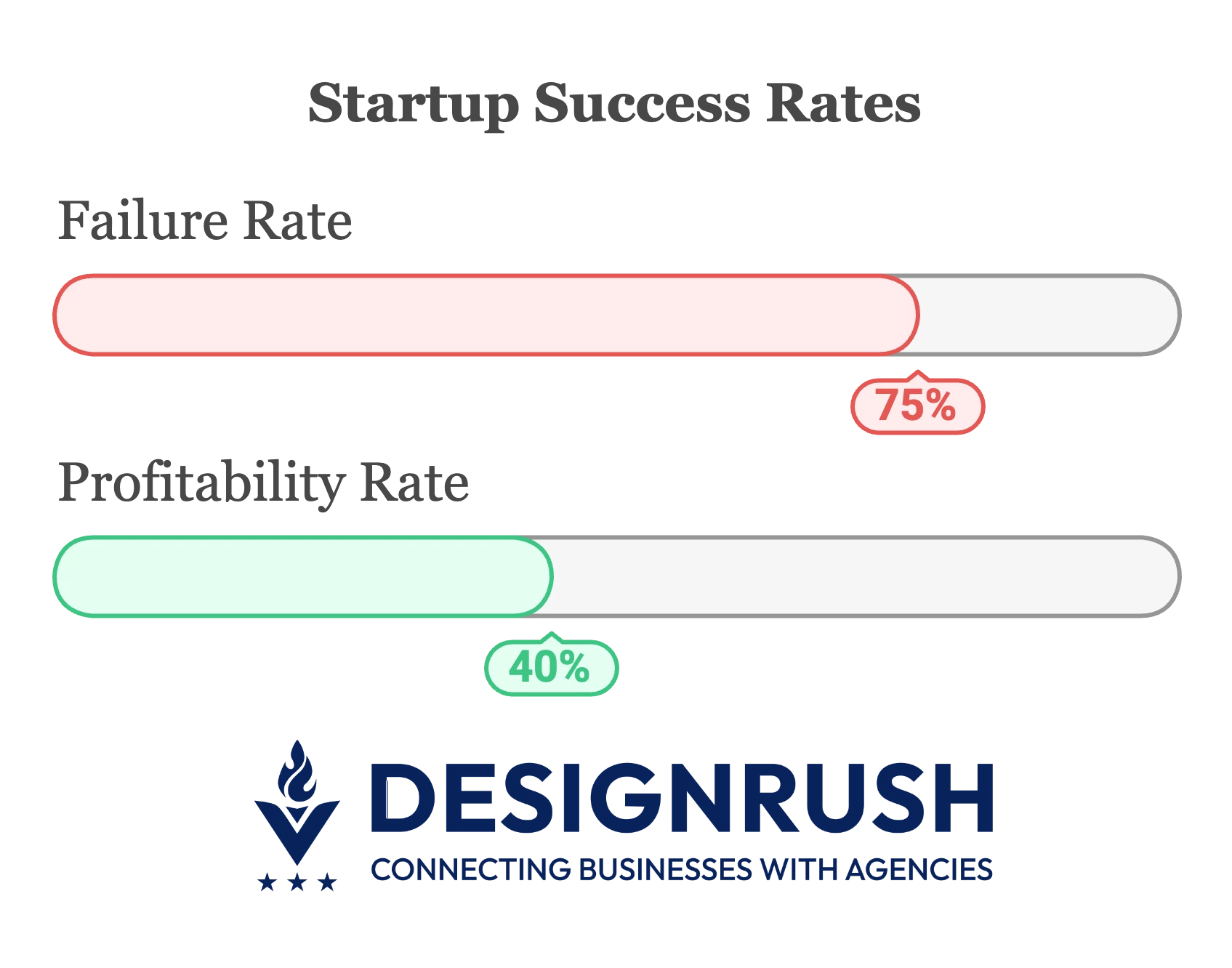
- 75% of venture-backed startups fail
- Only 40% ever turn a profit
- Most startups run at a loss for years — some never break even
- According to equity platform Carta, 254 venture-backed companies shut down in the first three months alone.
- Failory uncovered that 75% of venture-backed startups never return capital to investors, and in 30-40% of cases, the entire initial investment is lost.
 It’s important to note that closures are no longer confined to early-stage missteps, but rather, they’re accelerating across the venture spectrum.
As reported by 54Collective, the early-stage funnel remains steep:
- 60% of pre-seed startups fail to reach seed funding
- 35% of Series A companies don’t progress further
- only about 1% shut down past Series C funding
Another notable observation is that scale-ups, which are startups in the growth stage, face a lower risk of failure compared to their early-stage counterparts. Yet the broader picture remains sobering.
Most startups quietly filter out over time. Bureau of Labor Statistics data shows that:
- Roughly 1 in 5 new businesses, or 20% fail within the first two years
- By year five, that number jumps to 45%
- At the ten-year mark, 65% have closed their doors
- 75% of businesses don't make it past the 15th year



Why Startups Fail
Regional differences and industry-specific challenges play major roles in startup survival. Below, we examine how location and sector impact failure rates:
Regional Conditions Shape Survival Odds
Startup survival rates vary widely by region, shaped by local conditions like regulation, market maturity, and support infrastructure. Some ecosystems help startups thrive well beyond the launch phase, while others don’t.
According to Stripe, the global picture looks like this:
- United States: About 35% of startups survive 10 years
- United Kingdom: 50% survive beyond three years
- European Union: About 45% make it to five years
- India: Only 10% survive five years
- Brazil: 50% last at least four years
- Africa: 46% survive the early stage, but few make it past Series B
Inflation, currency devaluation, and foreign exchange bottlenecks erode working capital and make long-term planning nearly impossible. Startups operating in inflation-ridden countries are most affected by this and often struggle to stay solvent.
Then there’s geopolitics — the silent killer of business momentum. Regions dealing with political unrest and armed conflict repel foreign investment. For many founders operating in these zones, navigating bureaucratic uncertainty and sudden policy shifts becomes a daily grind.
In conclusion, macro risk isn’t a footnote; it’s a front-line concern. For founders, resilience means learning to build in the storm, not just after it.
Some Sectors Are Structurally Harsher on Startups
Some industries are tougher on startups than others. Whether it's razor-thin margins or brutal competition, failure rates vary wildly depending on what you're building and where you’re building it.
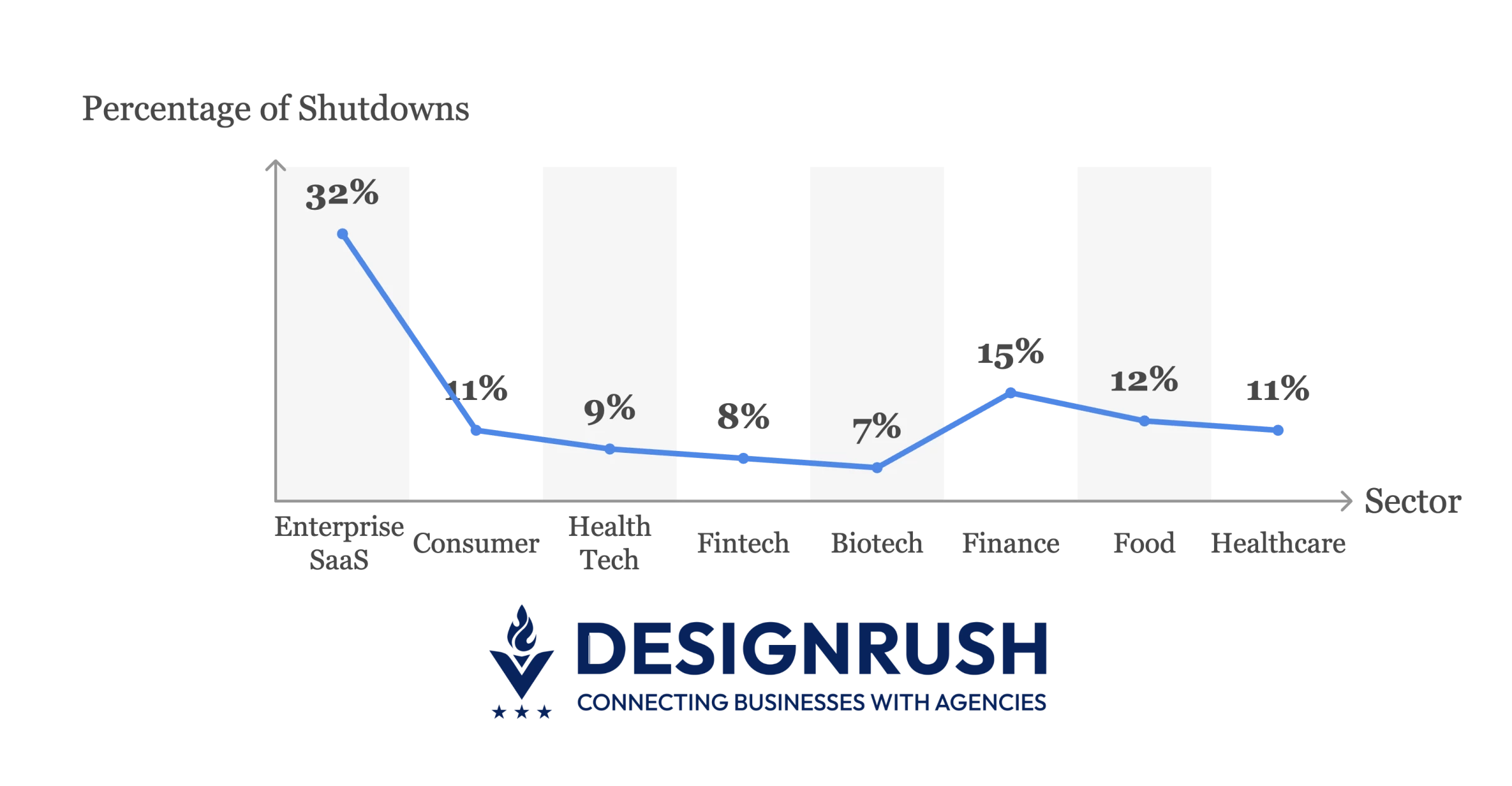
- Enterprise SaaS companies have taken the biggest hit in recent startup shutdowns, accounting for 32% of closures.
- Consumer startups followed at 11%, with healthtech at 9%, fintech at 8%, and biotech at 7%.
- A separate sample showed finance leading with 15% of shutdowns, followed by food at 12% and healthcare at 11%.
The lingering question is: why some sectors break startups faster?
The disparity in failure rates across industries reflects structural realities that startups often underestimate.
Take enterprise SaaS, which tops recent shutdown tallies. While the business model is attractive on paper — recurring revenue, high margins, scalable infrastructure — the path to success is long and capital-intensive.
Sales cycles are measured in quarters, not weeks. Startups must win over risk-averse decision-makers, survive lengthy procurement processes, and support complex onboarding — all before they see meaningful revenue. In downturns, that delay becomes deadly.
Biggest Startup Failures of All Time
When startups crash, they don’t always burn quietly. Some go down in history for how much they took with them — in dollars, expectations, and lessons learned.
- Quibi Holdings is arguably the most expensive misfire in startup history. Launched in April 2020 as a mobile-first streaming platform promising “quick bites” of Hollywood-quality content, Quibi shut down just six months later, despite raising an impressive $1.75 billion.
- Statista lists LeSports close behind, the sports-streaming arm of Chinese tech conglomerate LeEco. Based in Hong Kong, LeSports attracted a staggering $1.7 billion in disclosed funding before succumbing to operational chaos.
LeSports was ultimately shuttered due to unpaid rent, unresolved subscriber complaints, and unsustainable financial practices — a cautionary tale of overreach, mismanagement, and the brutal economics of live sports rights.
These high-profile collapses serve as stark reminders that scale and funding alone are no insurance against failure. When product assumptions miss the mark or execution falters, even billion-dollar bets can end in zero.
Future Prognosis
Understanding why startups fail is essential, but the outlook isn’t all grim.
In fact, there are early signs that founders are learning from past missteps, investors are favoring more sustainable models, and the ecosystem as a whole is evolving toward greater resilience.
- According to a new PwC analysis, the failure rate of new businesses relative to total corporate insolvencies hit a decade low in 2024.
- Startups made up just 46% of all company insolvencies, signaling a significant drop from the 10-year average of 60%, and the first time the figure has dipped below the 50% mark.
The stat comes despite record-high levels of new company incorporations, suggesting that today’s startups may be building with more caution, stronger fundamentals, or simply better timing.
Startup Failure Rate Statistics: Final Take
Startup success remains elusive, with failure rates holding steady across decades despite advancements in technology, funding, and business models.
The data shows that failure often stems from a mix of factors — from poor product–market fit and marketing missteps to timing and macroeconomic pressures.
While the odds are tough, informed strategies and strong fundamentals can still tip the balance toward long-term survival.

Our team ranks agencies worldwide to help you find a qualified partner. Visit our Agency Directory for the top Business Consulting companies, as well as:
- Top Business Operations Consulting Companies
- Top Startup Consulting Firms
- Top Startup Branding Agencies
- Top Startups Web Design Companies
- Top Digital Marketing Agencies For Startups
Startup Failure Rate Statistics FAQs
1. How should executives assess whether a startup is scaling too quickly?
Rapid growth is only sustainable when supported by validated demand, strong unit economics, and operational maturity.
Key red flags include rising burn rates without proportional revenue growth, overhiring ahead of proven market traction, and expanding into new markets before securing a stable core business.
2. What signals should leaders look for to decide when to pivot vs. persevere?
Executives should closely monitor customer behavior, churn trends, sales cycle length, and feedback consistency. If core assumptions repeatedly fail despite strong execution, a pivot may be warranted. Perseverance makes sense when you see increasing engagement, even if revenue lags behind.
3. How can founders protect long-term viability in volatile economic or political environments?
Diversify supply chains, keep lean cost structures, and build regional redundancies. In uncertain markets, prioritize flexible funding arrangements, local partnerships, and conservative forecasting.
Scenario planning and adaptability become critical to weathering unexpected disruptions.