


Branding shapes how people understand your startup before they ever try your product. It influences trust, recall, and how you’re evaluated against competitors.
Strong startup brands communicate their purpose and values with clarity.
This guide breaks down the core parts of branding for startups and gives you practical ways to turn early ideas into a brand people recognize and remember.
Startup Branding Strategies: Key Findings
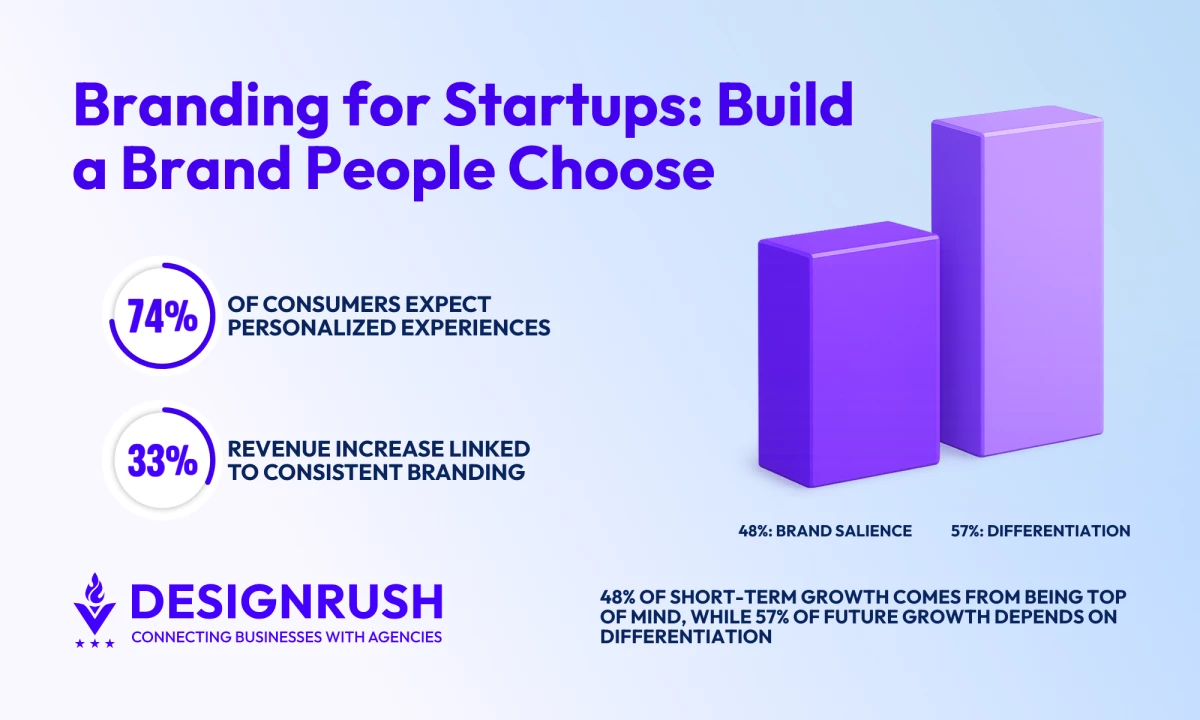
- 57% of brand growth comes from differentiation, making a distinct value proposition critical for startups.
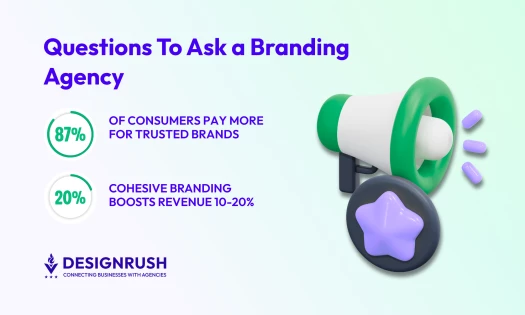
- 87% of shoppers will pay more for brands they trust, highlighting the impact of purpose, clarity, and relevance.
- Consistent branding across messaging, visuals, and channels helps your startup stay recognizable as it grows.
The Importance of Startup Branding in 2026
Many startups never reach scale. Roughly 90% of startups fail within the first five years, and common causes include lack of market demand and weak positioning in competitive markets.
In this environment, branding strategies help startups connect meaningfully with real customers and build a foundation that supports growth.
Why branding matters now:
- Connect with customers: Intentional branding helps people quickly understand what you do and who it’s for.
- Build trust and credibility: Consistency in visuals and messaging signals professionalism.
- Stand out in crowded markets: Strong branding makes your startup easier to recognize and remember.
- Create a foundation for growth: Early brand guidelines keep your identity consistent as you scale.
Branding for Startups: A Step-by-Step Guide
Branding works best when it is built intentionally.
Early decisions make it easier to stay consistent across your website, marketing, product experience, and customer communication.



The steps below walk through the key parts of startup branding:
- Define Your Brand Purpose and Vision
- Understand Your Target Audience
- Develop Your Unique Value Proposition
- Design Your Visual Identity
- Build a Strong Online Presence
- Measure Branding Success
1. Define Your Brand Purpose and Vision
Your brand purpose explains why your startup exists at its core. Your vision sets a long-term direction for where the brand is headed.
Together, these give you a foundation for messaging, audience connection, and strategic focus.
87% of shoppers say they will pay more for brands they trust.
That means purpose and authenticity can translate to real purchase behavior, especially for startups still building credibility.
How to define your brand purpose and vision:
- Write a concise purpose statement: One or two sentences that explain the problem you solve and who you serve.
- Describe your vision: Outline where you want the brand to be in 5-10 years in terms of impact or reputation.
- List core values: Choose three to five values that guide your decisions, culture, and communication.
- Validate for clarity: Test your statements with team members or early customers and refine based on their feedback.
2. Understand Your Target Audience
About 74% of consumers expect companies to deliver personalized interactions and experiences, which means generic messaging is easier to ignore.
Start by defining who your brand is for:
- Primary audience: The main group most likely to need and buy your product
- Secondary audience: A smaller segment that may influence decisions or grow over time
- Core problem: The specific challenge your audience is trying to solve
- Decision triggers: What pushes them to start looking for a solution
Once you’re clear on who you are targeting, you can gather meaningful insights.
Here's how to go about understanding your audience in practice:
- Interview real or potential customers: Ask what problem they were trying to solve, what alternatives they considered, and what nearly stopped them from choosing a solution.
- Review behavioral data: Use website and social insights to see which pages people visit most, what content they engage with, and where they drop off.
- Track recurring questions and objections: Look at sales calls, support emails, and comments to spot gaps in your messaging.
- Map motivations and frustrations: Identify what your audience wants to achieve and what makes the process difficult or risky.
- Create one or two short audience profiles: Include goals, challenges, decision triggers, and concerns. Keep them concise so your team actually uses them.
3. Develop Your Unique Value Proposition
Your unique value proposition (UVP) explains why your startup is the better choice. It clarifies the specific value you offer, who it is for, and what makes your solution really different.
57% of a brand’s future growth comes from differentiation, and it directly supports long-term revenue.
In crowded categories like fintech, healthtech, and SaaS, startups often compete with similar features and pricing. Well-defined positioning and distinct brand messaging help emerging companies stand out when products alone are not enough to set them apart.
At the same time, customers are becoming more price-conscious and less brand-loyal.
50% of shoppers are trying new retailers, and 69% prioritize price over brand names. In this environment, startups that cannot clearly explain their value are easier to replace.
So, what should you do? Follow the steps below to develop a strong UVP:
1. Pinpoint the core outcome you deliver
Focus on the result your customer gets and not on your product features. What improves in their life or work after using your solution?
2. Define who benefits most
Be specific about the type of customer who gets the highest value. Narrow positioning often makes messaging stronger.
3. Clarify your point of difference
Identify one to two factors that competitors don’t emphasize or cannot easily copy. This could be speed, specialization, experience, or approach.
4. Pressure-test your statement
Share your draft UVP with potential users and ask what they think you actually do and why it matters. If answers are vague or inconsistent, rethink it.
5. Align your pricing with perceived value
One-third of retailers are misaligned on pricing compared to the value customers perceive. Effective value communication helps justify your price and avoid competing only on cost.
For example, early-stage SaaS startups often begin by competing on features or price.
When they shift their positioning toward a specific audience and outcome, messaging becomes clearer, marketing more efficient, and lead quality improves.
4. Design Your Visual Identity
Your visual identity is how your brand becomes recognizable at a glance.
It shapes first impressions across your website, social media, product, and marketing materials. Many startups invest in a logo but skip the system around it.
Research shows consistent brand presentation can increase revenue by up to 33%, highlighting the business impact of visual consistency.
How to build a visual identity you can actually use:
1. Define your brand personality in practical terms
Choose three to four traits such as modern, reliable, bold, or friendly. Use these as a filter when reviewing design choices.
2. Design a flexible logo system
Create a primary logo, a simplified version for small spaces, and an icon or mark for social profiles and app use.
3. Choose a focused color palette
Pick one primary color, two to three supporting colors, and neutral tones. Make sure they work well on both light and dark backgrounds.
4. Select clear typography
Choose one font for headings and one for body text. Prioritize readability across devices and sizes.
5. Document basic visual rules
Create a short brand style guide that shows logo usage, color codes, font styles, and example layouts for social posts or web sections.
Visual consistency also depends on how design elements work together on the page. As Jason Saldana, President and CEO of Copa Design, explains:
"We advise focusing on a strong visual hierarchy — ensuring that the key message is immediately visible and supported by secondary elements.
Typography, color, and imagery must all work in harmony to reinforce the brand’s voice and the message being conveyed."
A professional visual identity can also influence how seriously your startup is taken by potential partners and customers.
5. Build a Strong Online Presence
About 78% of shoppers research online before making a purchase, even if they eventually buy offline. That makes your digital touchpoints central to how your brand is discovered and evaluated.
Here's how to build a strong and consistent online presence:
1. Make your website your primary brand hub
Clearly communicate what you do, who it is for, and why it matters within the first few seconds.
Ensure pages load quickly, navigation is simple, and your site works smoothly on mobile devices.
2. Align key pages with your UVP
Your homepage, about page, and core product or service pages should all reinforce the same value proposition and audience focus.
3. Choose social platforms strategically
Focus on one to two platforms where your audience is most active. Adapt your tone and content format to each platform while keeping your core message consistent.
4. Use content to demonstrate expertise
Share helpful articles, videos, or posts that address your audience’s common questions and challenges. This builds familiarity and trust over time.
5. Build an email list early
Even a small list allows you to stay in touch with interested prospects, share updates, and nurture long-term relationships beyond social algorithms.
A well-aligned online presence also helps you reduce friction in the buying journey, which can improve conversion rates and your brand’s overall marketing performance.
6. Measure Branding Success
Measuring performance helps you understand whether your brand is becoming clearer, more recognizable, and more effective over time.
80% of organizations view analytics as crucial to decision-making, and 73% say data reduces uncertainty and improves decision accuracy.
This highlights why startups should track brand performance using measurable indicators instead of relying on instinct alone.
What to measure and why:
- Brand awareness:
- Monitor direct website traffic, branded search queries, and social mentions to see whether more people recognize and actively look for your brand.
- Engagement:
- Track time on site, pages per visit, content interactions, and social engagement to understand how deeply people connect with your brand.
- Conversion performance:
- Measure sign-ups, inquiries, purchases, or demo requests to see if your positioning and messaging are encouraging action.
- Customer loyalty:
- Review repeat purchases, returning users, or subscription renewals to gauge long-term brand connection.
- Brand perception:
- Use short surveys to ask customers how they would describe your brand and what they associate it with.
Tools that support brand performance tracking:
- Google Analytics: Understand traffic sources, user behavior, and conversion paths.
- Social media analytics: Review audience growth, engagement trends, and top-performing content.
- SEO tools: Track branded keyword growth and search visibility.
- Behavior analytics tools: Use heatmaps and session recordings to see how users interact with key pages.
- Email analytics: Monitor open rates, click-through rates, and subscriber growth to assess ongoing interest.
Best Practices for Effective Startup Branding
Beyond the foundational steps, these principles will help your startup brand stay relevant and effective over time:
1. Communicate honestly
Authentic messaging builds trust and helps your brand form stronger long-term relationships with customers.
2. Ensure support from leadership
When founders and leaders actively support the brand, it shows in company decisions, culture, and communication, strengthening brand consistency from the inside out.
3. Track trends shaping startup branding
Keeping an eye on branding trends will help your startup stay relevant while still grounded in a consistent identity.
Here are a few trends to keep in mind:
- Motion graphics and interactive visuals
Use animation and micro-interactions on websites, product demos, and social content to make messaging easier to follow and more engaging.
- Eco-conscious branding
Highlight real sustainability efforts such as materials, operations, or supply chain choices. Be specific to avoid generic claims.
- Community-led growth
Create opportunities for customers to interact with each other through social groups, events, or user-generated content.
- AI in brand creation and personalization
Use AI tools to test content variations, generate visuals, and analyze audience behavior while keeping strategic direction human-led.
4. Document and protect your brand early
As startups grow, more people create content, design materials, and communicate with customers. Without basic brand documentation, messaging and visuals start to drift.
What you should do is create a simple internal brand playbook that includes your purpose, audience definition, value proposition, tone of voice, and visual guidelines. Even a short shared document helps new hires, freelancers, and partners represent your brand accurately.
This is not the same as the visual style guide alone. It brings together strategy, messaging, and identity in one place so your brand stays consistent as your team expands.
Startup Branding: Final Thoughts
Strong branding gives startups clarity, focus, and a way to stand out when attention is limited.
I’ve seen how much easier growth becomes when a brand clearly communicates who it’s for and why it matters.
Start simple, stay consistent, and let your brand evolve as your business does.

Our team ranks agencies worldwide to help you find a qualified partner. Visit our Agency Directory for the top branding agencies for startups, as well as:
- Top Digital Marketing Agencies
- Top Social Media Marketing Agencies
- Top Content Marketing Agencies
- Top Graphic Design Agencies
- Top Web Design Agencies
Branding for Startups FAQs
1. Is branding for startups difficult?
Branding can feel complex, but breaking it into steps makes it manageable.
Start with your purpose, audience, and value proposition, then build visuals and messaging around them. Many startups also benefit from outside perspective early on to avoid costly misalignment later.
2. What’s the biggest branding mistake startups make?
A common mistake is trying to appeal to everyone. Without a defined audience and value proposition, branding becomes generic and fails to stand out in competitive markets.
3. Is ineffective branding responsible for startup failure?
Yes, especially when unclear positioning and inconsistent messaging make it hard for customers to understand or trust the business.
Weak branding can lead to poor differentiation, low recognition, and difficulty gaining traction in the market.

-preview-webp.webp)