Accenture, Cognizant, Capgemini, IBM, Tata Consultancy Services - these are among the top system integrators enterprises select to unify technology ecosystems, streamline operations, and implement scalable infrastructure solutions that support secure and efficient business growth.
Organic rankings are determined by five factors: top services, reviews, portfolio, awards/press, and team expertise. Sponsored listings pay for a placement that appears above organic positions. Sponsorship does not affect star ratings or review content - read more on our methodology page.
Websites, die Kunden gewinnen
Waldbyte ist ein deutsches Digitalstudio für individuelle Webentwicklung und E-Commerce. Wir realisieren performante Unternehmenswebsites, Webanwendungen und Onlineshops mit TYPO3, WordPress, Shopware, PrestaShop und Magento. Ergänzend übernehmen wir technische Optimierung, Hosting, Wartung und die...
Top Services:
- Web Development
- Web Design
- WordPress Website Design
- eCommerce Development
- SEO
- Show more
- Location
- Stuttgart, Germany
- Number of Employees
- Under 49
- Average Hourly Rate
- $60/hr
- Minimal Budget
- $1,000 - $10,000
- Portfolios Count
- 1 Project Listed
Data sourced from the agency's DesignRush profile, its website, and other relevant accountsWaldbyte Digital Agentur Services
Data sourced from the agency's DesignRush profileBallonswelt Haq Public Shopixo
Your Business, Automated.
We help businesses scale by combining AI, automation, and CRM expertise into done-for-you solutions. From lead capture and client nurturing to AI-powered voice agents and custom workflow design, Yotomations builds systems that give you back time, reduce costs, and drive measurable growth. Your business...
Top Services:
- Web Development
- Digital Marketing
- SEO
- PPC
- Social Media Marketing
- Show more
- Location
- Lutz, Florida
- Number of Employees
- Under 49
- Average Hourly Rate
- $150/hr
- Minimal Budget
- $1,000 - $10,000
Data sourced from the agency's DesignRush profile, its website, and other relevant accountsYotomations LLC Services
Data sourced from the agency's DesignRush profileSalon Cadence Shefa Marketing AEI Law Sela Partners
Digitally Transforming Businesses.
We are a digital product development company that helps businesses create custom software solutions. Our core competencies involve creating solutions as per business processes and requirements...
Top Services:
- Mobile App Development
- Software Development
- IT Services
- AI Development
- DevOps Consulting
- Show more
- Location
- Noida, India
- Number of Employees
- 50 - 99
- Average Hourly Rate
- $50/hr
- Minimal Budget
- $1,000 - $10,000
- Portfolios Count
- 7 Projects Listed
Data sourced from the agency's DesignRush profile, its website, and other relevant accountsHonest Digital Services Pvt. Ltd. Services
Data sourced from the agency's DesignRush profileFlexipayment PepCorns Spot Shot MedPlant Pharmaceuticals, Inc. Texol Energies Verz Design India Fish Company Hush Bunny Giftly Tranxact LLC
Pave The Way To Innovation
Popway Software Pvt. Ltd., headquartered in Surat, India, brings over 15 years of IT expertise in software design and development, custom ERP and CRM solutionsserving industries such as furniture, healthcare (including dermatology ERP and multi-hospital ERP systems), and printing. We also specialize in web...
Top Services:
- Software Development
- IT Services
- eCommerce Development
- Web Design
- Mobile App Development
- Show more
- Location
- Surat, India
- Number of Employees
- Under 49
- Average Hourly Rate
- $20/hr
- Minimal Budget
- $1,000 - $10,000
Data sourced from the agency's DesignRush profile, its website, and other relevant accountsPopway Software Pvt Ltd Services
Data sourced from the agency's DesignRush profileSakhiya Skin Clinic Sharda Hospital Vishwastratis Better Living Fitmantra Lassya Fashion RightChoice Solar Esteem Medical Solution Vfollow




Explore IT Services Specializations
- AWS
- Data Science
- Enterprise Architecture Technology
- Finance
- Google Apps
- Government
- Hadoop Consulting
- Healthcare
- IBM
- IT Consulting
- IT Outsourcing
- Marketing Automation
- Master Data Management
- Microsoft Office 365
- Microsoft SharePoint Consulting
- MongoDB
- NetSuite Consulting
- OpenText
- Productivity & Collaboration
- SAP Consulting
- Startups
Popular Services
Everything You Need to Know About the System Integration Companies
What does a system integrator company actually do?

A system integrator connects all the different software and systems a business uses, so they work as one. Instead of tools operating separately, they make data flow automatically between them.
Most companies use multiple systems at the same time. CRM for sales, ERP for operations, accounting tools, marketing platforms, and inventory systems. Without integration, teams manually move data between them. That creates delays, errors, and duplicate work. System integration service providers remove that friction.
Their work usually happens in stages:
- System integrator companies analyze your current setup. They map all systems, data flows, and gaps. They identify where data breaks, where manual work happens, and what needs to be connected.
- They design how systems should communicate. This includes defining what data moves, how often, and in what format. They decide whether to use APIs, middleware, or custom-built connections.
- After that, they build and implement integration. This can include:
- Connecting systems through APIs
- Creating custom logic to transform data between systems
- Setting up automation so processes run without manual input
- Ensuring real-time or scheduled data syncing
- Once built, they test everything. System integration agencies validate that data flows correctly, systems stay stable, and performance holds under real usage. This step prevents failures after launch.
- After launch, they continue to support and improve the system. They monitor performance, fix issues, update integrations when tools change, and expand the system as the business grows.
What is the difference between a system integrator and an automation company?
A system integrator company connects different systems so they can share data and work together. An automation company reduces manual work by automating tasks and processes.
A system integrator company solves the problem of disconnected tools. An automation company solves the problem of repetitive work. In many cases, automation depends on integration first. If systems are not connected, automation cannot run properly.
Many services overlap, but the core difference is focus. Integration connects systems. Automation uses those connections to execute tasks.
| Factor | System integrator company | Automation company |
| Main goal | Connect systems | Automate tasks |
| Focus | Data flow and system communication | Workflows and processes |
| What they fix | Disconnected tools | Manual, repetitive work |
| Typical work | APIs, middleware, system architecture | Workflow tools, triggers, rules |
| Example | Connect CRM with ERP | Auto-send invoice after sale |
| Dependency | Foundation layer | Built on top of integration |
What can top system integration companies do for your business?
Top system integration companies connect all your systems, so they work as one. They link tools such as CRM, ERP, inventory, and finance, so data flows automatically instead of being entered manually. That removes data silos, reduces errors, and keeps the business running as a single system instead of separate parts.
Here is how system integrators impact your business:
1. Lower operational costs
Disconnected systems create hidden costs through manual work, duplicate tools, and constant fixes. Integration removes that overhead by automating data flow and simplifying your setup.
These improvements show up directly in cost reduction across daily operations:
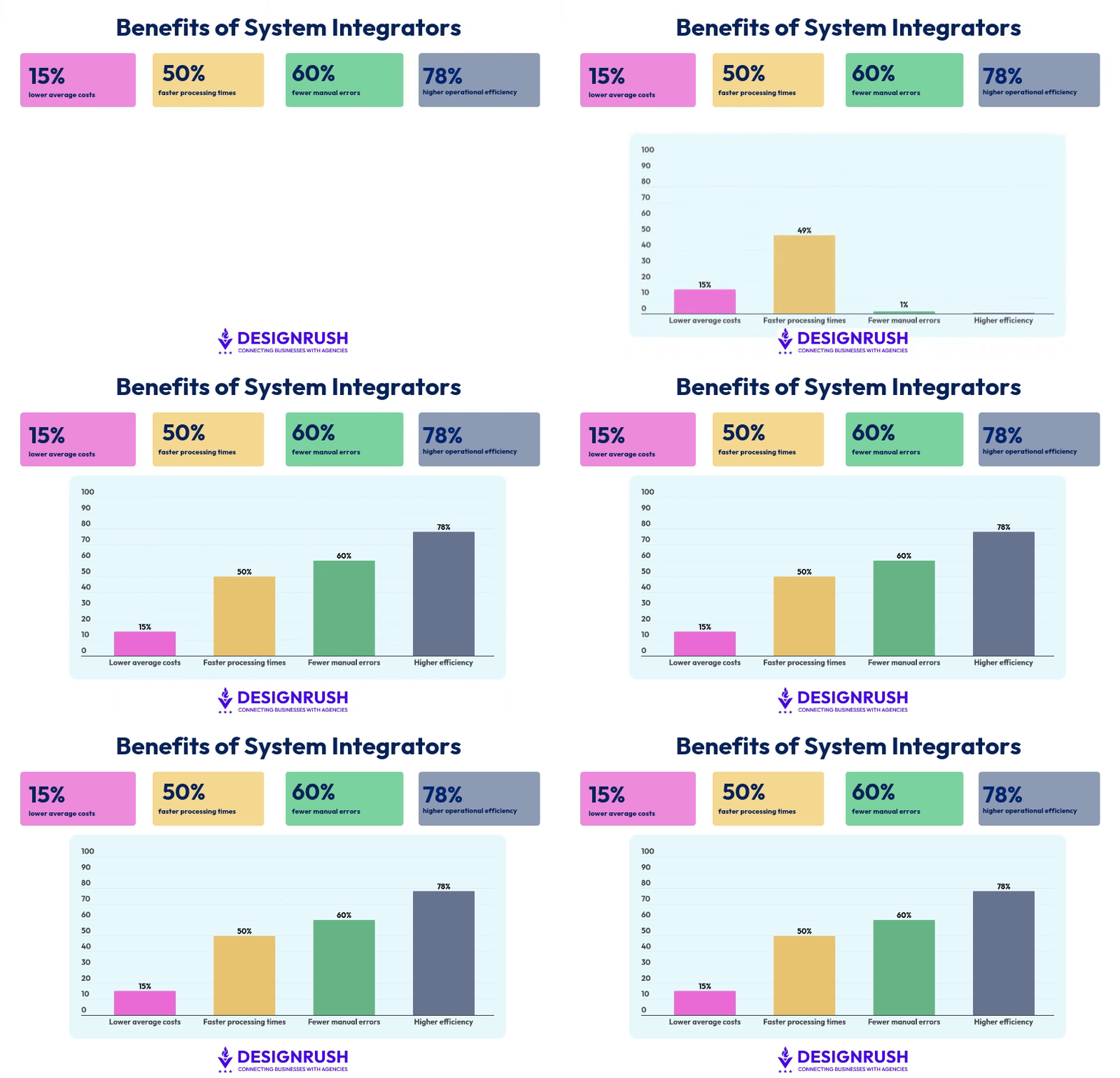
- 15% reduction in average costs across the organization
- Up to 20% lower administrative costs in sectors like healthcare
- Up to 80% savings in data processing in cloud-based integration setups
2. Higher employee productivity
When systems are not connected, employees spend time copying data between tools. Integration removes that work and speeds up daily operations.
The impact shows in higher output, faster execution, and less wasted time:
- 35% to 45% productivity increase for technical teams by year three
- Up to 78% improvement in operational efficiency with integrated ERP systems
- 50% faster processing times across core business workflows
3. Stronger return on investment (ROI)
Software only delivers value when systems are connected. Integration ensures your tools actually work together and produce measurable business results.
The return shows through higher efficiency, faster payback, and stronger long-term performance:
- 30% improvement in overall ROI from integration projects
- Up to 328% ROI over three years, with payback in 4.2 months
- 10.3x ROI for companies with mature integration compared to fragmented systems
4. Better data accuracy and decision-making
Manual data entry creates errors and delays. Integration creates a single, reliable source of data that updates in real time.
The result is cleaner data, fewer mistakes, and faster access to insights.
- 60% reduction in manual errors in systems like CRM or claims management
- 91% improvement in inventory optimization with integrated systems
- 50% less data engineering effort, enabling 75% faster time-to-insight
How can you choose the right system integrator?
Choosing the right system integrator directly affects whether your project runs smoothly or ends up with delays, budget overruns, and broken systems. The right partner understands both the technical side and your business goals. The wrong one only writes code without understanding how your systems should actually work together.
Follow these steps to make a solid decision:
- Define what you need to integrate
List all systems, tools, and data flows. Be clear on what needs to connect and what outcome you expect. A vague scope leads to wrong estimates and poor execution. - Check relevant experience
Look for companies that have done similar integrations. Same industry, same tools, or similar complexity. General experience is not enough. - Evaluate technical expertise and certifications
Confirm they work with the platforms you use. Check cloud (AWS, Azure), vendors (SAP, Salesforce), and security standards. No proof means higher risk. - Review past projects and case studies
Focus on real results. What systems did they connect, what problems did they solve, and what impact did they deliver? Avoid vague marketing examples. - Assess their integration approach
Strong system integration firms explain how they plan, build, test, and deploy integrations. They should talk about APIs, data mapping, testing, and fallback plans clearly. - Understand communication and project management
Integration projects involve multiple teams. You need structured communication, clear timelines, and defined responsibilities. Lack of this causes delays. - Ask about post-launch support
Systems change over time. Confirm how they handle maintenance, updates, and scaling. No support plan means long-term problems. - Compare cost vs value, not just price
Low cost often means shortcuts in planning, testing, or support. Look at the total cost, including maintenance, delays, and risk. Cheap integrations fail more often.
What questions should you ask system integrator companies before choosing one?
Asking the right questions helps you separate companies that truly understand integration from those that only sell development hours. A good integrator should be able to explain their experience, how they work, and how they will handle your specific case without vague answers.
Relevant background
- What similar integration projects have you completed, and for which industries?
- Which platforms, systems, or tools do you specialize in (ERP, CRM, cloud, etc.)?
- Can you share case studies with measurable results from past integrations?
- What certifications or partnerships do your team members have?
Services and processes
- How do you approach system integration from planning to deployment?
- How do you handle data mapping, transformation, and validation?
- What testing methods do you use before going live?
- How do you manage communication, timelines, and project updates?
Related to your project
- How would you approach integrating our specific systems and tools?
- What risks or challenges do you see in our setup?
- What timeline and cost range do you estimate for this project?
- What kind of support do you provide after launch?
Sources
DesignRush sustains a directory of over 40,000 agencies categorized by service category, location, expertise, and reviews. We build our database in two ways:
- Our dedicated team of agency experts actively searches the web for top-performing companies. We then pull information from their websites, online presence, and client testimonials to verify their status and qualifications prior to listing.
- The agencies listed get notified of their profiles on the website, and they can choose to claim them or not, which suggests their availability for more collaborations.
Agencies can also reach out to DesignRush and must go through the verification process prior to being listed.

Why companies trust DesignRush
Every agency is independently vetted before it can be listed or ranked
 4.8
 4.8
Some agencies pay for sponsored placement, clearly labeled and held to the same vetting standards.
5 Frequently Asked Questions About System Integrator Companies
Who needs system integrator company services?
Any business that uses multiple software systems and needs them to work together needs a system integrator. When systems are disconnected, data duplicates, processes slow down, and errors increase.
Typical use cases:
- Mid-size and enterprise companies that have multiple tools (ERP, CRM, HR, finance) that must share data
- Companies running legacy systems with outdated software that does not connect easily with modern tools
- Fast-growing businesses that are adding new tools quickly and losing control over data and workflows
- eCommerce and retail companies that need to sync orders, inventory, payments, and customer data in real time
- Manufacturing and logistics companies that require tight coordination between supply chain, inventory, and operations systems
- Finance and healthcare organizations that handle sensitive data and need secure, compliant integrations
- Companies undergoing digital transformation that move to cloud systems, automation, or new platforms
Clear signal you need an integrator:
- Data is entered manually into multiple systems
- Reports do not match across tools
- Teams rely on spreadsheets to “connect” systems
- Processes break when one system changes
- Scaling creates more errors instead of efficiency
At that point, integration is no longer optional.
How much do system integrator companies charge for their services?
System integrator services typically cost $15,000 to $1,500,000+, depending on how complex your systems are and how many platforms need to be connected.
Here is how pricing usually breaks down:
- Simple integrations (2 systems): $15,000 to $75,000
- Mid-level integrations (3–5 systems): $75,000 to $300,000
- Enterprise-wide integrations (5+ systems): $300,000 to $1,500,000+
Cost also follows a clear structure across the project:
- Planning and architecture: 10 to 20% of the total cost
- Development and setup: 50 to 70% of the total cost
- Testing and QA: 15 to 25% of total cost
- Training and rollout: 5 to 15% of total cost
There are ongoing costs that most companies ignore at the start. After launch, expect:
- Support and maintenance: 15 to 25% of the initial cost per year
- Cloud, tools, and licenses: Ongoing monthly or annual fees
- API and data usage costs: Depends on volume
Costs increase fast when systems are outdated, data is messy, or real-time processing is required. Legacy systems alone can add 20-50% to cost, and most companies should plan an extra 20-30% buffer for unexpected issues.
What is a typical timeline for system integration projects?
Most system integration service providers require from 3 to 18 months for their projects, depending on the number of systems, data complexity, and business size.
Here is how timelines usually break down:
- Small to mid-size projects: 3 to 9 months
- Large enterprise projects: 6 to 18 months
- Simple integrations (2 systems): 6 to 12 weeks
- Complex integrations (multiple systems): 9 to 18+ months
How system integration companies execute the project also affects speed:
- Phased rollout: 4 to 12 months, lower risk, more stable
- Big bang (all at once): 3 to 6 months, faster but higher risk
Several factors directly impact the timeline:
- Data cleanup and migration can take 15 to 20% of the total time
- Custom features add 3 to 6+ months
- Legacy systems slow everything down
- Testing and go-live add 1 to 2 months if done properly
Delays are common. Around 43% come from technical issues, and 40% from changing scope during the project.
How much downtime does system integration require?
Most system integrations require little to no downtime if planned correctly, but in practice, expect a few hours to a few days of disruption during final switchovers.
Downtime depends on how the company executes the project:
- Parallel integration (best case): Near-zero downtime
The new system runs alongside the old one, and then the switch happens quickly - Phased integration: A few hours at a time
Work is done in small parts during planned maintenance windows - Full cutover (big bang): Hours to several days
The entire system is replaced at once, with the highest risk of disruption
Several factors increase downtime risk:
- Legacy systems: Harder to connect, more failures
- Poor planning: No fallback or rollback options
- High system dependency: If one system fails, others stop
- No testing environment: Issues appear during live use
Strong teams reduce downtime by using backups, testing in advance, and scheduling work during low-activity periods. In well-managed projects, operations continue with minimal interruption.
What kind of support do system integrator companies provide after the project is finished?
System integration service providers do not stop at launch. They provide ongoing support to keep systems stable, secure, and working as expected. Without this, integrations break over time as systems update or data grows.
Post-project support usually includes:
- Fixing errors, broken connections, or data sync issues that appear after launch
- Tracking system health, fixing slow processes, and improving speed as data volume grows
- Adjusting integrations when connected platforms change or update
- Patching vulnerabilities and maintaining data protection standards
- Helping internal teams resolve issues and answering day-to-day questions
- Adding new features, connecting new systems, or expanding integrations as the business grows
- Providing guides and training so teams can use and manage the system properly
Most companies charge ongoing support as 15–25% of the initial project cost per year. Without this support, systems degrade, errors increase, and internal teams take on hidden maintenance work.
Latest Trends Related to System Integrator