Accenture, Cognizant, Capgemini, IBM, Tata Consultancy Services - these are among the top system integrators enterprises select to unify technology ecosystems, streamline operations, and implement scalable infrastructure solutions that support secure and efficient business growth.
Organic rankings are determined by five factors: top services, reviews, portfolio, awards/press, and team expertise. Sponsored listings pay for a placement that appears above organic positions. Sponsorship does not affect star ratings or review content - read more on our methodology page.
The Right Technology Partner Can Change Everything
Technoyuga builds iOS and Android apps using Flutter and React Native across fintech, healthcare, and eCommerce. Its portfolio includes clients from the US, UAE, and India. The IT services company is best for startups seeking an affordable full-cycle app development partner...
Top Services:
- Mobile App Development
- Software Development
- IoT
- Blockchain
- AI Development
- Show more
- Location
- New York City, New York
- Number of Employees
- Under 49
- Minimal Budget
- $10,000 - $25,000
- Portfolios Count
- 23 Projects Listed
Data sourced from the agency's DesignRush profile, its website, and other relevant accountsTechnoyuga Soft Services
Data sourced from the agency's DesignRush profileDecathlon Akasa Air Justlife Ordeno GFacility Trulipay
Technoyuga Soft Reviews & Testimonials

Mobile App Development Review from Fahmi Elabed
It was a pleasure working with TechnoYuga Soft. For Piccolo Trattoria, they created an intuitive and effective web application that has simplified our online ordering and reservation process. Their staff was punctual, kind, and professional. Their attention to detail really made a difference, and the caliber of their work surpassed our expectations. Strongly advised for any eatery trying to improve their online visibility!

Mobile App Development Review from Manuel Sonnleithner
The quality of work that TechnoYuga Soft has provided is outstanding. The commitment to delivering a mobile app that is of high quality for TradersYard has been great. Our relationship has been very collaborative, the team has been able to deliver on time and within the budget. TechnoYuga Soft enthusiasm for the project was my favorite part. I'm very pleased with project outcome, and will definitely recommend their service!

Mobile App Development Review from Troy Abromaitis
It was a pleasure to collaborate with TechnoYuga Soft on our real estate smartphone app. Our clients' ability to search properties and communicate with us has greatly increased because to the slick, user-friendly software they developed after understanding our demands. Throughout the project, their staff demonstrated professionalism, responsiveness, and a dedication to quality. We're thrilled with the outcome and forward to work together once more.
Reviews verified by DesignRush and sourced from the agency's profile View All Reviews
Femtomax Inc.
VerifiedVerified by the DesignRush team for authenticity and credibility.Technology Solutions for You.
Access information technology professionals with experience of working with startups to Fortune 500 companies without breaking the bank. Our services are well suited for retail, manufacturing, startups and healthcare businesses. Talk to us for a free consultation...
Top Services:
- Web Development
- Mobile App Development
- Software Development
- IoT
- AI Development
- Show more
- Location
- San Jose, California
- Number of Employees
- Under 49
- Average Hourly Rate
- $35/hr
- Minimal Budget
- $10,000 - $25,000
- Portfolios Count
- 9 Projects Listed
Data sourced from the agency's DesignRush profile, its website, and other relevant accountsFemtomax Inc. Services
Data sourced from the agency's DesignRush profileCeeyes Mobility Solutions Pvt. Ltd. Pioneer Property Zone Idaax Technologies Pvt. Ltd.
Transform Your Ideas Into Profitable IT Solutions
ITWEBS provides full-cycle software development, web and mobile application development, eCommerce platforms, DevOps, integrations, IT support, and dedicated development teams for businesses that need reliable digital solutions...
Top Services:
- eCommerce Development
- Web Development
- Software Testing
- Staff Augmentation
- Mobile App Development
- Show more
- Location
- Warsaw, Poland
- Number of Employees
- 50 - 99
- Average Hourly Rate
- $35/hr
- Minimal Budget
- $10,000 - $25,000
- Portfolios Count
- 4 Projects Listed
Data sourced from the agency's DesignRush profile, its website, and other relevant accountsITWEBS Services
Data sourced from the agency's DesignRush profileeCommerce Industry Education Industry Retail Industry
Ecommerce, End To End
Web Kraftz is a Toronto-based e-commerce development agency established in 2012, specializing in Shopify, WordPress, Salesforce, Microsoft, custom applications, AI, and commerce integrations. The agency has delivered more than 100 projects for DTC brands, retailers, associations, non-profits, and B2B...
Top Services:
- eCommerce Development
- WordPress Website Design
- Digital Strategy
- PPC
- eCommerce
- Show more
- Location
- Markham, Canada
- Number of Employees
- Under 49
- Average Hourly Rate
- $85/hr
- Minimal Budget
- $10,000 - $25,000
- Portfolios Count
- 1 Project Listed
Data sourced from the agency's DesignRush profile, its website, and other relevant accountsWeb Kraftz Services
Data sourced from the agency's DesignRush profileTMR Customs Gigi Pip Two Roads Hat Co. Florence Marine X Nupemall
Cloud, AI, software and digital transformation partner
Omax Tech is a custom software and SaaS delivery partner helping startups and mid-market teams ship products, AI MVPs, and cloud platforms. We combine product engineering, staff augmentation, and AWS DevOps across Allen, TX, Dubai, and Karachi — with senior ownership so quality doesn’t cliff when capacity...
Top Services:
- Web Design
- UI/UX Design
- Web Development
- Software Testing
- AI Development
- Show more
- Location
- Allen, Texas
- Number of Employees
- 50 - 99
- Average Hourly Rate
- $75/hr
- Minimal Budget
- $10,000 - $25,000
Data sourced from the agency's DesignRush profile, its website, and other relevant accountsOmax Tech Services
Data sourced from the agency's DesignRush profileConfidential client — AI mobile inspection Confidential client — caregiving app Confidential client — AWS cloud migration
With fox, we must play fox.
We are proud to be one of the best IT outsourcing companies in all over the world! And we Keep Learning! We are very grateful for working with you...
Top Services:
- Digital Services
- Web Development
- eCommerce Development
- Digital Strategy
- Affiliate Marketing
- Show more
- Location
- Hanoi, Vietnam
- Number of Employees
- 1000 & Up
- Average Hourly Rate
- $20/hr
- Minimal Budget
- $10,000 - $25,000
Data sourced from the agency's DesignRush profile, its website, and other relevant accountsVietIS Services
Data sourced from the agency's DesignRush profileHonda Hitachi Toyota Fujitsu
VietIS Reviews & Testimonials
Thành Trung Nguyễn's Review Sourced from Google
Great company. Fun and friendly staff. I haven't been back here in 1 year, but thank you for taking care of me during my internship
Reviews verified by DesignRush and sourced from the agency's profile View All ReviewsYour 360° Partner in Digital Transformation.
8Cloud Technologies Inc. is a full-service IT solutions and digital transformation company helping businesses modernize, automate, and scale. We offer Microsoft Solutions, cloud services, custom web and mobile development, eCommerce, AI, cybersecurity, managed IT, creative digital solutions, and staff...
Top Services:
- IT Services
- Business Consulting
- Staff Augmentation
- Digital Services
- Digital Strategy
- Show more
- Location
- Austin, Texas
- Number of Employees
- 50 - 99
- Average Hourly Rate
- $30/hr
- Minimal Budget
- $10,000 - $25,000
Data sourced from the agency's DesignRush profile, its website, and other relevant accounts8Cloud Technologies Inc. Services
Data sourced from the agency's DesignRush profileRiztech LLC Leeban Consulting Clear Path Logic Kkouture Heavy Equipment Connect
911 IT delivers managed IT, cybersecurity, cloud, compliance, business continuity, and VoIP services tobusinesses across Utah, Wyoming, and Arizona...
Top Services:
- Managed Services
- Cybersecurity
- IT Services
- IT Compliance Solution
- Customer Support
- Show more
- Location
- South Jordan, Utah
- Number of Employees
- Under 49
- Average Hourly Rate
- $38/hr
- Minimal Budget
- $10,000 - $25,000
Data sourced from the agency's DesignRush profile, its website, and other relevant accounts911 IT Services
Data sourced from the agency's DesignRush profileCPA Firm Healthcare Construction Engineering Law Firm
911 IT Reviews & Testimonials
Spence Bingham's Review Sourced from Google
We’ve been working with 911IT for quite some time, and they’ve been a dependable partner for our business. Their team is responsive, knowledgeable, and willing to help whenever issues arise. Whether it’s day-to-day support, infrastructure questions, or more complex IT challenges, they’ve consistently provided professional service and clear communication.A special thanks to Kody, who has always been great to work with. He takes the time to understand the issue, follows through, and makes sure things are resolved.As the in-house IT manager, I appreciate having a managed services partner that collaborates rather than simply closing tickets. It’s reassuring to know we have a team we can rely on when we need additional expertise or support.I would recommend 911IT to any business looking for a responsive and professional IT services provider.
Eli Jensen's Review Sourced from Google
If you’re looking for the best IT company, I can’t recommend 911 IT enough. Their professional service really stood out to me from the start. I loved working with Logan—he was such a great help and made everything feel straightforward and stress-free. What’s also impressive is their remote IT support, which means they’re always just a call away no matter where you are. The IT services they provide are reliable and tailored to fit your business needs perfectly. It’s clear they care about delivering top-quality IT support every time. Definitely a trusted partner!
Ingrid Sousa's Review Sourced from Google
I can’t say enough good things about the IT support I received here. From start to finish, the entire process felt smooth and stress-free thanks to their quick response and professional service. Logan was incredibly friendly and helpful throughout, going well beyond what I expected to make everything easier for me. The team’s knowledge really shines through, and their clear communication made understanding what was happening so much simpler. If you’re looking for reliable IT services that actually solve your issues without headaches, this is definitely the place to turn to.
Reviews verified by DesignRush and sourced from the agency's profile View All ReviewsCommitment to Tailored IT Management.
Stiqibit solutions is a specialized IT services company with a unique approach to providing embedded IT department solutions for impact investment firms and philanthropic organizations. Our focus on Apple-powered environments, cybersecurity, and tailored IT solutions uniquely tailored to our clients' vision...
Top Services:
- IT Services
- Location
- San Francisco, California
- Number of Employees
- Under 49
- Average Hourly Rate
- $195/hr
- Minimal Budget
- $10,000 - $25,000
Data sourced from the agency's DesignRush profile, its website, and other relevant accountsStiqibit Solutions Services
Data sourced from the agency's DesignRush profileOmidyar Network Flourish Ventures International Fund for Public Interest Media Imaginable Futures AI Collaborative First Look Media
Drive Business Growth with the #1 SaaS Solutions
Hitpoint Cloud is an Oracle NetSuite implementation and consulting partner specializing in China and Asia Pacific deployments, localization, integration, and global rollouts. Since 2009, its team of 100+ professionals has supported more than 400 businesses with NetSuite implementation, custom development...
Top Services:
- ERP Consulting
- CRM Consulting
- ECM Consulting
- Cloud Consulting
- IT Compliance Solution
- Show more
- Location
- Shanghai, China
- Number of Employees
- 250 - 499
- Minimal Budget
- $10,000 - $25,000
Data sourced from the agency's DesignRush profile, its website, and other relevant accountsHitpoint Cloud Services
Data sourced from the agency's DesignRush profilePopmart 52toys H&H Group Shokz ESG Solar NVC Elite Solar Domino's Pizza ADNUR ECHEMI
End-To-End Embedded Product Engineering
Jenex Technovation is an embedded product engineering firm that builds connected hardware, firmware, IoT platforms, cloud services, mobile apps, and AI/ML features for companies developing or scaling physical and digital products...
Top Services:
- Software Testing
- Mobile App Development
- IoT
- IT Services
- Engineering
- Show more
- Location
- Ahmedabad, India
- Number of Employees
- 50 - 99
- Average Hourly Rate
- $25/hr
- Minimal Budget
- $10,000 - $25,000
- Portfolios Count
- 1 Project Listed
Data sourced from the agency's DesignRush profile, its website, and other relevant accountsJenex Technovation Pvt. Ltd Services
Data sourced from the agency's DesignRush profileTransportation & Logistics Industry Software & IT Services Industry Hardware & Networking Industry
Jenex Technovation Pvt. Ltd Reviews & Testimonials
Larry Kaufman's Review Sourced from Google
Jenex did a great job with our website. They were great listeners and took in all of our concerns and had lots of great ideas. They worked quickly and were easy to work with on doing revisions. I highly recommend them.
chauhan harkisan's Review Sourced from Google
it improves our carrier go to growth and helpful to life, with good company with good experience.
Reviews verified by DesignRush and sourced from the agency's profile View All Reviews















Explore IT Services Specializations
- AWS
- Data Science
- Enterprise Architecture Technology
- Finance
- Google Apps
- Government
- Hadoop Consulting
- Healthcare
- IBM
- IT Consulting
- IT Outsourcing
- Marketing Automation
- Master Data Management
- Microsoft Office 365
- Microsoft SharePoint Consulting
- MongoDB
- NetSuite Consulting
- OpenText
- Productivity & Collaboration
- SAP Consulting
- Startups
Popular Services
Everything You Need to Know About the System Integration Companies
What does a system integrator company actually do?

A system integrator connects all the different software and systems a business uses, so they work as one. Instead of tools operating separately, they make data flow automatically between them.
Most companies use multiple systems at the same time. CRM for sales, ERP for operations, accounting tools, marketing platforms, and inventory systems. Without integration, teams manually move data between them. That creates delays, errors, and duplicate work. System integration service providers remove that friction.
Their work usually happens in stages:
- System integrator companies analyze your current setup. They map all systems, data flows, and gaps. They identify where data breaks, where manual work happens, and what needs to be connected.
- They design how systems should communicate. This includes defining what data moves, how often, and in what format. They decide whether to use APIs, middleware, or custom-built connections.
- After that, they build and implement integration. This can include:
- Connecting systems through APIs
- Creating custom logic to transform data between systems
- Setting up automation so processes run without manual input
- Ensuring real-time or scheduled data syncing
- Once built, they test everything. System integration agencies validate that data flows correctly, systems stay stable, and performance holds under real usage. This step prevents failures after launch.
- After launch, they continue to support and improve the system. They monitor performance, fix issues, update integrations when tools change, and expand the system as the business grows.
What is the difference between a system integrator and an automation company?
A system integrator company connects different systems so they can share data and work together. An automation company reduces manual work by automating tasks and processes.
A system integrator company solves the problem of disconnected tools. An automation company solves the problem of repetitive work. In many cases, automation depends on integration first. If systems are not connected, automation cannot run properly.
Many services overlap, but the core difference is focus. Integration connects systems. Automation uses those connections to execute tasks.
| Factor | System integrator company | Automation company |
| Main goal | Connect systems | Automate tasks |
| Focus | Data flow and system communication | Workflows and processes |
| What they fix | Disconnected tools | Manual, repetitive work |
| Typical work | APIs, middleware, system architecture | Workflow tools, triggers, rules |
| Example | Connect CRM with ERP | Auto-send invoice after sale |
| Dependency | Foundation layer | Built on top of integration |
What can top system integration companies do for your business?
Top system integration companies connect all your systems, so they work as one. They link tools such as CRM, ERP, inventory, and finance, so data flows automatically instead of being entered manually. That removes data silos, reduces errors, and keeps the business running as a single system instead of separate parts.
Here is how system integrators impact your business:
1. Lower operational costs
Disconnected systems create hidden costs through manual work, duplicate tools, and constant fixes. Integration removes that overhead by automating data flow and simplifying your setup.
These improvements show up directly in cost reduction across daily operations:
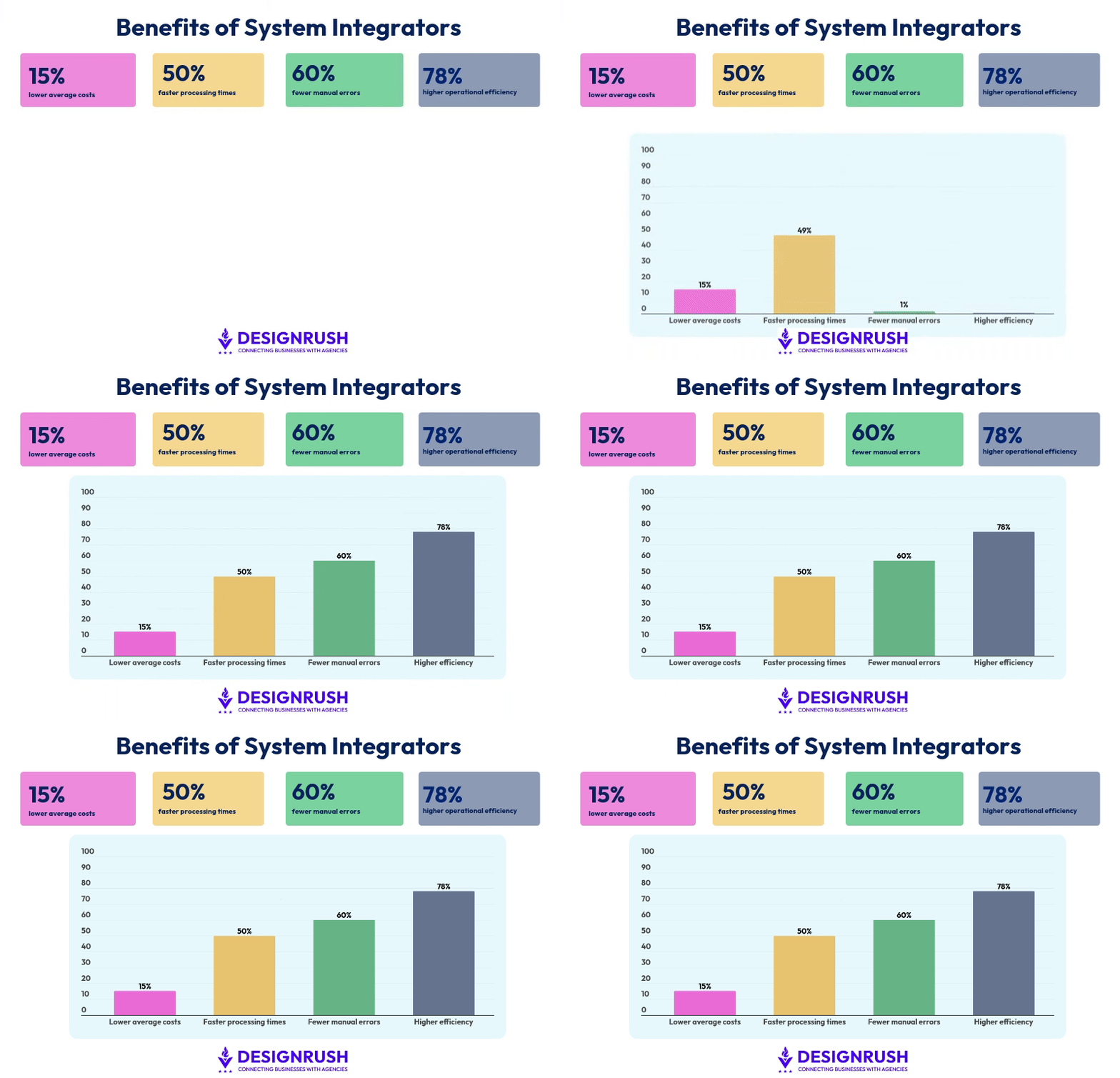
- 15% reduction in average costs across the organization
- Up to 20% lower administrative costs in sectors like healthcare
- Up to 80% savings in data processing in cloud-based integration setups
2. Higher employee productivity
When systems are not connected, employees spend time copying data between tools. Integration removes that work and speeds up daily operations.
The impact shows in higher output, faster execution, and less wasted time:
- 35% to 45% productivity increase for technical teams by year three
- Up to 78% improvement in operational efficiency with integrated ERP systems
- 50% faster processing times across core business workflows
3. Stronger return on investment (ROI)
Software only delivers value when systems are connected. Integration ensures your tools actually work together and produce measurable business results.
The return shows through higher efficiency, faster payback, and stronger long-term performance:
- 30% improvement in overall ROI from integration projects
- Up to 328% ROI over three years, with payback in 4.2 months
- 10.3x ROI for companies with mature integration compared to fragmented systems
4. Better data accuracy and decision-making
Manual data entry creates errors and delays. Integration creates a single, reliable source of data that updates in real time.
The result is cleaner data, fewer mistakes, and faster access to insights.
- 60% reduction in manual errors in systems like CRM or claims management
- 91% improvement in inventory optimization with integrated systems
- 50% less data engineering effort, enabling 75% faster time-to-insight
How can you choose the right system integrator?
Choosing the right system integrator directly affects whether your project runs smoothly or ends up with delays, budget overruns, and broken systems. The right partner understands both the technical side and your business goals. The wrong one only writes code without understanding how your systems should actually work together.
Follow these steps to make a solid decision:
- Define what you need to integrate
List all systems, tools, and data flows. Be clear on what needs to connect and what outcome you expect. A vague scope leads to wrong estimates and poor execution. - Check relevant experience
Look for companies that have done similar integrations. Same industry, same tools, or similar complexity. General experience is not enough. - Evaluate technical expertise and certifications
Confirm they work with the platforms you use. Check cloud (AWS, Azure), vendors (SAP, Salesforce), and security standards. No proof means higher risk. - Review past projects and case studies
Focus on real results. What systems did they connect, what problems did they solve, and what impact did they deliver? Avoid vague marketing examples. - Assess their integration approach
Strong system integration firms explain how they plan, build, test, and deploy integrations. They should talk about APIs, data mapping, testing, and fallback plans clearly. - Understand communication and project management
Integration projects involve multiple teams. You need structured communication, clear timelines, and defined responsibilities. Lack of this causes delays. - Ask about post-launch support
Systems change over time. Confirm how they handle maintenance, updates, and scaling. No support plan means long-term problems. - Compare cost vs value, not just price
Low cost often means shortcuts in planning, testing, or support. Look at the total cost, including maintenance, delays, and risk. Cheap integrations fail more often.
What questions should you ask system integrator companies before choosing one?
Asking the right questions helps you separate companies that truly understand integration from those that only sell development hours. A good integrator should be able to explain their experience, how they work, and how they will handle your specific case without vague answers.
Relevant background
- What similar integration projects have you completed, and for which industries?
- Which platforms, systems, or tools do you specialize in (ERP, CRM, cloud, etc.)?
- Can you share case studies with measurable results from past integrations?
- What certifications or partnerships do your team members have?
Services and processes
- How do you approach system integration from planning to deployment?
- How do you handle data mapping, transformation, and validation?
- What testing methods do you use before going live?
- How do you manage communication, timelines, and project updates?
Related to your project
- How would you approach integrating our specific systems and tools?
- What risks or challenges do you see in our setup?
- What timeline and cost range do you estimate for this project?
- What kind of support do you provide after launch?
Sources
DesignRush sustains a directory of over 40,000 agencies categorized by service category, location, expertise, and reviews. We build our database in two ways:
- Our dedicated team of agency experts actively searches the web for top-performing companies. We then pull information from their websites, online presence, and client testimonials to verify their status and qualifications prior to listing.
- The agencies listed get notified of their profiles on the website, and they can choose to claim them or not, which suggests their availability for more collaborations.
Agencies can also reach out to DesignRush and must go through the verification process prior to being listed.

Why companies trust DesignRush
Every agency is independently vetted before it can be listed or ranked
 4.8
4.8 4.8
4.8Some agencies pay for sponsored placement, clearly labeled and held to the same vetting standards.
5 Frequently Asked Questions About System Integrator Companies
Who needs system integrator company services?
Any business that uses multiple software systems and needs them to work together needs a system integrator. When systems are disconnected, data duplicates, processes slow down, and errors increase.
Typical use cases:
- Mid-size and enterprise companies that have multiple tools (ERP, CRM, HR, finance) that must share data
- Companies running legacy systems with outdated software that does not connect easily with modern tools
- Fast-growing businesses that are adding new tools quickly and losing control over data and workflows
- eCommerce and retail companies that need to sync orders, inventory, payments, and customer data in real time
- Manufacturing and logistics companies that require tight coordination between supply chain, inventory, and operations systems
- Finance and healthcare organizations that handle sensitive data and need secure, compliant integrations
- Companies undergoing digital transformation that move to cloud systems, automation, or new platforms
Clear signal you need an integrator:
- Data is entered manually into multiple systems
- Reports do not match across tools
- Teams rely on spreadsheets to “connect” systems
- Processes break when one system changes
- Scaling creates more errors instead of efficiency
At that point, integration is no longer optional.
How much do system integrator companies charge for their services?
System integrator services typically cost $15,000 to $1,500,000+, depending on how complex your systems are and how many platforms need to be connected.
Here is how pricing usually breaks down:
- Simple integrations (2 systems): $15,000 to $75,000
- Mid-level integrations (3–5 systems): $75,000 to $300,000
- Enterprise-wide integrations (5+ systems): $300,000 to $1,500,000+
Cost also follows a clear structure across the project:
- Planning and architecture: 10 to 20% of the total cost
- Development and setup: 50 to 70% of the total cost
- Testing and QA: 15 to 25% of total cost
- Training and rollout: 5 to 15% of total cost
There are ongoing costs that most companies ignore at the start. After launch, expect:
- Support and maintenance: 15 to 25% of the initial cost per year
- Cloud, tools, and licenses: Ongoing monthly or annual fees
- API and data usage costs: Depends on volume
Costs increase fast when systems are outdated, data is messy, or real-time processing is required. Legacy systems alone can add 20-50% to cost, and most companies should plan an extra 20-30% buffer for unexpected issues.
What is a typical timeline for system integration projects?
Most system integration service providers require from 3 to 18 months for their projects, depending on the number of systems, data complexity, and business size.
Here is how timelines usually break down:
- Small to mid-size projects: 3 to 9 months
- Large enterprise projects: 6 to 18 months
- Simple integrations (2 systems): 6 to 12 weeks
- Complex integrations (multiple systems): 9 to 18+ months
How system integration companies execute the project also affects speed:
- Phased rollout: 4 to 12 months, lower risk, more stable
- Big bang (all at once): 3 to 6 months, faster but higher risk
Several factors directly impact the timeline:
- Data cleanup and migration can take 15 to 20% of the total time
- Custom features add 3 to 6+ months
- Legacy systems slow everything down
- Testing and go-live add 1 to 2 months if done properly
Delays are common. Around 43% come from technical issues, and 40% from changing scope during the project.
How much downtime does system integration require?
Most system integrations require little to no downtime if planned correctly, but in practice, expect a few hours to a few days of disruption during final switchovers.
Downtime depends on how the company executes the project:
- Parallel integration (best case): Near-zero downtime
The new system runs alongside the old one, and then the switch happens quickly - Phased integration: A few hours at a time
Work is done in small parts during planned maintenance windows - Full cutover (big bang): Hours to several days
The entire system is replaced at once, with the highest risk of disruption
Several factors increase downtime risk:
- Legacy systems: Harder to connect, more failures
- Poor planning: No fallback or rollback options
- High system dependency: If one system fails, others stop
- No testing environment: Issues appear during live use
Strong teams reduce downtime by using backups, testing in advance, and scheduling work during low-activity periods. In well-managed projects, operations continue with minimal interruption.
What kind of support do system integrator companies provide after the project is finished?
System integration service providers do not stop at launch. They provide ongoing support to keep systems stable, secure, and working as expected. Without this, integrations break over time as systems update or data grows.
Post-project support usually includes:
- Fixing errors, broken connections, or data sync issues that appear after launch
- Tracking system health, fixing slow processes, and improving speed as data volume grows
- Adjusting integrations when connected platforms change or update
- Patching vulnerabilities and maintaining data protection standards
- Helping internal teams resolve issues and answering day-to-day questions
- Adding new features, connecting new systems, or expanding integrations as the business grows
- Providing guides and training so teams can use and manage the system properly
Most companies charge ongoing support as 15–25% of the initial project cost per year. Without this support, systems degrade, errors increase, and internal teams take on hidden maintenance work.
Latest Trends Related to System Integrator