
Every growing business hits the same constraint: you need more capacity, but hiring takes too long, costs too much, or locks you into the wrong structure.
So you look outside.
But now you face a different decision that’s just as risky: do you bring in external talent and manage them yourself, or hand off the work entirely to a vendor?
Staff Augmentation vs. Outsourcing: Key Findings
- If priorities shift frequently, use staff augmentation so you can adapt without renegotiating timelines or budgets.
- If your team lacks bandwidth or senior oversight, outsourcing reduces coordination risk and keeps delivery moving.
- Use augmentation for ongoing, evolving work and outsourcing for time-bound initiatives. This hybrid model aligns each type of work with the structure that executes it best, improving speed without sacrificing control.
72% Talent Shortage Is Reshaping How Companies Hire External Teams
The decision between staff augmentation vs. outsourcing is no longer limited to IT.
It’s a workforce strategy playing out across industries, from retailers preparing for peak seasons to logistics teams scaling operations and hospitality groups managing fluctuating demand.
At its core, the choice is simple: do you bring in external talent and manage them directly, or hand off execution to a vendor?
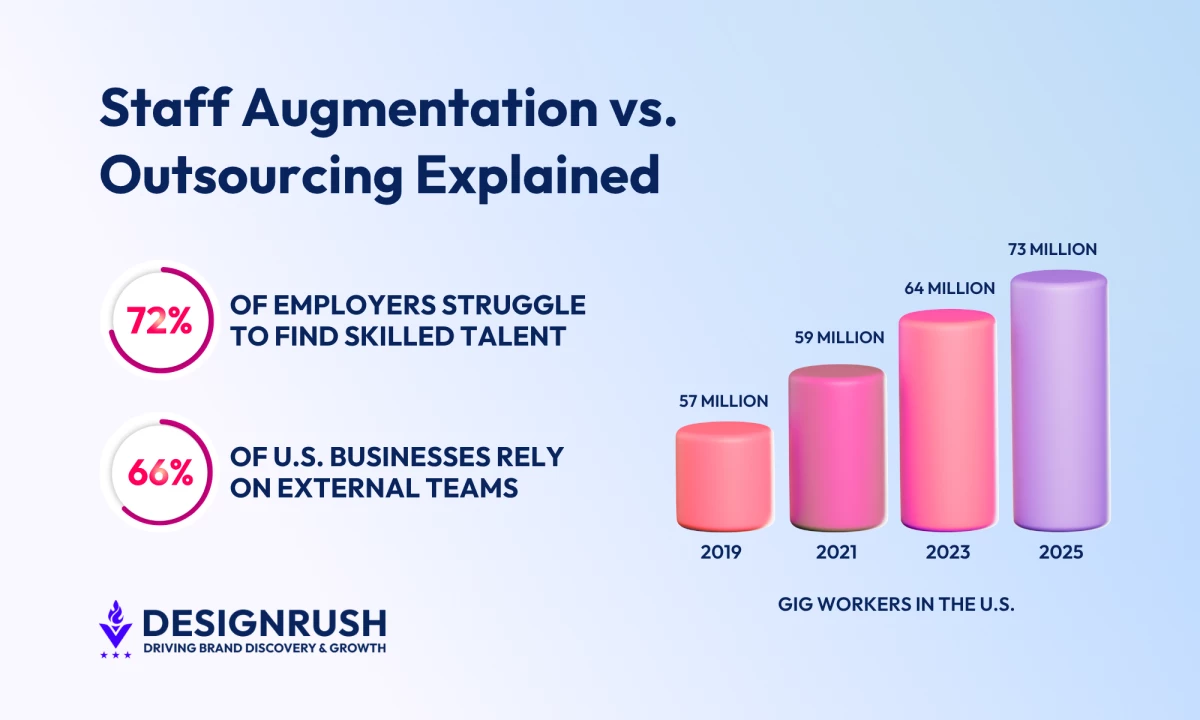
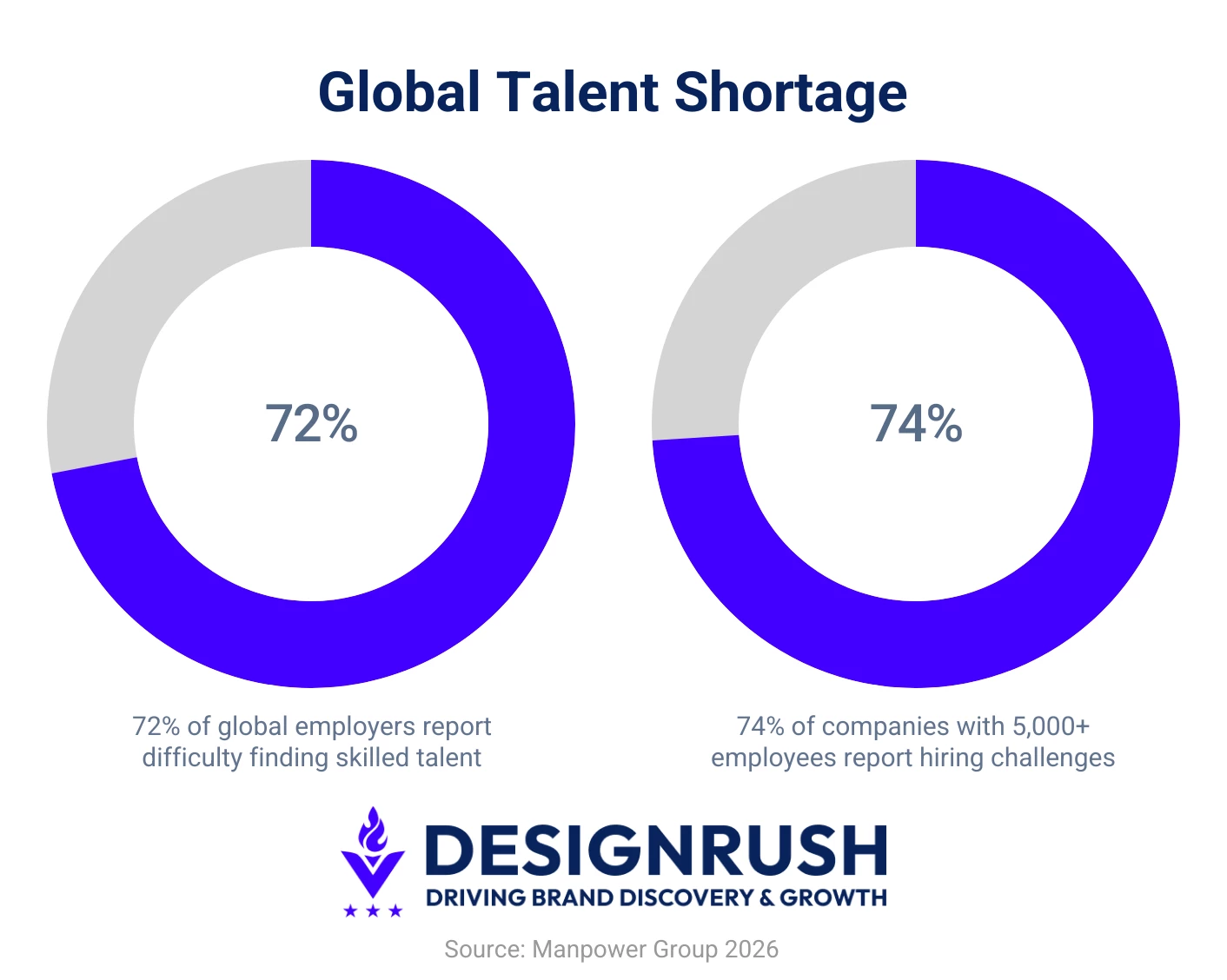
The urgency is real. Nearly three out of four employers report ongoing difficulty finding skilled talent.
At the same time, outsourcing is evolving into a nearly $700 billion global market, while over 30 million skilled workers in the U.S. now participate in flexible, on-demand roles.
This shift is forcing companies to rethink how work gets done.
Increasingly, the answer isn’t choosing one model over the other but combining both. Staff augmentation offers control and adaptability, while outsourcing delivers speed and packaged execution.


Pros and Cons of Staff Augmentation
With staff augmentation, the people are external, but management stays internal.
This applies just as much to a software team adding developers as it does to a warehouse bringing in temporary workers for peak season or an event company staffing a large function. You control the work, the standards, and the output.
It works best when you already have leadership in place, whether that’s a CTO, an operations manager, or a floor supervisor who can direct and integrate external staff effectively.
Augmented workers are capable, but they need direction. When that structure exists, they perform like part of your team.
Where staff augmentation stands out:
- Full control over execution. You manage workflows, quality, and output directly, catching issues early instead of waiting for vendor updates.
- On-demand specialized skills. Bring in exactly the expertise you need, whether it’s a developer, warehouse picker, or event staff, without long-term hiring commitments.
- Faster than traditional hiring. Talent can be deployed in days or weeks, not months, making it ideal for urgent gaps or seasonal demand.
- Predictable costs. Clear hourly or shift-based rates simplify budgeting compared to variable project pricing.
- Flexible scaling. Increase or reduce headcount quickly as demand shifts, without renegotiating contracts.
- Knowledge stays in-house. Your team retains context, processes, and operational insight even after external staff leave.
Where staff augmentation breaks down:
- Requires internal leadership. Without someone managing priorities and quality, output declines and coordination costs rise.
- Hidden management costs. Oversight time adds real cost, especially at senior levels.
- Limited long-term ownership. External workers focus on execution, not long-term strategy.
- Integration effort required. Performance depends on how well they’re embedded into your workflows and culture.
Staff augmentation is best suited to companies with strong internal leadership, evolving workloads, and a need for flexibility or specialized skills.
Staff Augmentation Agencies Worth Knowing
These providers make it easier to fill skill gaps and scale teams without long-term hiring commitments.
- Cheesecake Labs: Best for app design & AI strategy
- Bluebird International: Best for rapid tech talent deployment
- Instawork: Best for operations & logistics
1. Cheesecake Labs: Best for App Design & AI Strategy
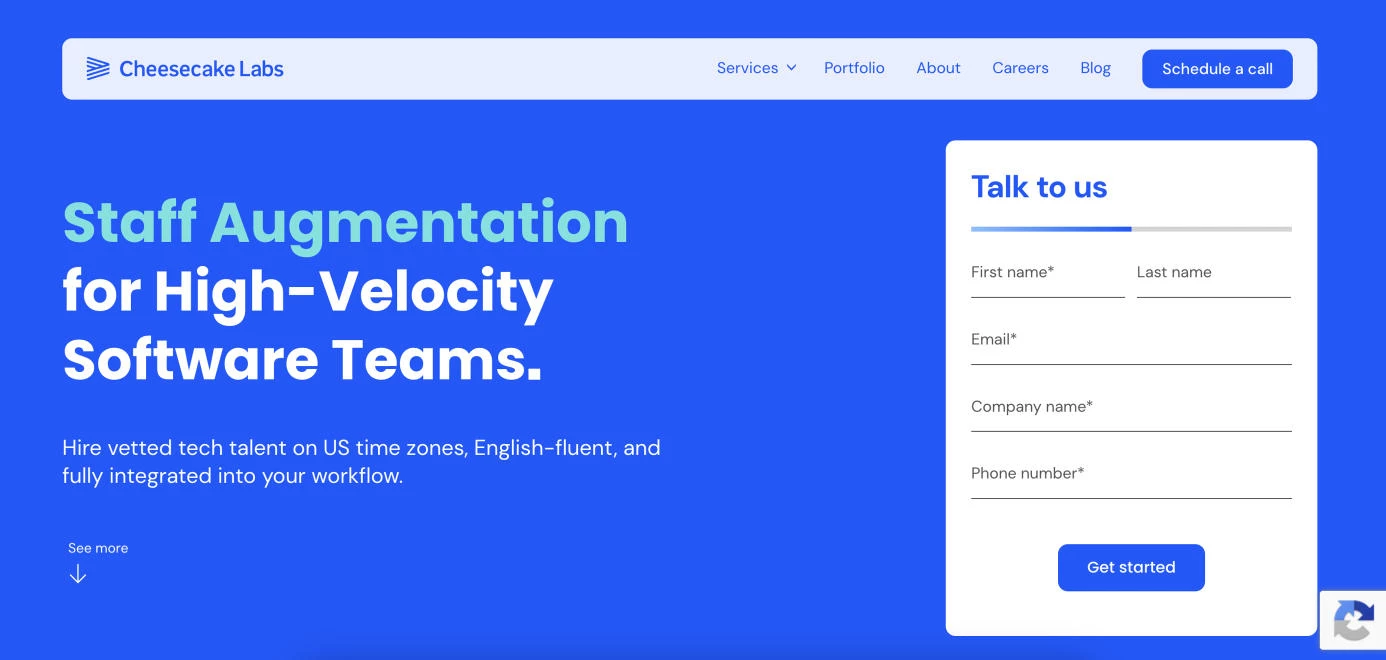
Cheesecake Labs provides staff augmentation services for high-growth teams needing fast, reliable access to skilled talent.
The company offers vetted, English-fluent professionals aligned with US time zones, enabling seamless integration into existing workflows. Its talent pool spans software engineering, design, DevOps, and product roles across modern technologies.
- Agency services:
- Staff augmentation
- Web app development
- AI strategy
- Average hourly rate: Inquire
- Notable clients: Pepsico, MoneyGram International, Sodexo
What Clients Say
Clients consistently highlight Cheesecake Labs’ proactive, solutions-driven approach and deep product thinking.
Teams value their ability to anticipate challenges, adapt quickly, and integrate seamlessly, delivering complex apps and AI-driven solutions while improving scalability, efficiency, and overall product outcomes across industries.
What Sets the Agency Apart
Cheesecake Labs’ work with SWIRL shows how its staff augmentation model supports AI product teams that need senior technical capacity without giving up ownership of the product.
SWIRL was building an enterprise AI platform that helps companies connect internal data to LLMs through real-time search, secure access, and more than 100 integrations.
Its internal team had the expertise, but the backend development, deployment, and DevOps workload was too large to move through quickly with internal capacity alone.
Cheesecake Labs embedded specialists into SWIRL’s workflow to support Python and Django integration pipelines, cloud infrastructure, DevOps optimization, and enterprise security requirements.
The collaboration helped SWIRL speed up development while keeping architecture decisions, roadmap priorities, and security standards under internal control.
Results:
- Supported real-time data access without migration or heavy ETL pipelines
- Strengthened deployment across private cloud, on-premise, and air-gapped environments
- Embedded role-based access, zero-trust architecture, and enterprise privacy standards
- Helped SWIRL clients reduce time spent searching internal data by up to 80%
2. Bluebird International: Best for Rapid Tech Talent Deployment

Bluebird International is a staff augmentation provider focused on quickly supplying vetted, senior IT professionals to support project delivery and team scaling.
With a streamlined hiring process that delivers candidates in 3 to 7 days, the company helps businesses fill skill gaps, meet tight deadlines, and reduce recruitment overhead.
It offers flexible, remote talent across a wide range of technical roles, enabling companies to scale efficiently without long-term hiring commitments.
- Agency services:
- IT staff augmentation
- IT recruitment
- Software development
- Average hourly rate: $50/hr
- Notable clients: Deloitte, KPMG, Bosch
What Clients Say
Clients consistently highlight Bluebird’s reliability in delivering qualified talent, even for complex roles, and its strong understanding of evolving business needs.
Partners value its flexibility, transparent processes, and ability to support large-scale transformation initiatives, reinforcing its position as a trusted provider of high-quality, on-demand workforce augmentation.
What Sets the Agency Apart
Bluebird International supported Deutsche Telekom IT Solutions in scaling development capacity for large, high-stakes projects tied to a €300M+ initiative.
By rapidly deploying senior IT professionals across multiple functions, Bluebird ensured timely delivery, improved resource availability, and maintained high-quality output without adding recruitment overhead.
Results:
- Delivered 250,000+ engineering hours
- Supported software development, testing, and operations
- Enabled on-time delivery for large-scale projects
- Provided senior talent with no additional overhead costs
3. Instawork: Best for Operations & Logistics
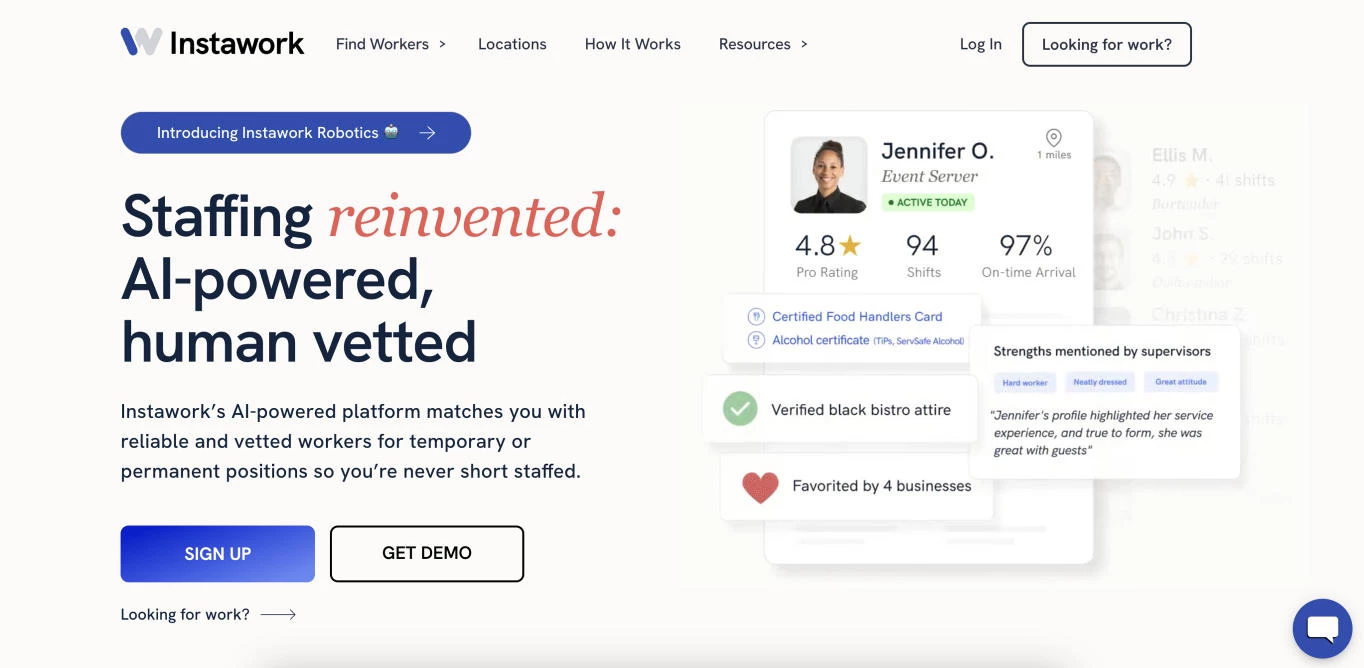
Built for speed, Instawork connects businesses with pre-vetted workers on demand, without traditional agency delays or retainers.
It’s especially effective for restaurants, warehouses, and event operators handling surge demand or seasonal spikes.
If your challenge is operational capacity rather than technical execution, Instawork offers a fast, flexible solution that aligns perfectly with augmentation.
- Agency services:
- Hourly Workers in Hospitality, Light Industrial, and Retail
- Average hourly rate: Inquire
- Notable clients: Google, Target, The Ritz-Carlton
What Clients Say
Clients highlight Instawork as a reliable, scalable staffing solution that saves time and reduces costs. They value access to pre-vetted, motivated workers, transparent ratings, and strong account support.
The platform enables teams to confidently scale operations, take on more work, and maintain quality without heavy hiring overhead.
What Sets the Agency Apart
SnackMagic scaled warehouse operations by adopting a fully flexible staffing model powered by Instawork, replacing traditional hiring with a high-performing, on-demand workforce.
This approach improved productivity, reduced overhead, and created a self-managed team that maintained speed and accuracy at scale.
Results:
- 15,000+ shifts completed
- 400+ workers on roster
- ~90% temporary workforce
- 75% repeat worker rate
- Reduced need for 3 full-time roles
Pros and Cons of Outsourcing
When comparing staff augmentation vs. project outsourcing, the latter shifts responsibility from managing people to managing outcomes. You define the result, and the vendor handles execution.
This can mean hiring a software firm to build an app, a logistics partner to run fulfillment, or a catering team to deliver an event.
The core tradeoff is control versus convenience, with success measured by deliverables rather than day-to-day oversight.
Where outsourcing stands out:
- Built-in systems and expertise. Vendors bring proven processes, tools, and teams ready to execute.
- Faster full-team deployment. Entire teams can start immediately, accelerating time-to-market.
- Lower management burden. Internal teams focus on strategy, not execution oversight.
- Cost efficiency for fixed scope. Predictable pricing works well when requirements are stable.
- Access to complete teams. No need to assemble multiple roles individually.
Where outsourcing breaks down:
- Limited control. You see results at milestones, not daily progress.
- Slower communication cycles. Time zones and workflows extend decision-making timelines.
- Knowledge loss after delivery. Critical context leaves with the vendor.
- Scope creep risk. Changes often increase costs by 20–40%.
- Less control over team quality. You rely on the vendor’s staffing decisions.
Outsourcing works best for clearly defined, time-bound projects where speed and convenience matter more than ongoing control or internal knowledge retention.
Outsourcing Agencies Worth Considering
These providers offer end-to-end delivery solutions for companies looking to offload full projects or operations.
1. TechSpeed: Best for AI-Enhanced Outsourcing
TechSpeed delivers AI-enhanced outsourcing solutions that combine advanced automation with skilled human support.
Its hybrid model integrates U.S.-based project management with global teams to provide scalable, cost-efficient services across data processing and customer experience.
With over 20 years of expertise, TechSpeed leverages AI to improve accuracy, efficiency, and turnaround times while maintaining strong security standards.
- Agency services:
- AI-driven processing
- Data services
- Customer experiences
- Average hourly rate: $6/hour
- Notable clients: Merrill Lynch, Wacom, Harvard University
What Clients Say
Clients have praised TechSpeed for combining AI efficiency with hands-on support, acting as a deeply integrated partner in fast-moving environments.
Reviews highlight exceptional accuracy, fast turnaround times, and proactive communication, with many noting the team’s ability to adapt quickly, exceed expectations, and deliver high-quality results on time and within budget.
What Sets the Agency Apart
TechSpeed partnered with job platform Otta to streamline complex data processing as the company scaled its personalized job-matching service.
Faced with inconsistent job categorization and process delays, TechSpeed deployed a trained team, built structured SOPs, and introduced QA systems with performance tracking dashboards.
Results:
- 24-hour turnaround for job postings
- Over $350,000 in labor cost savings
- Consistent accuracy and adherence to strict data standards
- Scalable support for expansion initiatives
2. Pexly: Best for eCommerce and DTC Support
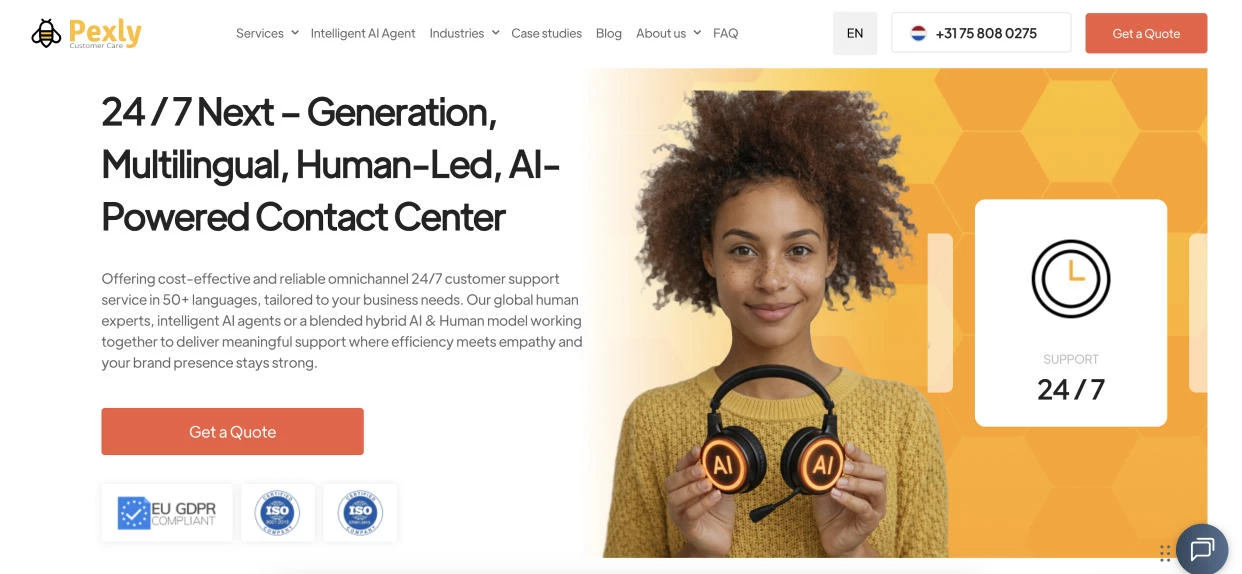
Pexly delivers next-generation customer support tailored for eCommerce and DTC brands, combining human expertise with AI-driven efficiency. Its omnichannel, 24/7 model supports 50+ languages, enabling seamless global communication at scale.
With a hybrid AI-human approach, Pexly handles high-volume inquiries instantly while preserving a personalized customer experience.
Backed by strong QA processes and flexible, scalable solutions, the company helps startups reduce costs, improve CSAT, and strengthen customer relationships.
- Agency services:
- Human-led customer support
- Tech support help desk
- Phone answering service
- Average hourly rate: $10/hour
- Notable clients: Sweatcoin, OnRecruit, Valo Motion
What Clients Say
Clients consistently praise Pexly for its professionalism, flexibility, and ability to scale quickly across global support needs. Teams highlight fast onboarding, strong communication, and reliable delivery, with measurable gains in CSAT, response times, and SLA performance.
Many describe Pexly as a proactive, responsive partner that integrates seamlessly and adapts under pressure.
What Sets the Agency Apart
Pexly partnered with a large U.S.-based eCommerce company to transform its overwhelmed customer support operations. Facing rising inquiry volumes, long wait times, and declining CSAT, the client needed a scalable, cost-efficient solution.
Pexly implemented a multilingual, omnichannel support system powered by AI and trained agents, automating routine queries and optimizing workflows.
The results were significant:
- Wait times dropped by 40%
- Operational costs decreased by 35%
- CSAT increased by 150%
- Zero downtime during high-demand periods
Staff Augmentation vs. Outsourcing: Full Comparison at a Glance
Both models solve a capacity problem. But they solve it differently, and the difference shapes every decision you'll make downstream: management, cost, control, and what happens when the engagement ends.
Use this as a guide to match the model to your situation.
| Dimension | Staff Augmentation | Outsourcing |
| Control over process | Full control over tools, workflows, and quality | Limited control; vendor sets process, execution, and delivery |
| Best for project type | Evolving, flexible, ongoing work | Fixed, well-defined deliverables |
| Team structure | Individual roles added to your team | Pre-built teams handling full projects |
| Management effort | Higher; requires active oversight | Lower; vendor handles coordination |
| Knowledge retention | Stays within your organization | Leaves with vendor after completion |
| Cost model & risk | Pay per time worked; management overhead | Fixed/project pricing; scope creep risk |
| Flexibility | High; scale up or down quickly | Lower; tied to contract terms |
How to Choose: 6 Questions to Ask Before You Decide
In the staff augmentation vs. outsourcing decision, the questions below are intentionally sequenced to clarify your choice step by step.
Answer them honestly before committing. Any friction or uncertainty you feel is a signal pointing toward the model that better fits your timeline, resources, and level of control required.
- Question 1: How stable is your project scope?
- Question 2: Do you have internal technical leadership with available bandwidth?
- Question 3: Is this work core to your product, or peripheral?
- Question 4: How sensitive is the work or data involved?
- Question 5: Are you paying for time, or for an outcome?
- Question 6: What is your timeline for onboarding external resources?
Question 1: How stable is your project scope?
Scope stability determines success. If requirements stay fixed, outsourcing works well. If they evolve through feedback or market shifts, fixed contracts trigger change orders, delays, and rising costs as the model resists flexibility.
Staff augmentation absorbs change naturally. You can reprioritize work, shift direction, and adapt without renegotiation. Choose outsourcing for stable scope, and augmentation when requirements are expected to evolve over time.
Question 2: Do you have internal technical leadership with available bandwidth?
Augmented teams require hands-on leadership. Someone must review work, set standards, and guide priorities. Without real bandwidth, external talent adds coordination overhead instead of output, leading to misalignment, inconsistent quality, and wasted spend.
Outsourcing shifts that burden to the vendor’s leadership. If your internal team lacks capacity or oversight, outsourcing reduces risk. Use augmentation only when you have a clear owner with time to manage external talent effectively.
Question 3: Is this work core to your product, or peripheral?
Core work defines your competitive advantage and requires retained knowledge. Peripheral work is more transactional, such as campaigns, events, or operational support. The distinction matters because ownership and long-term maintainability differ between models.
Augmentation keeps knowledge in-house, making it ideal for core functions. Outsourcing suits well-defined, non-critical work where speed and cost matter more than long-term ownership or deep operational understanding.
Question 4: How sensitive is the work or data involved?
Augmented staff operate within your systems, keeping data, processes, and access tightly controlled. This minimizes exposure and ensures sensitive assets remain within your environment throughout execution.
Outsourcing introduces exposure through external tools and workflows. Contracts help, but high-risk or regulated work requires deeper review. Use augmentation for sensitive operations and evaluate outsourcing risk carefully before committing.
Question 5: Are you paying for time, or for an outcome?
Outsourcing is built for outcome-based delivery. You define requirements, the vendor executes, and you evaluate results. Limited visibility is expected, as the focus is on deliverables rather than daily operations.
Augmentation provides transparency and control. You manage priorities, workflows, and output in real time. Choose it when you value visibility and flexibility, and avoid outsourcing if you expect hands-on control after work begins.
Question 6: What is your timeline for onboarding external resources?
Outsourcing often requires more upfront time. Vendor onboarding, discovery, scoping, and alignment can take weeks before real execution begins. That investment pays off when the work is well-defined and long enough to justify the setup.
If your need is urgent and execution-ready, augmentation is the faster path. If you can afford a structured ramp-up for a clearly scoped initiative, outsourcing becomes viable.
Can You Use Both? The Case for a Hybrid Approach
A hybrid approach works because different types of work require different levels of control, speed, and knowledge retention.
The real question isn’t “which model is better?” It’s “which model fits this specific work right now?”
Here are three common patterns used across industries:
Pattern 1: Keep core work in-house, outsource the edges
- Own what defines your competitive advantage. Your internal team handles core operations, processes, or systems that directly impact your customers and long-term direction.
- Outsource clearly defined side work. Use external providers for standalone projects like campaigns, facility upgrades, training programs, or relocations that don’t require ongoing iteration.
- Limit overlap between teams. Keep responsibilities separate, so your internal team retains control over key decisions and integration points that affect long-term performance.
Pattern 2: Outsource the build, then take it back
- Move fast with an external team. Outsource well-defined initiatives to quickly launch new capabilities without building internal capacity from scratch.
- Plan the handoff before completion. Bring in internal or embedded staff early to observe, document, and understand how the work is being delivered.
- Transfer ownership after launch. Use internal or embedded staff to absorb knowledge and maintain the output, avoiding long-term reliance on the external provider.
Pattern 3: Stay focused, outsource the surge
- Keep core operations stable. Your internal and embedded team continues ongoing work tied to long-term priorities and day-to-day execution.
- Outsource temporary surges. Hand off large, time-bound initiatives like expansions, audits, or system overhauls to external teams working in parallel.
- Ensure work is self-contained. Clear boundaries allow both streams to run independently, reducing coordination overhead and minimizing disruption to core operations.
When Each Model Fails: Common Mistakes to Avoid
When teams get this wrong, it’s usually not the model; it’s the context. Both staff augmentation and outsourcing fail in predictable ways when applied under the wrong conditions.
Here’s an overview of the most common failure points:
| Scenario | Where It Fails | What Happens | How to Avoid It |
| No leadership for augmentation | No internal owner | Misalignment, low output | Assign a dedicated lead |
| Augmenting without clear direction | Weak planning | Rework, slow progress | Set priorities and workflows first |
| Treating augmentation like outsourcing | Expecting autonomy | Missed expectations | Fully integrate into your team |
| Outsourcing evolving work | Changing scope | Cost overruns, delays | Use only for stable work |
| No outsourcing handoff plan | Knowledge loss | Vendor lock-in, gaps | Plan transition early |
| Expecting control in outsourcing | Misaligned expectations | Friction, micromanagement | Align on outcomes upfront |
| Poor communication setup | Timezone/culture issues | Slow decisions | Set cadence and overlap hours |
| Vague scope definition | Unclear requirements | Low quality, rework | Define success early |
The pattern is simple: augmentation fails without leadership and structure; outsourcing fails without clarity and stability.
Staff Augmentation vs. Outsourcing Final Thoughts
There’s no universally better model; only a better fit for the work in front of you.
If you’re clear on your scope, leadership capacity, and need for control, the decision becomes straightforward. Most organizations land on a hybrid approach, not by default, but because it mirrors how work actually happens: some needs evolve, others don’t.
Match the model to the work, and everything else gets easier.

Our team ranks agencies worldwide to help you find a qualified partner. Visit our Agency Directory for the Top IT Services Agencies as well as:
- Top IT Services in Chicago
- Top Software Outsourcing Companies
- Top HR Outsourcing Companies
- Top Staff Augmentation Companies
- Top BPO Companies
And don’t miss our Awards section, where we celebrate the most innovative projects in design, from logo and app design to print and packaging.
Staff Augmentation vs. Outsourcing FAQs
1. What is the difference between staff augmentation and outsourcing?
Staff augmentation means adding external workers to your team while you manage the work directly. Outsourcing means handing off a project or function to a vendor who manages execution. The key difference is control: augmentation keeps it in-house; outsourcing transfers it.
2. What is staff augmentation vs managed services?
Staff augmentation gives you external talent you manage day to day. Managed services go further by outsourcing an entire function, including tools, processes, and outcomes, to a provider. You focus on results, while the provider owns delivery, performance, and ongoing operations.
3. Is staff augmentation cheaper than outsourcing?
It depends on scope and duration. Outsourcing is often more cost-effective for short-term, clearly defined work. Augmentation can be cheaper for ongoing or evolving needs due to fewer renegotiations and more predictable, usage-based pricing.
4. What are the biggest risks of outsourcing?
The biggest risk is loss of knowledge after completion. Other risks include cost overruns from scope changes, slower decision-making due to communication gaps, and reduced control over execution quality and daily operations.
5. What is the difference between staff augmentation and a dedicated team?
A dedicated team is a hybrid model where an external provider supplies a stable, long-term team while managing hiring and operations. You get continuity and alignment without handling day-to-day workforce management directly.
6. When should a startup use staff augmentation vs. outsourcing?
Early-stage startups without internal leadership often benefit from outsourcing for speed and structure. As leadership matures, augmentation becomes more effective for scaling work while retaining control over direction, priorities, and execution quality.