How to Hire Web Designers in California
How do I know if I'm ready to hire a California web design agency?
You're ready to hire a California web design agency when you can answer three questions clearly:
What does the site need to do?
Who is it for?
What does success look like after launch?
Without those answers, you're not ready to brief an agency. You need to do discovery work first. Most failed projects start with a client who hasn't defined the problem yet.
California's tech economy contributes approximately $620 billion to the U.S. economy, which means web design companies in California work with high expectations and fast-moving clients. Agencies here are used to moving quickly, and they will, even if your brief isn't solid. That speed works against you if you haven't done the groundwork.
Before reaching out to any California web design firm, work through these:
Goals Audience Budget range Timeline Content
If you can answer all of the above, you're ready. If you're missing two or more, spend another two to three weeks on internal alignment before contacting web design firms in California.
The agencies worth working with will ask these questions anyway. Showing up with the answers puts you in a stronger negotiating position and shortens the project timeline.
How do I shortlist the best web design companies in California?
Shortlisting web design firms in California comes down to filtering fast on four criteria: industry fit, process transparency, measurable results, and communication style, before you spend time on calls or proposals.
With thousands of web and digital interface designers working in California alone, the pool is deep enough that you should never settle for an agency that doesn't check all four.
Start by narrowing down the category fit. A California web design firm that has built five SaaS onboarding flows understands conversion in a way a generalist agency doesn't, even if the generalist has a stronger portfolio overall. Look for case studies in your industry, not just your aesthetics.
Once you have a longlist of six to eight agencies, apply these filters to get to three:
Portfolio outcomes Does the case study mention what changed after launch? Traffic, bounce rate, conversion, and load time. If the answer is only “the client loved it,” move on.
Process documentation Can they send you a one-page overview of how they run a project? Agencies with a defined process have one ready. Those without one will improvise yours.
Proposal quality Send a brief and see what comes back. A generic deck means they didn't read it. A proposal with specific questions means they did.
Reference accessibility Can they connect you with a past client in a similar category? Not a testimonial, an actual conversation.
One thing worth doing before any agency call: run their own website through Google PageSpeed Insights . Web design firms in California that don't maintain their own site's performance are unlikely to prioritize yours. It takes thirty seconds and tells you something a portfolio never will.
Get to three agencies, send the same brief to all three, and compare how they respond; not just what they propose, but how fast, how specific, and what they ask. That process alone will tell you more than hours of research.
What should a good case study from a California web designer show?
A strong case study from a California web designer shows the problem that existed before the engagement, the specific decisions made to solve it, and what changed after launch - all in numbers. If any of those three elements is missing, the case study is a portfolio piece, not evidence of competence.
Most web design companies in California present case studies as visual showcases: before and after screenshots, a client quote, maybe a list of deliverables. That's not enough to evaluate whether an agency can solve your problem. What you're actually trying to learn from a case study is whether their thinking process aligns with your situation.
When reviewing case studies, look for:
A defined problem Decisions with rationale Metrics before and after Timeline honesty A client you can contact
One more thing worth checking: how old are the case studies? Web design has changed significantly in the past three years; mobile-first performance standards, Core Web Vitals, and AI-assisted workflows are now baseline expectations.
A California web design firm whose most recent case study is from 2021 may not be keeping pace with how the industry builds today.
How do I evaluate web designers in California if I don't have a technical background?
You don't need a technical background to evaluate web designers in California, but you do need the right questions. Most of what separates a strong agency from a weak one is visible in how they communicate, how they handle uncertainty, and whether they can explain their decisions in plain language. If they can't explain it to you clearly, they probably haven't thought it through clearly either.
Ask these 15 questions in any agency conversation or proposal review:
Who will work on my project?
Can I meet them before signing?
Why are you recommending this platform (Webflow, Shopify, or custom) for my specific situation?
What does your discovery process look like, and what do you deliver at the end of it?
How do you handle scope changes? What triggers a change order?
What does your revision process look like, and how many rounds are included?
Can you walk me through a project that didn't go as planned?
What does a handoff look like? Will I be able to manage the site myself after launch?
Who owns the design files and code when the project is complete?
What happens if the site has bugs or issues in the first 30 days after launch?
How do you measure whether the project was successful?
What information or assets do you need from me, and when?
What's the most common reason your projects run over the timeline or budget?
Can you connect me with a past client in a similar industry for a short call?
What would you do differently on this project if budget weren't a constraint?
The last question is particularly useful. It reveals how an agency actually thinks about your problem versus how they've scoped it to fit your budget. Web designers in California who thoughtfully answer that question have already considered your project beyond the brief. Those who struggle with it probably haven't.
Web design companies in California operate in one of the most competitive design markets in the world, and the best ones are used to working with non-technical decision-makers. If an agency makes you feel like an obstacle rather than a client, that's the answer you need.
When is it time to switch agencies vs give them more time?
Switch when the problem is structural: missed milestones with no credible recovery plan, communication that requires you to chase, or deliverables that don't match what was scoped. Give more time when the problem is a single incident, a difficult phase, or something that a direct conversation could resolve.
The distinction matters because switching mid-project is costly and disruptive, but staying with the wrong agency costs more.
The clearest signal that something is structural rather than temporary is a pattern. One missed deadline with a clear explanation is a project problem. Three missed deadlines with shifting reasons are an agency problem.
The same applies to quality: a round of revisions that misses the brief once is normal. Revisions that repeatedly miss it suggest the agency either didn't understand the scope or isn't prioritizing your project.
Switch immediately and don't give more time if any of the following are true:
You don't own your domain, hosting, or design files, and the agency is unresponsive about transferring access
The project timeline has slipped more than 25%, with no written recovery plan from the agency
The person who sold you the project is no longer involved, and their replacement clearly doesn't know your brief
You've raised the same concern more than twice, and nothing has changed
The agency is billing for work outside the original scope without a signed change order
Before switching documents, everything. Send a written summary of the issues, the agreed scope, and what you need resolved, and give a specific deadline for a response. This protects you contractually and sometimes prompts a genuine course of correction. If it doesn't, you have the paper trail you need to exit cleanly.
When you switch, secure your assets first: domain credentials, hosting access, all design files, and code repositories. Web design firms in California that have handled transitions before will be familiar with this checklist; if your new agency doesn't walk you through it, that's worth noting.
Why People Trust DesignRush
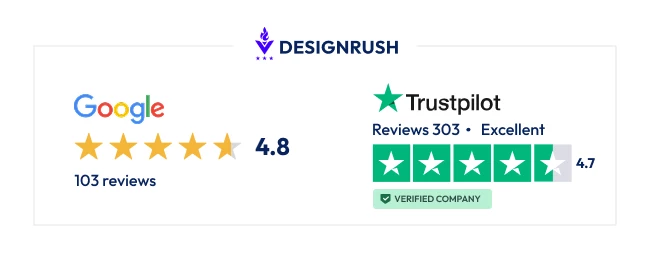
Rated 4.8 on Google and 4.7 on Trustpilot web design companies in California . We owe this to our executive selection team, which follows a strict screening process when featuring agencies on the platform, assessing key performance indicators, like portfolio, client reviews, and industry reputation.
Learn more about DesignRush Agency Ranking Methodology .
Sources
DesignRush sustains a directory of over 30,000 agencies categorized by service category, location, expertise, and reviews. We build our database in two ways:
Our dedicated team of agency experts actively searches the web for top-performing companies. We then pull information from their websites, online presence, and client testimonials to verify their status and qualifications prior to listing.
The agencies listed get notified of their profiles on the website and they can choose to claim it or not, which suggests their availability for more collaborations.
Agencies can also reach out to DesignRush and must go through the verification process prior to being listed.


 Proposals