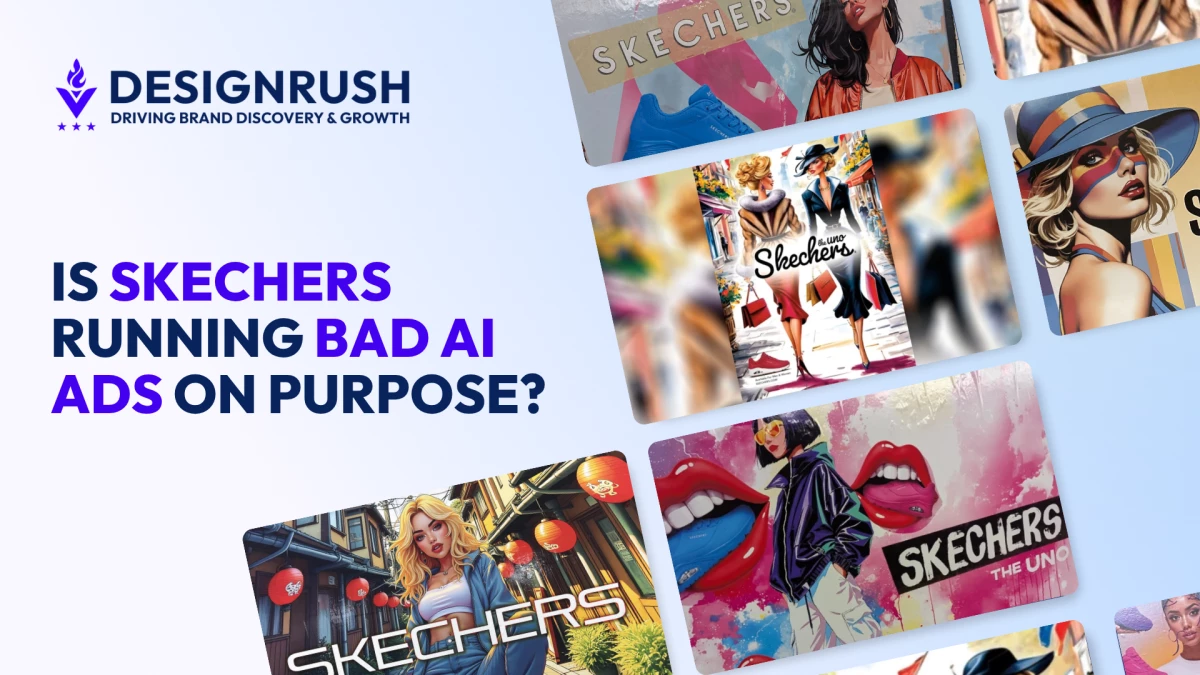

Three campaigns. Eighteen months. Documented backlash each time.
This isn't a brand making mistakes — it's a pattern. And a pattern is a policy.
Act One: The Vogue Incident (2024)
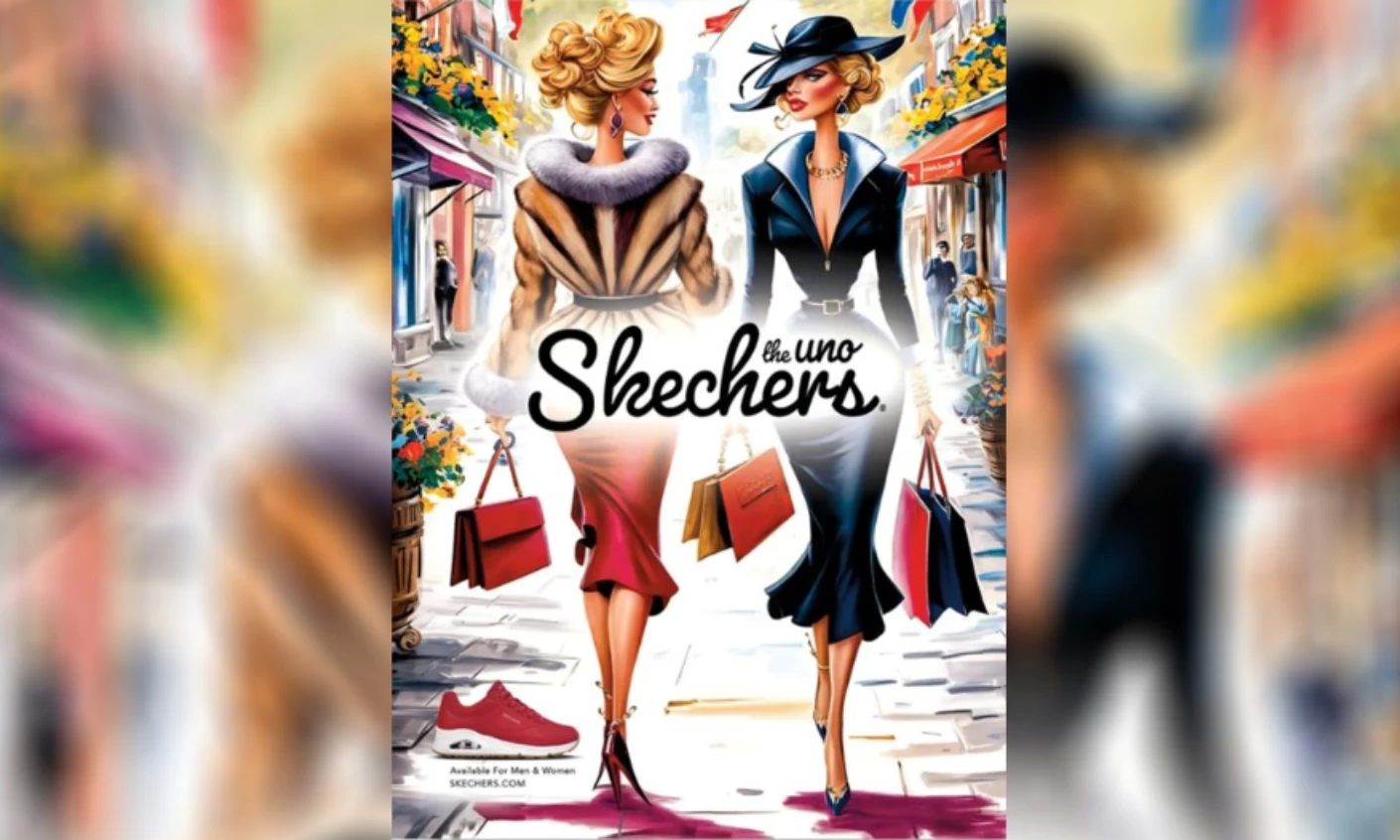
It’s December 2024, the most-watched issue of Vogue in recent memory. For the first time in the magazine's history, a guest editor took the helm. And not just any guest editor.
Marc Jacobs, a man who has made a career out of treating fashion as art, curated an issue the design world was watching closely.
The ad showed an illustrated scene of two blonde women walking a cobblestone European street lined with flower stalls and red awnings.
In the bottom-left corner, almost as an afterthought, sat the Skechers Uno, a chunky comfort sneaker with no business in the same visual world as those stilettos.
Background figures dissolved into faceless smears. Storefront text came out garbled, the kind of typographic nonsense AI reliably produces. Hands and proportions warped the way they do in AI-generated work.
AI allegations started swirling after creator @polishlaurapalmer posted a TikTok flagging the oddities. As Fortune reported, Skechers did not respond to requests for comment.
Her original TikTok caught the failure with real precision: "For one second, I was like, 'Oh, that's kind of cool.' I look at the drawing for two more seconds and I'm like, 'Oh, that's AI.'"
The brief moment of appreciation didn't last. "I wish people who use AI for art understand that now I hate this," she said in the now-viral clip. "You actually didn't save any money because now I hate you. Now I don't ever want to buy a Skechers shoe again."
And she wasn't alone. Ashwinn Krishnaswamy, partner at Forge Design and TikTok creator @shwinnabego, called the piece "AI slop" and described the faces as melting and demonic.
Fast Company's branding column flagged it, noting Skechers hadn't responded to their request either.
Futurism covered it and surfaced a Reddit observation that cut straight to the concept failure: "They portray two women. Both made to appear 'high end'. Apparently both too good to wear the shoe being advertised because the shoe is only shown in the corner."
An X user delivered the wider verdict: "We are so cooked."
The creative community had spoken. Skechers had been publicly embarrassed in the most-watched fashion publication of the season, and had nothing to say for itself.
Act Two: The Billboard (2025)
Skechers using ai to promote their product. They really be saving money on their million dollar company#AI#SKECHERSpic.twitter.com/AvQC8IP5UL
— JL (@JLOxlade) July 31, 2025
Eight months passed. The design community moved on, or thought it had.
Then in August 2025, a new Skechers ad surfaced. A billboard this time, and Creative Bloq catalogued it in detail: a blonde girl squatting on a lantern-lined street, supposedly in a pair of Skechers Uno sneakers. The style was AI's signature faux-sketch look.
Gaussian-blurred, softly rendered, the kind of illustration AI produces when asked to approximate hand-drawn art without an actual human hand. The figure had the frictionless beauty of an "Instagram face," with features averaged from data rather than observed from life.
The r/graphic_design subreddit descended on it almost immediately. Users piled on with real precision: "The determination not to use a human illustrator is incredible," one wrote.
Another zeroed in on the anatomical failures: "The weird folds and shapes of the crotch area and perspective is wild."
A third delivered the verdict the brand should have been dreading: "They should be ridiculed by every design website and mag for this tacky, unprofessional dross."
The answer at the time seemed obvious: cost-cutting. AI images are cheap to generate. Human illustrators aren't. Skechers appeared to be making a simple, if shortsighted, calculation.
Then came Act Three, and the calculus got more complicated.
Act Three: The NYC Subway Campaign (2026)
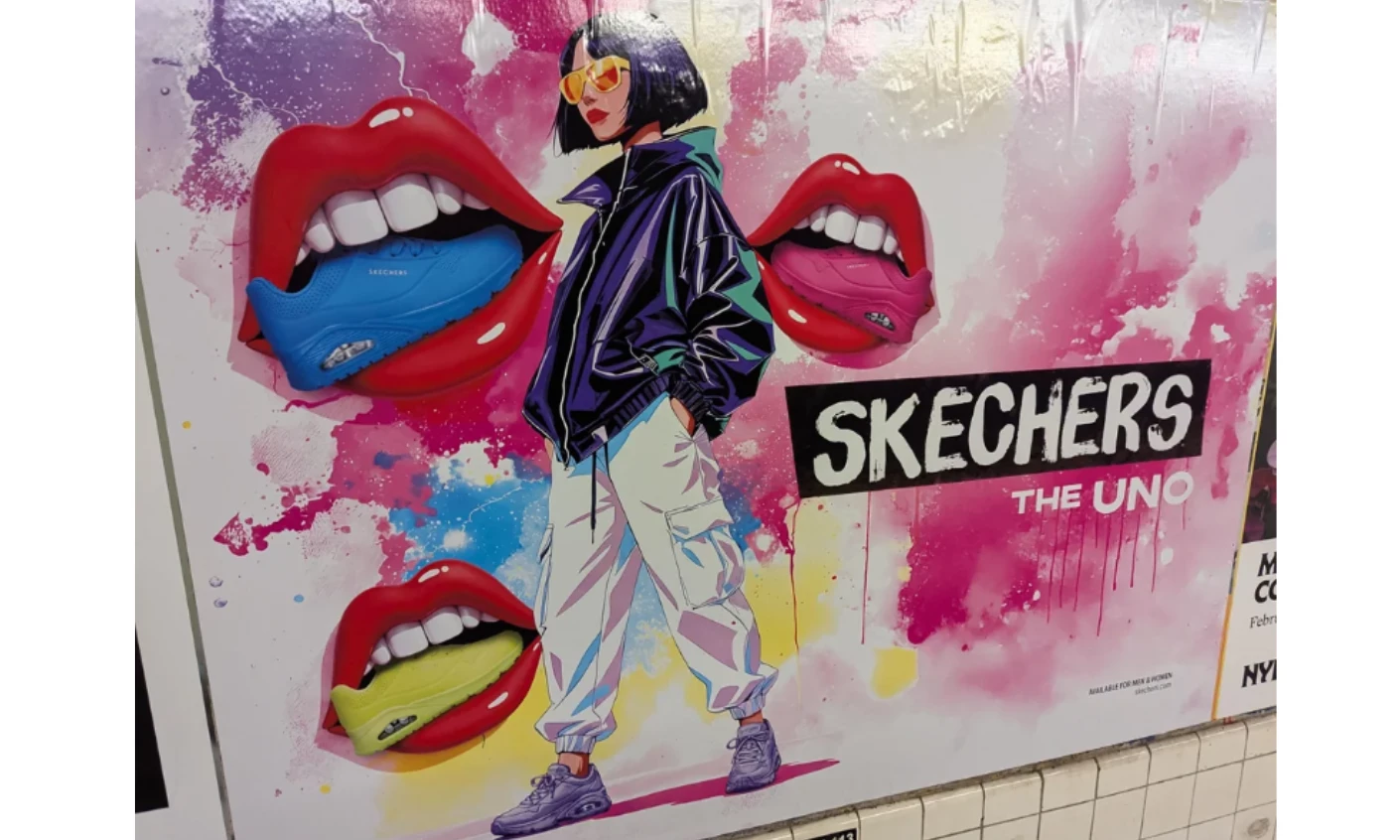
In April 2026, Creative Bloq reported that new Skechers ads had appeared across New York City's subway system. The style was immediately recognizable.
Same faux-illustration AI aesthetic, dressed up with bright paint splatters and pop graphics.
The creative community's reaction was, if anything, angrier this time around.
The Reddit thread, titled "Skechers Spotted Doubling Down on their AI Slop ad Campaign in NYC Subways", filled quickly. "So instead of using a talented agency to do slick ads, they use AI and get a total inconsistent and cheap-looking mess that looks like it is for a (no disrespect) small shoe store," one commenter wrote.
Another caught the economic absurdity with real precision: "It takes one illustrator one time to draw a perfect image, and then we can copy it over the whole world and print it everywhere forever, yet they are happy to remove that illustrator from the equation and think it's a huge productivity boost."
Creative Bloq's coverage delivered its own verdict: "an inconsistent and cheap-looking mess."
Three campaigns. Three rounds of backlash. Not a single course correction.
The Concept Failure Nobody Is Talking About

Here's what gets lost in the discourse about AI tells and melting faces. The deeper problem with the Vogue ad, and every ad that followed it, isn't that AI made it. It's that a room full of human beings approved of it.
Look at the Vogue ad again. Two well-dressed women on a cobblestone European boulevard, in fur, pencil skirts, and stilettos, luxury bags in hand.
This is aspirational fashion imagery, the visual grammar of wealth and style.
The Skechers Uno, a chunky comfort sneaker engineered for people who want to be on their feet all day without their knees giving out, sits in the bottom-left corner in a completely different visual register.
The models aren't wearing the product. They literally can't. The shoe doesn't belong in the world the AI built.
That's not an AI failure. It's a concept failure. AI did what it was told to do: build a fashionable, aspirational scene.
Nobody stopped to ask whether a comfort sneaker marketed to comfort-seekers had any business in that scene.
A human art director would have caught it. More importantly, a human art director would never have started there.
The whole job of an art director is to build a visual world around the product, not drop the product into someone else's world.
This is the technical failure buried under all the AI discourse. AI generates worlds. Human designers generate worlds for specific products. That distinction is everything.
The Uncomfortable Question: What If They Know?

Something should make everyone uncomfortable about this, including the creative community doing the most to publicize these ads.
Each viral callout is a media buy.
Every Reddit thread, every TikTok dissection, every "we are so cooked" tweet is free distribution.
The @polishlaurapalmer video reached an audience Skechers couldn't have paid for. The subway campaign, a modest placement by any standard, became a national story because designers couldn't resist.
Brandwatch data found online mentions of "slop" rose more than 200% in 2025, with 82% carrying negative sentiment. The audience is primed. Callouts are practically a genre now.
So is Skechers manufacturing controversy? Probably not on purpose. The execution is too genuinely sloppy.
Mismatched logo treatments, photoshopped product, inconsistent style across campaigns.
None of that reads like a media play. It reads like a brand that accidentally found out slop generates attention and leaned in without understanding the cost.
Marketing Dive noted that brands in 2026 are deliberately "pulling against the median," because AI content is, as one agency CEO put it, "merging to look very, very similar."
There's a rational case for standing out, even negatively.
But standing out negatively only works when the notoriety converts. Controversy has to feed something: a meme, a personality, a cultural moment that makes people want to buy the thing.
Skechers' AI ads haven't done that. They've generated mockery, not desire.
And the people doing the mocking, the design community, the fashion-adjacent TikTok creators, the Reddit design subs, are exactly the taste-makers and cultural amplifiers brands spend fortunes trying to win over.
The Pattern Is the Policy
Emarketer reported that the August 2025 billboard "added to concerns about declining creative standards."
The Vogue incident was no longer a one-off. By April 2026, CNN Business was predicting the year of "100% human" marketing, driven by growing consumer exhaustion with AI content.
Merriam-Webster chose "slop" as its 2025 word of the year. The cultural tide had turned, and Skechers was still swimming the other way.
The specific cost getting underweighted: brand equity with the people who actually buy sneakers.
Skechers' core customer isn't a Vogue reader in a fur coat. It's everyday people scrolling the same feeds where the callouts live, absorbing the message that this brand doesn't care enough about its product to represent it properly.
The illustrator that Reddit commenter was defending, the one who draws a perfect image once and lets it travel the world forever, isn't just a line item. That illustrator is the brand saying this sneaker is worth something. The AI image says the opposite.
Somewhere in Skechers' marketing organization, someone ran a budget comparison and AI won. The backlash hasn't yet been translated into a number that changes that math.
Until it is, the ads will keep coming. The Reddit threads will keep filling. The TikTok creators will keep posting.
And Skechers will keep dropping their sneaker into the corner of a world it was never built for, wondering why the picture doesn't look right.

Our team ranks agencies worldwide to help you find a qualified partner. Visit our Agency Directory for the Top Print Design Agencies, as well as: