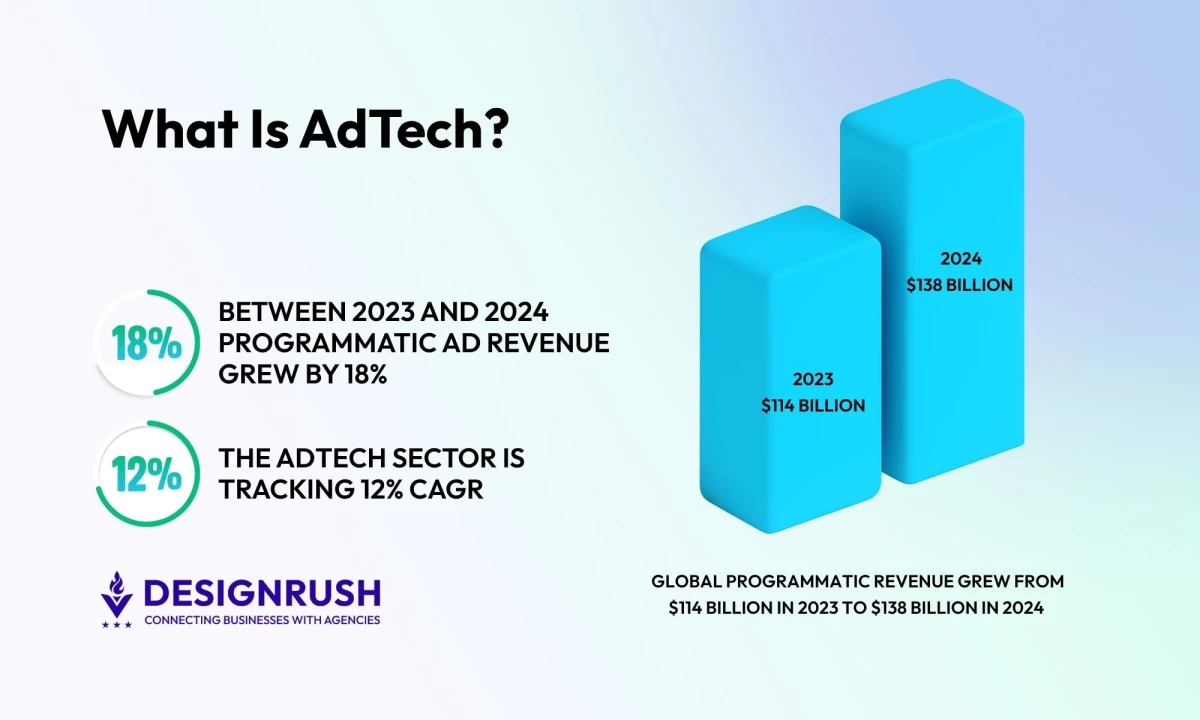

The silent partner behind modern media buying (and your KPIs) is AdTech.
What Is AdTech?: Key Findings
- Results in AdTech come from a proven workflow: DSPs → SSPs → Exchanges → Ad serving & data.
- Leaders are rebuilding AdTech around privacy-first precision, moving from third-party cookies to first-party data, consent, clean rooms, and contextual/cohorts.
- AdTech is scaling fast, tracking 12.2% CAGR to $3.8T by 2035, and programmatic grew 18% in 2024 to $134.8B.
What Is AdTech: Overview
AdTech is the central nervous system of modern marketing campaigns, optimizing the process of buying and selling ads online.
Let's take a closer look at how it works, and why it’s essential for driving campaign performance in a data-driven, privacy-conscious era.
What Is AdTech and Why It Matters
So, what exactly is advertising technology or AdTech? It’s the software and systems used to plan, execute, and measure digital advertising campaigns.
These technologies allow marketers to automate the buying and selling of ad space while using audience data for precise targeting and analyzing performance in real time.
AdTech bridges the gap between advertisers (brands looking to promote products) and publishers (websites, apps, and platforms with ad inventory). The goal is simply to deliver the right message to the right person at the right time, with maximum efficiency.
The secret to AdTech’s value is compounding business outcomes. With a 12.2% CAGR and a projected $3.8 trillion market value by 2035, it’s clear that the companies which make the most of AdTech for better targeting, smarter spend, and cleaner attribution are set to widen their advantage.
The Key Benefits of AdTech
In short, AdTech turns advertising from a guessing game into a measurable science. Here’s why it’s indispensable for your marketing strategy:
- Precision targeting and personalization: AdTech allows advertisers to define audiences using behavioral, demographic, and contextual data, serving personalized messages for better engagement.
- Automation and scale: Campaigns run automatically across multiple platforms and channels to save time while maintaining accuracy and reach.
- Real-time optimization: Algorithms constantly adjust bids, placements, and creative performance for better results, often while campaigns are still live.
- Transparency and measurement: Advanced analytics track impressions, clicks, conversions, and ROI, providing full visibility into what’s working.
- Cross-channel consistency: AdTech unifies messaging across mobile, video, social, and connected TV to give users a seamless experience.
- Data-driven decision making: Insights from AdTech help inform creative strategy, audience expansion, and future campaign investment.
Types of Ad Formats Enabled by AdTech
From mobile apps to CTV and podcasts, AdTech delivers ads wherever your audience is. Each format employs AdTech’s real-time data capabilities to ensure high engagement and measurable impact.
They include:
- Display ads: Traditional banners and static visuals that appear across websites.
- Video ads: Pre-roll, mid-roll, and out-stream placements within streaming or social platforms.
- Mobile ads: Optimized for mobile web or in-app experiences, often location-aware.
- Native ads: Seamlessly integrated into content, matching platform style and tone.
- Connected TV (CTV) ads: Targeted ads delivered via streaming services and over-the-top (OTT) devices.
- Audio ads: Spots played during podcasts or music streams, often paired with data-driven targeting.



Core Components of AdTech
Modern AdTech is a cohesive ecosystem of technologies and ad types. First, we’ll define the parts, then we’ll walk through how they fit together.
- Demand-side platforms (DSPs)
- Supply-side platforms (SSPs)
- Ad exchanges
- Ad networks
- Data platforms (DMPs and CDPs)
- Ad servers
1. Demand-Side Platforms (DSPs)
Software used by advertisers to plan and execute programmatic media buys from a single interface across many sources. DSPs centralize audiences, budgets, creative rotations, pacing, and measurement guardrails in one place.
2. Supply-Side Platforms (SSPs)
Software used by publishers to package and expose their ad inventory to qualified buyers with consistent controls. SSPs centralize yield policies, pricing floors, and access settings while maintaining publisher standards and preferences.
3. Ad Exchanges
Neutral marketplaces that connect buy-side platforms with sell-side platforms under common formats and deal types. Exchanges provide scaled access and standardized pipes for inventory discovery and price discovery across many partners.
4. Ad Networks
Before exchanges became dominant, ad networks aggregated publisher inventory and sold it in bulk to advertisers. Many still operate today, often with a focus on niche audiences or premium placements.
5. Data Platforms (DMPs and CDPs)
Data platforms unify audience and customer data to facilitate targeting and personalization. They can be divided into two categories:
- Data management platforms (DMPs): DMPs aggregate mostly anonymous behavioral and contextual signals to build audience segments for targeting and prospecting. Because they lean on cookies/device IDs, they’re shifting toward contextual and other privacy-safe activation.
- Customer data platforms (CDPs): CDPs unify consented first-party data (CRM, web/app events, purchases) into persistent customer profiles. They enable cross-channel personalization and orchestration while enforcing governance and consent.
6. Ad Servers
Software that stores, selects, and delivers digital ads to the right user, placement, and moment. Ad servers also log impressions, clicks, and conversions, providing the performance data that powers reporting, billing, and campaign optimization.
How AdTech Works for Your Company
AdTech functions through a complex, automated marketplace built on programmatic advertising, the real-time buying and selling of digital ad inventory.
Here’s how it works in four steps:
- Step 1: Plan and activate demand with a DSP
- Step 2: Package and monetize supply with an SSP
- Step 3: Clear price and match buyers/sellers in an exchange
- Step 4: Deliver, measure, and learn via ad servers and data platforms
Step 1: Plan and Activate Demand With a DSP
Advertisers start by using a DSP to set campaign goals, budgets, and target audiences. This is where you translate strategy into targeting, pacing, frequency caps, creative rotations, and measurement rules.
A good DSP setup also defines brand safety, inventory exclusions, deal IDs, and conversion tracking.
For example:
- The Trade Desk lets brands define audiences across display, video, and connected TV, automatically adjusting bids based on performance data.
- Google Display & Video 360 (DV360) allows marketers to unify campaign management and measurement across YouTube, apps, and programmatic display channels.
Step 2: Package and Monetize Supply With an SSP
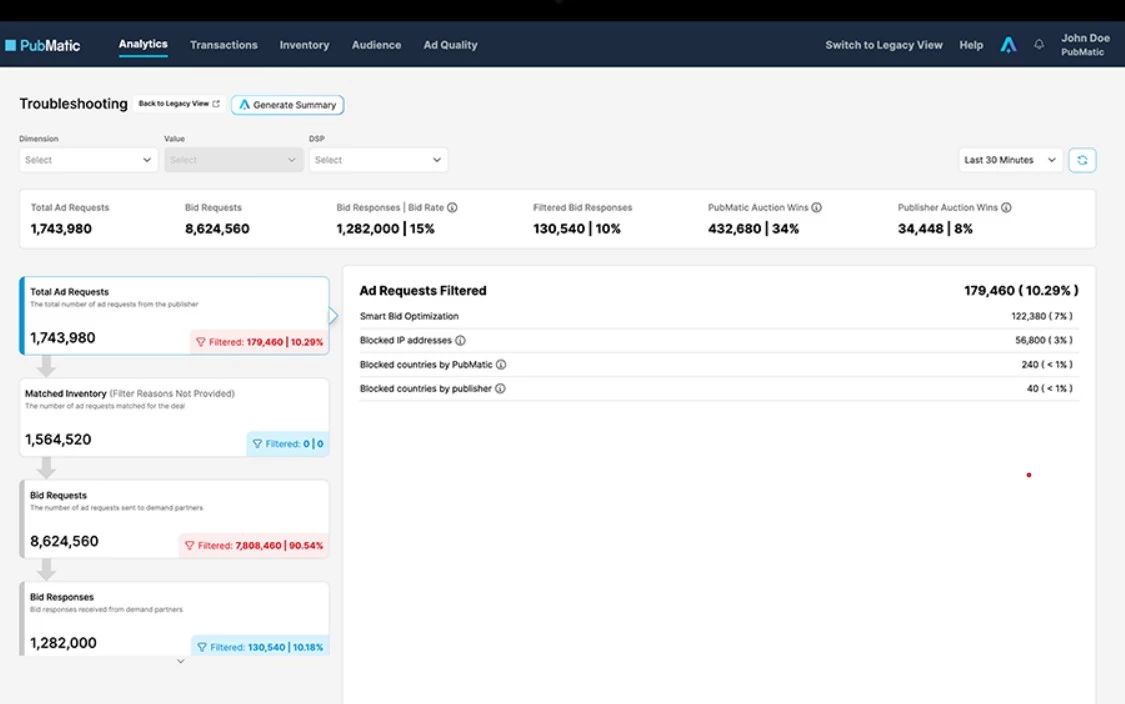
Publishers use an SSP to list their available ad space. Here, publishers manage floors, prioritize demand sources (open auction, PMPs, programmatic guaranteed), and enforce policies (brand safety, category blocks).
For example:
- PubMatic gives media owners the ability to package and sell their premium inventory to multiple DSPs with dynamic pricing controls.
- Magnite gives publishers (especially in CTV and video) tools to manage yield and optimize revenue through automated auctions.
Caution: Overly aggressive floor prices or too many intermediaries can hurt win rates and page latency. Publishers should use supply-path optimization (SPO) to streamline routes to demand.
Step 3: Clear Price and Match Buyers/Sellers in an Exchange
These platforms connect via an ad exchange where RTB happens in milliseconds. The exchange receives bid requests from SSPs, evaluates bids from DSPs, applies auction logic (first/second price, deal priority), and returns the winning creative—all before the page loads or the video starts.
For example:
- Google Ad Exchange (AdX) serves as a marketplace where thousands of advertisers compete for impressions in real time.
- Xandr Marketplace (Microsoft) connects global DSPs and SSPs, supporting advanced targeting and transparency tools.
Step 4: Deliver, Measure, and Learn via Ad Servers and Data Platforms
The winning ad is served to the user through an ad server, which selects the right creative (A/B variants, dynamic creative optimization), logs impressions/clicks, and fires measurement tags.
Data platforms (DMPs/CDPs) provide audience insights and identity resolution to inform bidding and post-campaign analysis.
For example:
- Google Ad Manager acts as both an ad server and exchange, delivering the winning creative while tracking impressions and conversions.
- Adobe Experience Platform (CDP) or Lotame (DMP) feed audience data into bidding algorithms to help advertisers reach users with greater relevance.
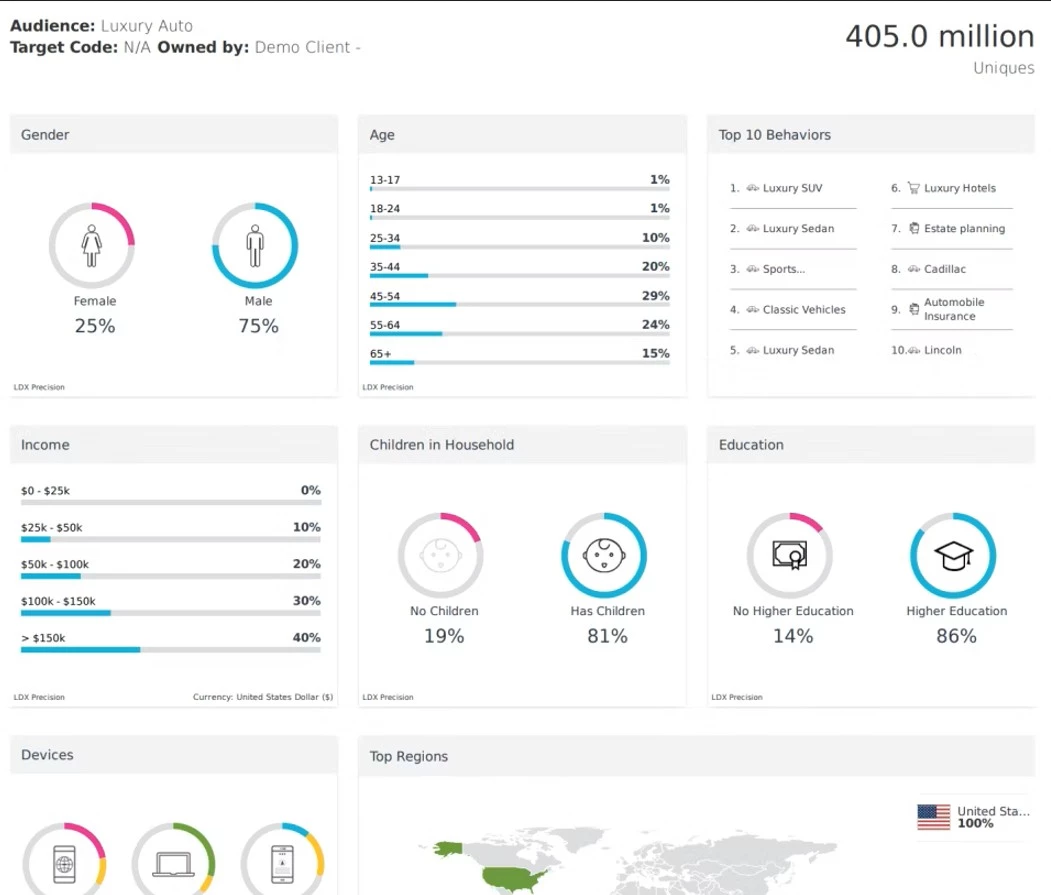
Make it count: Close the loop by pushing verified conversions (including offline/sales CRM data) back into the DSP/CDP. This makes bidding smarter, avoids re-targeting people who already bought, and improves LTV-based targeting.
What the Future Holds for AdTech
Third-party cookies are ending. That, paired with stricter privacy rules, is forcing a rebuild around how data is collected, shared, and activated. The winners will replace invasive tracking with privacy-first precision and prove performance with defensible measurement.
But momentum isn’t slowing while this rebuild happens. In 2024, programmatic revenue still grew by 18% to $134.8 billion, showing marketers are doubling down on automation and measurable outcomes even as the underlying identity fabric changes.
Expect a privacy-first playbook where clean rooms, consent frameworks, and first-party partnerships replace invasive tracking.
Here’s what else to expect:
- AI everywhere: Predictive bidding, creative variation testing, and anomaly detection move optimization from reactive to proactive.
- Retail & commerce media: Closed-loop attribution and on-site audiences push budgets toward retailers, marketplaces, and shoppable formats.
- CTV & streaming: Better identity graphs, frequency control, and SSAI make TV-like reach more accountable and less wasteful.
- Measurement that proves lift: MMM, incrementality tests, and privacy-safe attribution become standard to justify spend across channels.
- Supply-path transparency & sustainability: Simpler routes to inventory (SPO) and greener delivery paths reduce fees, fraud, and carbon.
Paul Turner, general manager of Digital at Deep Sync, expresses optimism about the value AI will be able to unlock for marketers through optimization in a post-cookies future.
“AI will make it easier to process vast quantities of data in an attempt to derive an outcome,” he says.
He adds that the challenge is access to data, as AI requires enough data to learn from.
“That said, we're already seeing data-rich platforms like Meta and Google offer more AI-centric optimization capabilities, which I think will work well for smaller, single-channel marketers.”
What is AdTech: Final Words
AdTech is the operating system for modern marketing. Its next chapter will be about blending data discipline with creative agility using AI, privacy-safe insights, and transparent media paths to make every impression count.

Our team ranks agencies worldwide to help you find a qualified partner. Visit our Agency Directory for the Top Adtech Companies as well as:
What is AdTech FAQs
1. What’s the difference between AdTech and MarTech?
While both use data and automation to improve marketing performance, AdTech focuses on buying, delivering, and measuring paid media (think DSPs, SSPs, and programmatic ads).
MarTech manages owned and earned channels such as CRM, email, and analytics. AdTech drives visibility and acquisition, MarTech nurtures engagement and retention.
2. Why might a strong campaign suddenly plateau?
Over time, the same people see the same ads and tune out, so performance falls even if budgets stay the same. Rotate fresh creative, expand or refresh audiences, test new formats (video/native/CTV), and reset frequency caps so your message stays relevant instead of repetitive.
3. How do I avoid paying for low-quality placements?
Prioritize trusted publishers and private marketplace deals, set brand-safety and suitability controls, and track viewability and attention (not just clicks).
Trim low-quality inventory paths, use allowlists where possible, and keep testing placements that actually drive engaged visits and conversions.