
I’ve watched companies sign agency contracts feeling confident, only to discover months later that they didn’t fully understand what they were handing over.
That’s the risk of signing before you’ve asked the right questions.
The framework below isn’t about being difficult. It’s about protecting control, continuity, and negotiating power before your ad budget is deployed.
Questions to Ask an Ad Agency: Key Findings
- Demand account ownership and full transparency. If you don’t legally own your ad accounts, tracking stack, and data, you’re renting your growth engine.
- Evaluate their thinking under pressure, not just their wins. Ask what their structured process is when performance declines and what they don’t change immediately.
- Make fee structure plain English before you sign. Get a line-by-line breakdown of service fees and confirm whether you pay ad platforms directly.
How To Vet an Ad Agency Like a Long-Term Partner
I’ve seen brilliant ad teams turn small businesses into market leaders.
I’ve also seen agencies burn through six-figure budgets with shallow planning and aimless optimizations.
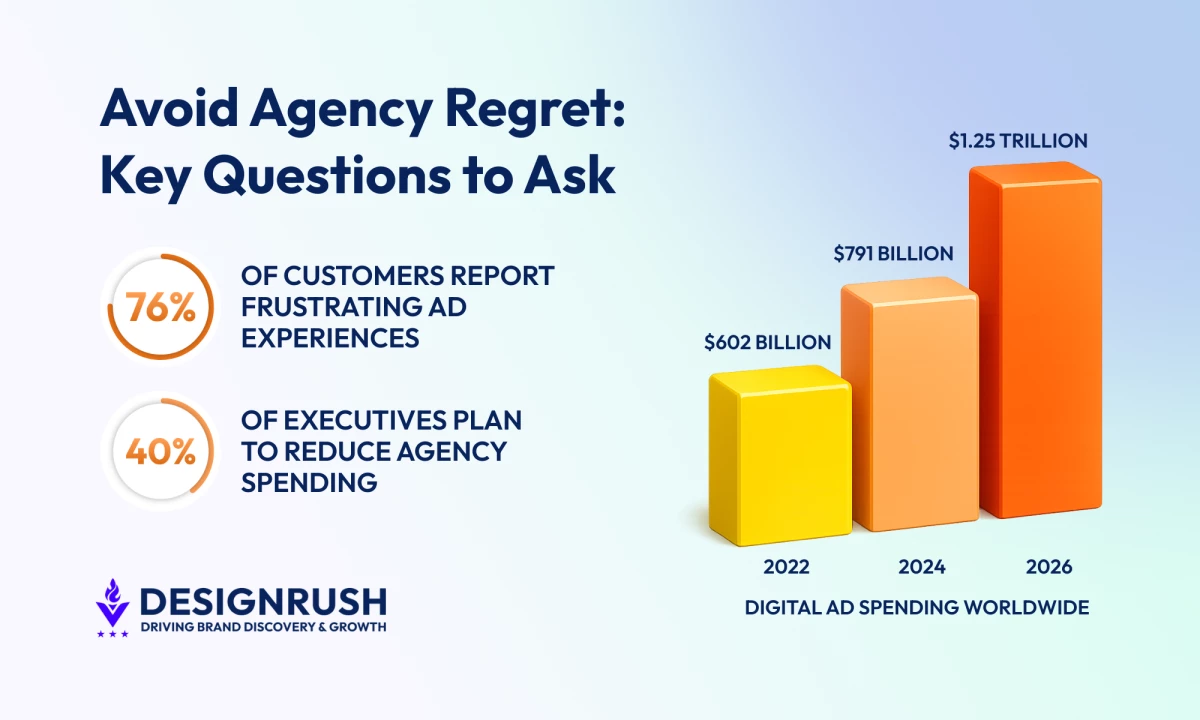
And this isn’t small money we’re talking about. Global ad spending is projected to reach $1.25 trillion by 2026, with search advertising alone nearing $360 billion.
When you’re operating in a market that size, small missteps compound quickly. What’s striking is this: the problems rarely start with bad intentions. They start with unasked questions.
The questions in this guide aren’t theoretical. They’re the ones clients wish they had asked during the vetting stage — before contracts were signed and ad dollars started moving.



1. What Types of Clients Are the Best (and Worst) Fit for Your Agency?
Not every agency is built for every business, and a mismatch doesn’t just waste money. It burns time, momentum, and internal trust.
Industry matters too — some agencies are genuinely sharper in certain verticals, and you want them to admit that.
A strong answer here tells you how self-aware the agency is. The best partners are candid about who they can win for, and just as candid about what tends to stall performance.
Ideal answer:
“We do our best work with clients who have clear goals and KPIs, make timely decisions, commit enough budget to learn, and can collaborate on creative, tracking, and landing pages.
When we’ve ended relationships, it’s usually because expectations weren’t aligned, approvals were slow, or the budget couldn’t support effective testing.”
What to watch for (nice-sounding lines that dodge the real question):
These phrases aren’t always deal-breakers, but they’re often a sign you’re not getting specifics:
- “We can work with anyone.” Usually means they haven’t defined their strengths, or they’ll say yes to anything.
- “We’re very flexible.” Flexibility is good, but ask: flexible how? Process, scope, strategy, accountability?
- “We have experience in lots of industries.” Fine, but press for: What have you done that’s closest to our model, margins, and sales cycle?
2. What Work Is Done In-House vs. Outsourced?
The real question isn’t whether agencies ever outsource — it’s whether they’re transparent about it, and if there’s a clean system for quality control when outside hands touch your account.
I always ask for a clear map of what’s handled by an agency's internal team vs. partners or contractors. Because if it turns out three different vendors are involved, brand messaging gets inconsistent and accountability gets fuzzy.
Ask who their partners are, what those partners actually do, and who owns the outcome. If the answer is vague, you may be hiring a chain of handoffs.
Ideal answer:
“Our core team handles strategy, day-to-day paid media management, creative direction/production, and reporting. For specialized work like influencer or advanced CRO, we use work with vetted partners.
We use a defined QA checklist before anything goes live, run milestone reviews, and keep reporting centralized so performance and deadlines don’t get fragmented.”
What to watch for:
- “We have partners we bring in when needed.” Who are they, how long have you worked with them, and who manages them day-to-day?
- “We outsource occasionally; it depends.” Depends on what? Ask for the conditions that trigger outsourcing and which work is most commonly outsourced.
- “We’ve got a bench.” A bench of who? Employees, freelancers, overseas teams? What’s the review process and turnaround expectations?
3. How Do You Learn Our Business Before Spending?
I judge agencies by what they want to understand before they spend real money. I need proof they’ll build a plan that fits reality:
- Unit economics (margin, LTV, CAC targets, payback window)
- Constraints (capacity, inventory, seasonality)
- The path to revenue (how leads convert, who closes, what the lag time looks like)
I also want to hear the prerequisites they require: tracking integrity, offer clarity, landing page basics, and a functioning sales follow-up process.
If they can’t clearly tell you what they need to understand before spending, you’ll end up paying for them to figure it out on your dime.
Ideal answer:
“Our structured discovery includes margins/LTV/payback targets, your sales cycle, seasonality, and any operational constraints. We’ll also audit tracking (GA4/GTM, pixels, conversion events) and walk the funnel from ads to closed leads.
If key pieces aren’t in place, we’ll flag it and recommend fixes before we finalize the budget.”
What to watch for:
- “We’ll learn as we go.” Translation: you’re paying for discovery through ad spend.
- “We have a proven framework; we’ll plug you into it.” Frameworks are fine. “Plug-and-play” usually means they haven’t looked at your specific margins, sales cycle, or constraints.
- “Let’s start with traffic and see what happens.” That’s not a strategy. It’s spending money to collect surprises.
4. Who’s Actually Running This?
The “bait-and-switch” concern is real: you meet the A-team during the pitch, but then the day-to-day work lands with junior staff or a rotating cast of contractors.
That’s not automatically bad — I’ve seen juniors outperform seniors — but only when there’s clear ownership and real oversight.
And it matters more than ever. Gartner’s CMO Spend research shows 39% of CMOs plan to cut agency budgets, and underperforming partners are getting trimmed. Upfront clarity on who runs your account is essential.
When I ask this question, I’m looking for three things:
- Who’s doing the work (and how experienced they are)
- How thin they’re spread (how many accounts they’re carrying)
- What happens when something breaks (continuity + escalation)
Ideal answer:
“Here’s your team: their names, roles, and what each person owns. We’ll tell you upfront if we use contractors, what they do, and who QC’s their work.
If a key person leaves or gets reassigned, we have a documented handoff process, a backup lead already briefed, and we’ll introduce them immediately.”
What to watch for:
- “You’ll have access to our whole team.” Sounds great, usually means no single owner. Ask: Who is accountable for results?
- “We staff based on availability.” Translation: your account gets whoever isn’t busy.
- “We’ll introduce the team after kickoff.” Push to meet the actual delivery leads before you sign.
5. Do We Own the Accounts and Do We Have Full Access?
I’ve seen the same horror story pop up repeatedly: businesses take over an ad program and find Google Ads, Analytics, or Tag Manager effectively held hostage by the previous agency. Sometimes access doesn’t come back until a final invoice is paid.
The worst setup is a black box: you can see some numbers in Analytics, but you can’t access the actual ad accounts, audiences, settings, or conversion setup, so you’re forced to trust screenshots and dashboards.
If the agency owns the accounts, you can lose years of learning and structure and end up rebuilding from scratch. What I ask is simple (and non-negotiable):
- Will our business be the legal owner/admin of every ad account and core asset from day one (Google/Meta/LinkedIn/TikTok, billing, pixels/tags, GA4, GTM, Merchant Center, call tracking, dashboards)?
- What access do we get by role? Can we see spend, settings, audiences, conversion setup, and change history anytime?
- Do you require running anything through agency-owned accounts? If yes, why? What do we lose by doing it that way?
Ideal answer:
“Everything is built under your business and stays under your business.
We access accounts through the proper manager/business tools, and your team has admin access to the full stack. You’ll be able to see what we see in-platform anytime.”
What to watch for:
- “Don’t worry, we’ll send reports.” Reporting is not transparency. How will you know the data they’re reporting is accurate if you can’t see the account?
- “We run campaigns from our agency accounts, it’s easier.” Easier for them, risky for you. That’s how companies end up worrying about losing history when they switch.
- “We can’t give admin access for security reasons.” There are clean ways to do this properly without compromising security.
6. What’s the 90-Day Plan?
If I’m signing a retainer, I’m buying a clear rollout with deadlines, owners, and real deliverables.
The first 90 days tell you almost everything about how an agency operates: whether they move with discipline, whether they can prioritize, and whether they can separate learning from noise.
Ideal answer:
First 30 days: Finalize objectives and guardrails, audit/tighten tracking, confirm conversion events, build account structure + reporting baseline, launch initial campaigns, and start a documented testing roadmap (creative angles, audiences, offers).
By day 60: Identify what’s working (and what isn’t) with real evidence, scale early winners, refresh creative, and fix landing page or funnel bottlenecks that are limiting performance.
By day 90: Deliver a scale plan tied to unit economics, budget allocation by channel, next test plan, and a forecast based on observed results, plus a clear list of what you need from our team to keep momentum.
What to watch for:
- “We don’t like to over-plan, we stay agile.” Agility without milestones usually turns into drift, delays, and reactive changes.
- “The first 90 days are mostly learning.” True, but learning still needs structure: hypotheses, test plans, and documented decisions.
- “We can’t commit to deliverables because performance depends on the market.” Performance varies. Execution milestones shouldn’t.
7. How Do You Prove Real Results?
When I ask this question, I’m listening for three things:
- How they handle attribution reality (multi-touch, lag time, offline conversions, messy data)
- Whether they understand incrementality (what actually changed because of ads vs. what would’ve happened anyway)
- How they separate signal from noise (learning periods, seasonality, creative cycles, budget shifts, small sample sizes)
The classic complaint seen online is the same: rigid packages, vague methodology, and a “trust me” strategy that never gets specific about why they think something will work.
If they don’t have strong answers, you’re about to get a templated playbook and a lot of confident narration.
Ideal answer:
“We expect discrepancies, and we have a process to reconcile them.
We’ll document a working hypothesis and define what would prove it wrong. If tracking is incomplete or CRM data is delayed, we’ll be explicit about what we can and can’t claim, prioritize fixes, and avoid scaling on shaky signals.
When the budget and volume justify it, we’ll use incrementality testing to validate what’s truly driving growth, not just what a platform is willing to take credit for.”
What to watch for:
- “We optimize to ROAS.” ROAS without margin, LTV, and payback context can still be unprofitable growth.
- “Our dashboard will show everything.” A dashboard is presentation. The question is how they resolve conflicting sources of truth.
- “We’ve got a proven system we roll out for everyone.” Systems are good. One-size-fits-all strategy is not. Ask what changes based on your margins, sales cycle, and constraints.
8. Show Me How Your Fees Really Work
This is where a lot of businesses get burned, not because the agency was dishonest, but because the fee model was never made plain English.
Then six months in, you realize you’re paying for a retainer, a markup, a stack of tools you didn’t approve, and nobody can explain what’s pass-through versus profit.
What I ask (before signing):
- Do we pay the platforms directly, or do you bill us?
- What is pass-through vs. service fee — line by line?
- Where can markups show up (media, creative production, tools, contractors, data fees)?
Ideal answer:
“We recommend clients pay platforms directly whenever possible. Our compensation is a clearly stated monthly service fee for management and strategy.
Any third-party costs (creative production, tools, contractors, data fees) are pre-approved in writing and billed at cost with receipts, unless we explicitly agree to a separate fixed fee for that work. You’ll have full visibility into invoices and, if needed, audit rights.”
What to watch for:
- “We’ll just roll everything into one simple number.” Simple for them, risky for you. Ask what’s included, what’s pass-through, and what can change.
- “We manage billing to make it easier.” Sometimes legitimate. Sometimes how markups and hidden fees creep in. Ask for a clean breakdown.
- “We can’t share that level of detail; it’s proprietary.” A fee breakdown isn’t proprietary. It’s table stakes.
9. What Happens When Performance Dips?
Performance always dips. The only question is whether your agency has a real system for diagnosing it. When I ask this, I’m looking for how they think under pressure.
Do they have a consistent way to isolate root causes? Do they know when to hold steady to let data mature, and when to intervene fast before you bleed cash? Do they have a creative pipeline, so you’re not running the same few ads into the ground?
Ideal answer:
“We don’t make ten changes at once. We prioritize the most likely drivers, make controlled adjustments, and document what changed and why.
On creative, we run an ongoing pipeline — new angles every month, planned refresh cadence, and structured tests — so performance isn’t dependent on one ‘winner’ ad.
When something works, we scale it responsibly; when it stops working, we know what to try next.”
What to watch for:
- “The algorithm needs time.” True in moderation. But it can also be a convenient excuse for not having a plan.
- “We’ll just test more creative.” Sometimes the right move, but sometimes a cover for not understanding the real bottleneck (tracking, offer, LP, audience).
- “We’ll tweak targeting and bids until it comes back.” That’s not a method; that’s knob-turning.
10. What Does a Clean Exit Look Like?
This is the question nobody wants to ask on the first call, and it’s the one that saves you the most pain later.
When agency relationships end, handoff can turn into chaos: No documentation. No account map. Hidden dependencies on the agency’s tools, scripts, dashboards, or call tracking numbers.
Everyone’s scrambling, performance drops, and you’re rebuilding things you assumed you already owned.
What I ask (before signing):
- What’s the minimum term, renewal language (especially auto-renew), and notice period?
- If service levels slip, what are the exit conditions, and are they written plainly in the agreement?
- If we’re unhappy in month two, what’s the cleanest way to unwind this without lighting money on fire?
- What does offboarding include in writing, and what timelines do you commit to?
Ideal answer:
“Offboarding is documented and included. Within X business days, you receive an offboarding packet: account access list, naming conventions, UTM framework, conversion setup documentation, reporting definitions, and the creative files produced.
We also disclose any tools, scripts, automations, landing pages, dashboards, or numbers that would be impacted if you stopped paying us, so nothing breaks unexpectedly.”
What to watch for:
- “We have a standard 12-month agreement.” Standard for them doesn’t mean smart for you. Ask what flexibility exists and why the term is that long.
- “It’s month-to-month, but…” Watch for “but” (hidden notice periods, minimum spend commitments, or early termination fees).
- “We use our own tools/dashboards to run things efficiently.” Fine, but what breaks if you stop paying? Get that inventory upfront.
Questions To Ask an Advertising Agency: Final Thoughts
Ask hard questions upfront. The right agency won’t be defensive; they’ll be happy to provide precise answers.
That precision is usually the difference between scalable partnership and expensive regret.
Find More Agency Hiring Resources:
1. In-House Marketing vs. Agency: Key Pros and Cons
2. Digital Marketing Objectives That Drive Real Business Outcomes
3. How To Onboard A Digital Marketing Agency
Treat the vetting process like due diligence, not a formality. The clarity you demand now protects every dollar you spend later.
Our team ranks agencies worldwide to help you find a qualified partner. Visit our Agency Directory to find top-rated advertising agencies, as well as:
- Top Small Business Advertising Companies
- Top Digital Marketing Agencies
- Top Branding Agencies
- Top Creative Agencies
- Top Media Buying Agencies
Questions To Ask an Advertising Agency FAQs
1. Do ad agencies guarantee performance?
Be wary of guarantees — reputable agencies usually set realistic KPIs linked to performance data, not blanket promises.
2. How can we maintain a strong long-term relationship with our advertising agency?
Treat the agency like a strategic partner, not a vendor. Share margin data, sales feedback, and shifting business priorities regularly. Set clear KPIs, review performance consistently, address issues early, and revisit goals quarterly to keep strategy aligned with growth.
3. How involved should my internal team be?
More than you think. Agencies need access to sales data, margin info, product constraints, and real feedback loops. Treat it like collaboration, not delegation.
4. Can a smaller agency outperform a large one?
Absolutely. Smaller teams often provide stronger focus and accountability. What matters is ownership clarity, workload distribution, and documented process.