
A truly effective advertising agency builds a structured strategy, executes creative campaigns, measures results, and continuously improves performance.
Good Advertising Agency Qualities: Key Findings
- The most effective advertising agencies act as strategic partners rather than task-based vendors, aligning campaigns with broader business goals such as growth, positioning, and market share.
- High-performing agencies combine strategy, audience insight, measurement, and continuous experimentation to improve campaign results over time rather than relying on one-off creative executions.
- 45% of marketers still struggle with measurement and 40% say proving ROI across channels is their biggest difficulty, highlighting the need for agencies that can clearly track performance.
What Makes a Good Advertising Agency?
Choosing an advertising agency is a high-impact decision for businesses. Because advertising campaigns often involve considerable budgets, the right partner can transform that investment into sustainable brand growth.
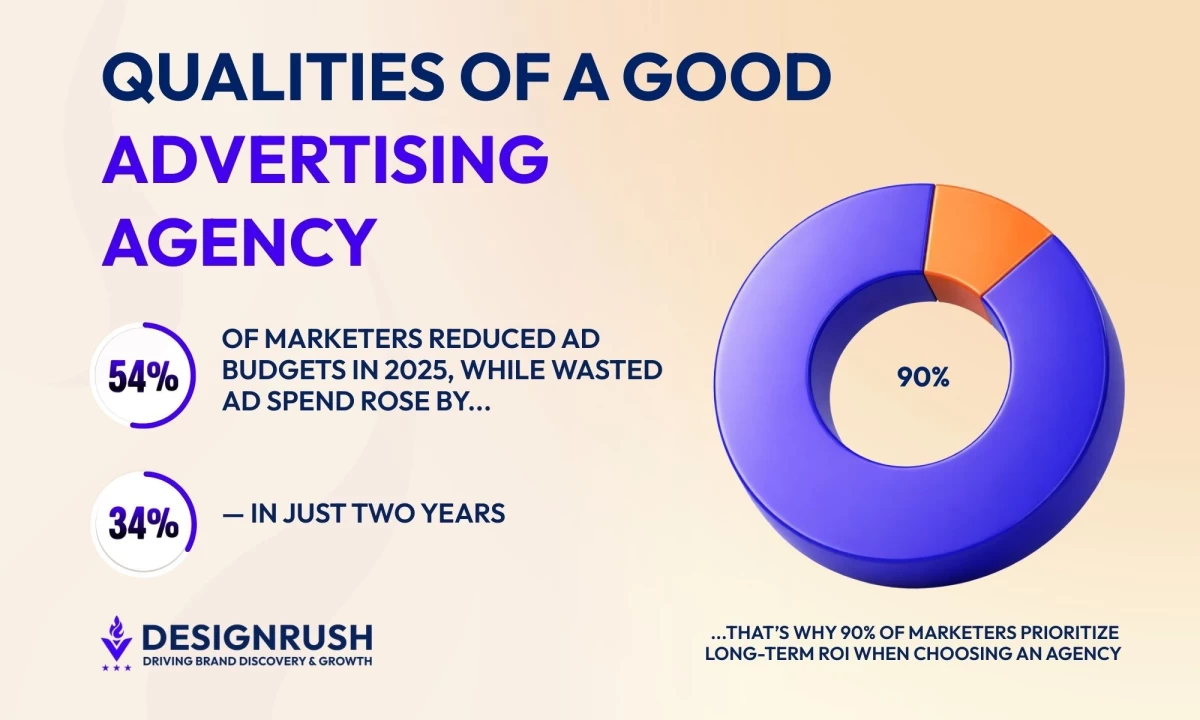
Ninety percent of marketers prioritize the value and long-term ROI an agency delivers over cost when choosing a partner, and today’s economic climate is forcing businesses to be more strategic with their investments.
Nielsen’s 2025 Annual Marketing Report found that 54% of global marketers were planning to reduce advertising spend. That shows how tightening budgets are pushing companies to demand more efficient, data-driven campaigns.
Businesses are increasingly looking for advertising agencies that can deliver smarter strategies that turn every advertising dollar into measurable impact.
The following qualities will help you determine whether an advertising agency is truly capable of delivering meaningful results.
1. They Start With Business Problems, Not Ad Formats
Weak agencies ask: “Do you want a video campaign or social ads?”
Good agencies ask: “What business problem are we solving?”
A great advertising agency begins with strategy and business context before thinking about creative execution. They want to understand revenue goals, margins, customer behavior, and competitive pressures before proposing any campaign.
Take note: If the first conversation is about deliverables instead of outcomes, that’s usually a red flag.
A good agency knows that advertising is just one small part of a broader business system. Sometimes the real issue isn’t awareness but positioning, pricing, or conversion friction. When agencies start with the business problem, they can design campaigns that actually influence growth.



2. They Understand the Industry and Category
Every business category has its own competitive dynamics, customer expectations, regulatory constraints, and buying behaviors.
Good agencies invest time in understanding the client’s industry so they can identify:
- How competitors position themselves
- What messaging customers already see constantly
- Where opportunities for differentiation exist
- Which channels and tactics actually work in that category
Without this context, campaigns often become generic and ineffective.
Great agencies develop category insight, not just creative ideas. They analyze how the market communicates so they can find white space rather than repeating the same claims competitors already make.
“If an agency partner can’t align the data with the needs of the audience, then it calls all their work into question,” says Gavin Johnston, director of UX research at Hyatt Hotels.
The needs of engineers are different for those of the C-Suite, he adds. “Know how your audience thinks, what jibes with them, and tell a story that will drive action," he advises.
A simple way to spot category expertise is whether an agency asks questions like these early in the relationship:
| Category Question | Why it Matters |
| Who are the real competitors? | Competitive positioning shapes messaging strategy. |
| How do customers currently buy? | Purchase journeys influence channel choices. |
| What claims are overused in this category? | Differentiation requires avoiding familiar messaging. |
| What regulatory or compliance limits exist? | Especially important in finance, healthcare, and regulated industries. |
3. They Define Success Clearly and Measure What Matters
Many less competent agencies use vague metrics like “engagement” or “brand lift” to obfuscate the actual numbers. In fact, 45% of marketers say they struggle with measurement, and 40% say proving ROI across channels is their biggest challenge.
A good agency, on the other hand, is comfortable connecting campaigns to measurable business outcomes and analyzing performance with real data.
Practically speaking, they will:
- Define success before a campaign launches
- Track meaningful KPIs
- Adjust campaigns based on results
Experienced agencies also understand that not all advertising produces immediate returns. Some campaigns build long-term brand equity while others drive short-term conversions.
Your agency should help you understand these differences and build measurement frameworks that reflect both immediate and long-term impact.
4. They Build a Deep Understanding of the Target Audience
A good advertising agency puts in the effort to develop a deep understanding of the target audience: their motivations, fears, habits, and context.
They don't rely on surface demographics like age, denger and income.
Instead, they look for insights such as:
- Why customers hesitate
- What triggers purchase decisions
- What messaging competitors are ignoring
Agencies that invest in research can uncover motivations and barriers that dramatically improve the relevance and persuasive power of their messaging.
In practice, this means going beyond surface-level market research with approaches that include:
- Customer interviews and qualitative research to understand the language customers use, their frustrations, and the factors that influence purchase decisions.
- Customer journey analysis to identify where people hesitate, drop off, or need additional reassurance before converting.
- Behavioral data analysis from analytics platforms, CRM systems, and advertising platforms to see what users actually do rather than what they say they do.
- Message and creative testing (A/B testing, concept testing, landing page experiments) to validate which ideas resonate most strongly with the audience.
- Competitive messaging audits to identify patterns in how competitors position themselves and uncover opportunities for differentiation.
The resulting insights make it possible to craft messaging that addresses real objections, highlights meaningful benefits, and connects with customers in a way that feels authentic.
5. They Push Back (Respectfully)
The best agencies are not order-takers. They challenge weak ideas, question assumptions, and occasionally say “this won’t work.”
Healthy agency-client relationships involve debate and collaboration because breakthrough ideas often emerge when assumptions are challenged. An agency that agrees with everything you say may be prioritizing the relationship over the results.
The key difference is how that pushback happens. A good agency will challenge ideas using evidence, audience insight, and strategic reasoning rather than ego or creative preference.
In practice, constructive pushback often looks like this:
| Weak Agency Behavior | Strong Agency Behavior |
| Executes whatever the client requests | Explains why an idea may not work |
| Avoids difficult conversations | Raises concerns early and clearly |
| Focuses on preserving the relationship | Focuses on achieving better results |
| Defends creative ideas emotionally | Supports recommendations with strategy and data |
6. They Operate Like a Partner, Not a Vendor
A common complaint businesses have about agencies is that they operate like vendors fulfilling requests instead of partners invested in the company’s success.
A vendor executes tasks, but a partner shares responsibility for the actual outcomes.
Good ad agencies feel more like an extension of your own team. They invest time in understanding the broader business so their recommendations a based on real strategic priorities instead of isolated campaign goals.
That means they:
- Learn the client’s industry and competitive environment
- Understand the company’s economics and growth objectives
- Think long-term about brand positioning and market share
- Proactively bring new ideas, insights, and opportunities
This thinking also goes to the heart of decision-making. Instead of just delivering what was requested, ad agencies should help clients weigh trade-offs, prioritize initiatives, and allocate budgets more effectively.
That deeper integration eventually allows the agency to identify opportunities that might otherwise be missed, like shifting budget toward higher-performing channels, refining messaging based on customer behavior, or spotting emerging market trends.
A partnership is more collaborative, which improves the quality of strategic thinking, and the work follows.
7. They Are Transparent About Data, Fees, and Media Buying
Transparency is one of the clearest signs of a trustworthy advertising agency.
Consider that wasted programmatic advertising spend has increased 34% in just two years, rising from $20 billion in 2023 to $26.8 billion globally. That shows how tough it can be to track where budgets actually go.
To help clients protect and optimize their advertising investments, a good ad agency will provide:
- Clear reporting
- Direct access to performance data
- Full transparency in how media budgets are allocated
Because advertising budgets often pass through multiple platforms, tools, and intermediaries, agencies should remove any ambiguity by making campaign performance and spending easy to understand.
In practice, that means openly sharing:
- Full campaign performance data — not just summary dashboards
- The strategic reasoning behind media plans and budget allocations
- A clear breakdown of how advertising spend is distributed across platforms and channels
8. They Understand the Full Customer Journey (Not Just the Ad)
Businesses often find that campaigns generate traffic, but the results never materialize. The problem isn’t the ad itself, but what happens after someone clicks.
Many agencies focus narrowly on impressions, clicks, or creative performance, while ignoring the broader customer journey. In reality, the vast majority of people who click on ads never take the desired action, with the median landing page conversion rate across industries being about 6.6%.
An ad’s effectiveness depends on the entire path to purchase. Strong agencies evaluate the full conversion environment, including:
- Landing page clarity and message alignment
- Friction in forms, checkout processes, or booking flows
- Mobile usability and page speed
- Whether the offer actually matches customer intent
Even well-targeted advertising can underperform if the landing experience creates hesitation or confusion. A small improvement in conversion rate often produces a larger business impact than increasing traffic alone.
Michael McGoldrick, Global Vice President of Marketing at pharosIQ, explains that when you’re tracking performance at every stage of the funnel, “you can adapt campaigns dynamically, reallocating budget toward what’s working and away from what’s not”.
Treating advertising as part of a larger conversion system lets agencies examine how traffic moves through the funnel, identify points of friction, and work with clients to improve the overall path to purchase.
9. They Continuously Experiment and Adapt
What works well today may perform very differently six months from now as algorithms evolve, competition increases, and consumer attention shifts.
A good agency knows effective advertising requires continuous learning. They treat campaigns as ongoing experiments designed to uncover better-performing strategies over time.
In practice, this means running structured tests such as A/B testing creatives, messaging, and targeting approaches.
A structure approach to ad testing would cover the following:
| Testing Area | What Agencies Should Test | Why It Matters |
| Creative variations |
| Small creative changes often produce large performance differences |
| Audience targeting |
| Expands reach and identifies higher-converting users |
| Messaging angles |
| Reveals which benefits resonate most with customers |
| Channel mix |
| Ensures budgets are allocated to the most effective channels |
| Landing experiences |
| Improves conversion rates after the click |
Good agencies run controlled experiments, iterate creative assets quickly, and analyze campaign performance in near real time. They then apply these insights in the next round of improvements.
10. Senior Expertise Is Involved in the Work
In a poorly run agency, senior leaders pitch the work but junior staff handle the account afterward.
While junior team members often play an important role in campaign execution, a good ad agency ensures experienced strategists and specialists remain actively involved throughout the engagement, especially the strategy, optimization, and any major decisions.
Clients should know:
- Who is responsible for the overall strategy
- Who is managing day-to-day campaigns
- Who they can speak to when important decisions arise
This clarity helps prevent miscommunication and ensures accountability within the agency team.
Senior expertise matters because experienced professionals have seen more campaigns, more market cycles, and more performance data. They are often better equipped to spot risks early, identify opportunities, and make informed strategic adjustments when campaigns need to evolve.
The result is better judgment, faster problem solving, and stronger strategic thinking — all of which contribute to more effective advertising outcomes.
Qualities of a Good Advertising Agency: Final Thoughts
The best agencies welcome thoughtful scrutiny and are comfortable explaining their strategy, their pricing model, how they measure success, and how they plan to improve results over time.
Look beyond presentations and portfolios and evaluate how the agency thinks, communicates, and approaches your business challenges. Approaching the hiring process with clarity will prevent misalignment later, and help to make the most of your ad budget.
More Agency Hiring Resources
If you're evaluating marketing partners, these related guides can help you make more informed decisions:
- Questions to Ask an Ad Agency
- In-House Marketing vs. Agency: Key Pros and Cons
- How To Onboard A Digital Marketing Agency

Our team ranks agencies worldwide to help you find a qualified partner. Visit our Agency Directory to find top-rated advertising agencies, as well as:
- Top Small Business Advertising Companies
- Top Digital Marketing Agencies
- Top Branding Agencies
- Top Creative Agencies
- Top Orlando Advertising Agencies
Qualities of a Good Advertising Agency FAQs
1. How long does it typically take to see results from an advertising campaign?
The timeline depends on the type of campaign and the goals involved. Performance campaigns focused on lead generation or direct sales can sometimes show measurable results within a few weeks.
Brand-building campaigns, however, often take several months to influence awareness, consideration, and market perception.
2. Should businesses choose a specialized advertising agency or a full-service agency?
The right choice depends on the company’s needs. Specialized agencies can offer deep expertise in specific areas like paid search, social media advertising, or creative production. Full-service agencies provide broader strategic coordination across multiple channels.
Companies with complex campaigns often benefit from agencies that can integrate strategy, creative, and media planning under one umbrella.
3. What warning signs should businesses watch for when evaluating agencies?
Some red flags include vague reporting, unclear pricing structures, an overemphasis on vanity metrics, or agencies that promise guaranteed results.
Be careful if an agency avoids discussing measurement, data access, or the strategic reasoning behind its recommendations.
4. What information should businesses prepare before hiring an advertising agency?
Providing clear context helps agencies develop better strategies. Be ready to share business goals, target audiences, competitive landscape, previous campaign results, and budget ranges.
The more insight an agency has into the business, the more effective its recommendations will be.
5. How involved should a business be after hiring an advertising agency?
Successful campaigns involve ongoing collaboration. While agencies handle execution and optimization, businesses still play an important role in sharing customer insights, reviewing strategy, and aligning marketing efforts with broader company priorities.
The strongest partnerships involve regular communication and shared decision-making.
6. How often should a business review its relationship with an advertising agency?
Many companies conduct formal performance reviews quarterly or annually to evaluate campaign outcomes, communication quality, and strategic alignment.
Regular reviews help ensure both sides remain focused on measurable results and provide an opportunity to adjust strategies as market conditions change.