
Key Findings
- Agencies that diversify client acquisition channels see a 31% increase in leads, highlighting the importance of moving beyond referrals for predictable growth.
- Before hiring or expanding your client base, standardize service delivery and invest in tools that support scale. Chaos at five clients becomes collapse at fifteen.
- Build a documented sales process to improve conversion rates. This allows revenue growth without overreliance on one salesperson or founder hustle.
The transition from boutique to powerhouse is about building an agency that can scale sustainably while delivering consistent value chasing vanity metrics. In this guide, we’ll walk through the key pillars of agency scaling.


Avoid Common Scaling Pitfalls and Challenges
 Scaling your agency is an exciting milestone, but it’s also where things can start to go sideways. The same qualities that helped you grow as a boutique shop (like flexibility, speed, and a hands-on approach) can become liabilities at scale if you don’t adapt.
And it’s not a matter of simply hiring more people or taking on bigger clients. It’s about redesigning how your agency operates so it can grow without breaking. And that transition isn’t always smooth. Many agencies face a set of predictable (but avoidable) challenges that can slow progress or even send things into reverse.
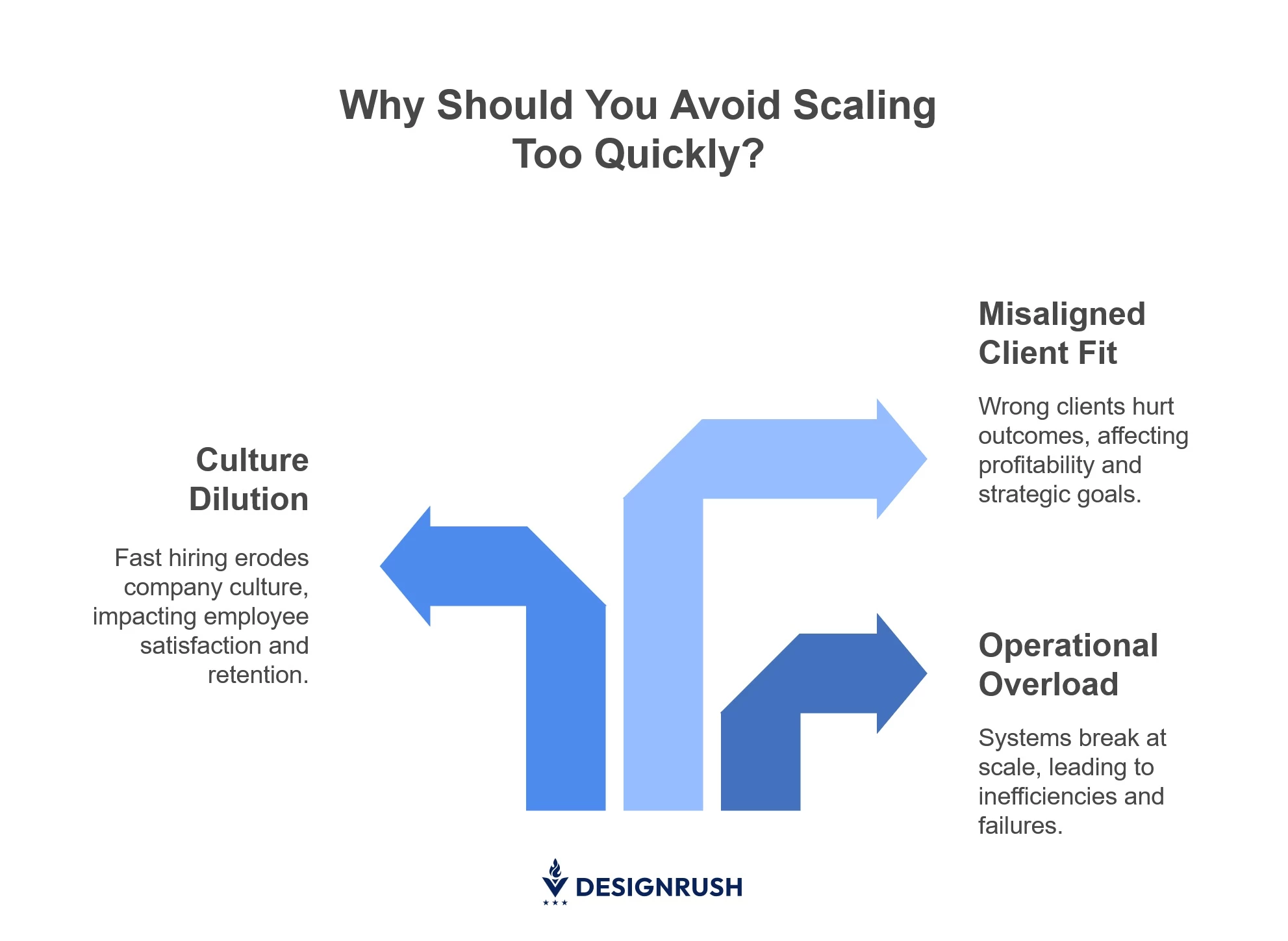
Before you scale, know what you're up against. Here are three common pitfalls to watch out for (and how to avoid them):
- Operational overload: More clients and larger projects expose weak or inconsistent systems. What worked for five clients may break down at fifteen when communication gaps, unclear ownership, and delivery bottlenecks start compounding. Growth adds friction instead of momentum if you lack scalable infrastructure.
- Culture dilution: Growth often requires hiring fast, and in that rush, it becomes harder to preserve the culture that set your agency apart. New hires may not understand your values, expectations shift, and internal alignment starts to fray. The result? Lower morale, less cohesion, and ultimately, reduced quality.
- Misaligned client fit: When revenue targets dominate decision-making, it’s tempting to say yes to any opportunity. But clients that aren’t aligned with your values, expertise, or way of working can lead to scope creep, strained teams, and diminished outcomes. Scaling successfully means getting more selective, not less.
So how do you avoid these traps and scale without losing what makes your agency great? It starts with taking a different approach.
Evaluate Growth Potential: Is Your Agency Ready to Scale?
Scaling before you're ready can create more problems than it solves. But when the foundation is solid, growth becomes sustainable, even energizing. Use this checklist to assess whether your agency is truly built for scale:
☐ Operational maturity: You’ve moved past duct-taped processes and one-person heroics. Your services are delivered through repeatable, documented workflows. Roles and responsibilities are clearly defined, and no single person is a bottleneck. You’ve created operational breathing room that allows for growth without chaos.
☐ Leadership bandwidth: Your leadership team isn't stuck in the weeds — they have the space to focus on strategy, hiring, client success, and innovation. If they’re constantly in “doer mode,” scaling will only add strain. Real scale requires leaders who can think and plan ahead.
☐ Consistent client demand: You’re regularly turning away projects, booking out well in advance, or operating near full capacity. This is a clear market signal that demand exceeds your current supply and it’s time to consider how to expand without sacrificing quality.
☐ Team alignment: Your team knows the mission, understands who your ideal clients are, and sees how their work contributes to the agency’s bigger goals. They’re executing with clarity and intention, not just reacting.
☐ Financial stability: You have predictable cash flow, healthy profit margins, and some financial reserves. You’re not constantly scrambling to cover expenses. Financial visibility and control are key to managing the risks of growth.
☐ Service clarity: You have a clearly defined set of offerings that your team can articulate — and that clients understand. You’ve moved beyond “we do everything” to a focused service model that’s easy to sell, staff, and scale.
☐ Client retention: Your existing clients are sticking around and even referring others. You’re not constantly replacing lost accounts. High retention is a sign your agency is delivering real value and has a strong foundation for growth.
When Not To Scale
Just as important are the signs that it would be better to wait before scaling just yet. Use this checklist to assess:
☐ Inconsistent cash flow: Revenue is unpredictable and you're constantly juggling expenses, adding more overhead will only compound the risk.
☐ High client churn: You’re losing clients faster than you can replace them.
☐ Unclear service offerings: Your team or clients are unsure about what exactly you do (or don’t do).
☐ Founder burnout: The founder is already stretched thin, and adding more clients, team members, and responsibilities may lead to faster burnout.
Scaling won’t fix these issues — it will only make them worse.
Laying the Groundwork for Scale
Scaling successfully starts with tightening your internal operations and refining your service model. This is where many agencies either set themselves up for success or build a machine that breaks under pressure.
“Creative businesses often scale without solid systems in place — and that’s what breaks them," says Andreja Zujkovic, founder of Icefyre Solutions, in a discussion on the importance of efficiency for any agency looking to scale. He explains that scaling successfully starts with tightening your internal operations and refining your service model.
Ultimately, it's the work that makes sustainable growth possible. Here’s how you can make it more efficient:
- Standardize your core services: Define what each of your offers include, how it’s delivered, and what outcomes it should produce.
- Create scalable workflows: Invest in tools that support streamlined execution, like project management platforms, CRMs, and automation.
- Choose tools that scale: Don’t overstack tech, but ensure your systems enable efficiency and clarity.
- Refine your service mix: Decide what to keep custom and what to productize. Validate demand for any new service before committing.
- Expand carefully: Explore partnerships or pilot services before hiring or building entire delivery teams.
- Begin the mindset shift: Become a leader. Delegate more. Empower others. Set the direction instead of running the day-to-day.
Hire Strategically
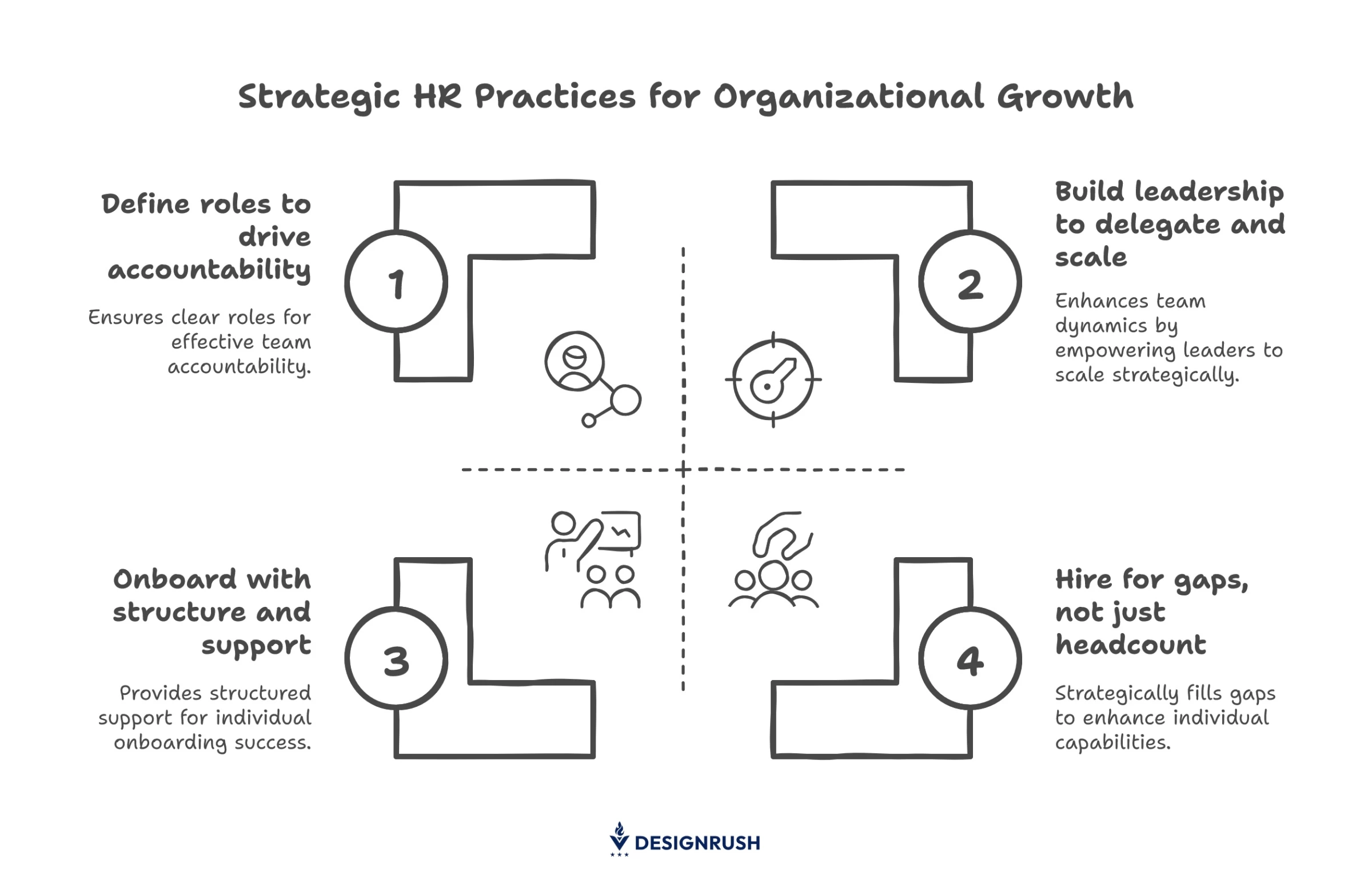
Hiring is where many agencies stumble. Adding people isn’t the same as adding capacity. Strategic hiring means filling the right gaps at the right time — and setting every new team member up for success.
Here’s how you can get it right:
- Build leadership layers: You can’t scale if everything goes through the founder. Delegate decision-making authority by building a leadership layer that can manage functions like operations, strategy, client success, and creative delivery. These leaders should be empowered to lead — not just execute — and own outcomes.
- Create role clarity: Avoid vague job descriptions that result in overlapping responsibilities and grey areas that create critical gaps. Each role should have a clear purpose with defined outcomes as well as a reporting structure. This will ensure accountability and avoid confusion as the team grows.
- Balance specialists and generalists: In early growth stages, generalists who can flex across tasks are valuable. As the agency matures, invest in specialists who bring depth to key areas like performance marketing, UX, or analytics. You’ll need the right mix to stay nimble while building real capability.
- Onboard intentionally: A good hire can flounder without the right support, but you can reduce churn by onboarding effectively. Create a structured onboarding experience with training, documentation, and checkpoints. Pair new team members with mentors or team leads who can help them absorb your workflows and culture.
“I think the most important thing is building a strong team,” is the advice offered by Matthew Burleton, Creative Director and Co-Founder of Long Story Short, who adds: “finding the right talent, supporting their growth, and fostering a work environment where they feel appreciated is crucial.”
He goes on to say that a happy team sticks around longer and performs better, which directly impacts the quality of services offered.
Strengthen Client Acquisition
Referrals may have gotten you this far, but they won’t get you to the next level. To scale predictably, you need a pipeline you can control and count on to be consistent — one that doesn’t rely on luck, timing, or word-of-mouth.
That starts with a clear go-to-market strategy and ends with a system that turns awareness into revenue.
- Define your positioning
- Diversify acquisition channels
- Build a repeatable sales system
- Use content strategically
1. Define Your Positioning
You need sharp, strategic positioning to stand out in a crowded market. That means clearly articulating who you serve, the specific problems you solve, and why your agency is the best choice to solve them. This isn't just marketing fluff — it's the foundation for your entire client acquisition strategy.
Strong positioning should:
- Speak directly to your ideal client’s pain points
- Differentiate you from competitors with similar offerings
- Align your messaging, sales conversations, and proposals
- Help unqualified leads self-select out early
When your positioning is clear, everything downstream — from marketing to closing — gets easier.
2. Diversify Acquisition Channels
Relying on a single channel is risky. To build a sustainable pipeline, you need a mix of acquisition methods working in tandem. This spreads your risk and helps you learn what scales best. In addition to that, multi-channel campaigns have shown a 31% boost in leads compared to single-channel campaigns.
Consider testing a blend of channels like:
- Outbound: Cold email, LinkedIn outreach, direct mail
- Inbound: SEO, content marketing, thought leadership
- Partnerships: Referral programs, co-marketing, channel partners
- Events: Speaking gigs, sponsorships, webinars
Track the performance of each and invest where the ROI appears. The goal is consistent lead flow — not one-off wins.
3. Build a Repeatable Sales System
Scaling acquisition means removing guesswork from your sales process. You want every prospect to move through a consistent, structured journey from awareness to close.
A repeatable system should include:
- A documented sales process with defined stages
- A CRM to track activity and forecast pipeline
- Clear role ownership (founder, strategist, or sales rep)
- Templates for outreach, proposals, and follow-ups
- Training to improve pitch quality and conversion rates
The result? Less reliance on individual talent, and more scalable, predictable revenue.
4. Use Content Strategically
Content should be a lever for driving revenue — not a time sink. If it’s not moving prospects through the funnel or reinforcing your expertise, it’s not doing its job.
Effective content should:
- Highlight relevant case studies and outcomes.
- Address key buyer objections and questions.
- Show how your approach solves real business problems.
- Generate qualified leads through gated assets or webinars.
- Reinforce credibility during long sales cycles.
- Be intentional. Every piece should have a purpose and a clear next step for the reader.
Build the Financial Engine That Powers Growth
Scaling simply won’t work if you can’t measure your growth effectively. Financial visibility is critical — not just for managing what you have today, but for building toward what comes next. For that, you’ll need:
1. Accurate Forecasts
Growth planning starts with knowing your numbers. It’s important to build forward-looking models that account for:
- Historical revenue trends and seasonality
- Client churn and acquisition velocity
- Average deal size and sales cycle length
- Upcoming hires and overhead needs
Use these forecasts to stress test your hiring plans, guide your pricing strategy, and avoid surprise cash shortfalls.
2. Scalable Pricing Models
Hourly billing limits your margin and caps your revenue potential. Support scale by transitioning to pricing models that:
- Emphasize value over time spent
- Create predictable cash flow (e.g., monthly retainers)
- Package services in clearly defined deliverables
- Allow for upselling and account expansion over time
Well-structured pricing makes your business more attractive to both clients and investors — and easier to manage as you grow.
3. Capital Needs Planning
Growth takes investment. That might mean new hires, marketing spend, or upfront costs to launch new services. To prepare:
- Know your runway and operating margins
- Explore financing options: credit lines, revenue-based financing, equity
- Build a model for when and why to raise external capital (if ever)
Underestimating capital needs is one of the biggest threats to momentum — plan ahead and build reserves.
4. Financial Expertise
Financial clarity isn’t a DIY job. Bring in experienced professionals who:
- Understand service-based business models
- Can help you create accurate forecasts and cash flow reports
- Provide objective input on profitability and investment decisions
Whether it’s a fractional CFO, an agency-savvy accountant, or a finance advisor, this kind of support gives you the insight and confidence to grow without guesswork.
Case Study: The Story of Hawke Media
Hawke Media began as a boutique marketing agency with a clear mission: to make expert marketing accessible to businesses of all sizes. Founded in 2014 as "Your Outsourced CMO," the agency spotted a market gap where companies either faced exorbitant fees and rigid contracts or lacked access to seasoned marketing expertise.
By offering flexible, affordable, and high-impact marketing solutions, Hawke Media positioned itself as a trusted partner that seamlessly integrated with clients' teams.
Here's how Hawke Media pulled it off:
- Establishing a clear vision: Hawke Media's commitment to making top-tier marketing accessible provided a strong foundation that guided all strategic decisions.
- Building a distinct brand identity: The agency differentiated itself by emphasizing flexibility and affordability which resonated with businesses seeking adaptable marketing solutions.
- Designing a scalable business model: Hawke Media focused on adaptable service offerings to ensure it could cater to a diverse clientele without compromising on quality.
- Prioritizing talent and culture: The agency recognized the importance of a skilled team and invested in hiring professionals aligned with their mission while fostering a collaborative culture.
- Leveraging technology and innovation: Hawke Media integrated advanced technologies to enhance service delivery and client outcomes.
- Mastering client acquisition and retention: The agency focused on building long-term relationships to ensure consistent client satisfaction and loyalty.
- Tracking success and planning for expansion: Regularly assessing performance metrics allowed Hawke Media to make informed decisions and strategically plan for growth.
Through these strategies, Hawke Media transformed from a small boutique firm into a $150 million agency, exemplifying how a clear vision, strong brand identity, scalable operations, and a focus on talent and innovation can drive substantial growth.
The Guide To Scaling Your Agency: Final Thoughts
Don’t think of scaling as a “one and done” type of exercise — it’s a shift in how you build and operate which will see you into the future. It requires structure, discipline, and leadership that can evolve.
It means building an agency that gets better, not just bigger. One that delivers value consistently, grows intentionally, and doesn’t lose its identity along the way. Start today by finding the expertise you need to get scale.

Our team ranks agencies worldwide to help you find a qualified partner. Visit our Agency Directory for the top business consulting companies, as well as:
- Top Small Business Consulting Firms
- Top Startup Consulting Firms
- Top HR Consulting Firms
- Top Software Consulting Companies
- Top Consulting Firms in Columbus
Our design experts also recognize the most innovative design projects across the globe. With a growing wave of fresh branding, be sure to explore our Awards section.
The Guide To Scaling Your Agency FAQs
1. How long does it typically take to scale an agency successfully?
Scaling timelines depend on your starting point, service model, and market demand. For most agencies, moving from boutique to scalable operation can take 12–36 months. But it’s less about speed and more about building sustainably — rushing the process often leads to burnout or breakdowns.
2. How involved should the founder be once the agency starts to scale?
Founders should shift from doing the work themselves to building the business. That means stepping back from day-to-day delivery and focusing on leadership, vision, hiring, and client strategy. Scaling successfully requires trust, delegation, and letting go of being the bottleneck.
3. When is the right time to bring in outside investors or partners?
Only consider outside capital when you have a clear growth plan, know your numbers, and understand how the funding will accelerate — not just sustain — your momentum. Many agencies scale without external funding by focusing on profitability and reinvesting wisely.