Our directory highlights top event marketing agency options in the US, evaluated across five core ranking criteria and reviewed by a team of 12 experts, with support from over 100 verified client reviews - helping you identify the right partner with confidence.
Organic rankings are determined by five factors: top services, reviews, portfolio, awards/press, and team expertise. Sponsored listings pay for a placement that appears above organic positions. Sponsorship does not affect star ratings or review content - read more on our methodology page.
Unlimited Dreams Graphic Design Multimedia Studio crafts elevated brand identities, powerful visual storytelling, luxury packaging, and digital experiences designed to turn big ideas into unforgettable impact...
Top Services:
- Digital Services
- Graphic Design
- Logo Design
- Design Services
- Package Design
- Show more
- Location
- Charlotte, North Carolina
- Number of Employees
- Under 49
- Average Hourly Rate
- $150/hr
- Minimal Budget
- Under $1,000
Intentional Marketing is an expert in assisting firms to realize their marketing objectives. Our experienced team has the knowledge, resources, and experience to develop a complete approach that will maximize your reach and influence. Our offerings include of content marketing, digital marketing, SEO, and...
Top Services:
- Digital Strategy
- Digital Marketing
- Content Marketing
- Public Relations
- Reputation Management
- Show more
- Location
- Scottsdale, Arizona
- Number of Employees
- Under 49
- Average Hourly Rate
- $125/hr
- Minimal Budget
- $1,000 - $10,000
San Diego Marketing & SEO is a full-service digital marketing agency specializing in search engine optimization, web design and development, PPC management, social media marketing, content marketing, email marketing, reputation management, and online presence analysis...
Top Services:
- Digital Marketing
- AEO
- SEO
- Advertising
- Branding
- Show more
- Location
- San Diego, California
- Number of Employees
- Under 49
- Average Hourly Rate
- $100/hr
- Minimal Budget
- $1,000 - $10,000
At PINK DOG DIGITAL we provide effective digital solutions for your business. Whether it is a website, search engine optimization, content creation, social media management, digital advertising or photography/videography, Pink Dog has a strategy custom-tailored to meet your needs. We create an online...
Top Services:
- Digital Strategy
- Social Media Marketing
- PPC
- SEO
- AEO
- Show more
- Location
- Cleveland, Ohio
- Number of Employees
- Under 49
- Average Hourly Rate
- $20/hr


Event Marketing Agencies by City
Event Marketing Agencies by State
Popular Services
Hiring Guide: How to Choose a Leading Event Marketing Agency in the US
Why should I hire an event marketing expert?
Event marketing helps businesses grow by increasing brand awareness, strengthening customer loyalty, and building meaningful relationships.
Its key advantages include:
- Brand building
Events let customers experience a brand firsthand through visuals, messaging, and product demonstrations, which creates stronger emotional connections and more positive brand perceptions. - Increased sales
Businesses can drive revenue through on-site purchases, exclusive event offers, and follow-up promotions that create urgency and encourage buying.
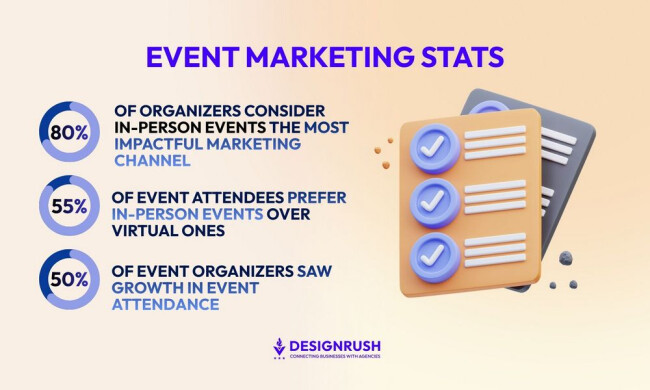
Over 80% of organizers consider in-person events the most impactful marketing channel, according to Swoogo. - Customer engagement
Interactive and personalized experiences help businesses connect more deeply with customers, gather feedback, and improve products or services.
Swoogo’s report also highlights that 55% of event attendees prefer in-person events over virtual ones. - Networking
Events make it easier to meet new customers, strengthen existing relationships, and form partnerships with industry peers, suppliers, and stakeholders.
Event organizers report increased attendance at their in-person B2B conferences, with over 50% seeing growth in attendance. - Data collection
Events provide valuable customer insights, including contact details and behavior patterns, which can be used to improve marketing strategies and decision-making.
How do I choose the right B2B event marketing agency for my brand?
Start by defining your event goal with absolute clarity. Are you trying to generate leads, build brand awareness, launch a product, or strengthen customer relationships?
Different agencies excel at different objectives.
- Look for agencies with proven experience in your specific event type, whether that's trade shows, conferences, experiential activations, or product launches.
- Evaluate their understanding of your target audience size and demographics. Industry experience matters because healthcare events differ dramatically from technology conferences or consumer brand activations.
- Compare creative vision by reviewing case studies and past work that demonstrates innovative thinking.
- Assess logistics capability by asking about their vendor relationships, venue networks, and execution track record.
- Budget control is essential, so ask how event marketing agencies manage costs and what reporting you'll receive throughout the planning process.
According to Splash's research, 77% of marketers say events are the most effective marketing channel for their company.
What kind of ROI can I expect from event marketing?
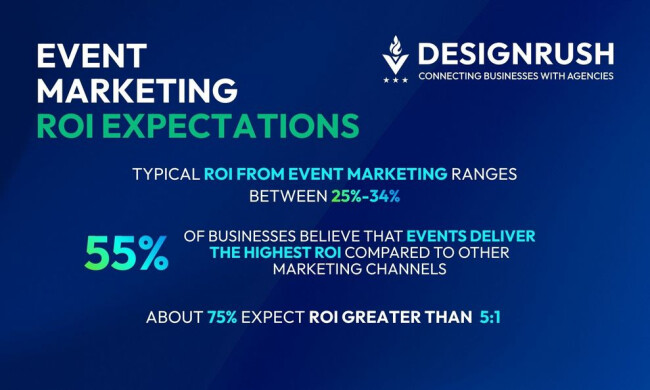
According to Swoogo, 52% of businesses believe that events deliver the highest ROI compared to other marketing channels, by fostering brand loyalty, building relationships, and creating memorable experiences.
Companies that invest $50–$100 million in event marketing report strong returns.
About 75% expect an ROI greater than 5:1, while 48% of brands anticipate returns between 3:1 and 5:1.
In addition, 44% of marketers say their event marketing efforts deliver an average ROI of 3:1, according to Equation Events.
You can easily calculate simple ROI with the following formula ROI = (Net Profit / Total Investment) x 100, and get a clear percentage that shows how much return you get for every dollar you invest.
If you’d like to estimate how much money you’ll generate as a direct result of the event, you’ll want to calculate the Advanced or Incremental ROI, and the formula is Incremental ROI = (Incremental Revenue - Event Cost) / Event Cost x 100.
According to Think Orion, typical ROI from event marketing ranges between 25%-34%, depending on the industry, making it an effective and profitable marketing strategy for businesses across various sectors.
Pre-event marketing, including email campaigns, social media posts, and targeted ads, helps maximize ROI.
The Agility PR Solutions research revealed that more than 75% of participants reported heightened trust in brands following personal interactions at events.
Many businesses experience an immediate increase in sales during or shortly after events, driven by live demonstrations and direct interactions, and gain valuable opportunities for personalized follow-up to turn interested attendees into customers.
What is the difference between an event marketing agency and an event production company?
Event marketing agencies focus on the strategic elements that drive business results.
They develop messaging, define audience engagement strategies, create content, manage promotion, and measure outcomes against business objectives.
Event production companies focus primarily on logistics and execution.
They handle staging, audiovisual equipment, lighting, venue management, and technical direction.
Think of it this way: a marketing agency determines what story you want to tell and how to tell it, while a production company ensures the stage, lights, and sound work flawlessly when you tell it.
Many full-service event marketing agencies handle both strategy and production, providing end-to-end support.
However, some brands prefer to separate these functions, hiring a marketing agency for strategy and a production company for execution.
How do I choose the best agency on DesignRush that fits my budget?
We’ve created a list of top event marketing agencies on DesignRush across multiple price points, so you can identify a service provider that’s within your price range.
| High budget: $50,000+ |
|
| Medium budget: $25,000-$50,000 |
|
Beyond budget, our agency directory allows you to filter agency profiles by location, area of expertise, agency reviews, client types, team size, and hourly rates.
Sources
DesignRush sustains a directory of over 40,000 agencies categorized by service category, location, expertise, and reviews. We build our database in two ways:
- Our dedicated team of agency experts actively searches the web for top-performing companies. We then pull information from their websites, online presence, and client testimonials to verify their status and qualifications prior to listing.
- The agencies listed get notified of their profiles on the website and they can choose to claim it or not, which suggests their availability for more collaborations.
Agencies can also reach out to DesignRush and must go through the verification process prior to being listed.

Why companies trust DesignRush
Every agency is independently vetted before it can be listed or ranked
 4.8
4.8 4.8
4.8Some agencies pay for sponsored placement, clearly labeled and held to the same vetting standards.
Event Marketing Agency FAQs
What types of businesses usually work with these types of companies?
They serve a wide range of industries, including:
- B2B technology and SaaS companies represent a significant portion of the market, using events to demonstrate products and generate qualified leads. According to statistics, corporate events, including trade shows, seminars, and product launches, account for 27.8% of the global events industry market.
- Enterprise services firms rely on conferences and executive briefings to build relationships with decision-makers.
- Consumer brands invest heavily in experiential activations to create memorable interactions with their target audiences.
- Fintech companies use events to build trust in an industry where credibility matters enormously.
- Healthcare and pharmaceutical organizations host educational conferences and product launches with strict compliance requirements.
- Educational institutions and associations depend on annual conferences as major engagement and revenue drivers.
- Media companies produce events ranging from intimate networking sessions to massive festivals.
- Trade associations bring entire industries together through exhibitions and annual meetings.
According to Cvent, the global corporate events market was valued at $325 billion in 2023 and is expected to grow to nearly $600 billion by 2029.
What services do most agencies offer?
Event marketing companies typically provide the following services:
- Event strategy development: Aligning event goals with business objectives and audience needs
- Experiential marketing: Creating immersive brand experiences that drive emotional connection
- Trade show management: Covering design, staffing, logistics, and lead capture
- Product launches: Orchestrating memorable reveals that generate buzz and coverage
- Conference production: Speaker management, session programming, and attendee experience
- Brand activations: Pop-up experiences, sponsorship activations, and guerrilla marketing
- Logistics coordination: Venue selection, vendor management, and timeline execution
- Production services: Staging, audiovisual, lighting, and technical direction
- Post-event reporting: Analytics, ROI measurement, and recommendations
According to Bizzabo's 2024 data, 78% of organizers identify in-person events as their organization's most impactful marketing channel, driving demand for these specialized services.
How much does event marketing cost?
The costs vary significantly based on scale, complexity, and objectives. According to Amex report, on average, 14% of a marketing budget goes toward event marketing. Furthermore, according to statistics, U.S. companies spend approximately $122 billion every year on event marketing.
| Event size | Cost |
| Small events (intimate product launches, executive dinners, or localized brand activations) | $15,000-$40,000 |
| Mid-sized events (regional conferences, multi-day trade show presences, or larger product launches) | $75,000-$250,000 |
| Large-scale or multi-city events, including national conferences, major experiential campaigns, or flagship annual events | $500,000+ |
According to GoGather's benchmarking data, the typical conference budget in the United States is approximately $1.89 million, accommodating an average of 601 attendees, with a per-person expenditure of about $3,144.
What additional costs should I expect when working with these types of agencies?
Beyond base agency fees, several additional expenses commonly arise during event execution.
Typical additional costs include:
- Venue rental: One of the largest line items, varying dramatically by location and prestige
- Travel and accommodation: For staff, speakers, and sometimes attendees
- Event staffing: Registration personnel, brand ambassadors, and technical crew
- Permits and insurance: Required for many public or large-scale events
- AV equipment: Sound systems, screens, lighting, and technical infrastructure
- Catering: Food and beverage accounting for roughly 30% of the total budget
- Insurance coverage: Liability and cancellation protection
- Post-event content: Photography, videography, and content repurposing
According to GoGather's data, food and beverage alone accounts for 29.9% of the total conference budget, with an average spend of $565,000, translating to approximately $940 per attendee.
The additional costs typically add 25% to 50% to base budgets, depending on event scope and production requirements.
How long does it take to plan and execute an event marketing campaign?
Event planning timelines depend heavily on scale and complexity.
| Type of event | Timeline |
| Simple activations or smaller gatherings | 6 -8 weeks |
| Corporate events | 3-6 months |
| Larger conferences, major trade show presences, or experiential campaigns | 9-12 months (planning should begin 12-18 months before the event) |
| Virtual events | 8-12 weeks |
Latest Trends Related to Event Marketing