
Looking for a managed IT service provider in the USA? DesignRush simplifies the process for you by showcasing top managed services, supported by a 4.5-star average rating from 800+ verified reviews. Browse trusted companies and filter by pricing or reviews to confidently choose the best option for your business.
Organic rankings are determined by five factors: top services, reviews, portfolio, awards/press, and team expertise. Sponsored listings pay for a placement that appears above organic positions. Sponsorship does not affect star ratings or review content - read more on our methodology page.
We execute software projects in true partnership spirit to exceed customer’s expectations by continually improving the processes and acquiring new skills...
Top Services:
- Software Development
- Web Design
- Web Development
- eCommerce Development
- UI/UX Design
- Show more
- Location
- Austin, Texas
- Number of Employees
- 50 - 99
- Average Hourly Rate
- $30/hr
- Minimal Budget
- $10,000 - $25,000

Managed Service Providers by City
Managed Service Providers by State
Popular Services
Hiring Guide: How to Choose the Best Managed IT Services Providers in the US
How to choose the best managed service provider in the United States?
Use the criteria below to narrow your shortlist before moving into detailed discussions:
- Clarify internal requirements
Start by mapping your current IT environment, key pain points, and expected growth. This helps you filter out providers that aren’t built for your scale or complexity. - Look for proven, relevant experience
Prioritize MSPs with experience supporting businesses like yours. Industry familiarity, certifications, and documented results signal the ability to operate within your technical and regulatory landscape. - Assess service breadth and maturity
An experienced MSP should support both daily operations and higher-level needs such as security, cloud optimization, and disaster recovery with the ability to adapt services over time. - Evaluate scalability and stability
The right partner can scale infrastructure and security as your business evolves, without service disruption or constant contract changes. - Review security and compliance readiness
Make sure the MSP you choose has proven experience handling data protection, risk management, and industry-specific compliance requirements. - Measure responsiveness and reliability
Clear SLAs, defined response times, and consistent communication practices are essential for maintaining continuity and minimizing downtime. - Check reputation and transparency
Client reviews and references should provide some insight into how the MSP will operate once the partnership starts.
What results could businesses expect from an MSP?
Working with a managed services provider leads to measurable operational outcomes alongside long-term business benefits. Here’s what you can expect:
- Reduced downtime and disruption
Organizations using managed services report up to a 27% decrease in system downtime, driven by continuous monitoring and faster incident response. - Lower overall IT operating costs
Companies that outsource IT operations report an average 19-30% reduction in IT operational expenses, primarily due to fewer outages, automation, and reduced internal overhead. - Faster issue resolution
AI-backed monitoring and automation used by MSPs have reduced incident response times by up to 40%. - Stronger resilience during security incidents
Managed security services helped mitigate over 36% of ransomware incidents globally in 2024, improving recovery speed and containment. - Better scalability as the business grows
You would be able to scale users, devices, and infrastructure without performance degradation or service gaps.
These results explain why in 2024 more than 68% of enterprises outsourced at least one IT function and why the U.S. accounted for 38% of the global MSP market.
How does a managed IT services company ensure security, compliance, and data protection?
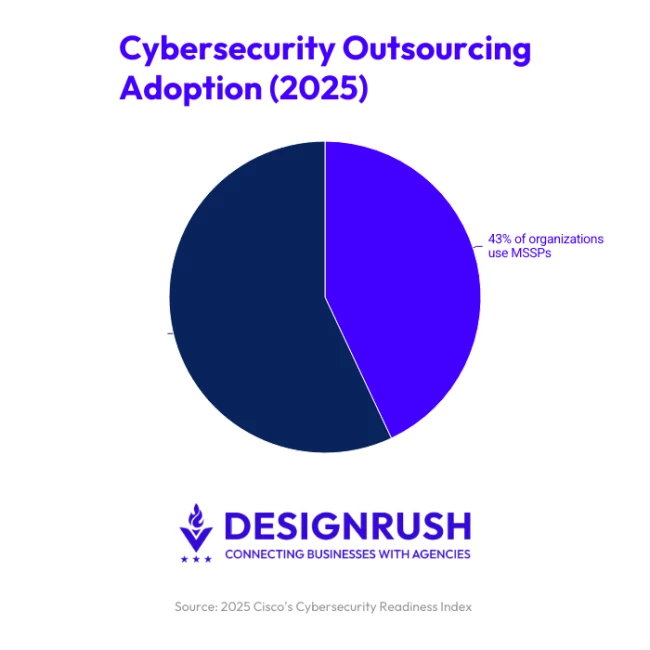
With a global shortage of 3.5 million cybersecurity professionals, 43% of organizations now outsource cybersecurity capabilities to managed providers. MSPs help businesses protect their systems and data through continuous monitoring and compliance-led practices:
- Cybersecurity monitoring and response
MSPs provide 24/7 monitoring across networks, endpoints, and cloud systems. AI-powered detection significantly improves response speed: it reduces average breach detection time from 181 days to 51 days and enables 73% faster containment than in-house teams. - Ransomware and threat mitigation
Layered security controls and rapid isolation help limit the impact of attacks. In 2024, over 36% of global ransomware incidents were mitigated through MSP-managed security services, improving recovery and containment outcomes. - Backup, disaster recovery, and continuity
MSPs maintain encrypted, redundant backups and tested recovery plans, which are required under many regulatory frameworks and critical for minimizing downtime during incidents. - Compliance management
34% of companies adopted managed security services specifically to meet compliance standards such as HIPAA, PCI DSS, and GDPR. What MSPs do is track regulatory requirements and maintain audit-ready documentation.
How to tell if a business needs fully managed services or co-managed IT?
The decision comes down to how much internal IT capability you have and how much responsibility you want to retain.
Fully managed IT is typically the right fit if:
- You don’t have an internal IT team or rely on generalist support
- You want to outsource IT operations, security, and maintenance fully
- Predictable monthly costs matter more to you than hands-on control
In this model, the managed services company owns day-to-day IT, including help desk, infrastructure, cybersecurity, compliance, and planning.
Co-managed IT is usually a better option if:
- You already have an internal IT team, but they lack capacity or specialized skills
- You want to retain oversight while outsourcing areas like security, cloud, or monitoring
- Your IT needs to scale with growth or hybrid work
What questions should you ask before hiring a managed services firm?
Asking targeted questions early will help you clarify how a managed service provider operates in practice, beyond sales promises and proposals.
Relevant Background
- What services and technologies/platforms do you specialize in?
- Can you share case studies and client references similar to my project scope and complexity?
- What is your support coverage (e.g., onsite or remote, after-hours coverage)?
Services and Processes
- How are support requests handled end-to-end (e.g., channels, ticket triage, and service level agreements)?
- Which security frameworks and compliance standards do you follow?
- What are our operational governance practices for incident response, escalation, change management, and post-incident reviews?
- What recovery time and recovery point objectives do you commit to, and what architecture/backup assumptions are required to meet them?
Related to Your Project
- Who will manage our systems daily, and what is their seniority level?
- How will you integrate with our existing tools and systems?
- How do you handle scaling and capacity planning as demand grows?
- What level of ongoing support is included after onboarding, and what will be billed separately?
How to find top managed services companies on DesignRush that fit your budget?
DesignRush helps you avoid guesswork by identifying MSPs that align with your budget and hiring criteria. You can compare providers based on reviews, team size, and rates.
| High budget: $50,000+ |
|
| Low budget: $25,000-$50,000 |
|
Sources
DesignRush sustains a directory of over 40,000 agencies categorized by service category, location, expertise, and reviews. We build our database in two ways:
- Our dedicated team of agency experts actively searches the web for top-performing companies. We then pull information from their websites, online presence, and client testimonials to verify their status and qualifications prior to listing.
- The agencies listed get notified of their profiles on the website and they can choose to claim it or not, which suggests their availability for more collaborations.
Agencies can also reach out to DesignRush and must go through the verification process prior to being listed.

Why companies trust DesignRush
Every agency is independently vetted before it can be listed or ranked
 4.8
4.8 4.8
4.8Some agencies pay for sponsored placement, clearly labeled and held to the same vetting standards.
Managed IT Services FAQs
What can a managed IT service provider do for business?
A managed service provider (MSP) is an external partner that manages and supports your IT systems so your team can focus on running the business instead of fixing tech issues.
MSPs typically handle:
- IT infrastructure management (networks, servers, hardware, and cloud systems)
- Proactive monitoring and maintenance to prevent downtime
- Cybersecurity and data protection, including threat detection and incident response
- Backup and disaster recovery to protect business-critical data
- Help desk and technical support for day-to-day issues
- IT planning and advisory, aligning technology with business goals
As IT environments grow more complex, more U.S. businesses are turning to managed services.
The U.S. managed services market reached $69.9 billion in 2024 and is projected to grow at a 10.5% CAGR through 2033, driven by remote work, cloud adoption, and rising cybersecurity threats.
What types of MSPs are there?
Managed service companies can be categorized in two ways:
1. By provider model (how the MSP operates and partners with your business)
| Type | What It Covers | Best For |
| Pure-Play MSPs | Core IT operations like monitoring, maintenance, patching, and system support | Small to mid-sized businesses needing reliable day-to-day IT management |
| Staffing-Led MSPs | Managed IT services combined with IT staff augmentation | Companies that need flexible capacity or temporary technical expertise |
| High-Level (Strategic) MSPs | End-to-end IT management, cybersecurity, cloud strategy, and long-term planning | Enterprises with complex infrastructure and strategic IT needs |
2. By service focus (what specific IT functions they manage)
Most specialize in one or more of the following areas:
- IT support: Ongoing monitoring, troubleshooting, and system maintenance
- Security services: Threat detection, vulnerability management, and compliance support
- Cloud services: Cloud migration, optimization, and ongoing management
- Network services: Network monitoring, performance optimization, and connectivity management
- Backup & disaster recovery: Data protection, backups, and business continuity planning
- Industry-specific: Tailored IT support for regulated sectors like healthcare, finance, retail, and legal
What benefits can businesses expect from managed IT service providers?
MSP services are designed to reduce operational strain and create more stability. Here’s what they bring to the table:
- Predictable IT costs
Fixed or subscription-based pricing reduces budget uncertainty and unexpected expenses. - Access to specialized expertise
On-demand support across infrastructure, cloud, security, and compliance. - Proactive system oversight
Performance issues now carry the same business impact as outages. According to Catchpoint’s SRE Report 2025, 53% of organizations agree that “slow is the new down,” reinforcing why proactive monitoring and performance management are core managed services benefits. - Stronger security foundations
Continuous threat monitoring, patching, and security controls reduce exposure to cyber risks. This is an increasing priority as the FBI recorded 859,532 cyberattacks in the U.S. in 2024, marking a 144% increase since 2018. - Simplified compliance support
Built-in processes ensure you meet regulatory requirements like HIPAA and PCI DSS. - Optimized technology management
Guidance on selecting, maintaining, and updating systems helps you avoid waste. - More focus on core work
Internal teams spend less time on IT operations and more on business priorities.
What is the difference between staff augmentation and managed services?
Staff augmentation providers and managed service providers both offer IT outsourcing solutions, but they differ in several key ways:
| Aspect | Staff Augmentation | Managed Services |
| Primary purpose | Fill skill or capacity gaps | Fully manage defined IT functions |
| Control | Client retains full control | Provider owns delivery and outcomes |
| Engagement type | Short-term or project-based | Usually ongoing, long-term partnership |
| Accountability | Client manages performance | Provider accountable via SLAs |
| Team integration | Works as part of your in-house team | Operates as an external IT owner |
| Cost structure | Hourly or contract-based | Typically fixed or subscription-based |
How much do managed service providers in the USA charge?
On average, managed service firms charge $150-$400 per user per month or $175-$300 per hour. For enterprise-level projects, pricing can start at $10,000 per month.
Main factors that influence MSP pricing:
- Number of users or devices
- Scope of managed services
- Infrastructure complexity and data volume
- Contract length and service hours
Common MSP pricing models:
- Per-user pricing: Predictable costs tied to headcount
- Per-device pricing: Charges based on supported hardware
- Tiered plans: Different service levels at increasing prices
- Flat-rate pricing: Unlimited support for a fixed monthly fee
- À la carte services: Pay only for specific IT needs