
Most businesses don't lose money on PPC because Google Ads doesn't work. They lose it because campaigns are optimized for the wrong goals, tracked with incomplete data, or managed without enough time or expertise.
That's why more companies outsource PPC. The right partner improves lead quality, lowers acquisition costs, and helps every advertising dollar work harder.
Outsourced PPC: Key Findings
- Build a lead-quality feedback loop before buying more PPC technology. The best agencies improve performance by giving ad platforms better conversion signals, not necessarily more software.
- Optimize for your entire customer journey, not just online conversions. If your ads influence offline purchases, measuring only digital sales leaves revenue on the table.
- Treat Google's default campaign settings as a starting point, not a strategy. High-performing agencies customize campaign structure around your buyers, products, and sales cycles.
How the Best PPC Partners Turn Ad Spend Into 200% ROAS
PPC outsourcing means hiring an external agency, freelancer, or specialized team to manage some or all of your paid advertising across platforms like Google Ads, Microsoft Advertising, and Meta.
The work can cover everything from full account management to specific projects, such as campaign audits, ad creative, landing page testing, or managing a single advertising channel.
The value isn't measured by how many campaigns an agency launches or reports it delivers. It comes down to whether they improve the metrics that affect profitability.
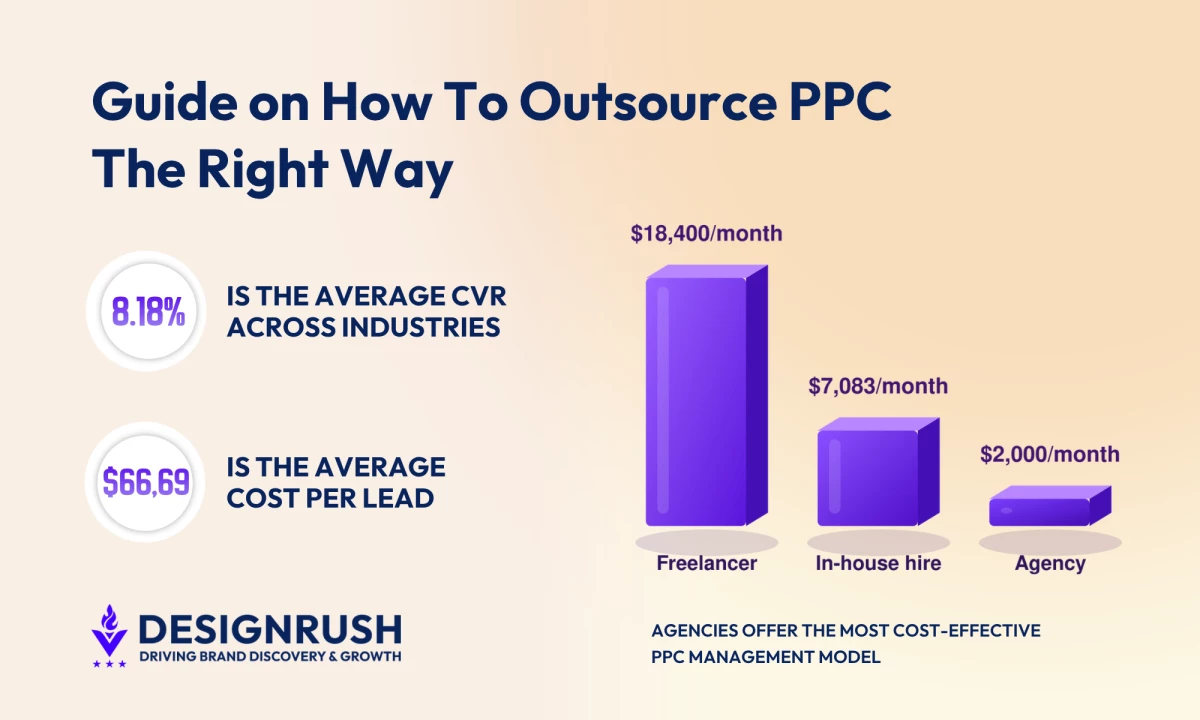
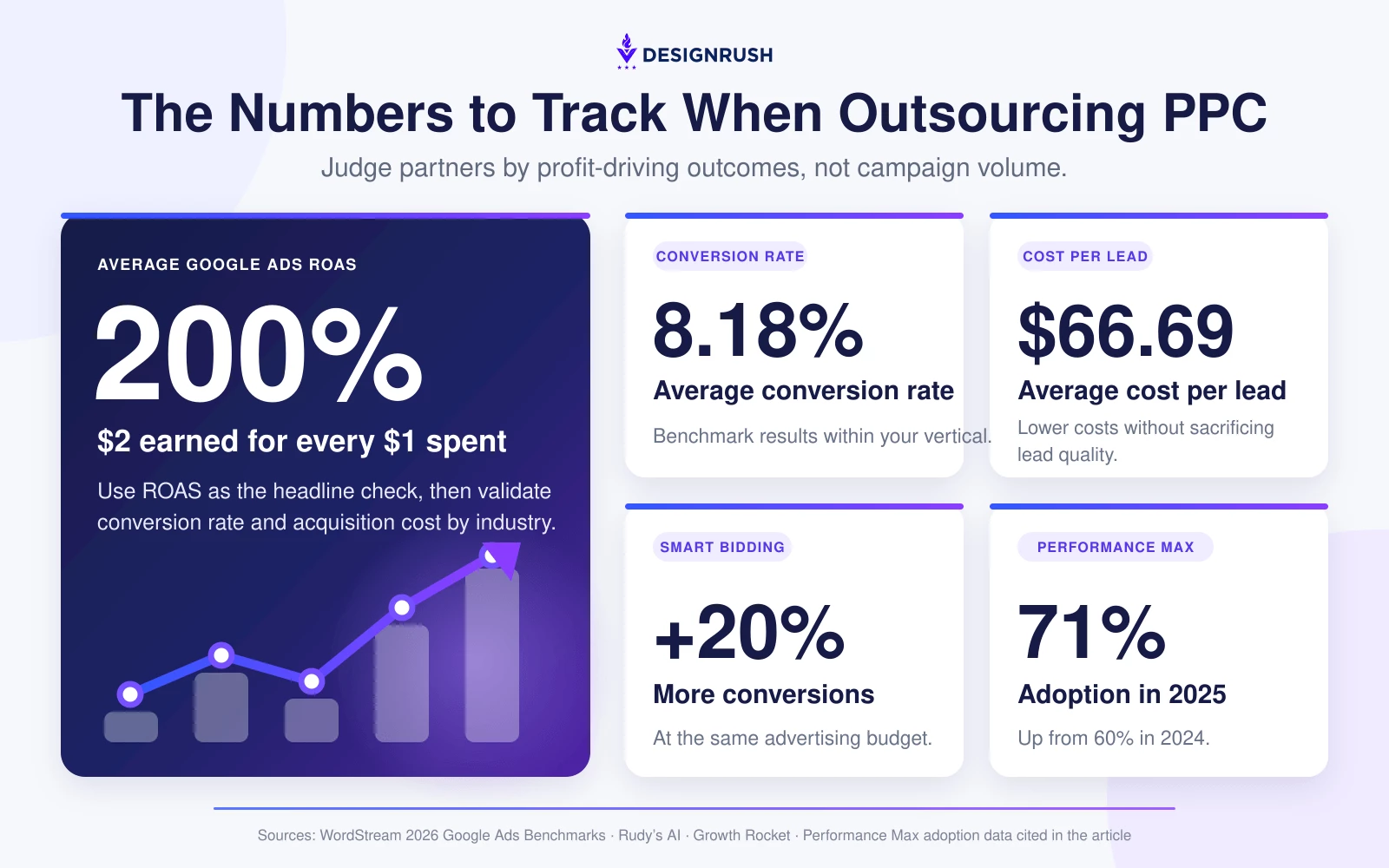
According to WordStream's 2026 Google Ads Benchmarks, the average conversion rate across industries reached 8.18% and the average cost per lead was $66.69.
A capable PPC partner should work toward outperforming those benchmarks within your industry, since conversion rates and acquisition costs vary widely by vertical.
That performance can pay for itself. Industry aggregators consistently cite an average return of roughly $2 in revenue for every $1 spent on Google Ads, or roughly 200% ROAS.
Automation is a major reason those returns are possible when campaigns are managed well:
- Smart Bidding increases conversions by about 20% at an equivalent budget
- Adoption of Google's Performance Max campaigns grew from 60% in 2024 to 71% in 2025
Automation only works as well as the data behind it, which is why experienced PPC managers spend as much time refining account structure and measurement as they do launching campaigns.
What a PPC Agency Can Do for You
Most businesses that outsource PPC end up with an agency, and it helps to know what you are actually buying.
An agency is not one person running your ads; it is a team and a process assembled around your account. The core services usually include:
- Campaign strategy and account structure, so your budget is organized around your goals rather than a default template.
- Cross-platform management across Google Ads, Microsoft Advertising, Meta, and other channels, run by specialists who work in each platform daily.
- Keyword research, audience building, and bid management, the hands-on optimization work that moves cost per acquisition.
- Ad creative and copywriting, often paired with landing page recommendations or testing, since ads that convert depend on where they send people.
- Conversion tracking and measurement setup, which is what lets the account optimize real outcomes rather than surface metrics.
- Reporting and a dedicated account manager, so you have both the numbers and a person accountable for them.
The practical advantage of that bundle is access you could not justify buying piece by piece. A single business rarely needs a full-time strategist, analyst, creative specialist, and platform expert, but an agency spreads that team across clients, so you get all of it for a retainer rather than four salaries.
Agencies also carry platform certifications and cross-account benchmarking data that a solo hire cannot match, which is why the case studies earlier in this article were agency-led.
Note that outsourced PPC agencies are not the only option, and they are not always the right one:
- A freelancer, typically $80 to $150 per hour or a part-time retainer, fits a defined project like an audit or a one-off build.
- A dedicated offshore specialist, from around $3,500 per month, suits teams that want daily execution owned by one person while strategy stays in-house.
- An in-house hire, roughly $70,000 to $100,000 or more per year fully loaded, pays off only when paid media is core to the business and busy enough to fill a full-time role.
The agency model earns its cost when you want to hand off a whole function, run more than one platform, or scale spend without building a team, which is exactly the situation most growing businesses find themselves in.
PPC Outsourcing: 4 Best Practices Backed by Real-World Results
With the right strategy, tracking, and collaboration in place, outsourcing PPC to an agency can lower acquisition costs, improve lead quality, and turn ad spend into measurable growth.
These examples show what that looks like in practice.
- Fix the Feedback Loop Before You Build the Tech Stack
- Measure the Full Customer Journey Before You Optimize It
- Replace the Default Setup With a Strategy Built Around Your Buyers
- Address the Brand Problem Before It Becomes a Sales Problem
1. Fix the Feedback Loop Before You Build the Tech Stack
You do not need a full CRM or enterprise attribution setup before an agency can optimize for better leads. What matters first is creating a reliable way to identify which leads are worth pursuing and feed that information back into the ad platform.
That process can begin with a simple manual system rather than a costly technical build.
Before investing in new technology, ask how the agency can improve lead-quality signals with the systems you already use.
Disruptive Advertising Cut Hornet Corp’s Cost per Lead 40% Without a CRM
Hornet Corp had a one-person sales team, no CRM, and no reliable way to connect ad spend with lead quality. Rather than adding a complex new platform, Disruptive Advertising built a lightweight lead-rating system that let the sales team flag valuable leads and send that feedback directly to Google Ads.
This gave the bidding algorithm a stronger conversion signal without adding more software to the sales process.
The results came within about two months:
- Cost per lead fell 40%
- CPL dropped from $139.74 to $83.55
- Google Ads began optimizing toward higher-quality leads
2. Measure the Full Customer Journey Before You Optimize It
Optimization is only as good as the outcomes you are measuring. If your ads drive sales your tracking cannot see, the platform will keep optimizing toward the narrow slice it can measure and quietly underweight everything else.
That gap is common for any business where the buying journey crosses channels, such as a retailer whose online ads influence in-store visits. The fix is to measure incrementality first, then optimize against the full picture rather than the convenient one.
Before scaling spend, ask how the agency plans to capture conversions that happen off the platform, and how they will prove those conversions were actually caused by the ads rather than assumed.
Tinuiti Lifted DSW's ROAS 15% by Optimizing for In-Store Sales, Not Just Online
DSW, a national footwear retailer with nearly 500 US stores, had a customer journey that blended online and in-store shopping. Its Meta ads were driving both, but campaign optimization focused only on online conversions, leaving the in-store impact unmeasured and untargeted.
When Meta introduced the ability to optimize for online and offline outcomes together, Tinuiti designed a conversion lift test with a 30% holdout group to isolate the true incremental impact across both channels.
The holdout received no Meta ads and served as the baseline, which let the team attribute in-store and online sales to the campaigns with statistical confidence before shifting to full omni-channel optimization.
Optimizing against the complete journey outperformed the business-as-usual online-only approach:
- ROAS increased 15%
- Cost per acquisition fell 18%
- Purchases rose both online and in-store
3. Replace the Default Setup With a Strategy Built Around Your Buyers
Google's default campaign settings are built for the average advertiser, not for your specific buyers or your busiest sales window. A capable partner treats the out-of-the-box setup as a starting point and rebuilds around how your customers actually research and buy.
That often means matching the campaign type to the goal and following shoppers into the placements where they spend time, rather than staying inside a single template. The payoff tends to be largest during high-stakes periods like the holidays, when generic setups leave the most efficiency on the table.
Before a peak season, ask the agency which campaign structure they recommend for your goals and why, and where your buyers are researching beyond the search results page.
WebFX Grew Furbo's Black Friday Revenue 348% by Ditching the Default Shopping Setup
Furbo, the best-selling interactive dog camera in 11 countries, treats the holiday season as its most important sales window and wanted to capture the full Black Friday shopping journey rather than lean on a generic, template-style shopping campaign.
WebFX moved Furbo off Standard Shopping, Google's default setup, and onto a tailored Smart Shopping strategy that reached prospects beyond search across YouTube and Gmail, where shoppers were researching products. The team deliberately left the ROAS target unset so the Maximize Conversion Value bid strategy could optimize for the highest total value.
Comparing Black Friday week under the new setup against the prior year's default approach, the results were:
- Revenue increased 348%
- ROAS improved 76%
- Cost per acquisition dropped 54%
4. Address the Brand Problem Before It Becomes a Sales Problem
Sometimes the reason ads underperform has nothing to do with bids or targeting. If customers no longer believe what your brand stands for, better campaign mechanics will not fix a positioning problem. A strong partner will tell you when the issue lives upstream of the ad account.
Diagnosing that requires looking at how your audience actually perceives the brand, not just how your campaigns are pacing.
When the perception has drifted, the fix is to realign the message first and let the media carry a story people believe, rather than spending harder against a story that no longer lands.
Before pouring more budget into paid channels, ask the agency to pressure-test whether your brand positioning still resonates with the buyers you are trying to reach.
Amsive Drove a 20% Sales Lift for VOSS by Fixing Perception First
VOSS, the Norwegian luxury water brand, built its identity around a sleek, iconic bottle when it launched in the US in 1999.
Over time, though, consumers began reading that stylish exterior as a pricey façade rather than a mark of quality, and the brand needed to reconnect with a new generation of luxury buyers.
Amsive used its Audience Science method to analyze VOSS's audience and media habits, then built a new brand platform, "It's What's on the Inside," carried by a multichannel campaign across digital, social, TV, and premium placements.
The strategy reframed the brand around quality before scaling the media behind it.
The repositioning produced measurable growth:
- Sales rose 20% in target markets within three months
- Amazon sales increased 344% year over year
- The campaign reached 38.5 million people and generated 137 million impressions
How Much Does Outsourced PPC Cost?
According to DesignRush Agency Directory data, PPC outsourcing costs fall into two buckets: what you spend running the ads and what you pay an agency to manage them.
Both vary widely depending on your industry, platforms, and the scope of the engagement, so the ranges below are starting points rather than fixed quotes.
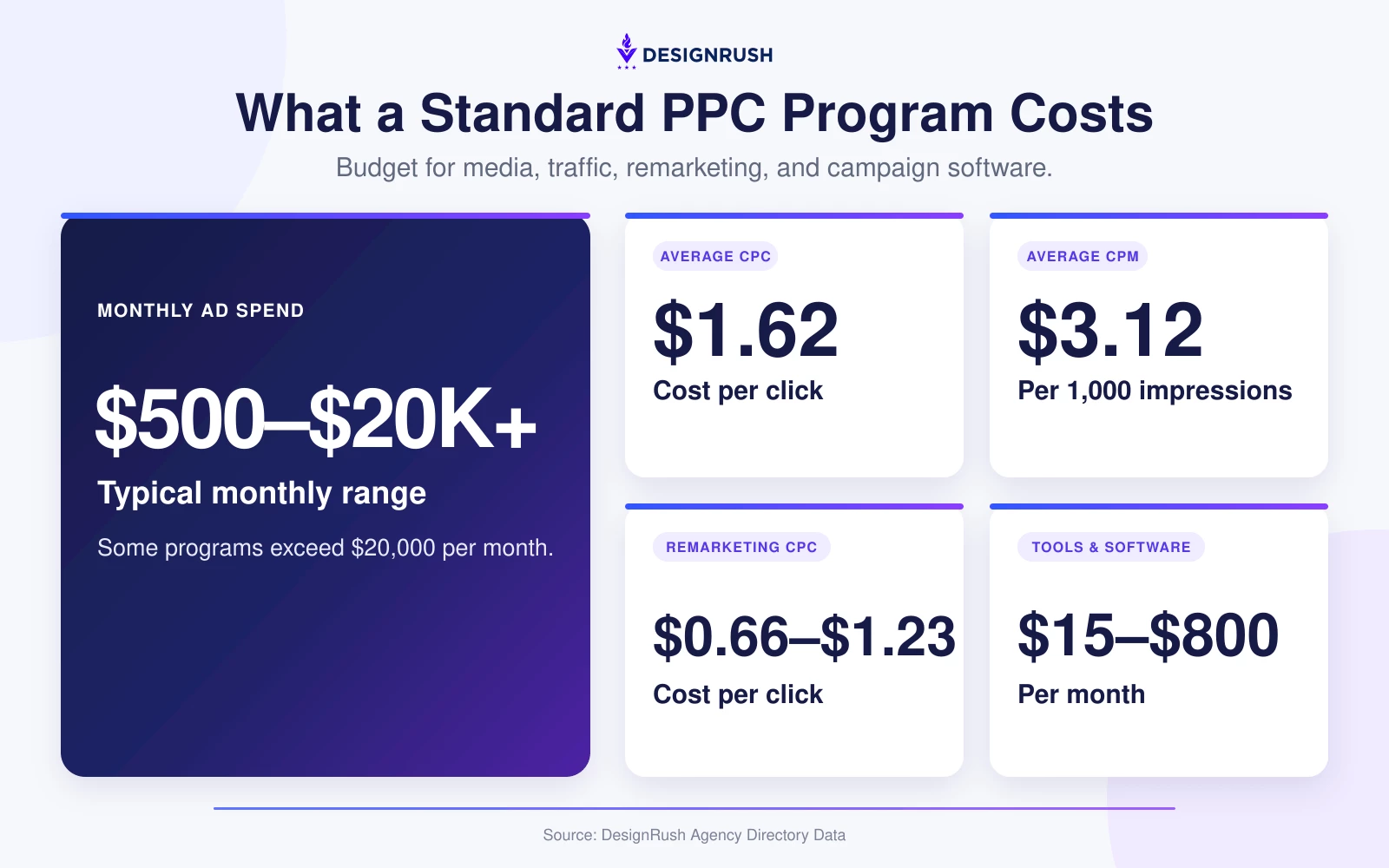
On the campaign side, average costs for a standard PPC program are:
- Ad spend ranges from $500 to more than $20,000 per month.
- Cost per click averages around $1.62.
- Cost per 1,000 impressions (CPM) averages around $3.12.
- Remarketing cost per click runs from $0.66 to $1.23.
- Tools and software cost between $15 and $800 per month.
On the management side, agencies typically bill using one of three models:
- Percentage of ad spend, usually 12% to 30% of your monthly spend.
- A flat monthly fee, often $1,000 to $3,000 for small to mid-sized businesses.
- Project-based pricing, from $1,000 to more than $10,000 for audits, setup, or short-term engagements.
Which model fits best depends on how much you spend and how hands-on you want the agency to be.
Percentage-of-spend pricing scales with your budget and suits growing accounts, flat fees give predictable costs for steady programs, and project pricing works when you need a defined piece of work rather than ongoing management.
When You Need to Outsource PPC Management
Outsourcing works best when you bring a clear problem and enough infrastructure for a partner to act on it. A few signals suggest the timing is right:
1. Your Ad Spend Has Outgrown Your Time
Once campaigns need daily attention that you or your team cannot give them, the account starts to drift. Budgets get spent on underperforming keywords, tests go unfinished, and small inefficiencies compound. At that point, a dedicated partner usually recovers more value than their fee costs.
2. You Can Define What a Good Outcome Looks Like
The agencies in the examples above delivered because they had something concrete to optimize toward, whether a lead-quality signal or an incrementality baseline.
If you can name the conversion that matters and roughly what it is worth, an agency can go to work immediately. If you cannot, that is the first thing to fix, and a strong partner will help you build it before scaling spend.
3. You Want Expertise You Cannot Justify Hiring In-House
Platform certifications, cross-account benchmarking data, and daily time inside the ad platforms are hard to build for a single business. They come standard with an experienced agency, which is often the clearest argument for outsourcing over a full-time hire.
4. You Have Realistic Expectations, Not Just a Target Number
Outsourcing tends to disappoint when a business wants a guaranteed figure rather than a working partnership.
PPC results depend on your offer, your margins, and your tracking as much as on campaign management, so the strongest engagements start with shared expectations rather than a promised return.
Before signing with anyone, get honest about which of these describe you. The clearer you are about your goals, tracking, and budget going in, the more likely an outsourced partner is to produce the kind of results the examples above illustrate.
Questions to Ask Before You Hire a PPC Partner
Before you sign with anyone, a short list of pointed questions will tell you more than any pitch deck.
The goal is to find out how a prospective partner thinks, how they measure success, and who will actually be doing the work. Several of the strongest questions come straight from the situations the case studies above illustrate.
Who will manage my account day to day, and how much experience do they have?
- The senior name who wins the pitch is often not the person running your campaigns. Ask to meet the actual account manager before you commit.
How will you improve lead quality with the systems I already use?
- A good partner does not require a full CRM or enterprise attribution setup before they can help. As the Hornet Corp example showed, a lightweight feedback loop can sharpen results without new software, so ask how they will work with what you have.
How will you capture conversions that happen off the platform, and prove the ads caused them?
- If your buying journey crosses channels, optimization is only as good as the outcomes you measure. Ask how they will track offline or cross-channel conversions and how they will demonstrate incrementality rather than assume it.
What campaign structure do you recommend for my goals, and why?
- Be wary of anyone who reaches for Google's default setup. A capable partner should be able to explain why a given structure fits your objectives and where your buyers are researching beyond the search results page.
Will you tell me if my problem is not actually a PPC problem?
- Sometimes weak performance comes from positioning or brand perception, not bids and targeting. A partner worth hiring will flag when the issue lives upstream of the ad account rather than spending your budget against it.
How do you report, and what can you change without my sign-off?
- Agree on the metrics that matter, the reporting cadence, and the line between what the partner adjusts on their own and what needs approval, before the work starts rather than after.
Who owns the ad accounts, data, and creative?
- Insist that you retain ownership of the accounts, the historical performance data, and the creative assets. Confirm what transfers to you if the engagement ends, so you are never locked in.

Our team ranks agencies worldwide to help you find a qualified partner. Visit our Agency Directory for the top PPC agencies, as well as: