Finding the right developer means knowing what to look for before the first conversation. Here, you'll find vetted software developers in New York with portfolios, reviews, and rates to compare, so you can move forward with confidence.
Organic rankings are determined by five factors: top services, reviews, portfolio, awards/press, and team expertise. Sponsored listings pay for a placement that appears above organic positions. Sponsorship does not affect star ratings or review content - read more on our methodology page.
Turning Digital Ideas into Powerful & Lucrative Realities
Wezom offers custom software development services, providing solutions that address business challenges, meet market demands, enhance internal operations, and stay up-to-date with the latest technologies...
Top Services:
- IT Services
- Software Development
- Mobile App Development
- Web Design
- eCommerce Development
- Show more
- Location
- New York City, New York
- Number of Employees
- 250 - 499
- Average Hourly Rate
- $49/hr
- Minimal Budget
- $50,000 & Up
- Portfolios Count
- 27 Projects Listed
Data sourced from the agency's DesignRush profile, its website, and other relevant accountsWezom Services
Data sourced from the agency's DesignRush profileMetinvest John Deer Roshen INTERPIPE Aptiv Toyota Material Handling SCHWARZ LOGISTICS Cooper & Hunter OneVoiPlanet Nova Lines
Wezom Reviews & Testimonials

IT Services Review from Taras Oliinyk
The project involved developing a mobile app for an e-commerce client, with U1CORE building the marketplace and WEZOM responsible for the mobile application. Both companies worked as partners on the same product, so the mobile app had to fit naturally into the marketplace's functionality. WEZOM brought solid mobile development expertise to the project and built the application around the marketplace requirements. Their team was able to work within the shared product setup and keep the mobile functionality consistent as the project progressed. We would be happy to work with WEZOM again on similar projects!

eCommerce Development Review from Ivan Usenko
We involved WEZOM to support the technical side of a U.S. e-commerce client's advertising setup. Our team handled PPC and marketing, while WEZOM implemented server-side tracking and profit-based ROAS attribution.Their technical work fit well into the client's existing setup and gave us a more reliable view of campaign performance. This made it easier to assess results and adjust advertising spend accordingly. Overall, we had a positive experience with WEZOM!

eCommerce Development Review from Max Zakhozhiy
For one of our jewelry e-commerce clients, WEZOM took care of the website development while our team handled its promotion. The teams coordinated well throughout the project, especially on technical requirements that could affect the websites future promotion. WEZOM was open to our input and made it easy to align development with the client's marketing needs. The finished website gave us a good foundation for ongoing promotion, and we were happy with how the two teams worked together. We'd be glad to collaborate with WEZOM again.
Reviews verified by DesignRush and sourced from the agency's profile View All Reviews

Software Development Companies in New York by City
Related Services in New York
Software Development Specializations in New York
Popular Services
Everything You Need to Know Before Hiring a Software Development Company in New York
What is the single biggest mistake buyers make when hiring a software development agency in New York?
Confusing technical vocabulary with delivery capability.
An agency can speak the right language in a sales call without having shipped a product at your complexity level.
Buyers get sold on the pitch, skip the portfolio audit, and discover the gap two or three months into a paid engagement when sprint velocity collapses, or early architectural decisions start creating problems that are expensive to reverse.
The way to catch it before signing is to directly ask the agency to walk you through a project that went wrong.
An agency with real delivery experience will talk about the specific decision that caused the problem and what they did differently afterward.
An agency without it will describe the outcome without touching the process.
What red flags in a proposal should make you walk away before signing?
The proposal is the agency's best effort under zero pressure. If problems appear here, the engagement will have larger ones.
Watch out for some of these warning signs:
- No named engineers. Ask for names and seniority levels before signing.
- Fixed-price contracts on undefined scope. Fixed pricing only works when requirements are fully documented first. An agency offering a fixed price before requirements are locked is either underquoting to win the deal or planning to recover the margin through change orders.
- No change control process defined. Every software project has scope shifts. A proposal that does not define what happens when requirements change leaves the agency free to interpret it in its favor when billing questions arise later.
- Vague timeline language. "Approximately 3 to 4 months" without defined milestones or delivery checkpoints is a placeholder.
- Pressure to sign quickly. Urgency at the proposal stage is a sales tactic. It tends to reappear throughout the relationship.
What should an engagement contract contain?
An engagement contract should define scope, pricing, revision triggers, milestone timelines, and exit conditions clearly enough that neither party needs to interpret anything.
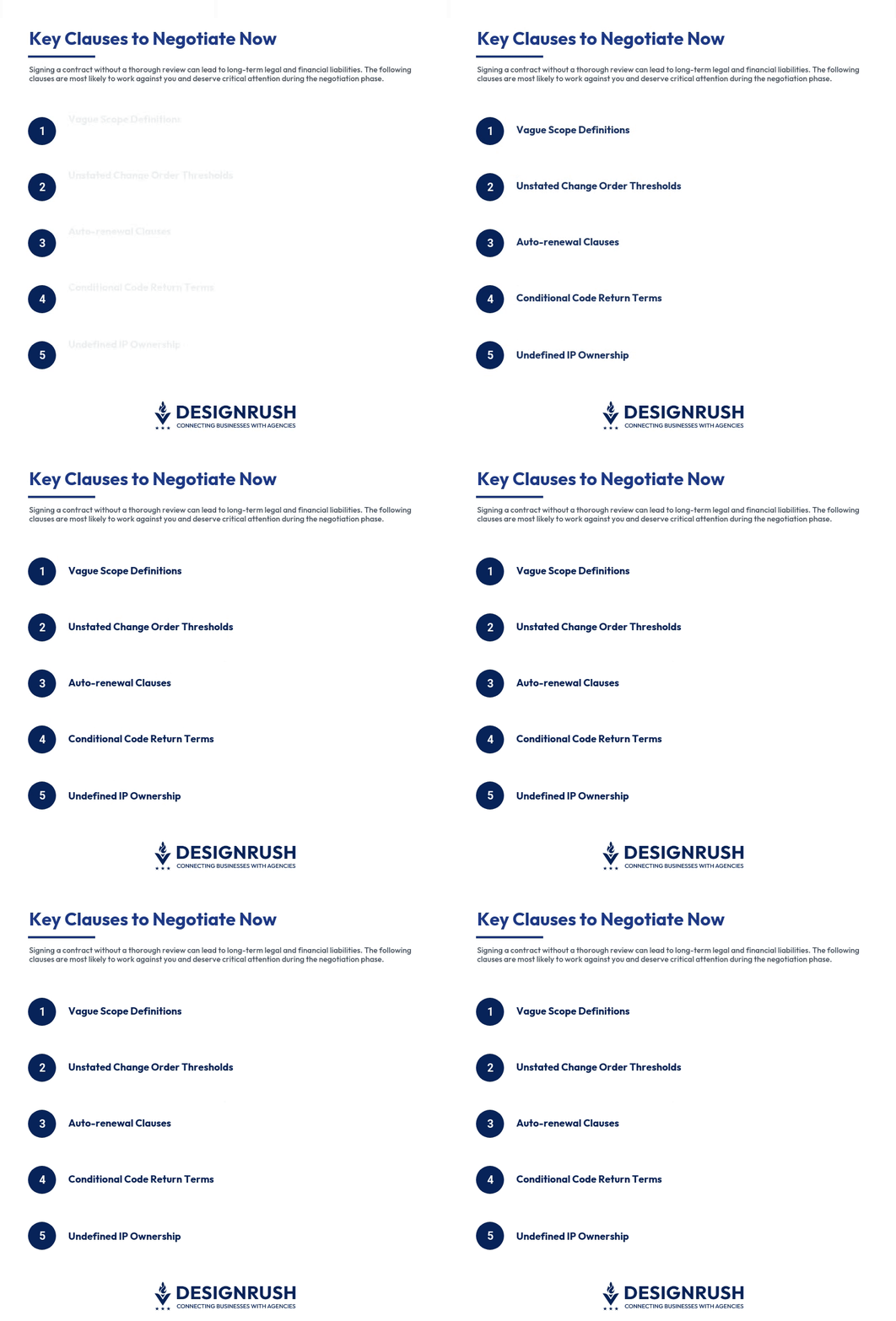
The clauses most likely to work against you and worth negotiating before signing include:
- Vague scope definitions. Language like "software development services as needed" without named deliverables gives the agency latitude to bill for work you did not anticipate authorizing.
- Unstated change order thresholds. The contract should specify what constitutes a scope change, what approval is required, and what it will cost, before any changes are requested.
- Auto-renewal clauses. Contracts that renew automatically with 30 to 60-day cancellation windows can lock you into another full cycle regardless of performance. Make sure the exit terms are explicit.
- Conditional code return terms. Contracts that make returning source code or documentation conditional on outstanding payment create leverage that is difficult to challenge after the fact.
- Undefined IP ownership. Confirm in writing that your business owns all code, assets, and documentation produced during the engagement. Do not assume this is standard; it should be stated explicitly.
How do you choose between two software developers in New York who look equally qualified on paper?
When two agencies carry comparable credentials, similar pricing, and equivalent portfolios, the deciding factor is almost always how each one behaves during the evaluation process itself.
Test these side by side:
| Differentiator | What a strong answer looks like |
| Account ownership | Named engineer with stated seniority and relevant experience |
| Industry depth | Multiple clients in your sector |
| Risk identification | Specific risks called out about your project |
| Communication cadence | Defined check-in schedule, not "we'll be in touch" |
| Response time | Stated commitment, typically 24 to 48 hours |
| Fee transparency | Written, itemized answer given without hesitation |
| Reference quality | Reference offered without prompting, from a comparable project |
What should you have prepared before approaching a software development company in New York?
Agencies quote more accurately, onboard faster, and make fewer assumptions when the buyer comes in prepared. Have the following ready before the first conversation:
- Clear software requirements, description of what you are building, and what problem it solves
- Your current tech stack, if one exists
- Any third-party systems the new software needs to integrate with
- A realistic budget range
- A timeline and what is driving it (a launch date, a funding milestone, a regulatory deadline)
- A list of what you have already tried or ruled out, and why
The last item is underrated, as it allows the agency to understand what you have already attempted and thus spend less of your billable time on approaches you have already rejected.
Sources
DesignRush sustains a directory of over 40,000 agencies categorized by service category, location, expertise, and reviews. We build our database in two ways:
- Our dedicated team of agency experts actively searches the web for top-performing companies. We then pull information from their websites, online presence, and client testimonials to verify their status and qualifications prior to listing.
- The agencies listed get notified of their profiles on the website and they can choose to claim it or not, which suggests their availability for more collaborations.
Agencies can also reach out to DesignRush and must go through the verification process prior to being listed.

Why companies trust DesignRush
Every agency is independently vetted before it can be listed or ranked
 4.8
4.8 4.8
4.8Some agencies pay for sponsored placement, clearly labeled and held to the same vetting standards.
5 Frequently Asked Questions About Software Development Companies in New York
How do I know if I need a software development agency or an in-house hire?
The decision comes down to what you are building and how long you need to build it.
An in-house hire makes sense when software is a core, ongoing function of the business and will likely require continuous iteration and deeper institutional knowledge. An external hire, on the other hand, makes sense when the timeline is fixed or the technical requirements exceed what a single hire could cover.
If the answer to all these questions is “yes,” then likely a specialized agency is a better fit than an in-house hire:
- Do you need something shipped within a specific window?
- Do you need multiple specializations at once?
- Are you not sure yet about the product direction to justify a permanent headcount commitment?
How much do software development companies in New York charge for their services?
Software development companies in New York typically charge $100 or more per hour, though rates as low as $40 per hour exist depending on the agency's size and specialization. North American agencies more broadly average $70 to $200+ per hour, with New York firms at the higher end of that range, given local market costs.
Here are some factors that drive price variation:
- Seniority mix. An agency billing you lower hourly rates is likely staffing your project with junior or mid-level developers, whereas an agency charging higher fees typically means senior engineers will be hands-on.
- Engagement model. Fixed-price contracts carry a built-in risk premium: agencies charge more upfront to protect against scope shifts. Time-and-materials contracts are priced lower per hour but require active management on your end to prevent overruns.
- Specialization. A software development company in New York that works primarily in fintech, healthcare, or regulated industries will price above a generalist shop.
- Project size. Agencies price smaller engagements higher per hour. A $30,000 project will cost more per hour than a $300,000 one from the same firm.
What hidden costs don't show up in the initial quote?
The quoted number and the final invoice rarely match. Notably, research shows that around 70% of software projects exceed their initial budget, with an average overrun of 27%. The gap usually compounds from several smaller add-ons that were not defined at the start.
The most common “hidden costs” include:
- Scope change fees. Any feature or requirement that was not in the original spec gets billed as a change of order, typically at a higher hourly rate than the base engagement.
- QA and testing. Some software developers in New York include testing in the base scope. Many do not. User acceptance testing, load testing, and security testing are frequently itemized separately.
- Infrastructure and environment setup. Cloud configuration, third-party API integrations, and staging environments often appear as separate line items after the contract is signed.
- Post-launch support. Bug fixes, performance monitoring, and small adjustments after go-live are almost always billed separately unless written into the contract upfront.
The simplest protection from such overruns is to ask for a written breakdown of every category of work that triggers an additional charge before signing anything.
Is a larger software development company in New York safer than a smaller one?
Not by default, and for most buyers, the assumption works against them.
Larger software development companies in New York bring staffing depth, structured processes, and institutional accountability. For enterprise-level builds with complex compliance requirements, multi-region infrastructure, or large concurrent engineering teams, that scale is genuinely necessary.
For most projects, the dynamic tends to invert: your account gets assigned to mid-level engineers, senior oversight is limited, and the relationship becomes transactional once the contract is signed. The senior developer who impressed you in the sales call may not be the one writing your code.
The more useful question is who will lead your project day-to-day. Ask for the name, seniority level, and relevant experience of the lead engineer and project manager assigned to your account before signing.
When does it make sense to switch software development companies mid-project?
Here are some situations that justify switching firms mid-project:
- Consistent missed sprint deliverables with no clear explanation
- Engineers who cannot answer questions about their own architectural decisions
- Billing disputes the agency will not itemize or resolve
- A point of contact who relays information but cannot make decisions
- Code that an independent review has flagged as creating long-term technical debt
If you decide to switch, you will need: full codebase access and documentation, all environment credentials and infrastructure configurations, a list of open bugs and known issues, and any third-party API keys or service accounts tied to the project. Do not assume these will be handed over without being asked for explicitly; make them a condition of the offboarding.
The best window to switch is between major milestones, after a working build has been delivered and before the next phase begins. Switching mid-sprint, or worse, mid-launch, multiplies handoff risk significantly.
Latest Trends Related to Software Development
Software Development
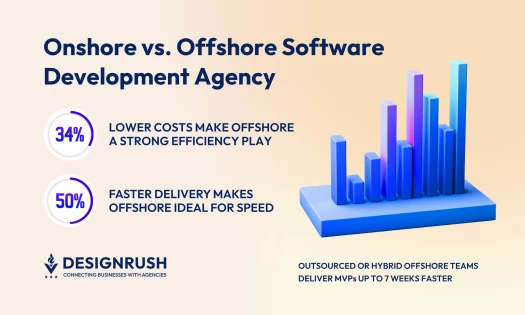
Onshore vs. Offshore Software Development Company: Which One Is a Better Choice?
2,659