Finding a software development company in Texas means filtering through 450+ agencies with wildly different specializations, pricing models, and track records. Our directory does that work for you, profiling verified reviews and real case studies, to help you find a match faster.
Organic rankings are determined by five factors: top services, reviews, portfolio, awards/press, and team expertise. Sponsored listings pay for a placement that appears above organic positions. Sponsorship does not affect star ratings or review content - read more on our methodology page.
A lifelong partner to solve any tech challenge together
Hi there! We were expecting you!We are a nearshore software services and consulting company that partners with forward-thinking companies to achieve their business goals and accelerate growth in the digital age.We are seen as a lifelong partner for tackling any tech challenge...
Top Services:
- Software Development
- Mobile App Development
- IT Services
- UI/UX Design
- Web Development
- Show more
- Location
- Austin, Texas
- Number of Employees
- 100 - 249
- Average Hourly Rate
- $70/hr
- Minimal Budget
- $50,000 & Up
- Portfolios Count
- 1 Project Listed
Data sourced from the agency's DesignRush profile, its website, and other relevant accountsSwitch Software Solutions Services
Data sourced from the agency's DesignRush profilePenske Logistics Santander Consumer Zenus Bank Verifone BBVA Bank Axletree Oddissey BCIE Sodexo Allied World
Switch Software Solutions Reviews & Testimonials
Hernán Garro's Review Sourced from Google
Excellent working place. People is the most valuable characteristic. Interest in continuous improvement is not less remarkable. It is a comfortable place to work with plenty of amenities.
Andres Sierra's Review Sourced from Google
Test your software before taking it to production, do it with what you are developing or with what you are buying.
Reviews verified by DesignRush and sourced from the agency's profile View All Reviews



Software Development Companies in Texas by City
Related Services in Texas
Software Development Specializations in Texas
Popular Services
Everything you need to know before hiring a software development company in Texas
How do I know if I'm ready to hire a software development company in Texas?
You are ready to hire a Texas software development company when you can define the problem your software needs to solve, connect it to a business outcome, and name a single internal person with the authority to approve decisions throughout the engagement.
Before briefing any Texas software company, confirm if you can present the following:
- A problem statement, not a feature list
"We need a client portal" is a feature request. "Our account managers spend 11 hours per week answering status emails that a self-serve portal would eliminate" is a problem statement. The latter allows for faster build, more accurate scope, and fewer questions mid-project. - A realistic, disclosed budget
Withholding your budget will not lead to better proposals. Knowing your bracket upfront eliminates agencies that would underscope your project to win it. - A named internal owner
Projects with multiple decision-makers and no single owner experience longer approval cycles, more change orders, and higher final costs. Assign one person, give them authority, and ensure the agency knows who that person is before the sprint starts. - Defined requirements
If your core requirements have changed more than once in the last four weeks, you are not ready to brief an agency. - Access to your existing technical environment
If you have a current codebase, database, or third-party integrations the new build must connect to, document them before any agency conversation. Agencies that discover mid-project that integrations exist will issue change orders for the discovery work they should have done in week one.
How do I shortlist software development companies in Texas without spending weeks on the wrong ones?
A shortlist should contain up to three agencies, selected by filtering on four non-negotiable criteria before a single conversation takes place: relevant domain experience, project size match, recent client reviews, and a disclosed pricing model.
The sheerness of available options always poses intimidation. Most buyers start reading agency descriptions before applying filters, which means they spend time evaluating agencies for whom they are too small, too large, or in the wrong vertical.
Apply these filters to cut the list before opening any agency profile:
- Project size alignment
An agency whose minimum engagement is $250,000 will assign a junior team to your $80,000 project. Filter for agencies whose stated minimum falls within 50% of your budget in either direction. - Verified reviews with industry relevance
Star ratings without context are meaningless. Look for agencies with three or more verified reviews from clients in your industry, completed recently. - Disclosed pricing model
Any agency that won't share its pricing structure in the first email exchange is creating an information asymmetry that will not resolve itself after signing. Move on. - Founding team tenure
Check the founding team's LinkedIn profiles. Agencies younger than three years carry significantly higher delivery risk regardless of how polished the website is. The portfolio will be thin, the processes immature, and the team more likely to be figuring things out on your project.
Should I start with a pilot project or commit to a full engagement upfront?
For any software engagement over $100,000 or longer than four months, a paid pilot scoped to a real but non-critical deliverable is the most reliable way to validate quality before full commitment.
The pilot will not be a free sample. When agreed to, it is a structured four-to-six-week engagement with a written brief, a defined deliverable, sprint demos, and a handover package at the end.
Pilots should be treated as real projects as they reveal a lot about communication, code quality, and deadline management.
A solid start in that direction is to choose a deliverable that exercises the stack, architecture decisions, and team communication patterns you wish to see.
Then, define what "done" looks like before the pilot begins. A vague success criterion will inevitably produce a vague result.
The first two weeks will reveal how the agency runs the kickoff, provisions environments, and manages the first sprint.
If the pilot delivers late, produces poorly documented code, or requires you to chase status updates, do not rationalize it; these outcomes are your answer if you should trust the agency with the remainder of the project.

How do I evaluate a software development company in Texas if I don't have deep technical knowledge?
Non-technical individuals can evaluate software development companies effectively by measuring the clarity of technical communication.
Namely, if an agency can explain architecture decisions in plain language, it means it understands your problem and can build a product that addresses it.
If you still feel unsure in your capacity to evaluate a developer, consider some of these options:
- Hire a fractional CTO for two to three days
- Ask agencies to argue against their own recommendation
- Ask about post-launch maintenance costs, in addition to build costs
How do I set expectations with a Texas software agency so I'm not disappointed three months in?
The most effective solution in this direction is a written kickoff document, produced and signed by both parties before sprint one.
The document should state who approves what, how quickly decisions must be made, what "done" means for each deliverable type, and what the escalation path is when timelines slip.
Define these four things in writing before development begins:
- Decision SLA: Agree in writing that client responses will arrive within one business day and make it reciprocal, so the agency commits to the same.
- Communication channel: Agencies and clients that communicate across five channels produce five different versions of project status. Agree on one channel and maintain all communication there.
- Definition of "deliverable complete:” Define this for every category before the building sprint begins.
- Escalation path: Name a contact on both sides for issues that cannot be resolved at the project manager level. Define the timeline for escalation: if a blocker is not resolved within 48 hours at the PM level, it moves up.
Sources
DesignRush sustains a directory of over 40,000 agencies categorized by service category, location, expertise, and reviews. We build our database in two ways:
- Our dedicated team of agency experts actively searches the web for top-performing companies. We then pull information from their websites, online presence, and client testimonials to verify their status and qualifications prior to listing.
- The agencies listed get notified of their profiles on the website and they can choose to claim it or not, which suggests their availability for more collaborations.
Agencies can also reach out to DesignRush and must go through the verification process prior to being listed.

Why companies trust DesignRush
Every agency is independently vetted before it can be listed or ranked
 4.8
4.8 4.8
4.8Some agencies pay for sponsored placement, clearly labeled and held to the same vetting standards.
5 FAQs About Software Development Companies in Texas
What are the red flags when evaluating software developers in Texas?
The clearest red flag is an agency that skips a paid discovery phase and moves directly to writing code, which almost always leads to scope creep, plenty of rework, and a final bill that bears no resemblance to the original quote.
If the development requirements are not well defined prior to billing, the ambiguity works in the software agency’s favor as it allows it to add more billable hours. Here are some other warning signs to look for during evaluation:
- No structured discovery phase offered. Any agency that can quote a fixed price within 48 hours of a brief discovery call hasn't fully scoped your project.
- Case studies that show screenshots but not outcomes. A credible case study should name the client, the problem, the timeline, and the outcome.
- The team you meet in sales is not the team building your product. Ask to meet your assigned project manager and lead developer before signing.
- Vague answers on IP ownership. You should own 100% of the code on day one after final payment. Any hedging on this needs a lawyer before you proceed.
- No defined communication frequency in the contract. If sprint reviews, status reports, and escalation paths aren't written into the agreement, you'll be chasing updates six months in.
- References are unavailable or from more than three years ago. Tech projects fail regularly; ask for two references from engagements completed in 2024 or 2025.
What do software development companies in Texas charge that most clients don't expect?
Project management overhead and infrastructure provisioning routinely add 30% to 50% to the base development rate. Here's what other costs are commonly add-ons:
- Change order premiums. Every feature added after scope sign-off is typically billed at a higher rate. Agencies add 20% to 40% contingency to fixed-price quotes simply because requirements almost always change.
- Post-launch support and maintenance. Annual post-launch support for any application is rarely included in a proposal for the build phase.
- Cloud infrastructure and DevOps setup. AWS, Azure, or GCP configurations do not fall under development, and agencies often bill them separately.
- QA and testing. Many proposals quote for development hours only.
- Handover and documentation. At the end of the engagement, you need working documentation to maintain and extend the codebase.
What's the difference between a good Texas software agency and an average one?
The difference between a good and average software developer in Texas will reflect in the way they handle your first two conversations: a good agency asks harder questions than you do, while an average agency rushes to propose solutions before understanding the problem.
Here's what separates them across the five critical evaluation criteria:
| Criteria | Average agency | Good agency |
| Discovery | Quotes after one call | Charges for discovery; won't quote without it |
| Case studies | Screenshots and logos | Named client, defined problem, measurable outcome |
| Team access | Sales team only pre-contract | Introduces your actual PM and lead dev before signing |
| Scope handling | Agrees with everything you say | Pushes back on unrealistic timelines or budgets |
| Risk discussion | No mention of what could go wrong | Mentions technical and timeline risks proactively |
What should a software development case study feature?
A case study worth taking seriously names the client or offers a reference call, describes the specific technical problem, identifies the stack used, and quantifies a measurable outcome. Here's what to look for:
- A defined starting point: Where was the client's system before the engagement? Without a baseline, be it legacy architecture, error rate, deployment frequency, or user drop-off, there is no way to evaluate how much the agency actually moved.
- A specific problem: "The client needed a modernized platform" is not a problem. "The client's monolithic architecture was preventing deployments more than once per quarter" is. The specificity of the problem statement tells you how precisely the agency scopes work.
- Stack and architecture decisions explained: Why did they choose that framework, cloud provider, or database? Agencies that can articulate sequencing decisions understand software architecture as a system.
- Timeline honesty: How long did the engagement actually run versus what was originally scoped? An agency that only presents on-time, on-budget case studies is either working in low-complexity environments or omitting the engagements that didn't go as smooth.
- A business outcome: Deployment frequency doubled. Support ticket volume dropped 60%. Time-to-close for sales-assisted workflows cut from 14 days to 3. If the case study stops at "we re-architected the backend," ask directly why no business result is cited.
How do I choose between two software developers in Texas that look equally qualified on paper?
When two software development companies look equally qualified on paper, the differentiator is always process. Ask each one the same operational questions and compare the specificity of their answers:
- What happens if a requirement needs to change mid-sprint?
A named change order process with a written approval step is the right answer. "We're flexible" is not. - How do you handle a project that falls behind schedule?
You're looking for a specific escalation contact and a defined timeline for resolution. - Who do I contact at 4pm on a Friday with an urgent issue?
The answer should be a name, not a reference to a support portal. - Can I see a sample sprint report from a current engagement?
Redacted client information is expected. What you're evaluating is the format, the depth, and whether it's the kind of document that would actually keep you informed. - What would you do differently if you could restart your most recent project?
An agency with no candid answer to that question hasn't examined its own work closely enough to improve it.
Latest Trends Related to Software Development
Software Development
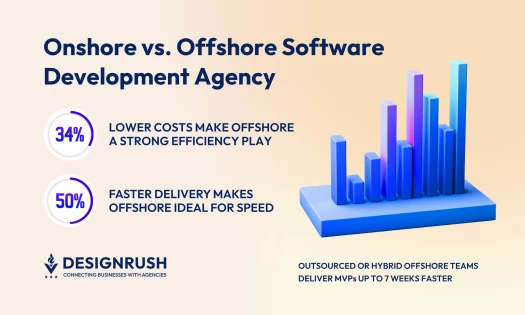
Onshore vs. Offshore Software Development Company: Which One Is a Better Choice?
2,658