How To Hire Austin Web Design Companies Table of Contents
How do I shortlist Austin web design agencies faster? Shortlist Austin web design agencies faster by filtering three hard criteria first, before you look at a single portfolio: relevant industry experience, projects in your budget range, and a clear, transparent process.
Most buyers waste weeks because they start with portfolios, which all look impressive by design, rather than with the criteria that actually predict a good fit.
Here is a faster way to build a shortlist:
Filter by industry and project type first. A team that has built sites like yours will understand your buyers and your technical needs without a long ramp-up.Match the budget before falling in love. Confirm a team works in your range early, so you do not spend hours on a partner you cannot afford.Look for a documented process. Discovery, design, development, testing, and launch. A team that cannot describe its process clearly will improvise on your time and your money.Read reviews on independent platforms. Third-party verified reviews are harder to fake than testimonials curated on a company's own site.Check for live, launched work. Ask for URLs you can visit, not just images.If you skip this filtering and dive straight into portfolios, you will spend days comparing web designers in Austin who all look equally talented, with no basis to choose. The criteria give you that basis, and they apply just as well whether you are comparing boutique studios or established Austin web design services.
Once you have four or five options that clear these bars, then look at portfolios and book calls. 75% of users judge a business's credibility on web design alone, so a shortlist built on proven, relevant work protects the single most visible asset your business has.
Whether you end up with a small studio or a larger web design company in Austin, the filtering step is what makes the final choice defensible.
What contract terms should you review before hiring an Austin website design agency? The most important contract terms to review before hiring an Austin website design agency are ownership, scope, payment, and exit, because these four decide what you walk away with and what it costs you if the relationship ends.
Review these terms line by line:
Ownership of code, content, and assets. The contract must state in plain language that you own the finished website, source files, and content once payment is made in full. Skip this, and you may be unable to move or edit your site without the original provider.Scope and revision limits. How many rounds of revisions are included, and what triggers a paid change order? Vague scope is the number one source of surprise invoices.Payment schedule and milestones. Tie payments to delivered milestones, not the calendar. Avoid paying the majority up front before you have seen real work.Intellectual property for custom web design features. If the team builds custom functionality, confirm that you can keep and reuse it.Termination and handoff. What happens if you part ways mid-project? A fair contract defines how files and access are transferred, so you are never held hostage.Warranty period. A defined window for fixing bugs at no cost after launch.Push back on any clause that keeps ownership with the provider, auto-renews a retainer without notice, or leaves scope open-ended. If a team resists putting these terms in writing, treat that as your answer and move on.
Should I start small or commit to a full website rebuild? Start with a smaller, defined project when you are unsure about a team, and commit to a full rebuild only once they have proven they can deliver, communicate, and hit deadlines.
A pilot project, such as a landing page, a single template, or a design concept for your homepage, lets you test the working relationship with limited risk.
Here is how to decide:
Start small if you have not worked with the team before, your budget is tight, or your internal requirements are still shifting. A pilot reveals how a team communicates and handles feedback before you commit your full budget.Commit to a full rebuild if you already trust the team, your current site is actively hurting your business, or a piecemeal approach would cost more in the long run through repeated setup and coordination.The risk of committing to a full rebuild with an unproven team is obvious: you discover the communication problems, missed deadlines, or quality gaps only after you have paid most of the budget. The risk of starting too small is subtler.
A disconnected pilot may not reflect how the team handles a complex, integrated build. The safest approach is a paid pilot that is a real slice of the larger project, so what you learn actually applies to the full engagement.
This is where working with experienced Austin web design services pays off, because a seasoned team will scope a pilot that genuinely predicts the full build.
What process and timeline should I expect after hiring an agency? After hiring a web design agency in Austin, TX, expect a five-stage process that runs roughly 6 to 12 weeks for a standard custom site: discovery, design, development, testing, and launch. Knowing this arc lets you spot when a project is drifting and hold the team accountable at each stage.
The table below shows what typically happens in each phase and what you are responsible for.
Stage What the agency does What you provide Duration Discovery Research, goals, sitemap, requirements Business goals, brand assets, content direction 1 to 2 weeks Design Wireframes, visual mockups, revisions Timely feedback, approvals 2 to 3 weeks Development Building pages, features, integrations Final content, logins, access 2 to 4 weeks Testing Bug fixes, device and browser checks Review, sign-off 1 week Launch Deployment, final checks, handoff Go-ahead, DNS or hosting access A few days
The single biggest cause of delay is slow client feedback, so the timeline above assumes you respond within a few business days at each approval point. If your internal reviews take weeks, expect the total to stretch accordingly.
A reliable team gives you this schedule in writing at kickoff and updates you when a milestone slips, rather than going quiet. If a provider cannot describe its process this clearly before you sign, that is a preview of how the project will run.
How do I know whether to switch web design agencies or give the current agency more time? Switch web design agencies when the problems are about trust, communication, or repeated missed commitments, and give the current team more time when the issues are about results that simply need longer to materialize.
The distinction matters because switching mid-relationship is expensive in money, time, and lost momentum, so you want to be sure the problem is with the partner, not the timeline.
Give them more time when:
Communication is honest and responsive, even when the news is not good. Missed targets come with a clear explanation and a revised plan. The work is technically sound, and the results are trending in the right direction, just slower than hoped. Switch when:
Deadlines slip repeatedly with no explanation or accountability. You cannot get straight answers about status, cost, or ownership. The same mistakes recur after you have raised them. You do not own your own assets, and the team uses that as leverage. Before you switch, make sure you can take your website, content, and accounts with you, which comes back to the ownership terms in your contract. Document the problems in writing and give one clear, final chance to fix them. If nothing changes, move on.
Staying out of sunk-cost loyalty only compounds the loss. Plenty of capable web designers in Austin are ready to take over a project when the current relationship has run its course. Among the many Austin web design companies competing for that work, a fresh team with a clean handoff often revives a stalled site faster than you expect.
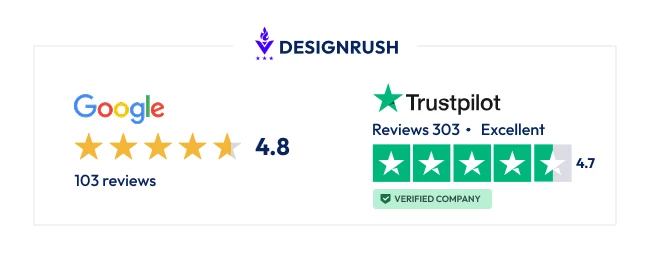
Why People Trust DesignRush Rated 4.8 on Google and 4.7 on Trustpilot , DesignRush Agency Directory is a reliable resource for finding Austin web design services. We owe this to our executive selection team, which follows a strict screening process when featuring agencies on the platform, assessing key performance indicators, like portfolio, client reviews, and industry reputation.
Learn more about DesignRush Agency Ranking Methodology .
Sources DesignRush sustains a directory of over 40,000 agencies categorized by service category, location, expertise, and reviews. We build our database in two ways:
Our dedicated team of agency experts actively searches the web for top-performing companies. We then pull information from their websites, online presence, and client testimonials to verify their status and qualifications prior to listing. The agencies listed get notified of their profiles on the website and they can choose to claim it or not, which suggests their availability for more collaborations. Agencies can also reach out to DesignRush and must go through the verification process prior to being listed.



 Proposals