-details-webp.webp)

Logo Design Prompts: Key Points
- Prompt Engineering = Strategic Advantage: 27% of SMB owners consider prompt engineering a critical business skill.
AI Design Systems Are a Monetization Engine: Agencies are upselling AI-assisted services via retainer packages, speed-to-market solutions, and prompt-based asset licensing, reducing overhead while expanding revenue opportunities.
Tool Stack Determines Output Quality and Workflow Speed: Tools like Midjourney (creative freedom), Ideogram (typography accuracy), and Adobe Firefly (commercial-ready vectors) offer strategic use cases. Vectorizer.AI and Figma bridge the gap from concept to client-ready formats.
Pressed for time? Listen instead.
We break down the most actionable parts of this article — stats, strategies, and real-world applications — in our Spotify audio summary.
Stream the full discussion here.
Visual branding is entering a new era, one where AI tools like Midjourney and DALL·E can generate logo concepts in seconds. But raw power isn't strategy.
For agency leaders and brand decision-makers, the real opportunity lies in harnessing AI with precision, through logo design prompts and prompt libraries that scale creativity without sacrificing brand control.
This guide shows how prompt engineering is becoming the backbone of scalable, sellable, and brand-safe logo design in the AI era.
What Are AI Logo Design Prompts?
AI logo prompts are written instructions that tell generative tools (like Midjourney, DALL·E, or Ideogram) what kind of logo to create. But effective prompts go beyond vague descriptions.
Why It Matters
Generic prompts = generic results. The more specific your prompt, the more brand-safe and commercially viable the output.
4 Types of AI Prompts for Logo Design
Not all prompts are created equal. Understanding the different types helps match prompt strategy to brand goals.
Before writing your next logo prompt, it’s essential to understand which type fits your design objective.
Let’s take a closer look at how each prompt type works and when to use it in your creative workflow.
1. Functional Prompts
Focus on where and how the logo will be used. These prompts are driven by application: platforms, mediums, and audience needs.
Prompt Structure Example:
"Design a logo for a children's educational app. Use bright, engaging colors, rounded shapes, and highly legible text. Ensure it's optimized for small mobile screens and app icons."
Best For: Specific product use (apps, packaging, apparel)
Tip: Mention screen sizes, resolution needs, or placement context (e.g., “on tote bags,” “in dark UI”).
2. Descriptive Prompts
Use when the brand's visual language is well-defined. Focus on style, structure, and tone.
Prompt Structure Example:
"Create a minimalist tech logo with clean geometric lines, a cool-toned gradient (blue to teal), and a sans-serif wordmark. Place it on a white background with ample negative space."
Best For: Brands with a strong aesthetic direction
Tip: Call out desired shapes (e.g., “hexagon-based icon”) and visual balance (“centered composition”).
3. Inspirational Prompts
Use references to guide tone—whether iconic brands, design eras, or specific creatives.
Prompt Structure Example:
"Generate a brand mark inspired by Apple’s simplicity and elegance. Prioritize smooth curves, subtle use of negative space, and a grayscale palette."
Best For: Evoking familiar styles or paying homage
Tip: Pair artist or brand references with clear direction (e.g., “inspired by Bauhaus minimalism”).
4. Conceptual Prompts
Express what the brand stands for. Translate positioning or core values into symbolic visual language.
Prompt Structure Example:
"Design a logo that visually conveys trust, authority, and innovation. Suitable for a real estate consultancy targeting high-net-worth individuals. Avoid literal house icons; aim for abstract, modern shapes."
Best For: Mission-led brands, early-stage companies
Tip: Define emotional tone and desired perception (e.g., “feels premium, not flashy”).
Agency Tip: Consider building your own internal prompt libraries organized by brand vertical or aesthetic style. This allows teams to quickly retrieve prompts based on sector, saving time and improving visual consistency.
How to Craft an Effective AI Logo Design Prompt
According to Adobe, 27% of small business owners say prompt engineering is a "very important" skill for their business.
Effective prompts are part art, part syntax, whether you’re using Midjourney, Firefly, or Ideogram. An effective AI prompt for logo design should include:
- Logo Type: Wordmark, pictorial mark, monogram
- Structure Keywords: vector logo, badge, flat design
- Style Cues: Minimalist, vintage, brutalist, playful
- Brand Context: Industry, tone, audience (e.g., “luxury skincare” or “esports team”)
- Color Palette: Specific hues or gradients
- Output Modifiers: White background, high-res, 300dpi, centered composition 1:1 aspect ratio, etc.
Universal AI Prompt Template:
"[Style cue] [structure keyword] for [brand context], [color palette], [format modifiers] --v 5 --ar 1:1"
Understanding Logo Types and How to Prompt for Each
Not all logos are built for the same job, and neither are the prompts behind them.
Whether you're crafting a scalable brand system or pitching first-round concepts to a client, knowing the anatomy of each logo type helps you guide AI with purpose.
The more intentional your prompt, the more viable your results.
1. Pictorial Mark (Brand Mark)
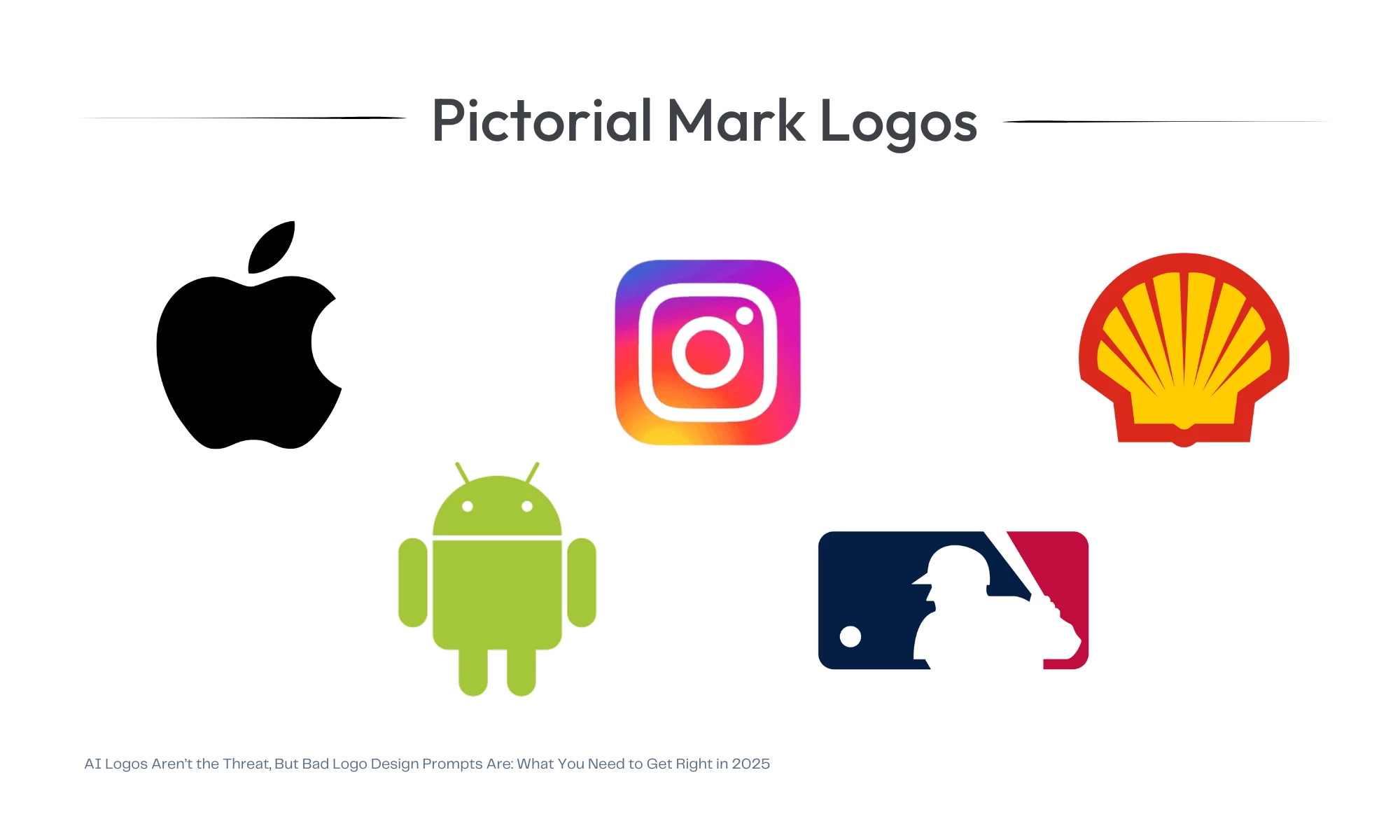
A symbol or icon-based logo that can stand on its own without text, think Apple, Twitter, or Shell. These are best suited for companies with strong brand recognition or visual storytelling.
You can pair your symbol with text, but the mark should also be recognizable on its own. That’s what makes this logo type powerful and risky.
For newer brands without strong recognition, it can be a challenge.
To work well, aim for a design that is:
- Instantly identifiable
- Simple enough to scale
- Visually distinctive without relying on text
Prompt Strategy: Use minimalism and clarity in the description
"pictorial mark logo of a hummingbird in flight, minimalist, clean lines, vector-style, white background --v 5 --ar 1:1"
Style Reference: Paul Rand (IBM, ABC), Rob Janoff (Apple), Sagi Haviv (US Open).
2. Gradient Logos
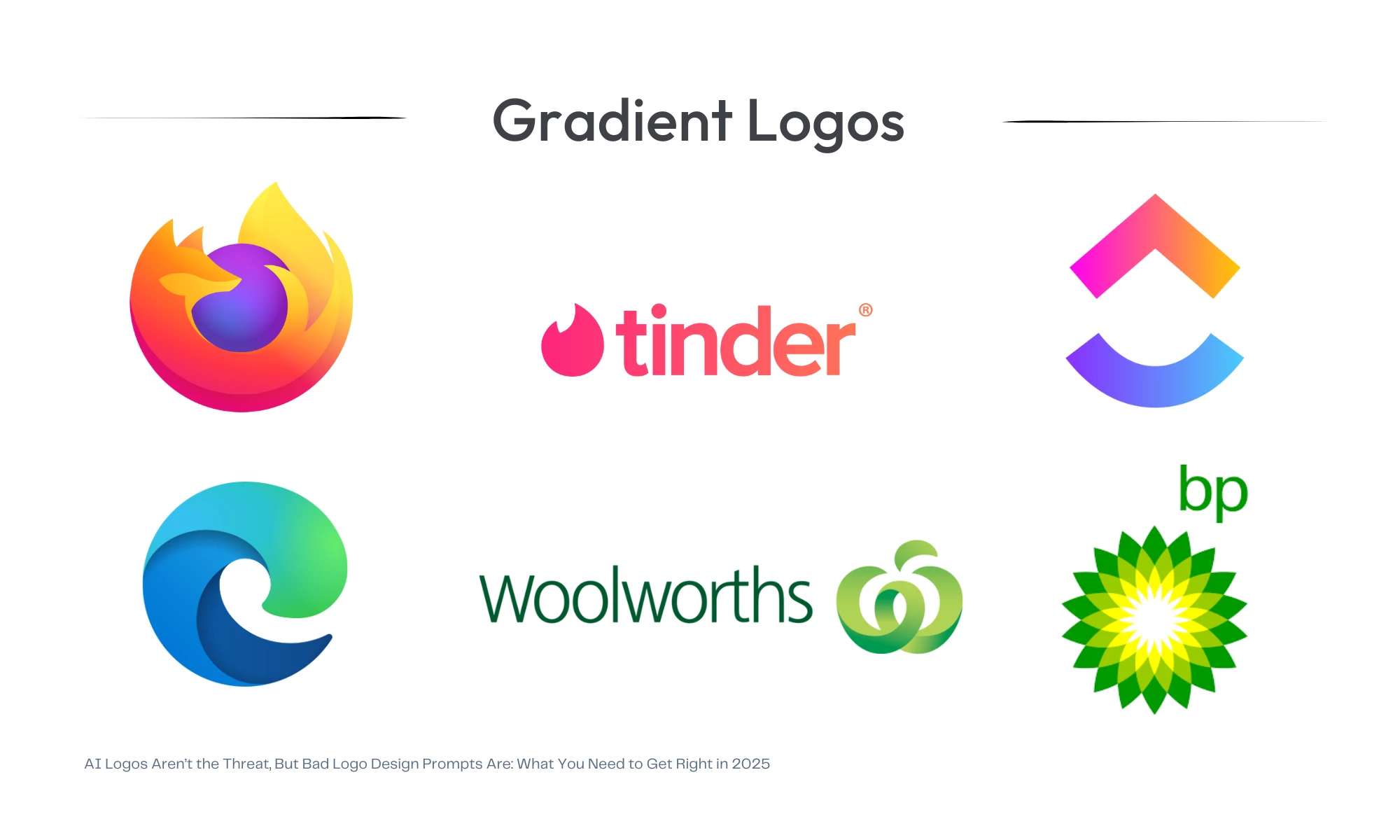
Gradient logos use smooth color transitions to create visual energy, depth, and modernity, often without adding complexity.
They’re especially effective for digital-first brands in tech, lifestyle, and media. Think Instagram, Firefox, or Adobe Creative Cloud.
Gradients can be subtle or bold, but without clarity, AI will default to extremes. To get brand-usable outputs, make sure to guide the structure and flow.
Great gradient logos are:
- Clean and scalable (not overly complex)
- Defined by controlled color transitions
- Balanced between vibrancy and brand readability
Prompt Strategy: Be precise with gradient direction and palette
"gradient logo with linear transition from royal blue to teal, geometric icon, centered on white background, vector format"
Style Reference: Mackey Saturday (Instagram), Pentagram (Firefox), Moving Brands (Netflix system marks)
3. Minimal Line Art
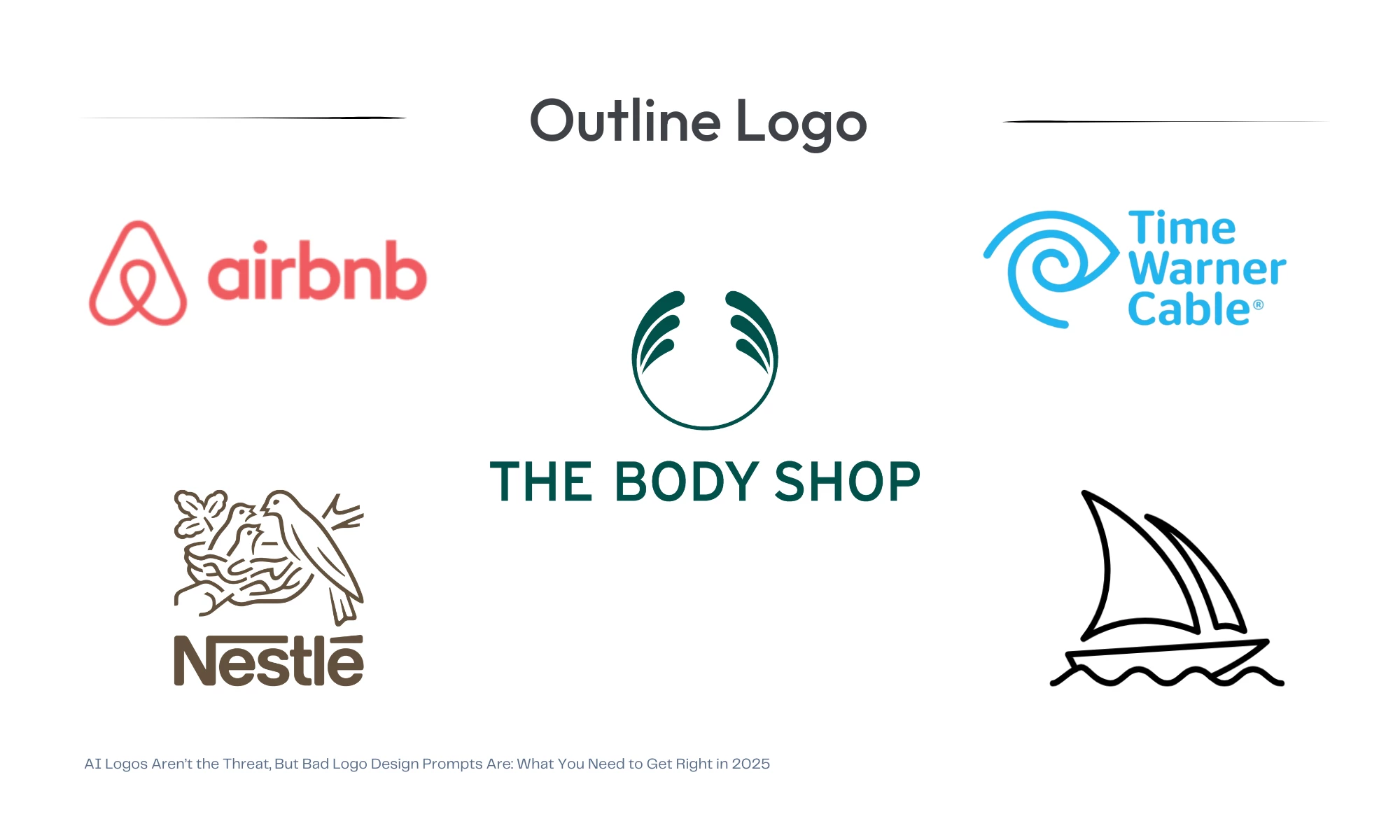
Minimal line logos lean into restraint: single strokes, negative space, and ultra-clean geometry.
Popular across beauty, wellness, and boutique brands, they evoke refinement without noise. Examples include Glossier, Aesop, and the original Airbnb Bélo.
They may seem simple, but line logos are hard to get right. To work, they must be:
- Structurally clear and visually intentional
- Readable at all sizes
- Conceptually strong despite few elements
Prompt Strategy: Use structural cues like single-line icon or continuous stroke illustration
"minimal line art logo of a lotus flower, single-stroke vector drawing, soft beige on white background, balanced composition"
Style Reference: Stephane Leopold, DesignStudio (Airbnb)
4. Wordmark
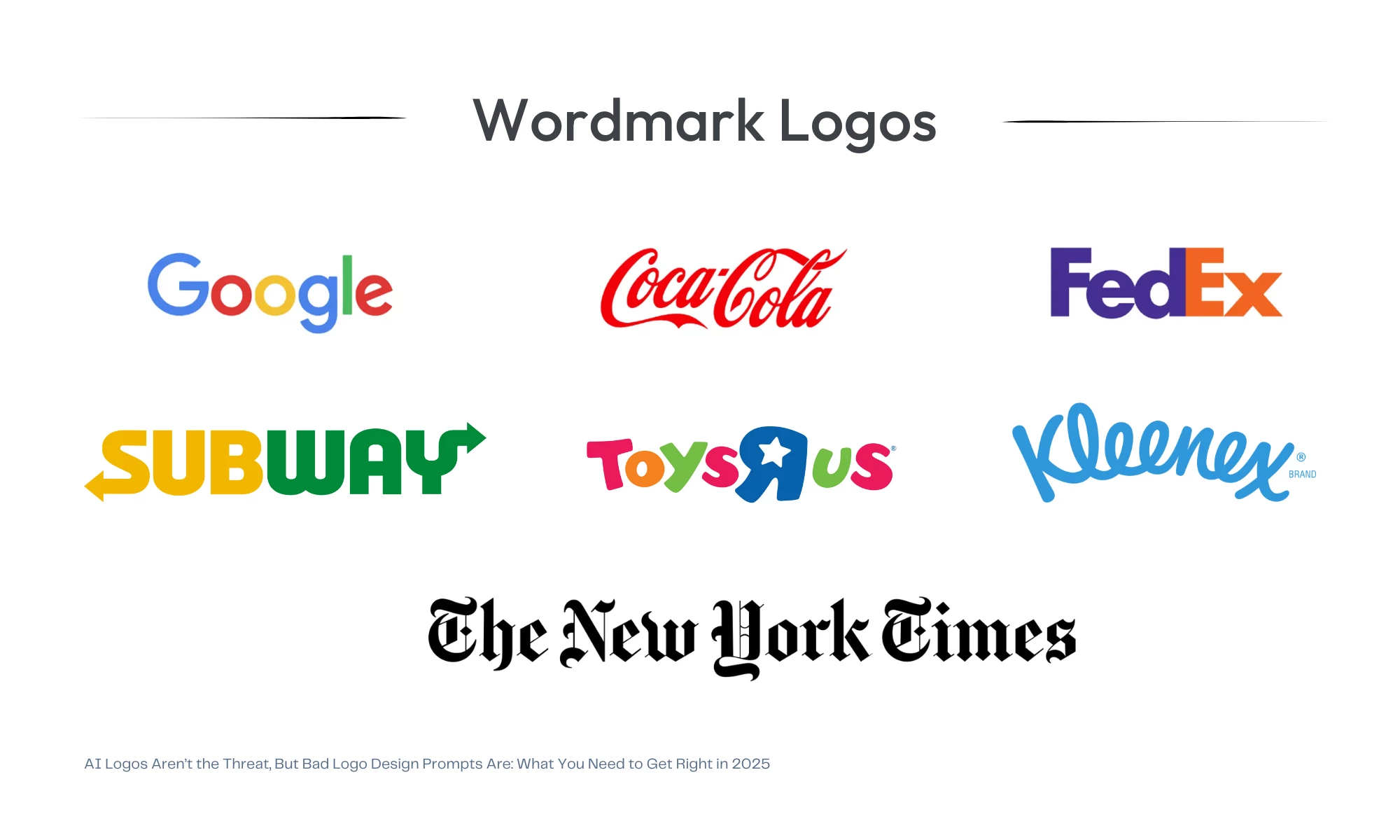
A typography-only logo that relies entirely on the brand name for recognition — no symbols, no icons, like Google, Coca-Cola, or FedEx.
Wordmarks are best suited for companies that want to build strong name recall and don’t have (or don’t need) a standalone icon.
What makes a wordmark effective isn’t just the typeface, it’s how the letterforms are customized to convey tone, positioning, and differentiation.
Strong wordmarks are:
- Built on distinct, ownable type choices (custom or modified)
- Designed with precise kerning, spacing, and balance
- Scalable and legible across mediums, from screens to packaging
Prompt Strategy: Focus on typography style, tone, and layout.
Include terms like bold sans-serif, custom ligature, wide tracking, or italic serif depending on the brand voice.
"wordmark logo for a modern skincare brand, custom serif typeface, elegant spacing, black on white, vector format"
Style Reference: Massimo Vignelli (American Airlines), Herb Lubalin (Avant Garde, Mother & Child).
5. Lettermark (Monogram)
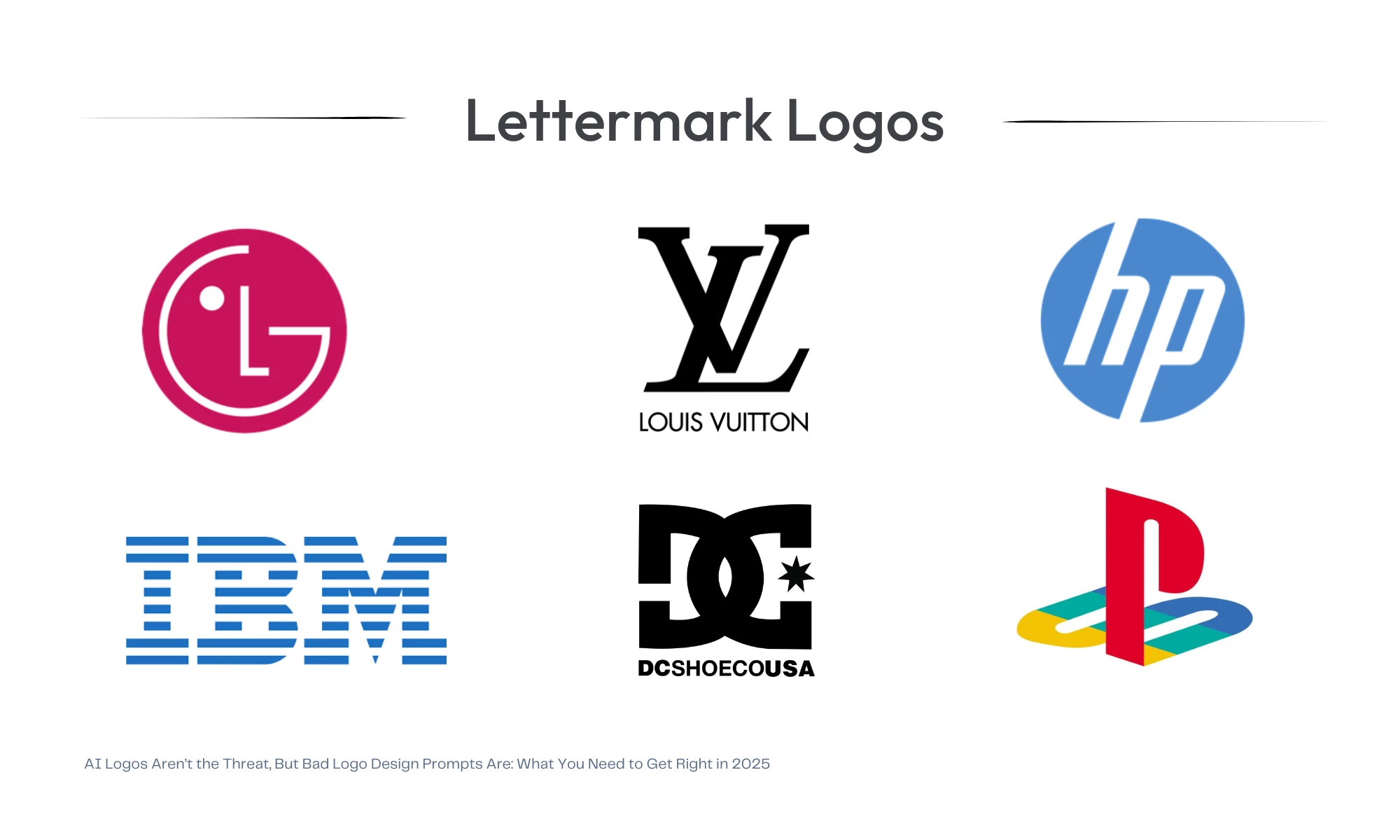
Initial-based logos that simplify long brand names — examples include IBM, LV, CNN.
Unlike wordmarks, which rely on full name recall, lettermarks focus on creating quick visual recognition through a tight combination of just one to three characters.
A well-executed lettermark:
- Uses custom typography to avoid generic, forgettable letterforms
- Prioritizes balance and spacing to feel cohesive at all sizes
- Works well on limited real estate (app icons, favicons, apparel)
Prompt Strategy: Focus on initials, symmetry, font weight, and brand tone.
"monogram logo using letters L & M, modern serif font, symmetrical design, luxury aesthetic, gold foil on black, vector format"
Style Reference: Jessica Walsh (bold typographic monograms), Yves Saint Laurent, Chanel, NASA (lettermark refinement through negative space)
Stay sharp. Stay relevant. These 2025 design trends can fuel your next round of AI prompts with fresh, on-brand inspiration.
6. Combination Mark
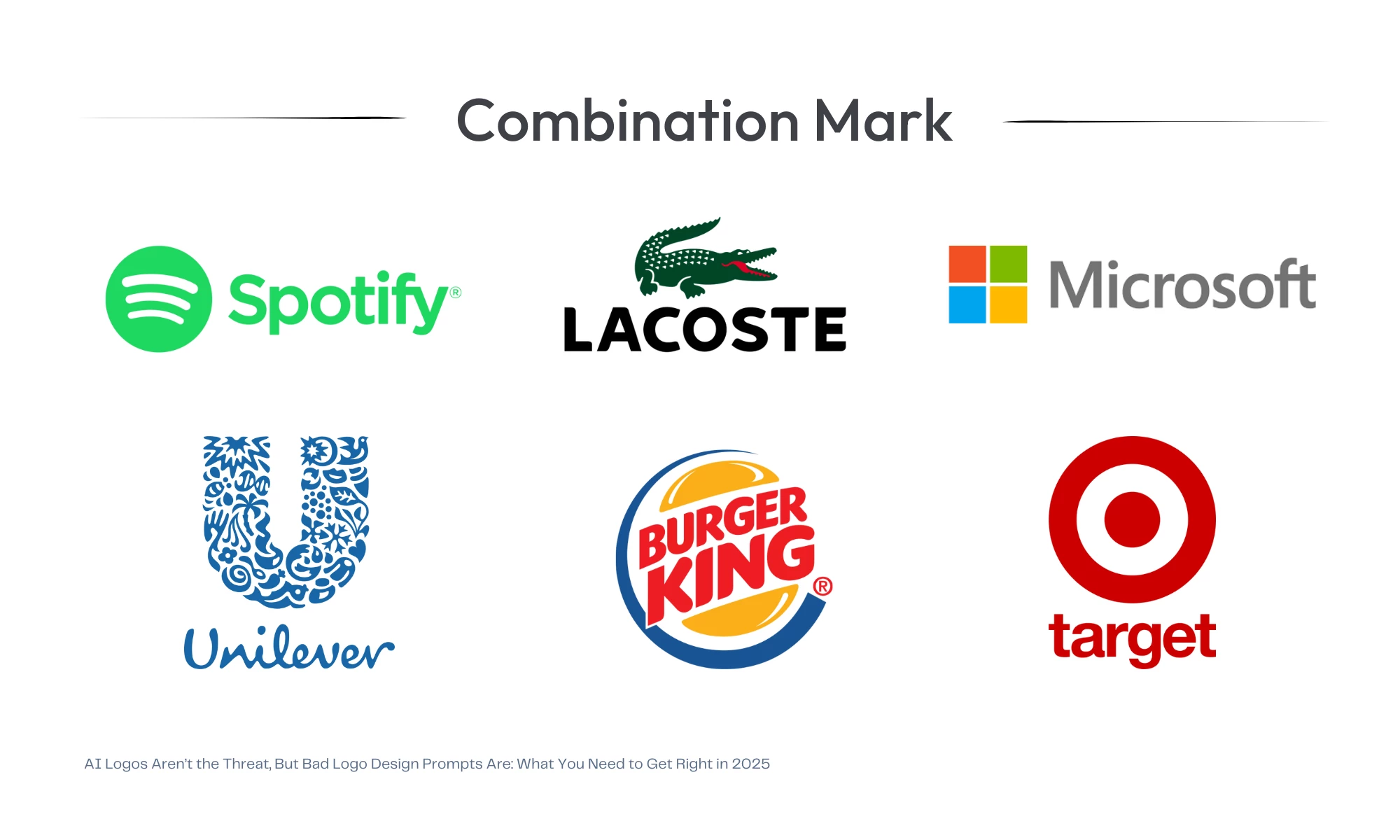
Combines a pictorial or abstract symbol with a wordmark, allowing brands to toggle between text-only, icon-only, or hybrid formats. Seen in brands like Adidas, Lacoste, Spotify, and Burger King.
This format offers strong flexibility across digital and print touchpoints.
When well executed, it reinforces name recognition and visual identity simultaneously. Effective combination marks:
- Maintain clear hierarchy between text and symbol
- Can be split apart for modular use (e.g., favicon vs. packaging)
- Align visual style of icon and wordmark for brand cohesion
Prompt Strategy: Emphasize structure with terms like icon plus wordmark, horizontal layout, stacked format, or side-by-side. Add brand tone and format cues.
"combination logo with stylized wave icon and brand name 'Auralux', cool blue palette, minimalist composition, sans-serif text, horizontal layout"
Style Reference: Paula Scher (Spotify redesign), Adidas, Lacoste
7. Abstract Mark
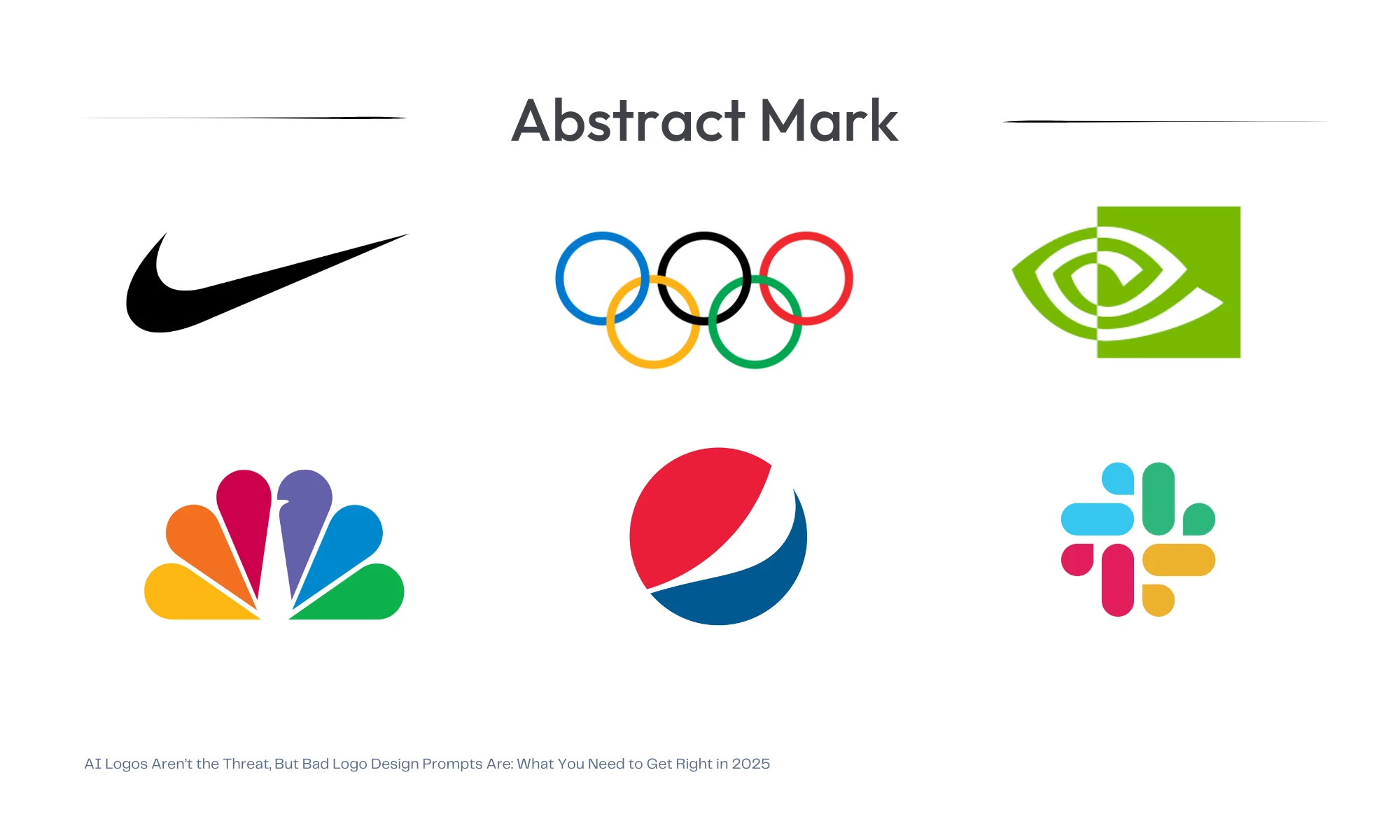
Uses non-literal shapes and geometric forms to evoke ideas, emotion, or uniqueness, without depicting specific objects, as seen in Nike’s swoosh, Pepsi’s globe, or Chase Bank’s octagonal symbol.
Best suited for brands that want to convey a distinct identity without being overly descriptive.
When crafted well, abstract marks:
- Offer strong visual distinctiveness
- Scale across media and geographies without language barriers
- Leave room for brand storytelling and interpretation
Prompt Strategy:Include keywords like abstract symbol, dynamic geometry, or non-representational mark, and specify layout or palette.
"abstract mark using intersecting gradient circles, minimal composition, futuristic style, brand identity for global tech platform"
Style Reference: El Lissitzky, Pentagram (Windows 8), FutureBrand (Visa refresh)
8. Emblem
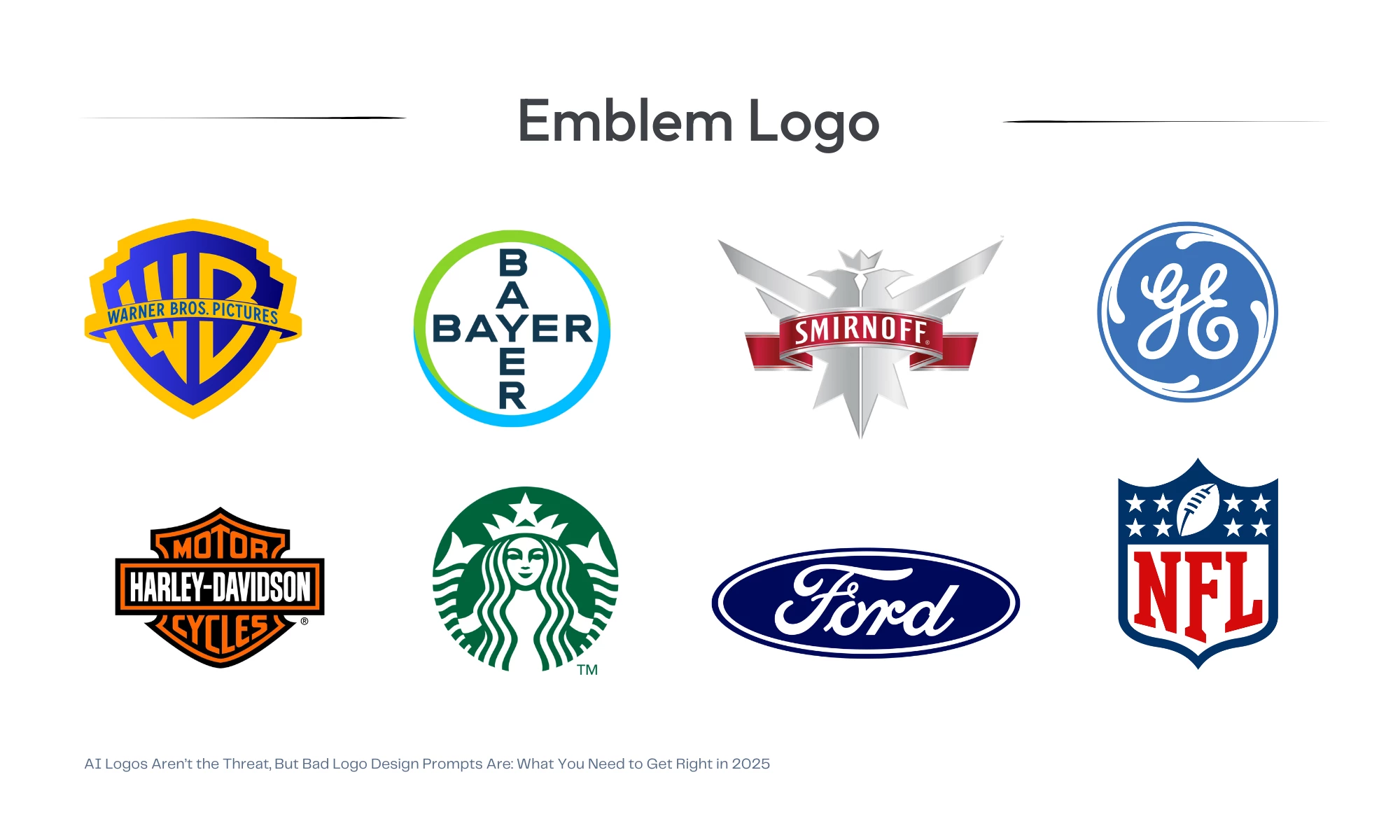
Text enclosed within a badge, seal, or shield, often traditional, dense, and layered in style. Used by Starbucks, Harley-Davidson, US universities, and government agencies.
This format evokes heritage and institutional credibility. Effective emblem logos:
- Use symmetry and framing to establish authority
- Employ detailed illustration or iconography to signal craft
- Require clear vector structure to ensure legibility at small sizes
Prompt Strategy:Use structure terms like badge, crest, stamp, or seal. Mention framing elements and font styles.
"emblem logo for artisanal coffee roaster, vintage crest with banner text, illustrated plant icon, serif typography, earth tone palette"
Style Reference: Saul Bass (Yale School of Architecture), Starbucks, Levi’s
9. Mascot Logo
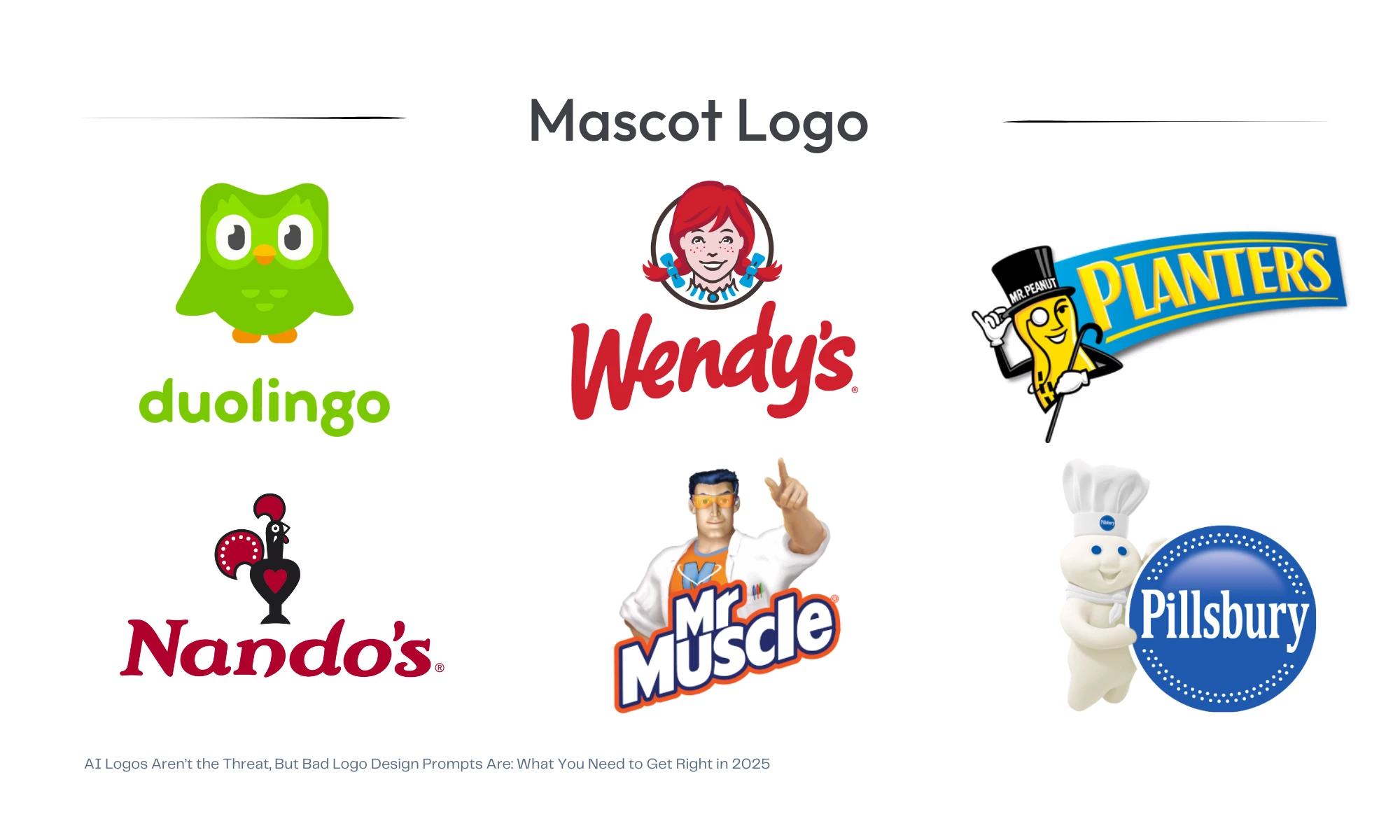
Features a character or illustrated figure that personifies the brand. This is ideal for youth-oriented or casual brands. Seen in KFC, Mailchimp, Pringles, and Duolingo.
Mascot logos drive emotional connection and are highly versatile in animation, merch, and brand storytelling. Solid mascots logo:
- Are expressive and personality-driven
- Use bold outlines and distinctive color palettes
- Work across static and motion-based formats
Prompt Strategy:Use descriptors like cartoon mascot, friendly character, playful expression, and specify species or personality traits.
"mascot logo of a cheerful red panda, cartoon style, bold outlines, warm color scheme, brand mascot for eco kids platform"
Style Reference: Duolingo Owl, Mr. Peanut, Wendy's
Best Practices for Crafting Effective AI Logo Prompts
McKinsey’s 2024 data tells a sharp story: 99% of C-suite leaders say they’re familiar with generative AI, but most underestimate how deeply it’s already woven into daily creative work.
While executives believe only 4% of employees use gen AI for a third of their tasks, the actual number is more than triple. That disconnect more than a tech issue, it’s a strategy gap.
If you're leading a brand or agency, prompt fluency is no longer optional. It's the difference between output that wows and noise that drains resources.
The following best practices are your short course in precision prompt writing, designed to help you generate logo concepts that are usable, scalable, and on-brand from the start.
- Be Hyper-Specific: The more granular your details (shapes, colors, textures, lighting, angles), the more precise the output.
Don't assume the AI knows what you mean by "modern" – define what makes it modern (e.g., "minimalist lines," "futuristic typography"). - Emphasize Vector/Scalability: Always include terms like "vector art," "flat design," "clean lines," "scalable," "graphic design," "illustration," to ensure the output is suitable for a logo.
Avoid "photorealistic" unless specifically aiming for a complex mascot or emblem. - Specify Background: "White background," "transparent background," "isolated on white," "clean background" are crucial for practical logo use.
- Aspect Ratio: For logos, 1:1 (square) is generally ideal for versatility.
- Iterate and Refine: AI generation is a dialogue. Start with a clear prompt, then refine based on what the AI produces. Use "remix" or "variations" features if available.
- Negative Prompts (where applicable): Use negative prompts to exclude unwanted elements (e.g., "no text," "no busy background," "no blurry edges").
- Brand Context is King: Always tie the design back to the brand's industry, target audience, and core values.
This helps the AI understand the purpose of the logo.
Writing better prompts starts with knowing your brand’s personality.Use this guide to align your logo prompts with proven archetypes.
How Logo Design Prompts Drive Scalable Creative Workflows
For agencies handling multiple clients, efficiency is revenue. Prompt-based design systems enable:
- Rapid ideation: Faster generation of brand-specific visuals for moodboards, client pitches, and early-stage concepts.
- Asset consistency: Using structured prompts ensures uniform output across client deliverables, from brand kits to social avatars.
- Cost control: Cuts down on manual iterations and early-stage creative bottlenecks, improving team utilization.
Agency Insight: The same McKinsey report also states that the long-term value of AI in corporate environments is estimated to reach $4.4 trillion in added productivity.
For agencies, that translates directly into scalable growth models when AI tools like prompt-based design systems are effectively implemented.
Monetizing Prompt-Based Design Systems
Beyond faster output, prompt engineering opens up monetization pathways:
- Retainer upsells: Offer clients on-demand logo variants using AI, backed by your proprietary prompt packs
- Licensable assets: Package logos from unused prompt runs as royalty-free assets
- Speed-to-market services: Promote AI-assisted design for clients in product launch or rebrand crunch windows
Agencies integrating AI-based design systems are better positioned to offer higher-margin, lower-overhead branding services — a crucial edge in competitive creative markets.
AI Logo Design Prompt Tech Stack for Agencies & Brand Leaders
For high-level teams building prompt-driven design workflows, the right tools can mean the difference between noise and strategic creative output.
Below is a curated set of platforms at the forefront of AI logo generation today:
1. Midjourney
Best for: Artistic fidelity and concept exploration
Strengths:
- Delivers stunning visual styles and creative freedom
- Highly customizable with parameter control (--v, --ar, --style)
- Great for brand exploration, moodboards, and early creative sprints
Limitation: Struggles with typography and fine-tuned branding (e.g. legible logotypes)
Version 6 and beyond offers significantly improved coherence and text rendering. "--style raw" is highly recommended for logos to get cleaner, less artistic outputs.
Effective Prompt Structure:
[Logo Type] logo for [Brand Context/Subject], [Style Cues], [Key Elements/Icon Description], [Color Palette], [Output Modifiers]. professional, clean lines, scalable, vector art, graphic design. --ar 1:1 --style raw --v 6
2. Ideogram
Best for: Logos with accurate typography/text rendering
Strengths:
- Designed specifically to handle text in image outputs
- Ideal for wordmarks, lettermarks, or hybrid logo systems
- Fast rendering with more brand-usable outputs
Pro-Tip: Use for projects where name legibility is critical (e.g., early logo proofs for client decks)
Effective Prompt Structure:
[Logo Type] logo, "[Exact Text for Logo if applicable]", for [Brand Context/Subject], [Style Cues], [Key Elements/Icon Description], [Color Palette], [Output Modifiers]. professional, vector, flat design, clean, scalable.
3. Adobe Firefly (and Express)
Best for: Creative control + brand-safe commercial usage
Strengths:
- Integrated into Adobe ecosystem (Photoshop, Illustrator)
- Commercial-use rights built-in for all outputs
- Ideal for agencies needing frictionless handoff to vector editors
Bonus: Adobe’s enterprise licensing ensures outputs are copyright-safe for client work
Effective Prompt Structure:
(Use Firefly's "Text to image" or "Text to vector" features) [Logo Type] logo for [Brand Context/Subject], [Style Cues], [Key Elements/Icon Description], [Color Palette], [Output Modifiers]. isolated on white, vector graphic, clean, professional, scalable.
4. DALL·E 3 (via ChatGPT)
Best for: Generating logos from rich natural-language prompts
Strengths:
- Deep integration with GPT for rapid ideation and revision
- Handles metaphor-heavy, conceptual prompts well
- Great for C-suite who want to brainstorm in text + image cycles
Pro-Tip: Combine it with ChatGPT’s prompt-writing to streamline ideation, then vectorize externally
Effective Prompt Structure:
Design a [logo type] logo for [Brand Context]. It should be [style cues] and include [key elements/icon description]. If text is needed, use the exact text "[Exact Text for Logo]". The color palette should be [color palette]. Ensure it is a clean, simple, vector-style graphic on a white background, suitable for professional branding.
5. Google Gemini (via ImageFX + Gemini Pro)
Best for: Future-forward brands seeking contextual design
Strengths:
- Taps into Google's search/contextual awareness
- Visual generation is still emerging, but strong in prompt logic
- Great companion tool for prompt development and iteration
Pro-Tip: Use Gemini to build better prompts, not necessarily for logo rendering just yet
Effective Prompt Structure (for ImageFX via Gemini Pro):
(Start with a clear, descriptive prompt. If results aren't perfect, use Gemini Pro to refine or suggest improvements.)
Generate a [logo type] logo for [Brand Context]. The design should be [style cues], incorporating [key elements/icon description]. Use a [color palette]. Ensure the output is a professional, clean vector graphic, isolated on a white background, suitable for scalable branding.
Optional Add-ons for Vector Refinement
- Vectorizer.AI: Instantly turns raster outputs into editable SVGs
- Adobe Illustrator / Figma: For polishing, alignment, export
- Canva: Lightweight editing for mockups or client presentations
Logo Design Prompts: Final Take
AI won’t replace great branding, but it will expose the teams who don’t know how to scale it. The agencies winning in this new era aren’t just faster, they’re sharper. They’re turning prompt libraries into creative infrastructure, building reusable IP, and delivering brand systems that keep up with the pace of business.
If you treat AI like a toy, you’ll get novelty. If you treat it like a system, you’ll get leverage. The choice is yours.
Logo Design Prompts: FAQs
1. What are logo prompts used for?
Logo prompts are structured text inputs for generating logos using AI tools. They help guide the output style, format, and brand tone—streamlining the design process for agencies.
2. How can agencies benefit from using AI logo prompts?
Agencies gain speed, cost efficiency, and creative consistency. They can quickly ideate, scale output across clients, and even productize design services with curated prompt libraries.
3. Are AI-generated logos legally safe to use?
This depends on the platform and its licensing terms. Midjourney and Adobe Firefly both offer commercial-use licenses, but final outputs should be verified or post-edited for uniqueness.
4. How do I write a prompt that generates a usable logo?
Use specific style terms (“minimalist logo”), structure tags (“vector format”), and brand context (“for a luxury skincare brand”) to guide the model. Avoid abstract language and include formatting modifiers.
5. Can prompt-based logos match custom designer work?
While not a full replacement, prompt-based outputs are ideal for early concepting, rapid prototyping, or low-budget branding, especially when refined by a human designer.

-preview-webp.webp)