

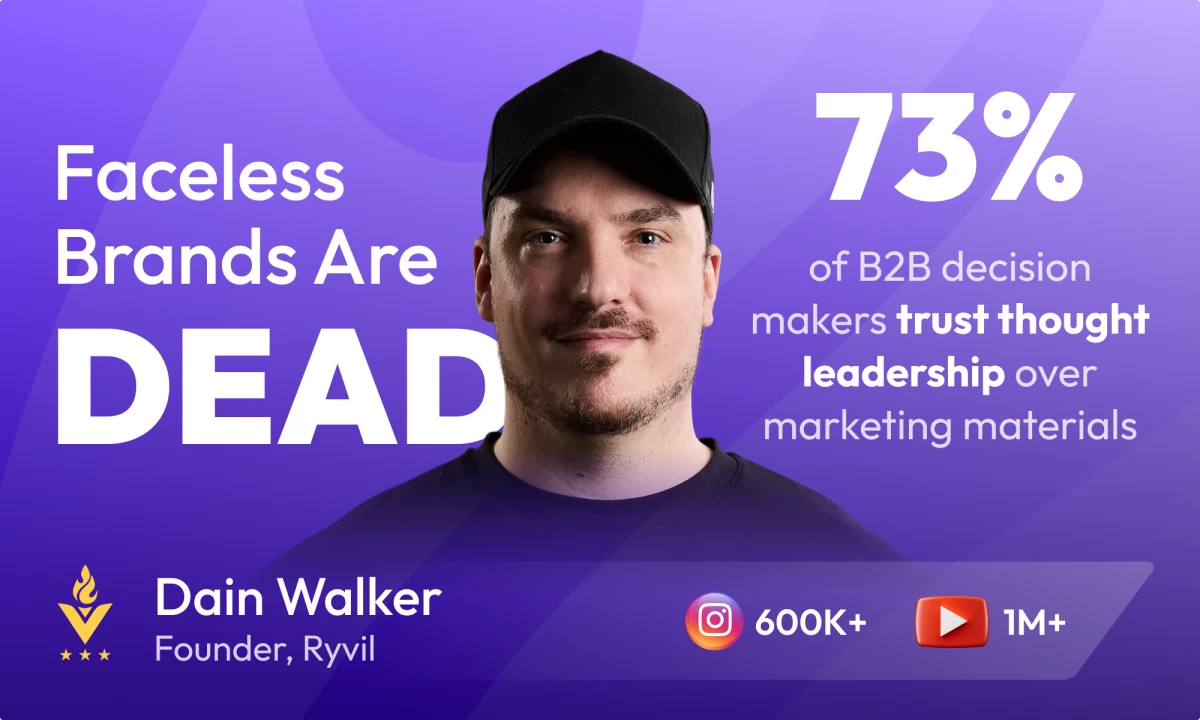

Ask yourself: when was the last time a company said something you genuinely cared about?
Now ask the same question about a person.
That gap is where modern brand strategy is being rewritten.
Brand Strategy in the AI Era: Key Findings
- Faceless branding is losing its edge. In a market driven by attention and trust, people connect more deeply with visible founders than with polished corporate identities alone.
- AI is flooding the market with sameness. As content becomes easier to produce, the brands that stand out are the ones anchored in real perspective, lived experience, and a human voice.
- Founder visibility is becoming a growth strategy. More than a branding trend, it’s now one of the most powerful ways to build trust, attract opportunity, and stay relevant in a crowded digital landscape.
For most of the last twenty years, businesses followed a clear rule: the brand should be the hero, while the founder stayed behind the scenes.
Companies built distance between leadership and their audience. They invested heavily in logos, brand guidelines, messaging frameworks, and carefully engineered identity systems, designed to communicate consistently, regardless of who was behind the business.
And for a long time, that model worked.
Distribution belonged to corporations. Media meant television, magazines, and billboards. Attention was something you could buy, and brands spoke through controlled, highly produced campaigns.
But the internet changed that.
The Shift From Corporate Identity to Human Connection

Distribution no longer belongs exclusively to companies. It belongs to individuals — people scrolling through feeds, deciding in real time who earns their attention.
Platforms reward personality more than polish. Audiences trust people more than corporate messaging.
As a result, we’re seeing a structural shift in how brands grow.
The companies winning today are rarely faceless. And if they are, they often rely on visible personalities to carry their message. The new generation of brands is increasingly founder-led, built not just on identity systems, but on human presence.
Meanwhile, businesses still hiding behind logos and guidelines are starting to face an uncomfortable reality:
The market has already moved on.
The Attention Economy Has Changed Brand Strategy
And the rules of brand strategy have shifted alongside it. What once relied on logos, typography hierarchies, and rigid brand guidelines now demands a deeper understanding of how attention is captured and sustained across every touchpoint.
Those tools still matter. But they are no longer enough. Modern branding operates in what economists call the “attention economy,” where the most valuable asset is not simply visibility but sustained audience attention. And this shift is not just theoretical.
A global study by McKinsey & Company, spanning more than 7,000 consumers, suggests that attention is no longer defined solely by time spent, but by its quality.
Now here’s the catch: it’s no longer about who’s the best, or about who paid the most, both of which often meant corporate bureaucracy and bloat. Instead, it increasingly comes down to one thing: who’s the most entertaining.
Attention differs markedly from traditional media exposure. Historically, brands purchased attention through advertising. Companies with the largest budgets controlled the loudest voices.
Consumers follow founders, creators, and experts whose ideas they trust. Algorithms reward authentic perspectives over carefully crafted corporate messaging.
Simply put, we now live in a world where many influential brands are closely tied to visible founders.
Consider companies like Gymshark, Skims, or Liquid Death. While each brand has strong visual identities and distinctive positioning, their growth has been heavily fueled by personalities connected to the brand story.
The founder or figurehead becomes part of the narrative. Now, “narrative” may sound fanciful in theory, but in practice, this strategy is clearly reflected in companies’ bottom lines.
This dynamic is not limited to consumer brands.
In professional services, consulting, and agency businesses, founder visibility has become one of the most powerful marketing channels available.
Personalities like Steven Bartlett can accomplish in just a few years, largely through their own voice and platform, what once took figures like Oprah decades to build through institutional gatekeepers.
A founder who consistently shares industry insights builds trust long before a potential client ever visits the company website. That trust converts into opportunity. However, trust is never earned through promotion; it's earned through giving value. And that value must be able to stand on its own, free from the pressure of any immediate call to action.
The Rise of Founder-Led Branding
Yet in today’s landscape, sustaining that value is more challenging than ever. The next major shift in branding is being driven by artificial intelligence.
Every week, new AI tools emerge promising to automate content creation, generate design assets, or accelerate marketing workflows. For agencies and designers, these tools are already transforming the speed at which work can be produced. But they introduce a major side effect: they dramatically lower the cost of producing content.
And when the cost of producing content drops, the volume of content explodes.
Blog posts, ads, graphics, and videos can now be generated at scale with minimal effort. Chances are, if you’re reading this right now, you have no idea whether this was written over hours of effort or produced from a well-crafted prompt. And perhaps the very act of acknowledging that raises a deeper question about the quiet social contract of trust between writer and reader, one that now feels increasingly fragile.
At first glance, AI seems beneficial. But the explosion of content creates a new challenge: much of it becomes indistinguishable. Technically competent. Algorithmically optimized. But emotionally forgettable.
As audiences are flooded with content that looks and sounds the same, they begin filtering more aggressively. They search for signals that indicate real expertise or an authentic perspective.
This is where founder-led branding becomes incredibly valuable.
Founder-led branding is not simply about personal branding or self-promotion. It’s about giving people direct access to a human voice in a world increasingly saturated with automated output. I get it, everyone gets insecure when this topic comes up. But at its core, it’s about presence. About showing up as a person in an environment where sameness is becoming the default.
AI can generate content. But it cannot generate lived experience. It cannot replicate the credibility of someone who has spent years building businesses, solving problems, and forming strong opinions about their industry.
When founders publicly share ideas, insights, and experiences, they create a steady stream of content that attracts customers, employees, and partners.
Over time, this creates a compounding effect. Familiarity leads to trust. Trust leads to conversations. And conversations often lead to commercial opportunities.
In many modern businesses, the founder effectively becomes the top of the marketing funnel.
In my own case, I run a branding agency with more than thirty employees. A significant portion of our inbound opportunities originates from content tied to my personal brand. Podcasts, short-form video, and thought leadership create awareness that eventually leads people to the agency itself.
This has manifested in opportunities I could never have planned for:
- Speaking engagements on stage with Gary Vee
- Working with comedian Andrew Schulz
- Lifting weights at the gym with Dan Martell
- Securing sponsorship for my show from Wix.com.
None of these were planned. All of them emerged from my personal brand.
Once this system is in place, it becomes extremely powerful. Marketing no longer relies solely on advertising or search traffic. Instead, it is fueled by an ongoing stream of ideas shared directly with the market.



AI Will Eventually Become Invisible

Right now, artificial intelligence dominates almost every conversation about the future of marketing. But technology revolutions tend to follow a predictable pattern.
At first, the technology itself is the story. Eventually, it fades into infrastructure.
The internet followed this trajectory. In the late 1990s, companies proudly described themselves as “internet companies.” Today, that phrase sounds almost meaningless because the internet is simply everywhere.
Artificial intelligence will likely follow the same path.
Within a few years, AI will be integrated into nearly every design tool, marketing platform, and workflow. It will become expected rather than remarkable.
When that happens, competitive advantage will shift away from the tools themselves and toward the ideas being expressed through them.
In other words, AI will scale content production. But it will not replace human perspective. In the same way we eventually stopped obsessing over the “World Wide Web” and simply got on with life, the public will eventually grow tired of talking about AI and move on.
The brands that stand out will still be the ones with something meaningful to say to people who are simply trying to live their lives. And that is the point: be human, not a fraud; have a conversation, not an automation.
The Real Business Risk Is Not Visibility

Yet even with this clear advantage, many founders hesitate to build a public presence because they fear the business becoming too dependent on them.
On the surface, this sounds logical. But it often ignores the real risk most businesses face: cash flow instability, which is becoming ever more difficult to navigate amid the apocalyptic level of change in the business world.
Businesses fail far more often because they struggle to generate sustained attention than because their founder becomes too visible.
If founder visibility helps attract leads, partnerships, talent, and media attention, then that visibility becomes a strategic advantage rather than a liability.
The founder is already shaping the business. Their thinking influences strategy, culture, and customer relationships every day.
Making that thinking visible simply amplifies its impact.
When done right, even a strong founder can increase their company's valuation effectively turning their own name into an asset.
For designers and creative agencies, understanding this evolution is crucial because the way founders show up publicly now shapes how brands are designed and marketed.
What This Means for Designers and Agencies

This shift in brand strategy presents both a terrifying inevitability and an enormous opportunity. I’ve experienced this firsthand. Building a personal brand carries real costs, and they're often heavy, but they are ultimately well worth paying.
Traditional branding projects often focused heavily on visual identity systems: logos, typography hierarchies, color palettes, and detailed brand guidelines.
These elements remain important, but modern brands require something more: a human voice.
The most effective brand systems today operate across three layers:
- Identity, which defines how the brand looks and feels visually.
- Narrative, which clarifies positioning, messaging hierarchy, and the strategic story behind the company.
- Personality, which emerges through the founder’s visible thinking and leadership voice.
This third layer is increasingly difficult for competitors to replicate. Visual styles can be copied. Messaging frameworks can be imitated. But a founder’s lived experience, opinions, and perspective cannot be easily duplicated.
Agencies that understand this shift can move beyond simply designing brand identities. They can help founders build visibility systems. That means helping leaders articulate their ideas, identify the conversations they want to lead, and show up consistently in the places where their audiences spend time.
The Founder Is the Brand Now

Branding used to be about controlling the message. Now it’s about owning the conversation. And conversations don’t happen between logos. They happen between people.
The uncomfortable truth is that most founders aren’t invisible because they’re strategic, but because they are afraid — afraid of saying the wrong thing, afraid of looking foolish, afraid someone might disagree.
But markets don’t reward caution. They reward clarity.
The brands that win the next decade won’t be the ones with the cleanest guidelines or the most perfectly kerned logos. They’ll be the ones with a human voice loud enough to cut through the noise.

Our team ranks agencies worldwide to help you find a qualified partner to implement the latest branding solutions. Visit our Agency Directory for the Top US Brand Strategy Agencies as well as:



-preview-webp.webp)

-preview-webp.webp)