

You have the design talent and a portfolio to back it up. Yet, you find yourself losing bids for high-value logo projects. The problem often isn’t your work; it’s the proposal.
A well-crafted logo design proposal is your most important sales tool. It frames your work around the client's success, justifies your pricing, and builds the trust needed to close the deal.
By shifting from a simple price quote to a well-thought-out document, you change the conversation from cost to investment.
While you can find many proposal templates on the internet, it's often better to design one that's truly yours. We’ve provided a complete guide and an example logo design proposal template that you can easily personalize.
Logo Design Proposal: Key Points
- A winning logo design proposal is a strategic document that solves a business problem. It’s your best tool for moving the conversation away from "how much does it cost" and toward the value of the outcome.
- Personalization is a powerful conversion tool. Data shows that for branding and advertising businesses, customizing as little as half of the executive summary can boost close rates to nearly 100%.
- Sending your logo design proposal digitally with an e-signature option can make it 3.3X more likely to close and close 30% faster. Using automated reminders can also increase your close rate by 10%.
What is a Logo Design Proposal?
A logo design proposal is a formal document an agency sends to a prospective client to outline a project.
For clients learning how to outsource logo design, this document is a critical piece of the evaluation process. It’s your first opportunity to demonstrate your professional approach and strategic thinking.
You use a proposal after initial contact and a discovery call, once you have a firm grasp of the client’s needs. It’s important because it formalizes your understanding of the project and sets clear expectations.
A good proposal shows the client you listened, you comprehend their goals beyond "we need a new logo," and you have a structured process for delivering results.
It protects both parties by defining the scope, timeline, and cost, preventing scope creep and future misunderstandings.
The Anatomy of a Logo Design Proposal
A winning logo design proposal follows a logical structure that guides the client from their problem to your solution. Each section builds on the last, creating a compelling case for choosing your agency.
- Project Overview: Start with a brief summary of the client's project. Reiterate their situation and what they want to achieve in their own words. This immediately shows you were listening.
- Goals & Objectives: This is where you translate "we need a logo" into business terms. What is the goal? Is it to attract a new demographic, support a price increase, or stand out in a crowded market?
- Why Me/Us: Introduce your agency and explain why you are the right fit for this specific project. Ultimately, your clients are trying to find the right agency to tell their brand story. This section of your proposal directly answers that.
- Scope & Deliverables: Be explicit. List exactly what the client will receive. This includes the number of initial concepts, revision rounds, and all final file formats (e.g., .AI, .EPS, .PNG, .SVG).
- Our Process & Timeline: Break down your entire design process into phases (e.g., Discovery, Concept Development, Revisions, Finalization). Assign a clear timeline for each phase so the client knows what to expect and when.
- Your Investment: Present your pricing clearly. This section should directly answer the client's question of how much does branding cost. Include payment terms, such as a 50% deposit.
- Next Steps: Tell the client exactly what to do next, and what happens once they’ve signed. "To get started, simply sign the proposal below and we will send the invoice for the initial deposit."
- Digital Signing + Pre-written Contract: Use proposal software to allow for an easy e-signature, as it can make clients 3.3X more likely to close. Attach your terms and conditions or contract here, too.
- Bonus: Payment Gateway: Integrating a payment gateway allows the client to sign and pay the deposit in one seamless action, reducing friction and getting the project started faster.
How to Write a Winning Logo Design Proposal in 5 Steps
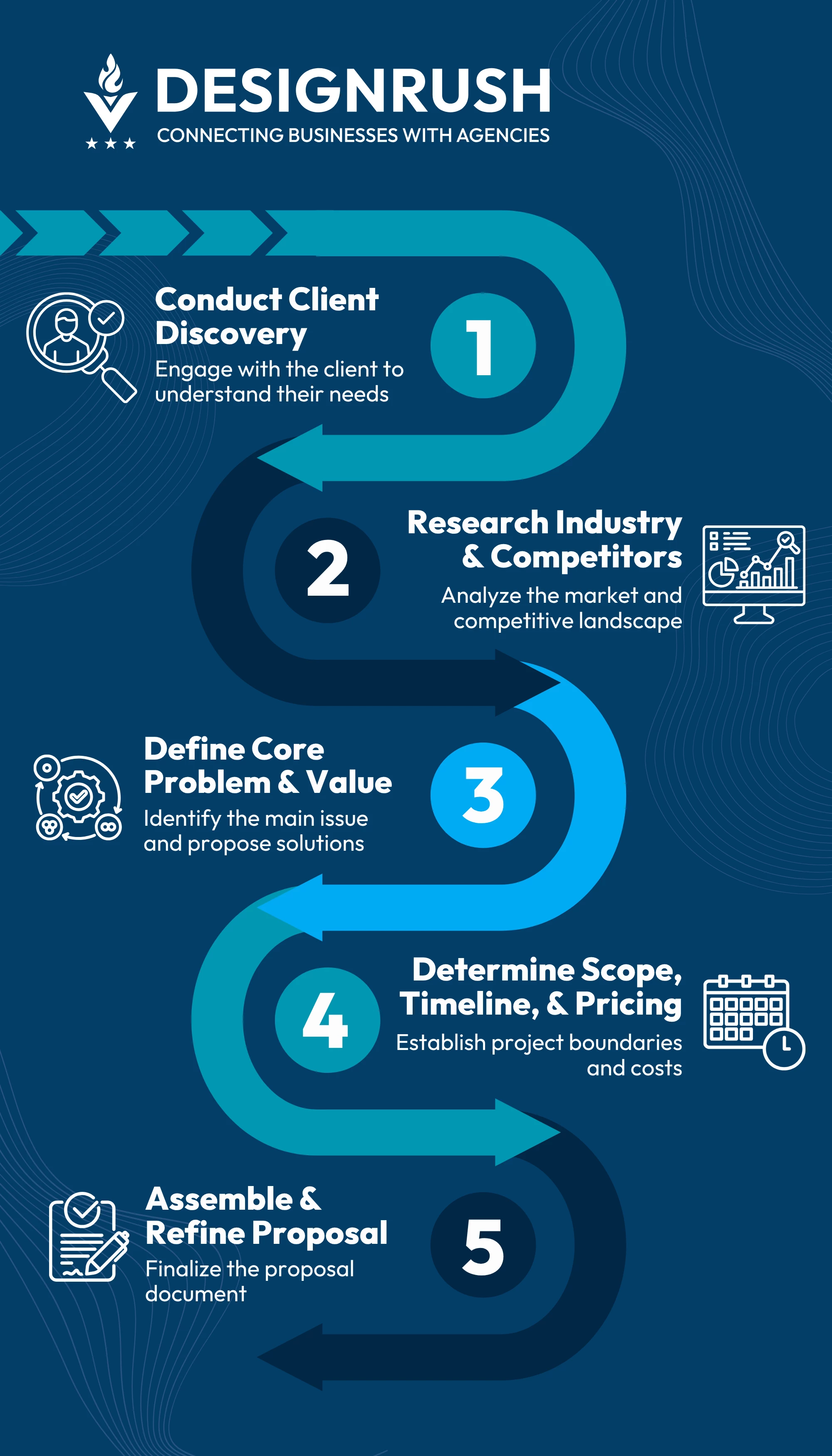
Follow these steps to create a structured and persuasive document every time.
Step 1: Conduct a thorough client discovery session
You cannot write a great proposal without a deep understanding of the client.
Before writing a single word, hold a discovery call to ask critical questions. Go beyond their favorite colors. Ask about their business goals, target audience, brand values, and direct competitors.
This information is the foundation for the Project Overview and Goals & Objectives sections. It allows you to use the client’s own words to describe their problem and frame the project's success around their specific business goals.
Step 2: Research the industry & competitors
Analyze the client’s competitors to identify trends and opportunities for differentiation. This research shows the client you are thinking strategically about their position in the market, not just creating a pretty picture.
Use this research to strengthen your Project Objective. Stating that your goal is to "differentiate the brand from a sea of blue competitors" proves you have a strategic plan.
Step 3: Define the core problem & frame your value
Use the information from your discovery and research to define the client’s true problem. It’s rarely "a lack of a logo." It's more likely "a failure to connect with a younger audience" or "being perceived as outdated."
Frame your service as the solution to that specific business problem. This becomes the central theme of your proposal. The value proposition should be at the heart of the Project Objective and Why Us sections.
Step 4: Determine scope, timeline, and pricing
With a clear understanding of the problem and the required solution, you can accurately define the project scope. Calculate a realistic timeline based on your team's capacity and the defined scope.
Price your services based on the value you provide and the results you will deliver, not just the hours you spend.
Remember to:
- List every single deliverable. Be explicit.
- Break the project into phases and assign a timeline to each, noting where client action is needed.
- Price your services based on the value of the outcome, not just the hours worked.
Example of scoping:
- Instead of saying "Logo," specify "Primary logo, a simplified secondary mark, a full color palette with digital and print codes, and a brand guide PDF."
This work directly populates three sections of the template: Scope & Deliverables, Our Process & Timeline, and Your Investment.
Being clear and specific here prevents future scope creep and sets professional expectations.
Step 5: Assemble, design, and refine your proposal
Assemble all the sections into a clean, professionally designed document.
Your proposal is a reflection of your agency’s design skills — it should be well-branded and easy to read. Proofread it carefully to eliminate any typos or errors, then send it to the client.
Remember to:
- Use a consistent layout with clear headings.
- Incorporate your own branding (logo, colors, fonts).
- Proofread the entire document twice for typos and grammatical errors.
- Send it via a professional system that allows for e-signatures and online payment.
A polished, error-free proposal sent through a professional platform builds trust before the project even begins. It’s your first chance to prove you deliver high-quality work.
Logo Design Proposal Template Example
A modern proposal doesn't need to be a 20-page document. Often, a concise logo design proposal sample like this one is more effective for busy decision-makers.
The following logo design proposal template is designed to be customized and sent electronically using proposal software.
These tools streamline the process, allowing your client to review, sign, and even pay the initial deposit in one seamless workflow.
Logo Design & Brand Identity Proposal Prepared for: [Client Name] Prepared by: [Your Company Name] Project Overview [Start with a brief summary of the client's project. Based on your discovery session, reiterate their current situation and what they hope to achieve. This shows you were listening and understand their perspective before presenting your own solutions.] Goals & Objectives [Translate "we need a logo" into tangible business goals. What is the desired business outcome of this project? Connect your design work to measurable results.]
Why Us: A Relevant Case Study [Introduce your agency and explain why you are the right fit for this specific project. Instead of a simple portfolio grid, feature one highly relevant case study using the Problem-Solution-Result framework.]
What They Said: [Optional: Include a powerful, specific quote from that client that reinforces the result. Scope & Deliverables [Be explicit about what the client will receive. List all key deliverables to set clear expectations.]
Our Process & Timeline [Break down your process into clear phases with a timeline for each. This shows the client what to expect and when.] Phase 1: Discovery & Strategy ([Number] weeks)
Phase 2: Concept Development ([Number] weeks)
Phase 3: Refinement & Revisions ([Number] weeks)
Phase 4: Finalization & Delivery ([Number] week)
Your Investment Project Pricing:
Payment Terms:
Next Steps To get started, please review the proposal and the linked contract. If everything looks correct, you can electronically sign below. Once the proposal is signed and the initial deposit has been paid, we will schedule our project kickoff meeting to discuss your needs in greater detail. Work will officially begin as soon as the payment has cleared and all necessary resources have been provided. Digital Signing & Contract [Your proposal software's e-signature block will appear here. Ensure your standard terms and conditions or a full contract are attached or linked for the client to review before signing.] Bonus: Secure Payment Gateway [If your software supports it, a payment module can be integrated into the next step, allowing the client to sign the proposal and securely pay the initial deposit in one step.] |
Best Practices for a Persuasive Logo Design Proposal
Moving from a good proposal to a winning one requires shifting your mindset from vendor to strategic partner. These best practices show a client you’re not just a pair of hands but a business-minded expert they can trust.
1. Personalize the proposal content
Generic proposals get generic results. To truly stand out, every part of your proposal should feel like it was crafted exclusively for the client.
This goes beyond just using their name. It means weaving the insights from your discovery call and research into every section, from the project overview to the final deliverables.
The impact of this approach is significant. For instance, in the broader marketing and advertising industry, proposals that feature just 50% customized content in the executive summary can see close rates nearing 100%.
This demonstrates that clients don't just appreciate personalization; they are decisively won over by it.
2. Frame the project around a strategic business objective
Your client wants more than a new image; they want a business result. Your job is to connect your design work directly to that outcome.
Go through your discovery notes and identify their core business driver. Are they trying to increase prices, attract a new customer segment, or expand into a new market?
Structure your proposal around that goal. For example, imagine your client is a high-end real estate agency that wants to attract ultra-high-net-worth clients.
- A generic proposal would say: "We will design a professional and modern logo for your business." This is a task, not a solution. It fails to show any understanding of the client's unique challenge.
- A strategic proposal would say: "Our objective is to position your agency as the definitive leader in the luxury property market. We will develop a brand identity that communicates exclusivity by using specific design elements:
- Typography: We will craft a custom serif wordmark. This style suggests stability and a long-standing reputation.
- And so on…
This reframes the project from a creative exercise into a strategic investment, allowing you to anchor your value to a tangible business goal.
3. Present a mini case study instead of just a portfolio grid
A grid of logos shows what you've made. A case study shows what you've achieved.
Instead of expecting a potential client to see the value in a list of images, guide them through a relevant success story.
How to structure it: Use a simple Problem -> Solution -> Result framework.
- Problem: Briefly describe a past client's business challenge.
- Solution: Explain the work you did.
- Result: Detail the business impact, using numbers whenever possible.
Placing a concise, powerful case study like this in your proposal proves you are a results-oriented partner.
4. Build trust by proactively addressing risks
Clients, especially those new to working with agencies, have fears: What if I don't like the design? What if the project goes over budget? What if it takes too long?
A winning proposal addresses these fears head-on by setting clear rules that safeguard both you and the client.
This means clearly defining:
- Revision Rounds: Specify the exact number of revisions included. "This proposal includes up to three rounds of revisions on your chosen concept."
- Communication: Set expectations for meetings and response times. "We will hold one 30-minute check-in call per week and will respond to all emails within 24 business hours."
- Ownership: Clarify that they will have full ownership of the final design upon final payment.
By defining the rules of engagement, you demonstrate professionalism and show the client you have a structured process designed to protect their investment.
5. Use hyper-specific social proof
Generic testimonials are forgettable. Specific, relevant social proof builds powerful connections.
Dig into your past successes and find a quote that mirrors your potential client's own situation or role.
Tailor the proof to their context:
- If the client is a Marketing Director: Use a quote from a past Marketing Director. "Their team integrated seamlessly with ours, delivering a brand identity that was not only beautiful but also perfectly aligned with our Q4 campaign goals."
- If the client is a startup founder: Use a quote from another founder. "As a founder, I needed more than a designer—I needed a partner. [Your Agency] was instrumental in helping us define our brand and secure our first round of funding."
This shows the client that people just like them have succeeded by working with you.
6. Show you understand the client’s business
Demonstrate that you’ve done your homework before asking for their business. This proves you are a serious, invested partner.
Before writing the proposal, dedicate time to thoroughly researching their company and industry.
Your pre-proposal checklist should include:
- Reviewing all documents they have sent (business plans, marketing materials).
- Analyzing their website and social media presence.
- Researching their top 3 competitors to understand the visual landscape.
Weave your findings into the proposal. Use their internal language and reference their stated goals.
This small investment of time shows immense respect for their business and instantly sets you apart from competitors who use a generic, copy-paste approach.
Logo Design Proposal: Wrap-Up
A logo design proposal is your agency’s opportunity to rise above competition. By moving beyond a simple list of services and prices, you demonstrate your strategic value from the very first interaction.
A thoughtful, client-focused, and highly personalized proposal that clearly outlines the goals, process, and deliverables builds the confidence and trust necessary to turn a prospect into a partner.
It’s the foundation for a successful project and a long-term client relationship.
Logo Design Proposal FAQs
1. How long should a logo design proposal be?
A proposal should be comprehensive but concise. We suggest aiming for a one-page document.
The goal is to provide all the necessary information for a decision without overwhelming the client. The length will naturally vary based on the project's complexity.
2. What’s the biggest mistake to avoid in a proposal?
The biggest mistake is making it all about you. Instead, focus every section of your logo design proposal sample on the client: their problem, their goals, and how you will specifically help them achieve those goals.
3. Should I include multiple pricing options?
Yes, offering 2–3-tiered pricing packages is a highly effective strategy.
A "Good, Better, Best" model allows clients to choose a level of investment that fits their budget and needs. This can increase your average project value, as clients often choose the middle or top tier.


-preview-webp.webp)
-preview-webp.webp)