
Shopping online is changing rapidly. Consumers are discovering products through AI assistants, buying directly inside social feeds, watching livestreams before purchasing, and expecting personalized experiences at every touchpoint.
At the same time, new technologies are lowering the barriers to entry, creating more competition than ever for customer attention.
eCommerce Trends: Key Findings
- Prepare your product catalog for AI-driven shopping, as nearly half of online shoppers are projected to use AI shopping agents by 2030.
- Invest in mobile-first experiences and frictionless checkout. Smartphones already account for 69% of online orders and mobile wallets process 56% of online payments.
- Build social, livestream, and immersive shopping experiences now, with social commerce reaching $585.9 billion in 2026 and AR/VR revenue projected at $50.9 billion.
4.1 Billion eCommerce Users by 2030 Raise the Stakes for Every Brand
eCommerce has become a routine part of how people shop.
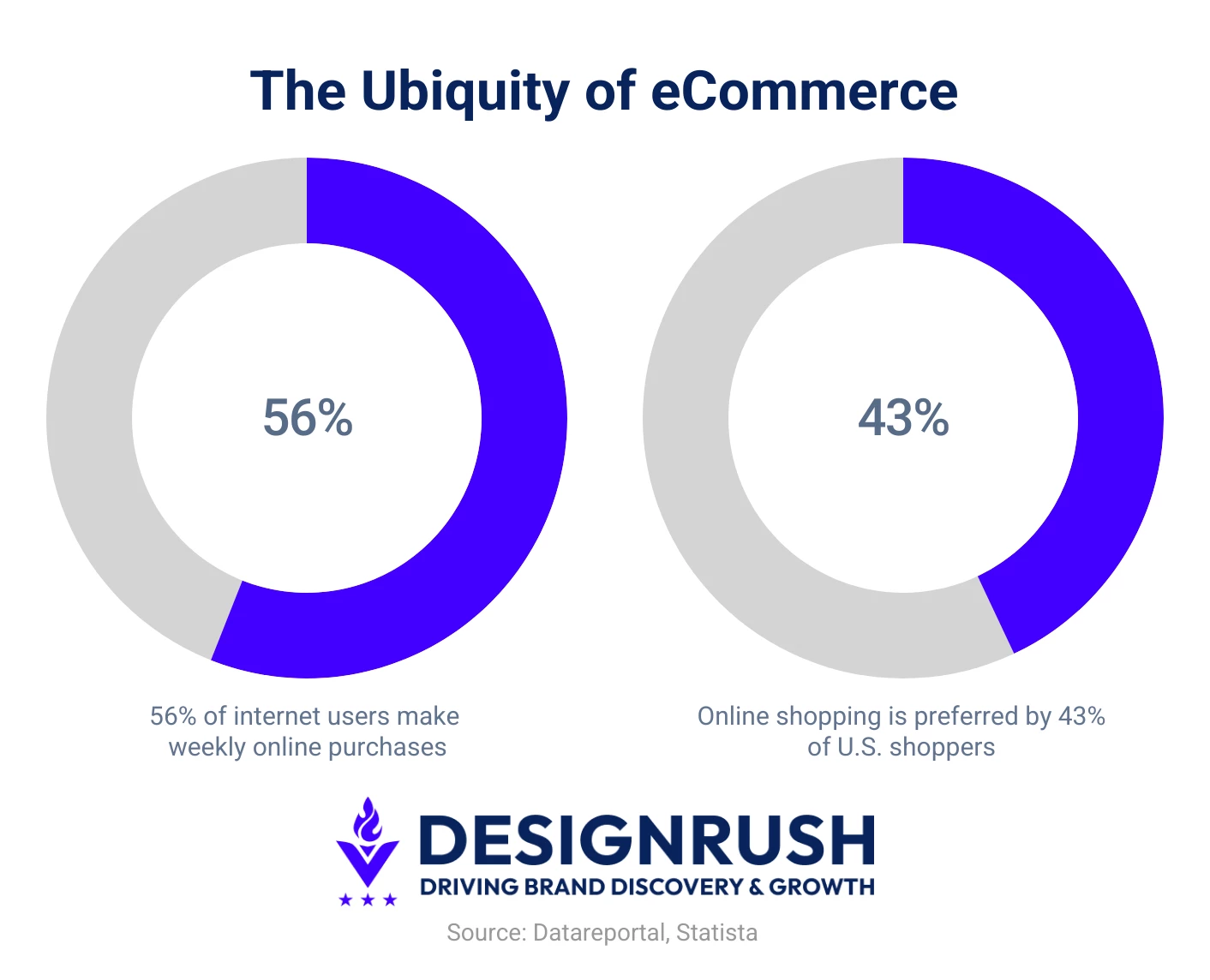
DataReportal reports that 56.1% of internet users aged 16 to 64 make at least one online purchase every week.
Consumer preferences continue moving in the same direction. Statista found that 43% of U.S. shoppers now prefer buying online rather than visiting a physical store, and the audience is still growing.
Statista projects that the global eCommerce user base will reach 4.1 billion by 2030.
For brands, a larger market also means a more crowded one. More shoppers are online than ever before, but every retailer is competing for the same attention, trust, and repeat business.



The 12 eCommerce Trends at a Glance
The trends defining eCommerce in 2026, including personalized shopping experiences, social commerce, and faster fulfillment, have moved beyond differentiation. Many shoppers now treat them as standard expectations.
# | Trend | Key Stats | Who Should Pay Attention |
1 | Nearly 50% of online shoppers may use AI shopping agents by 2030 | Brands with large product catalogs | |
2 | 9 in 10 retail executives expect AI to reshape product discovery by 2027 | Retailers relying on organic search | |
3 | AR/VR market reaches $50.9B in 2026 | Furniture, fashion, beauty, home, and luxury brands | |
4 | 92% of top ecommerce companies use AI-powered product feeds | Mid-sized and enterprise retailers | |
5 | 26% of shoppers say AI-written copy makes brands feel impersonal | Content-heavy ecommerce brands | |
6 | 44% of retailers say legacy systems slow innovation | Multi-channel retailers | |
7 | Case studies report 43% higher conversions and 73% faster server response | Enterprise, multi-brand, and multi-market retailers | |
8 | $585.9B global revenue in 2026 | Consumer brands targeting Gen Z and Millennials | |
9 | U.S. sales reach $14.64B with conversion rates up to 30% | DTC brands, creators, and retailers selling visually demonstrable products | |
10 | 69% of global online orders come from smartphones | Every ecommerce business | |
11 | Mobile wallets account for 56% of online payment transactions | Every online retailer | |
12 | 391% three-year ROI (IDC study of BigCommerce B2B customers) | Manufacturers, wholesalers, and distributors |
Discovery: The eCommerce Trends Reshaping How Shoppers Find Products
Both trends point to the same shift: a machine now sits between a shopper's intent and your catalog.
You're no longer optimizing for a person reading a page, but for a system parsing a feed.
- Agentic commerce: Nearly half of online shoppers will use AI shopping agents by 2030
- AI-driven discovery: 9 in 10 retail executives expect AI discovery to displace search by 2027
1. Agentic Commerce: Nearly Half of Online Shoppers Will Use AI Shopping Agents by 2030
Agentic commerce is shopping carried out by an AI agent on a person's behalf.
The shopper sets an intent and constraints like a category, budget, or delivery deadline, and the agent handles discovery, comparison, and often the purchase itself.
In short, the human sets the parameters, and the agent executes.
This inverts two decades of eCommerce practice spent learning to win rankings, earn clicks, and convert landing pages. In agentic commerce, none of those steps necessarily happen.
The agent queries feeds and APIs, evaluates price and availability, and returns an answer or completes a transaction, often without the shopper ever seeing a product page.
The market sizing from the institutions doing the forecasting is clear:
- Morgan Stanley projects nearly half of online shoppers will use AI shopping agents by 2030.
- McKinsey estimates agentic AI could redirect $3-5 trillion in global retail spend by 2030.
- DHL's 2026 trends report, based on a survey of 29,000 consumers and 5,800 businesses across 29 countries, found 29% of shoppers would be willing to hand shopping control to AI, rising to 33% of Gen Z and 36% of millennials.
Consumer willingness is real but not yet the majority, which means 2026 is a preparation year rather than a harvest year.
Start with the audit, not the integration. Pull your top 20 products and check them against an agent-readiness checklist.
Most retailers find the problem is data hygiene rather than missing technology, which is cheaper to fix and faster to ship.
2. AI-Driven Discovery: 9 in 10 Retail Executives Expect AI Discovery to Displace Search by 2027
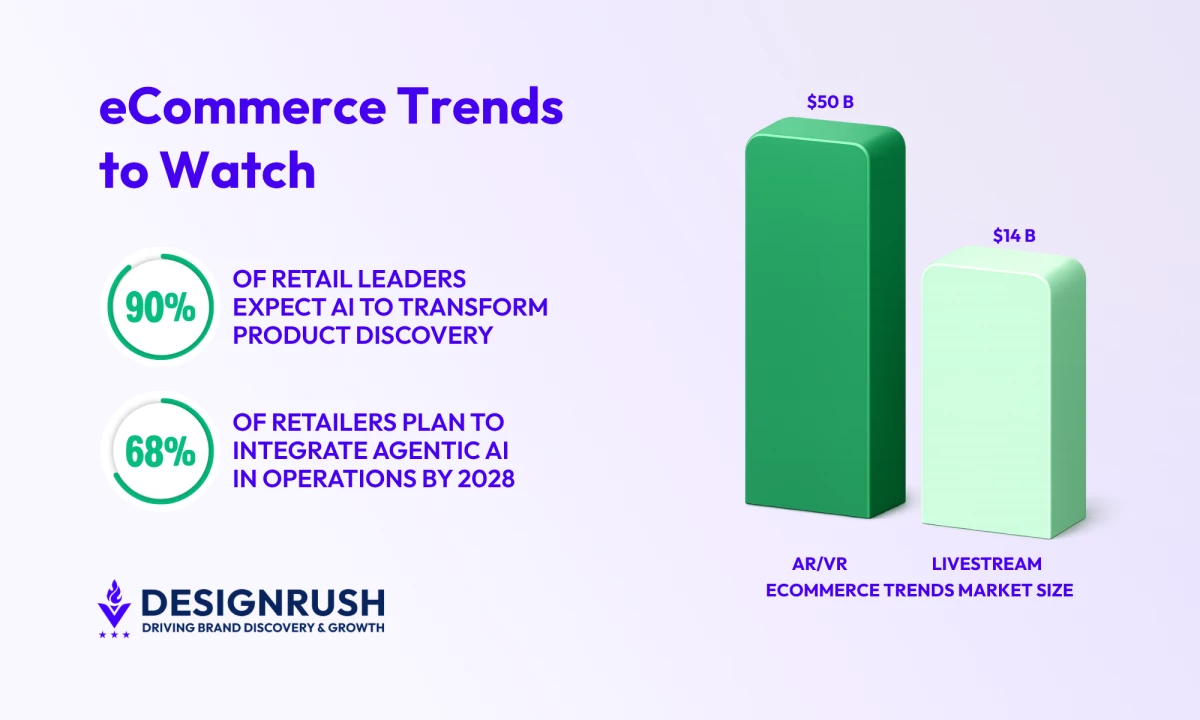
According to Deloitte’s 2026 Retail Industry Global Outlook, 9 in 10 retail executives expect consumers to shift from search engines to AI for product discovery.
Deloitte's data puts 41% expecting that shift to be mainstream by 2026, with a further 45% expecting it by 2027.
Consumers appear increasingly comfortable with that idea. Statista found that 55% of survey respondents worldwide trust AI to gather and present product information before they make a purchase.
That trust is changing how people discover products online:
- Shoppers ask AI assistants for buying advice in natural language.
- Recommendation engines rely on intent signals instead of click history alone.
- Chat interfaces guide users from product questions to checkout.
- Product suggestions appear before shoppers enter a search query.
- Research, comparison, and purchasing happen within the same AI-assisted experience.
Tools such as ChatGPT are becoming part of the product research process, but consumers still want to make the final decision themselves.
That puts pressure on brands to provide accurate, structured, and up-to-date product information.
Product specifications, reviews, pricing, and inventory data all influence whether AI systems surface a product during the consideration stage.
If a model can't parse your specs, reviews, or availability, you're invisible at the moment of consideration.
Jeff Nordstedt, Director of User Experience at eDesign Interactive, believes this changes how brands earn visibility online.
“Showing up now depends on how well machines understand your product,” Nordstedt says.
“What once required multiple steps - searching, clicking, and comparing - has been compressed into a single, AI-driven interaction.”
Retailers are already investing accordingly. Deloitte reports that:
- 68% plan to embed agentic AI into operations in the next two years
- 67% aim to launch AI-powered personalization within a year
Early adopters are beginning to see results. Deloitte reports that AI chat tools generate as much as 20% of website traffic for some retailers.
Many companies still face technical barriers. Among surveyed retailers, 44% say legacy systems limit their ability to deploy new AI capabilities.
The implications extend beyond search rankings. As consumers shift product discovery into AI interfaces, retailers need systems that machines can interpret, trust, and recommend.
Brands that fail to provide structured, accessible product data risk disappearing from the conversation before a shopper ever reaches their website.
Experience: How Shoppers Evaluate Before They Buy
Once shoppers reach a product, the challenge shifts from being found to earning their confidence.
These three trends examine how retailers reduce purchase uncertainty and where automation helps, or starts to undermine trust.
- Hybrid shopping experiences: AR/VR revenue to reach $50.9 billion as visual shopping goes mainstream
- AI personalization: 92% of top eCommerce companies already run dynamic product feeds
- AI content backlash: 26% of shoppers call a brand impersonal when copy reads as machine-written
3. Hybrid Shopping Experiences: AR/VR Revenue to Reach $50.9 Billion as Visual Shopping Goes Mainstream
Immersive technology has moved out of the experimental phase and into mainstream shopping.
Ken Braun, Co-Founder and Chief Brandtender of growth marketing and web design experts, Lounge Lizard, says it’s becoming a baseline eCommerce expectation in 2026:
“Static images don’t carry enough decision weight anymore. When shoppers need to judge scale, detail, or configuration, flat visuals slow them down or leave gaps.
3D removes a lot of that uncertainty, especially in categories where confidence drives the purchase more than impulse.”
Statista projects the global AR/VR market will generate $50.9 billion in revenue by 2026 and reach 3.8 billion users by 2030.
As adoption grows, shoppers increasingly expect more from product pages than a single hero shot and a gallery.
Brands are responding with experiences that let consumers explore, try on, and customize products before they buy:
- Virtual try-ons preview apparel, eyewear, and cosmetics on a shopper's own face or body.
- Interactive 3D configurators let customers personalize colors, materials, and features in real time.
- 360° product visualization gives a complete view from every angle.
- AR shopping places furniture, decor, and large purchases inside a customer's actual space.
- Digital showrooms recreate in-store browsing in a fully online environment.
Shoppers gain confidence when they can inspect products in detail before committing, and engagement time climbs as customers interact with what they're considering instead of scrolling past it.
Purchase friction drops because visualization closes the gap between expectation and reality, which also pushes return rates down and conversion rates up.
LOOP-LOC Uses 3D Visualization to Improve the Buying Experience
Lounge Lizard designed and developed a new website for LOOP-LOC, a leading manufacturer of luxury pool liners and safety covers.
At its center is Mirage, a custom interactive 3D configurator that lets customers visualize different liner patterns and cover designs against lifestyle imagery before they buy.
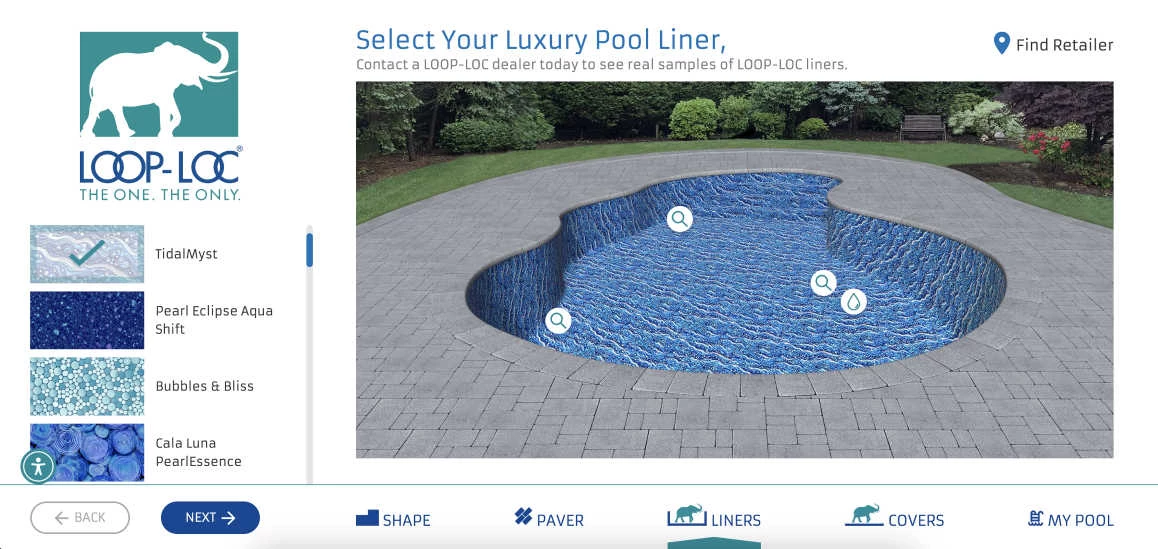
The site also connects liner selections to matching outdoor accents and includes a dealer portal for LOOP-LOC's distribution network.
The results show how interactive product experiences influence both discovery and conversion:
- 177% increase in non-branded traffic
- 26.5% increase in time on site
- 207 new keywords ranked on Google
- 20% jump in total users within three weeks of launch
AR and 3D visualization are quickly becoming the difference between a product page that gets scrolled past and one that closes a sale.
As more categories adopt these tools, retailers gain a competitive edge in conversion, customer confidence, and post-purchase satisfaction, three of the hardest metrics to move in modern eCommerce.
4. AI Personalization: 92% of Top eCommerce Companies Already Run Dynamic Product Feeds
Segment's State of Personalization Report finds that 92% of top-performing eCommerce companies use AI to power dynamic, personalized product feeds.
That foundation makes the move to autonomous shopping possible. Several shifts now define the category:
- AI shopping agents act on a user's behalf to find, compare, and complete purchases without manual input at each step.
- Autonomous purchasing handles repeat orders, replenishment, and time-sensitive buys in the background.
- Personalized shopping assistants stay with a customer across sessions, remembering preferences, budgets, and prior purchases.
Trust remains the constraint. Statista's 2024 data shows customer service and support were the leading AI applications for 34% of companies, yet only 9% believed AI for customer service improves their online shopping experience.
Retailers cannot launch autonomous tools and expect adoption by default. Shoppers will hand over more responsibility once they trust the tradeoff, understand how their data is being used, and know a human can step in at any point.
Showing how decisions are made now matters as much as what the agent can do.
5. AI Content Backlash: 26% of Shoppers Call a Brand Impersonal When Copy Reads as Machine-Written
HubSpot’s 2026 State of Marketing report shows that 80% of marketers now use AI for content creation, and 75% use it for media production to keep pace with the volume modern audiences expect.
Adoption is wide because the use cases reach across content and operations:
- Product descriptions get generated at scale from structured catalog data.
- Marketing copy for emails, landing pages, and ads pulls from brand-tone libraries and campaign briefs.
- Multilingual content lets brands localize for new markets without scaling headcount linearly.
The catch sits on the consumer side. Bynder's research shows that 26% of shoppers say a brand feels impersonal if its website copy reads as AI-written, and 20% go further and call the brand lazy.
That perception undercuts the productivity gains that drove adoption in the first place. AI-drafted product descriptions still need a human pass to keep voice and credibility intact.
Marketing copy still needs editorial judgment on tone and positioning. Localization requires cultural fluency that translation tools alone don't deliver.
AI will keep absorbing more of the content and operations stack across 2026. The brands that benefit will invest as much in editorial review and quality control as they do in the models.
Foundations: The eCommerce Technology Trends Underneath Everything Else
Neither of these trends is visible to shoppers, yet both determine whether everything else on this list is possible.
One connects the systems behind your sales channels; the other determines how easily you can replace any one of them.
- Unified commerce: 44% of retailers say legacy systems block their top growth priority
- Composable and headless commerce: 43% more conversions and 73% faster server response
6. Unified Commerce: 44% of Retailers Say Legacy Systems Hold Back Growth
Deloitte's 2026 Retail Industry Global Outlook asked 330 retail executives where they saw their biggest growth opportunity.
Improving the omnichannel experience came out on top at 46%, ahead of private-label offerings (40%), loyalty programs (36%), and in-store experience (35%).
Yet 44% said legacy systems were slowing their ability to innovate. Everyone wants connected commerce, but what's holding them back is architecture.
Experts at Magneto IT Solutions argue that this is where most omnichannel programs come apart:
"Most omnichannel initiatives don't fail because of the customer experience – they fail because the underlying systems aren't designed to exchange data in real time...
Successful unified commerce depends on an API-first, event-driven architecture where ERP, payment gateways, commerce platforms, CRM, and fulfillment systems communicate through a single source of truth.
Real-time synchronization of inventory, pricing, customer data, and order status is essential to eliminate inconsistencies, reduce manual intervention, and provide customers with a consistent experience across every touchpoint."
That’s what separates omnichannel from unified commerce. Omnichannel connects the channels a customer touches while leaving the systems behind them separate.
Unified commerce goes further by merging those layers to a single source of truth, so inventory, orders, customer data, and payments stay synchronized in real time.
Connected systems are also the precondition for what retailers now want to do with AI:
"Once data flows reliably across systems, organizations can expand into advanced capabilities such as unified customer experiences, AI-driven personalization, and intelligent inventory management with significantly lower implementation risk."
Once inventory, pricing, customer, and order data resolve to one source of truth, retailers can reliably deploy AI capabilities like:
- AI-powered search: Intent-based ranking weighted by real availability
- Personalization: Offers driven by one profile spanning web, app, marketplace, and store
- Product recommendations: Cross-sell informed by full purchase history and live stock
- Intelligent merchandising: Category ordering driven by margin, velocity, and inventory position
- Dynamic pricing: Responsive to demand and stock depth within contract and channel constraints
- Conversational commerce: Assistants that can check stock, reorder, and process returns rather than deflect
The payoff differs by model. B2B retailers gain from automated quoting, negotiated pricing, and smarter reordering, producing larger and more frequent orders with less sales-team administration.
B2C retailers typically see higher conversion rates and average order values through better search and personalization.
For D2C brands, unified data supports subscription optimization and churn prediction, which is where customer lifetime value is won.
What Unified Commerce Solves at Scale: NEOM

Magneto IT Solutions built the ticketing platform for NEOM, the Saudi giga-project, unifying ticket sales across categories like entertainment, health, retail, sports, and cultural events onto one system in a 12-week engagement.
The project solved two major issues: no single platform supported every event category, and Shopify order IDs didn't align with SAP payment IDs, which broke sales tracking and invoice management.
"The biggest advantage wasn't simply connecting multiple platforms – it was creating one connected operational ecosystem.
By integrating Shopify with SAP, Amazon Payment Services, and Saudi National Bank, we automated the complete transaction lifecycle.
Orders, payments, invoices, refunds, and financial records moved seamlessly between systems without manual processing,” the team at Magneto IT Solutions adds.
After the integration:
- Invoices no longer had to be raised and reconciled by hand
- Order and payment data synchronized in real time across platforms
- Finance and support teams gained a single view of every transaction
- Financial reporting became accurate, with fewer manual errors
Magneto IT Solutions puts the improvement at 59% for data synchronization and 47% for payment processing.
The commercial impact: less time spent reconciling transactions gives finance teams more capacity.
Faster payment verification improves cash flow, while real-time order visibility reduces support requests and refund disputes.
By contrast, disconnected systems leave teams manually matching transactions across multiple platforms:
"A channel-by-channel setup creates isolated data silos where teams spend significant time matching transactions manually.
An integrated ecosystem ensures every transaction is reflected consistently across commerce, finance, and ERP systems, enabling both operational efficiency and better decision-making."
Many mid-size retailers assume the first step is replacing their commerce platform. Magneto recommends starting with an integration and infrastructure assessment to identify where operational bottlenecks exist.
"Many retailers already have capable systems – they simply aren't connected effectively.
Establishing a scalable integration foundation often delivers greater business value than replacing platforms prematurely.”
That's the work Magneto IT Solutions did: modernizing commerce ecosystems across B2B, B2C, and D2C so that unified data, automation, and AI add up to growth.
7. Composable and Headless Commerce: 43% More Conversions and 73% Faster Server Response
Composable commerce decouples the frontend storefront from the backend commerce engine and connects them through APIs.
A brand can replace its search provider, CMS, or checkout without rebuilding the entire platform, which is what makes it possible to adopt the ecommerce technologies as they mature instead of waiting for a major replatform every few years.
Much of ecommerce innovation in 2026 is happening behind the scenes, even if shoppers never notice it directly. Two named results illustrate the pattern:
- Movora posted more than 100% year-over-year growth within two months of launch, with online orders rising from 27% to 34% of total orders.
- Music Direct recorded a 43% increase in conversions and a 73% decrease in server response time after adopting an API-first, headless architecture.
Composable architecture replaces one vendor relationship with several, and it shifts integration work in-house. It suits teams with development capacity and a genuine need for flexibility.
However, businesses already succeeding on an all-in-one platform may see a better return by optimizing their existing ecommerce experience before investing in a composable architecture.
Any replatforming decision should also account for the ongoing costs of integrations and maintenance, not just the initial implementation.
Channel Trends: Where the Transaction Actually Happens
The storefront is no longer a single destination.
These trends cover the surfaces where purchases now close: inside social feeds, during live video, and on a phone screen that most catalogs still treat as secondary.
- Social commerce: $585.9 billion revenue worldwide as platforms become storefronts
- Livestream commerce: U.S. sales hit $14.64 billion at conversion rates up to 30%
- Mobile commerce: 69% of global online orders are placed on a smartphone
8. Social Commerce: $585.9 Billion Revenue Worldwide as Platforms Become Storefronts
Social platforms have become shopping destinations in their own right. Most still drive product discovery, but they now also handle the purchase itself.
Statista estimates that social commerce generated $585.9 billion in revenue worldwide in 2026, with continued growth expected to push that figure to $928.65 billion by 2030.
Creators drive much of this activity. Research has shown that 73% of U.S. Gen Z shoppers say social media is their main source for learning about new products. That changes where brands need to show up first.
Each major platform has built out its own shopping infrastructure:
- Instagram Shopping lets brands tag products across posts, Stories, and Reels, turning everyday content into a browsable catalog. Roughly 130 million Instagram users tap on shoppable posts each month.
- TikTok Shop has become the breakout channel for in-app buying. eMarketer projects TikTok Shop will reach $23.4 billion in U.S. eCommerce sales in 2026, a 48% increase year over year.
- Facebook Shops continues to carry the largest base of U.S. social buyers, anchoring the category even as newer platforms grow faster.
Shoppable content collapses the distance between seeing a product and buying it, with video formats now driving most social commerce activity.
In-app checkout removes the redirect to an external site, letting a shopper complete a purchase without leaving the feed.
Brands gaining ground treat each platform as a real storefront, with product feeds, creator partnerships, and fulfillment tied back into their core systems.
9. Livestream Commerce: U.S. Sales Hit $14.64 Billion at Conversion Rates Up to 30%
Live shopping has merged broadcast and checkout. Hosts demonstrate products in real time, and viewers buy without leaving the stream.
According to eMarketer, U.S. livestream eCommerce sales grew nearly 50% in 2025 to reach $14.64 billion, with the number of buyers climbing 21.5% year over year.
TikTok Shop, Whatnot, and eBay Live are leading the expansion, while brands test creator-led streams to reach audiences that are already watching.
The format converts because it compresses discovery, demonstration, and purchase into one moment.
Firework reports that live shopping delivers conversion rates between 9% and 30%, compared to the 2% to 3% typical of standard eCommerce. The mechanics behind that lift are consistent across platforms:
- Live shopping events create urgency through limited drops, time-boxed pricing, and host-driven momentum.
- Influencer livestreams pair products with a trusted face, carrying the endorsement directly into the buying moment.
- Interactive demonstrations let hosts answer questions and show products in use, closing the gap a static page leaves open.
- Real-time purchasing means a viewer can check out the instant interest peaks, before the impulse fades.
TikTok Shop has normalized live shopping for younger audiences. An estimated 48.9% of TikTok users are TikTok Shop buyers.
Legacy retailers are following the audience: QVC gained more than 100,000 customers through TikTok Shop in Q2 2025, backing its push to reposition as a "live social shopping company” (eMarketer).
10. Mobile Commerce: 69% of Global Online Orders Are Placed on a Smartphone
Statista reports that 69% of global online orders were placed via smartphone in Q2 2025. For most catalogs, the phone is no longer a secondary surface. It is the primary one, and desktop is the exception.
Designing for that reality means treating the small screen as the default draft:
- Responsive design that reflows layouts, images, and grids for the screen in hand instead of shrinking a desktop template.
- Streamlined mobile navigation with shallow menu depth, persistent search, and filters that are usable without pinching.
- Mobile-first content built around shorter copy blocks, front-loaded product information, and thumb-friendly tap targets.
- One-click mobile checkout that pairs stored credentials with a single-screen flow, so intent converts before the form does its damage.
Conversion Trends for Checkout, Retention, and Revenue Models
These trends sit at the commercial end of the funnel, where intent either converts or quietly leaks away.
One covers the payment layer every shopper passes through; the other covers a buyer type most consumer-facing coverage leaves out entirely.
- Wallet-first checkout: Mobile wallets now handle 56% of online payment transactions
- B2B eCommerce modernization: IDC finds a 391% three-year ROI on B2B commerce tooling
11. Wallet-First Checkout: Mobile Wallets Now Handle 56% of Online Payment Transactions
How customers pay has become as decisive to conversion as what they pay.
Statista reports that mobile wallets accounted for roughly 56% of global eCommerce payment transactions in 2025, making them the most popular online payment method worldwide, with usage projected to grow at a 10.2% CAGR through 2030.
Credit cards ranked second at 20% in 2025, a share expected to slip to 16% by 2030.
Every modern payment option removes a reason for shoppers to hesitate at the final step:
- Digital wallets store payment and shipping details so customers can pay in a tap, without re-entering card numbers.
- Buy Now, Pay Later (BNPL) breaks larger purchases into installments, lowering the price barrier on higher-ticket items. The BNPL market reached $26.77 billion in 2026 and is projected to grow to over $118 billion by 2032.
- One-click payments collapse the entire checkout into a single action for returning customers, cutting friction at the moment intent is highest.
Shoppers assume they can pay the way they want. A checkout that forces a single method or a long form gives them a reason to leave.
For retailers in 2026, the payment layer is part of the product experience. Checkout is the last and most fragile point in the funnel, where a customer who already intends to buy can still walk away over a missing option or an extra step.
12. B2B eCommerce Modernization: IDC Finds a 391% Three-Year ROI on B2B Commerce Tooling
An IDC study found a 391% three-year return on investment for businesses using B2B-specific ecommerce tooling.
The International Trade Administration projects the global B2B ecommerce market to grow at a 14.5% CAGR through 2026.
The shift is away from cold calls, PDF catalogs, and manually keyed purchase orders, and toward buying experiences that resemble the consumer web:
- Self-service portals where existing accounts can reorder, track shipments, and pull invoices without contacting a rep.
- Personalized B2B pricing and catalogs that reflect negotiated rates, contract terms, and account-specific assortments.
- Bulk and repeat ordering through CSV upload, saved order templates, and quantity-break pricing surfaced at the line-item level.
- Role-based account permissions that separate who can browse, who can requisition, and who can approve spend.
The buyer expectation is the driving force. The person purchasing $80,000 of inventory at work shops on their phone at home, and the gap between those two experiences is increasingly hard to defend.
How Businesses Can Prepare for the Future of eCommerce
The trends shaping eCommerce in 2026 converge on the same shift.
Discovery, personalization, and purchase are increasingly handled by systems that interpret data, with less manual input from the shopper or the retailer.
Preparing for that environment means building a foundation that holds up as customer behavior and technology keep moving. Chasing any single trend won't get a business there.
These priorities give businesses a practical place to start:
- Invest in scalable technology so the platform can absorb traffic spikes, new sales channels, and added AI capabilities without a rebuild every time demand grows or a new tool emerges.
- Optimize product content for AI and search by structuring specifications, descriptions, and reviews so both search engines and AI assistants can parse and surface them at the moment of consideration.
- Improve omnichannel experiences by connecting web, app, marketplace, and in-store touchpoints so a customer's cart, history, and preferences follow them across every channel.
- Strengthen personalization using intent signals, purchase history, and predicted needs rather than generic recommendations that ignore who the shopper actually is.
- Maintain accurate product data across pricing, inventory, and availability, since outdated or inconsistent information undermines both AI recommendations and customer trust.
- Adopt automation strategically by applying it first to back-end functions like inventory forecasting, fraud prevention, and workflow management, where it creates value without putting unproven AI in front of the customer.
- Continuously monitor customer behavior to catch shifts in how people discover, evaluate, and buy, so strategy adjusts to real patterns instead of last year's assumptions.
None of these require adopting every emerging technology at once. They require a shared foundation: clean data, connected systems, and the flexibility to add capabilities as they mature.
A brand that gets the foundation right can layer on agentic commerce, immersive product experiences, or new payment options when the timing makes sense, rather than scrambling to retrofit each one.
eCommerce Trends: Final Thoughts
The biggest eCommerce trend in 2026 is the growing expectation that shopping should be faster, smarter, and more personalized.
The retailers gaining market share are building the infrastructure to support that expectation: clean product data, connected systems, flexible technology, and frictionless customer experiences.
Trends will continue evolving, but those foundations will remain valuable regardless of what comes next.

Our team ranks agencies worldwide to help you find the best fit. Visit our Agency Directory for the top eCommerce development agencies, as well as:
- Top eCommerce Consultants
- Top UI/UX Design Companies
- Top Website Design Companies
- Top Content Marketing Agencies
- Top eCommerce Companies in Orlando
For creative inspiration, explore our Design Awards, featuring the latest winners in website design.