Picking accountants in North Carolina matters more when an audit, a merger, or a growth decision is ahead of you. Here, you'll find vetted firms with portfolios and reviews to compare, so you can move forward with confidence.
Top 10 Accounting Agencies in North Carolina, United States
Discover the top 10 Accounting agencies in North Carolina, United States, known for their exceptional service and expertise. These agencies boast an impressive average rating of 4.4/5 stars and offer competitive pricing ranging from $1 to $35. Catering to industries such as Financial Services, Accounting, Tax Preparation, Legal Services, Law Firms, Solo Practitioners, Healthcare, and more, these firms excel in providing strategy, app development, technology solutions, and public relations. They have been selected for their verified client reviews, outstanding portfolio quality, and proven track record of delivering measurable results.
Organic rankings are determined by five factors: top services, reviews, portfolio, awards/press, and team expertise. Sponsored listings pay for a placement that appears above organic positions. Sponsorship does not affect star ratings or review content - read more on our methodology page.
United States × North Carolina × Insurance × $50,000 & Up ×Clear Filters
iRapidO Global is a Business Process Management organization delivering scalable back-office and operational support to growing businesses worldwide. We combine domain expertise, structured process frameworks, automation, and AI-enabled tools to help companies improve efficiency, control costs, and focus on...
Top Services:
Accounting
BPO
Business Consulting
Call Centers
HR Outsourcing
Show more
Location
Raleigh , North Carolina
Number of Employees
250 - 499
Average Hourly Rate
$50/hr
Minimal Budget
$50,000 & Up
iRapidO Global Services
Accounting
BPO
Business Consulting
Call Centers
HR Outsourcing
Customer Support
Market Research
Phone Answering Services
IT Services
IT Compliance Solution
Data sourced from the agency's DesignRush profile, its website, and other relevant accounts
Finance
Insurance
Health Care
Data sourced from the agency's DesignRush profile
iRapidO Global Reviews & Testimonials
Nurse Gigs Review from Google
5.0★
Nurse Gigs's Review Sourced from Google
iRapidO offers top-quality services with impressive speed and professionalism. Their team handles projects efficiently and ensures consistent, high-value results. Great service experience with strong reliability—definitely recommended for businesses needing fast and dependable solutions.
Driver Gigs Review from Google
5.0★
Driver Gigs's Review Sourced from Google
iRapidO delivers outstanding quality and services. The team is highly professional, fast, and reliable, providing excellent results every time. Their support, pricing, and overall service experience make iRapidO one of the best choices for businesses. Highly recommended!
Abhishek Pal vlogz Review from Google
4.0★
Abhishek Pal vlogz's Review Sourced from Google
I had a great experience working with iRapidO Global. The team is professional, responsive, and truly understands business needs. They deliver quality work on time and make collaboration smooth and efficient. I’m impressed with their expertise in global capability centers and how seamlessly they handle operations. Highly recommend them to any company looking for a reliable and experienced partner.
Reviews verified by DesignRush and sourced from the agency's profile View All Reviews
6 Frequently Asked Questions About Accounting Firms in North Carolina
How do I know if I actually need an accounting firm rather than just a bookkeeper?
A business should transition from bookkeeping to a full accounting firm when annual revenue approaches $500,000 to $1 million, when outside investors or lenders become involved, or when the business operates across multiple entities or locations.
The distinction matters in practical terms. Namely, a bookkeeper records and organizes financial transactions such as invoices, expenses, payroll entries, and bank reconciliations. That level of service is adequate for early-stage businesses with a single revenue stream and straightforward tax obligations.
The shift toward a full accounting firm becomes necessary when the business starts operating beyond that baseline. At that stage, a CPA (Certified Public Accountant)-level firm will provide tax strategy, financial statement preparation that holds up to external scrutiny from lenders or auditors, and the ability to represent the business before the IRS, which are capabilities that fall outside a bookkeeper's scope entirely.
How much do accountants in North Carolina typically charge, and what drives the variation in price?
Local business owners should expect to pay between $120 and $160 per hour for business accounting and CPA services in North Carolina. The hourly rates for bookkeeping range between $42 and $48, while tax preparation services entail a fixed fee of $200 to $220.
Here are some typical cost ranges for the most common accounting services a business owner is likely to need:
Service
Average cost range
Monthly bookkeeping (flat rate)
$300 to $2,000/month
Business tax return (small business)
$500 to $2,500
Full-service monthly accounting package
$800 to $2,500/month
Full-service audit
$5,000 to $50,000+
Firms based in mid-size North Carolina markets such as Greensboro, Winston-Salem, Wilmington, or Asheville typically run 15% to 30% below Charlotte and Raleigh rates for comparable services, without a proportional drop in technical quality.
What unexpected fees do accounting firms in NC charge that business owners don't anticipate before signing?
The most underestimated cost is the rush fee, which can add up to 20% to 25% on top of standard tax preparation fees when a business owner delivers records late or requests expedited turnaround near a deadline.
The second common surprise is the document disorganization charge. Most engagement letters include a stated assumption about the condition of the records being delivered. When records arrive incomplete, inconsistent, or require significant reconciliation before any accounting work can begin, firms bill the additional time at their standard hourly rate.
North Carolina-specific obligations add a third layer of unexpected charge. The state's corporate income tax, franchise tax, and various local county and municipal filings are frequently itemized as additions to a base engagement quote rather than included in it.
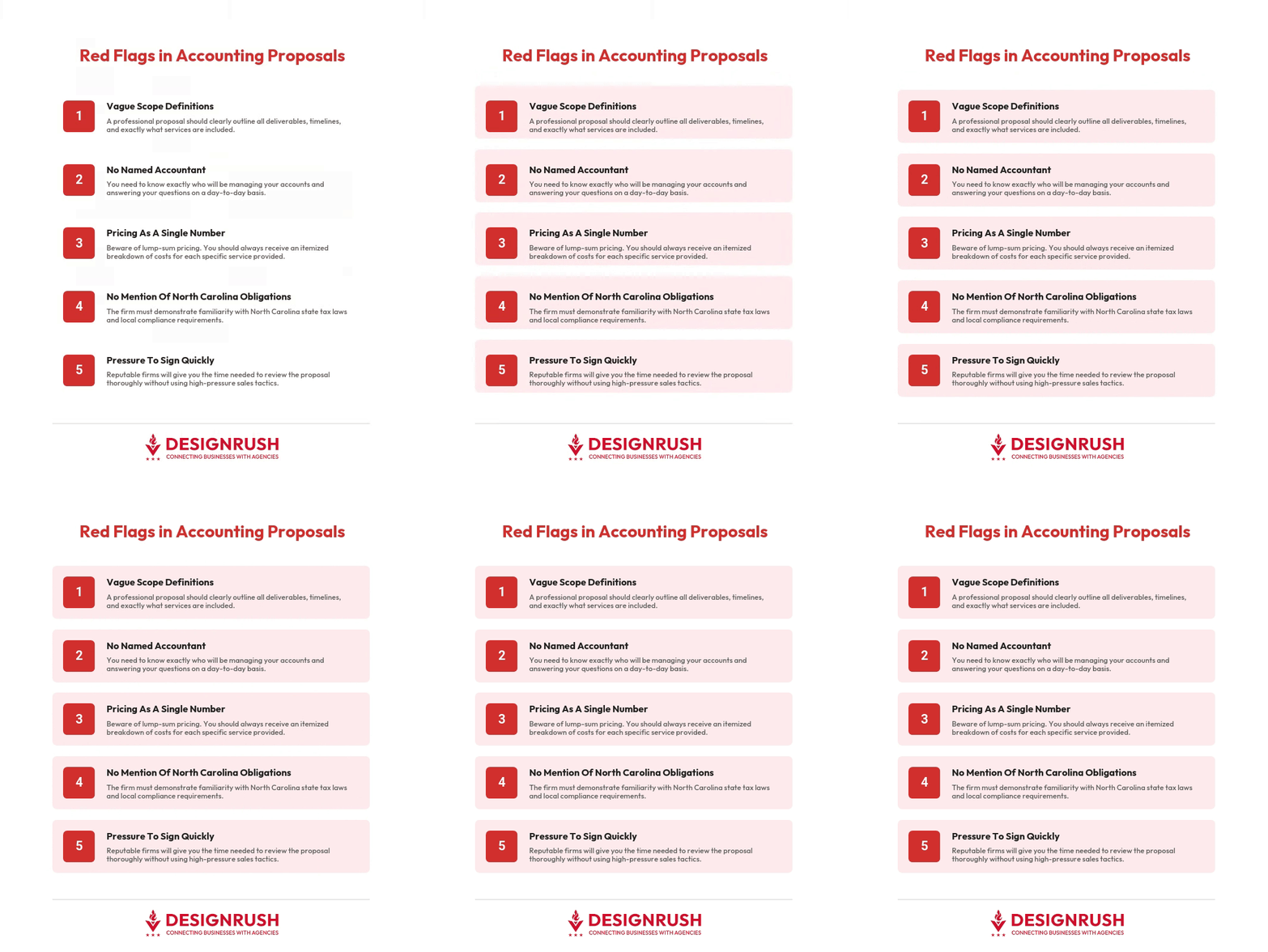
A potential red flag to consider in this situation is whether a firm that cannot provide a written, itemized fee schedule before signing an engagement letter is a firm whose billing practices will be difficult to predict or dispute later.
What should business owners verify about an NC accountant's credentials before signing anything?
The CPA designation in North Carolina is a regulated title, and any firm or individual using it must hold an active license issued by the NC State Board of CPA Examiners, which operates a public license lookup database that any business owner can check in under two minutes.
That verification step is important as an unlicensed or lapsed-credential practitioner cannot legally represent a client before the IRS, cannot issue audited or reviewed financial statements, and cannot sign off on documents that lenders and investors require for financing or acquisition due diligence.
The risk of hiring a practitioner operating on an expired or inactive license can affect the legal defensibility of financial statements and the validity of filed returns.
Beyond the base CPA credential, additional designations signal specific capability worth understanding:
An Enrolled Agent (EA) designation grants federal tax representation rights before the IRS, which is relevant for businesses anticipating audits or disputes.
A Certified Management Accountant (CMA) credential indicates depth in internal financial management and strategic planning.
Is a larger accounting firm in North Carolina a safer or more reliable choice than a smaller local firm?
Firm size is not a reliable proxy for service quality, and for most small to mid-size North Carolina businesses, a smaller local firm usually delivers better day-to-day access, faster response times, and more invested account management than a regional office of a larger firm will.
Larger accounting firms in North Carolina, including regional offices of national firms, bring structured processes, broad staffing depth, and brand accountability. For businesses that require multi-state audit capability, SEC reporting, or enterprise-level advisory, that scale is genuinely necessary.
For a business generating under $10 million in annual revenue with standard compliance needs, the same scale tends to produce a different result: the work gets assigned to staff with limited direct access to senior-level accountants, and the relationship becomes transactional.
The more useful question is who specifically will handle the account and what their individual experience level is. Asking for the name and credentials of the assigned accountant before signing an engagement letter is a great step toward verifying the talent you’ll bring on board.
When is it worth switching accounting firms mid-year?
Switching accounting firms mid-year is worth it when the current firm is creating active financial risk. The cost of staying with the wrong firm compounds faster than the cost of moving to a better one.
The most common triggers that justify switching mid-year:
Missed deadlines or unfiled obligations
Errors that have gone unacknowledged or uncorrected
Consistent unresponsiveness during critical periods
Billing disputes that the firm will not clarify or resolve
The transition itself is manageable. A new firm will need prior-year returns, current-year workpapers, payroll records, and any open IRS or North Carolina Department of Revenue correspondence. Most firms charge an onboarding review fee at standard CPA rates, typically one to three hours of billable time.
In terms of the timing of the switch, the best and worst windows for North Carolina businesses on a calendar-year schedule are:
January – March: Possible, but tight; a new firm has a limited runway before filing deadlines.
April – October: The least disruptive window; the bulk of compliance work is either done or far enough out.
November – December: Highest risk of something falling through the gap during handoff.
One procedural step businesses commonly miss is the IRS power of attorney authorizations, more specifically, Form 2848. It must be formally revoked and reissued when changing firms, as without that update, the previous firm retains legal authority to communicate with the IRS on the business's behalf.





 4.7
4.7 4.7
4.7


 Proposals