Our directory of top accounting firms in the US is built on five main ranking criteria and reviewed by a team of 12 experts, supported by a 4.1-star average rating from verified client reviews. This gives you a clear and reliable way to choose the best accounting firms for your business.
Organic rankings are determined by five factors: top services, reviews, portfolio, awards/press, and team expertise. Sponsored listings pay for a placement that appears above organic positions. Sponsorship does not affect star ratings or review content - read more on our methodology page.
Maximum Results With A Positive Approach
Fair Capital, your premier debt collection agency. Effective and affordable with a 'no recovery, no fee' policy. Maximum results with a positive approach...
Top Services:
- Customer Support
- Business Consulting
- Accounting
- Call Centers
- Show more
- Location
- Spring Valley, New York
- Number of Employees
- 100 - 249
- Average Hourly Rate
- $50/hr
- Minimal Budget
- $10,000 - $25,000
- Portfolios Count
- 1 Project Listed
Data sourced from the agency's DesignRush profile, its website, and other relevant accountsFair Capital Services
Data sourced from the agency's DesignRush profileT-Mobile Samsung Hilton ipsos
Fair Capital Reviews & Testimonials
J's Review Sourced from Google
I’ve had a positive experience with Fair Capital. Interactions were polite, professional, and communication was clear. My issues were resolved and appropriate care was taken by the Fair Capital team. I would recommend for anyone considering their services.
eva alexandre's Review Sourced from Google
I loved working with them, especially Ben. Curtious, professional, and was able to get the payments from the client within a month (something that I was unsuccessful at for 6 months prior). Highly recommend.
Tricia Roberts's Review Sourced from Google
We haven't worked with collections companies very often, so I wasn’t sure what to expect, but my experience with Fair Capital was extremely positive. Their team was very responsive, always available to answer questions, and provided truly personal service throughout the process. They made everything straightforward and professional from start to finish. Exceptional experience overall.
Reviews verified by DesignRush and sourced from the agency's profile View All Reviews



Accounting Firms by City
Accounting Firms by State
Accounting Specializations in the US
Popular Services
Hiring Guide: How to Choose the Top Accounting Firms in the US
What should I prepare for my first meeting?
A well-prepared first meeting helps them recommend the right services, set realistic timelines, and establish a productive working relationship from the start.
It also allows the firm to quickly determine whether your needs are primarily operational, compliance-driven, or advisory-focused.
Before the meeting, gather key business and financial information to support an efficient onboarding process.
You should include business registration documents, your Employer Identification Number (EIN), and financial statements from the last 12 months, such as profit and loss statements, balance sheets, and cash flow reports.
Recent bank and credit card statements, along with payroll summaries, are also essential for providing a complete picture of your finances.
You should also be ready to explain how your business currently handles invoicing, expense tracking, payroll frequency, and tax payments.
When you provide context like that, the firm will be able to evaluate your workflows and identify potential areas for improvement much better.
Many first-time clients underestimate onboarding timelines as initial setup, data cleanup, and reconciliations can take 2–6 weeks, depending on the quality and consistency of existing records.
If cleanup is required, the firm may recommend a phased approach before moving into ongoing monthly services.
Finally, outline your main financial priorities and challenges, such as improving cash-flow visibility, preparing for growth, managing compliance, and reducing tax exposure.
Clearly defined priorities help prevent over-scoping and ensure the firm focuses on services that deliver measurable value early on.
What documents should I prepare if I’m switching providers?
If you’re switching companies, having well-organized documentation will help ensure a smooth and efficient transition.
Most firms will ask for two to three years of financial statements, prior tax returns, and detailed transaction histories to understand your financial position and historical reporting.
This historical context helps the incoming firm identify inconsistencies, past adjustments, or compliance risks early in the process.
You should also prepare bank statements, credit card records, and payroll documentation, including W-2s, 1099s, and quarterly filings, to maintain continuity in payroll processing and financial reporting.
Providing secure access to your accounting software reduces manual data entry, speeds up reconciliations, and minimizes the risk of errors.
In some cases, structured communication between your outgoing and incoming firms helps clarify prior accounting treatments, resolve open items, and address outstanding compliance issues.
Such coordination is typically limited to transition-related questions and helps avoid duplicated work or conflicting adjustments.
How do businesses benefit from hiring US accountants?
They ensure financial accuracy, tax compliance, and strategic growth through expert budgeting, forecasting, and identifying cost savings, ultimately freeing up owners' time and protecting them from costly errors or legal issues by navigating complex U.S. tax laws and regulations.
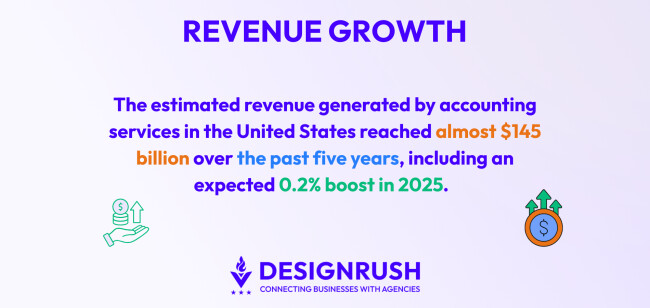
The estimated revenue generated by accounting services in the United States reached almost $145 billion over the past five years, including an expected 0.2% boost in 2025.
According to statistics, 72% of accounting and bookkeeping practices reported increased revenue in the past 12 months to highlight the growth seen across the industry.
Offering new and additional services to clients is a leading reason for revenue and profit increase. On average, accounting and bookkeeping practices offer around six services to their clients.
Key benefits include:
- Ensured adherence to federal and state financial law
- Help with strategic financial planning
- Low operational costs
- Allow owners to focus on core business activities
- Accurate financial reporting
What red flags should I watch out for when hiring a firm?
Several red flags can indicate a poor accounting partner, including:
- Unclear pricing: Vague fee structures or a lack of detailed pricing breakdowns often lead to unexpected charges, budget overruns, and disputes once work is underway.
- Slow or inconsistent communication: Delayed responses (longer than 24 hours and leading to several days) during the sales or onboarding phase may indicate ongoing responsiveness issues, especially during critical reporting or tax deadlines.
- Lack of industry experience: Firms without experience in your specific industry may overlook relevant tax strategies, misinterpret regulations, or apply inefficient reporting practices.
- No structured onboarding process: Top accounting firms typically offer defined timelines, clear document checklists, and assigned points of contact to ensure a smooth transition and accurate setup.
- Purely reactive approach: Firms that only respond when contacted tend to focus on basic compliance rather than proactively identifying risks, explaining financial trends, or recommending improvements before issues escalate.
What is the difference between an accounting firm and a CPA firm?
Top accounting firms typically offer a range of services, including bookkeeping, payroll, financial reporting, and advisory services, that support day-to-day operations.
They may employ accountants without CPA licensure and typically focus on management and operational accounting.
A CPA firm employs Certified Public Accountants who have passed licensing exams and meet state regulatory requirements.
In the United States, there are over 650,000 actively licensed CPAs, reflecting the professional standards required to hold this credential.
In addition to standard services, CPA firms can perform audits, reviews, and formal attestations of financial statements and represent clients before the IRS.
While all CPA firms are accounting firms, not all accounting firms are CPA firms. The distinction matters when audited financials or formal tax representation is required.
How do I measure whether they are actually adding value?
To truly measure value, you need to consider other factors aside from receiving reports on time.
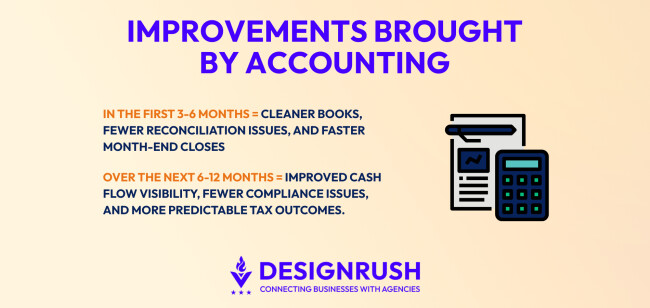
In the first 3-6 months, improvements typically show up as cleaner books, fewer reconciliation issues, and faster month-end closes, often shortening reporting cycles by 20-40%.
You may also notice a decline in last-minute requests for missing data or corrections, indicating stronger processes and better organization.
Over the next 6-12 months, value should extend further into improved cash flow visibility, fewer compliance issues, and more predictable tax outcomes.
Reduced penalties, smoother audits, and proactive tax planning are strong indicators of effective performance.
At this stage, your accounting firm should help you anticipate potential issues and plan, rather than react to problems after they arise.
Time savings are another measurable benefit. Many business owners reclaim 5-15 hours per month previously spent on financial administration.
When your partner consistently improves accuracy, provides forward-looking insights, and supports better decision-making, it is delivering strategic value rather than just transactional support.
Regular review meetings and performance check-ins are also strong signs of a high-value accounting partnership.
Sources
DesignRush sustains a directory of over 40,000 agencies categorized by service category, location, expertise, and reviews. We build our database in two ways:
- Our dedicated team of agency experts actively searches the web for top-performing companies. We then pull information from their websites, online presence, and client testimonials to verify their status and qualifications prior to listing.
- The agencies listed get notified of their profiles on the website and they can choose to claim it or not, which suggests their availability for more collaborations.
Agencies can also reach out to DesignRush and must go through the verification process prior to being listed.

Why companies trust DesignRush
Every agency is independently vetted before it can be listed or ranked
 4.8
4.8 4.8
4.8Some agencies pay for sponsored placement, clearly labeled and held to the same vetting standards.
Frequently Asked Questions About Accounting Companies
At what point should I hire an accounting firm?
Most businesses begin working with one of these companies once financial complexity interferes with daily operations.
While there is no universal threshold, many companies seek professional support when:
- Annual revenue consistently exceeds $100,000-$250,000
- Monthly transaction volume reaches 40-50 or more entries
- Payroll, tax filings, or reporting begin consuming operational time
At those stages, manual bookkeeping becomes inefficient and increases the risk of errors or missed compliance deadlines.
Accounting outsourcing is also driven by efficiency. Around 65% of businesses outsource finance and accounting tasks to free up internal resources and focus on growth.
As requirements expand, they provide structure, accuracy, and regulatory oversight that small internal teams often struggle to maintain.
What accounting services do most top accounting companies offer in the US?
The best accounting firms in the US typically provide a mix of core financial, compliance, and advisory services.
Common offerings include:
- Bookkeeping and bank reconciliations
- Financial statement preparation
- Payroll processing
- Accounts payable and receivable management
- Tax planning and federal, state, and local tax filings
Many firms also offer:
- Budgeting and forecasting
- Cash flow and financial performance analysis
- Audit preparation and internal controls assessments
- Compliance support under U.S. Generally Accepted Accounting Principles (GAAP)
Many businesses outsource several accounting functions at the same time, which is why US companies typically offer these services as bundled, ongoing engagements rather than isolated tasks.
This approach aligns with the scale of the finance and accounting outsourcing market, which stood at $54.79 billion in 2025.
How much does it cost to hire top accounting firms in the United States?
The cost of hiring one of these firms in the United States depends on business size, transaction volume, and service complexity. Typical pricing includes:
- $300-$800 per month for basic bookkeeping and reconciliations
- $150-$400 per hour for specialized CPA services
- $800-$2,500 per month for comprehensive monthly packages (payroll, reporting, tax support)
- $2,500-$5,000+ per month for mid-sized or higher-complexity businesses
At a macro level, the global accounting outsourcing market is expected to exceed $80 billion by 2030, as companies pursue cost efficiencies of 20-60% compared to maintaining full in-house accounting teams.
What additional costs can I expect from these types of companies?
In addition to base retainers, they often charge for specialized or non-recurring services, such as:
- Year-end financial statements
- Multi-state or corporate tax filings
- Audit preparation
- System migrations
- International compliance
- Advisory or consulting projects
Other common add-ons include payroll setup, budgeting assistance, and financial forecasting.
For many growing businesses, these services increase total annual accounting spend by 20-40% beyond base fees.
While this raises short-term costs, outsourcing often reduces overall operating expenses by eliminating the need for full-time internal finance staff and minimizing compliance risks.
What do I need to know before I switch to a top accounting firm?
Switching companies usually involves a transition period of 4-8 weeks. During this time, businesses should be prepared to provide:
- 2-3 years of financial statements
- Prior tax filings
- Payroll records
- Access to accounting software
A brief overlap between outgoing and incoming firms is common and helps:
- Resolve open items
- Prevent reporting gaps
- Ensure continuity of compliance
Planning the transition outside of peak tax or reporting seasons further reduces disruption and operational risk.
Latest Trends Related to Accounting