Picking accountants in North Carolina matters more when an audit, a merger, or a growth decision is ahead of you. Here, you'll find vetted firms with portfolios and reviews to compare, so you can move forward with confidence.
Top 10 Accounting Agencies in North Carolina, United States
Discover the top 10 Accounting agencies in North Carolina, United States, known for their exceptional service and expertise. These agencies boast an impressive average rating of 4.4/5 stars and offer competitive pricing ranging from $1 to $35. Catering to industries such as Financial Services, Accounting, Tax Preparation, Legal Services, Law Firms, Solo Practitioners, Healthcare, and more, these firms excel in providing strategy, app development, technology solutions, and public relations. They have been selected for their verified client reviews, outstanding portfolio quality, and proven track record of delivering measurable results.
Organic rankings are determined by five factors: top services, reviews, portfolio, awards/press, and team expertise. Sponsored listings pay for a placement that appears above organic positions. Sponsorship does not affect star ratings or review content - read more on our methodology page.
Quality Back Office (QBO) relieves business owners from the burdensome tasks of payroll, bill pay, invoicing, bookkeeping, accounting and more. With a dedicated team of real people and over 10 years of experience, we have successfully taken over 500+ back offices. Let us be your go-to back office provider...
Top Services:
HR Outsourcing
Business Consulting
Accounting
BPO
Show more
Location
Durham, North Carolina
Number of Employees
100 - 249
Quality Back Office Services
HR Outsourcing
Business Consulting
Accounting
BPO
Data sourced from the agency's DesignRush profile, its website, and other relevant accounts
Blue Bird Day
Neocol
Point B Properties
Data sourced from the agency's DesignRush profile
Quality Back Office Reviews & Testimonials
Graham Ebetsch Review from Google
1.0★
Graham Ebetsch's Review Sourced from Google
We found ourselves in the hands of QBO after our previous accountant merged her practice with theirs. We didn't feel great about the process in working with them for tax prep and pursued other help after one year. Our new accountant caught a major error within minutes of scanning through our QBO filings which cost us well over $2,000 at the time.We followed up with their team to understand how an error like that could have happened. I was assured by the president that he would personally investigate; I never heard back.
Charles Botchway Review from Google
5.0★
Charles Botchway's Review Sourced from Google
QBO has handled our accounting and tax work for 5+ years and done a great job. They are very responsive and attentive. If you need outsourced bookkeeping or accounting services, you'd be hard pressed to find a better option.
Randy Tylin Review from Google
5.0★
Randy Tylin's Review Sourced from Google
QBO has been doing my personal and now my Company's tax work. I was dissatisfied with my previous CPA- and the difference over the past 5 years has been night and day. Extremely knowledgeable and responsive. Additionally we have outsourced my Business' bookkeeping service to QBO and have referred them to other friends/businessowners.
Reviews verified by DesignRush and sourced from the agency's profile View All Reviews
IT, Business, BPO, Audit, Tax and Advisory are just the beginning.
IT, Business, BPO, Audit, Tax and Advisory are just the beginning.
Grant Thornton LLP (US) is an IT, project management, audit, tax, AgTech, and BPO company headquartered in Chicago, Illinois with over 50 U.S. offices and access to a global network or member firms in over 135 countries. We offer a broad range of services in strategy and consulting, operations, technology and...
Wolters Kluwer (www.wolterskluwer.com) is a global leader in information services and solutions for professionals in the health, tax and accounting, risk and compliance, finance and legal sectors. We help our customers make critical decisions every day by providing expert solutions that combine deep domain...
Blackman & Sloop strives to work with our clients to help them meet their goals. As a partner, we offer an insight into the issues our clients face each day. We offer proactive solutions and services for the ever-changing needs of businesses and families alike...
Red Bike Advisors is a modern accounting firm that delivers strategic financial guidance, tax planning, and advisory services to help businesses grow with confidence...
Here at Steward, Ingram, & Cooper, PLLC, our top priority is to provide accurate and knowledgeable accounting and bookkeeping assistance to individuals and small businesses in and around Raleigh. While much of our focus is on working with our clients to look toward the future with financial success, we also...
We have been working in the accounting profession for over 20 years. We provide audit, controller and business services, specializing in bookkeeping, accounting, taxes and payroll...
GBK Advisors is a strategic accounting partner specializing in tax, valuation, and business planning for growth-oriented businesses. With a focus on personalized service and innovative solutions, GBK goes beyond traditional accounting to help entrepreneurs and companies navigate complex financial challenges...
Goldsmith Molis & Gray is a reliable accounting advisor, allowing clients to entrust all accounting tasks to a dedicated team while focusing on core business operations. Goldsmith Molis & Gray streamlines workflows for seamless collaboration, providing real-time insights into clients' financial data...
DMJPS is a distinguished tax, assurance, and business advisory firm renowned for its tailored solutions and unwavering commitment to client satisfaction. With a team of seasoned professionals, DMJPS provides personalized attention and expertise to address diverse financial challenges. Guided by the principle...
Akram & Associates is a full-service accounting firm specializing in assurance, advisory, and tax services for hedge funds, cryptocurrency funds, investors, traders, family offices, and high-net-worth individuals. Since 2013, the firm has provided tailored accounting solutions, maximizing after-tax income...
Cherry Bekaert Advisory is a premier national accounting and advisory firm, driving growth with tailored, industry-focused solutions. Its team of over 2,500 professionals delivers expert tax, advisory, and assurance services. Committed to empowering clients and reimagining the future, Cherry Bekaert Advisory...
Hobart Wealth is a trusted financial advisory firm in Charlotte specializing in personalized wealth management and financial planning. Their mission is to guide individuals and families toward financial security with customized strategies and clear communication...
Profit by the Books delivers professional bookkeeping services, helping small and medium-sized business owners understand their financials with timely, accurate reports and personalized support...
Collaborating for Lasting Impact in Business Consulting
Collaborating for Lasting Impact in Business Consulting
Join us at Deloitte, where we believe that our collective influence is the cornerstone of our value. With a rich legacy spanning over 175 years and a global network encompassing 150 countries, we empower remarkable achievements, solve complex problems, and drive meaningful progress for clients, professionals...
BRC is a CPA & Advisory firm w/ offices in Greensboro, Charlotte, Raleigh, Winston-Salem, Dunn & Wilmington, NC. BRC operates as a leading CPA firm w/ top business advisors engaged in helping today’s middle market & private co, not-for-profit orgs...
MCM CPAs & Advisors is a large regional CPA firm providing highly specialized services to a broad range of clients and industries. Core Services: Tax, Assurance, IT Compliance & Advisory, Management Advisory Services, Valuation/Litigation Support, M&A, Fraud & Forensics, Accounting Services, Bank Relationship...
Forvis Mazars is a leading public accounting firm ranked among the top 10 in the nation. With a forward vision and unwavering commitment to unmatched client experiences, we redefine excellence in the industry. Formed through the merger of two esteemed firms, BKD and DHG, FORVIS combines legacy and innovation...
Oasis, A Paychex Company, is a leading Professional Employer Organization (PEO). We provide Human Resources Administration, Employee Benefits, Healthcare Reform Support, Payroll Administration, Workers’ Compensation services and much more. Our human resources-related products and services allow small- and...
GreerWalker LLP has developed into one of the leading accounting and business advisory firms.
GreerWalker LLP has developed into one of the leading accounting and business advisory firms.
Founded by Charlie Greer and Kevin Walker in 1984, GreerWalker LLP has developed into one of the leading accounting and business advisory firms based in the Carolinas, with a total staff of more than 100 associates including eighteen partners...
As a large, local CPA firm, TJT has the capacity and capability to offer numerous services to our clients. We deliver audit reports, corporate tax returns, and valuable business and accounting advice year round. See less...
Business owners like you are seeking ideas, problem-solvers, and strategies for success. Our firm makes businesses more profitable, more valuable, and able to provide the lifestyle business owners desire...
Expert Outsourced CFO Services For Startups And Growing Businesses
Expert Outsourced CFO Services For Startups And Growing Businesses
At K-38 Consulting, we provide comprehensive CFO services designed to give your business the strategic financial expertise it needs to grow and thrive. From cash flow management to financial planning and tax optimization, we deliver actionable insights that drive smarter business decisions. Partner with us...
Protiviti is a global consulting firm that offers deep expertise, objective insights, and tailored solutions to empower leaders in tackling future challenges. With a comprehensive range of services spanning finance, technology, operations, data, analytics, governance, risk, and internal audit, we serve...
Johnson Lambert was formed in 1986 in the Washington, DC area by Larry Johnson and Debbie Lambert, Partners Emeriti. Prior to the formation of Johnson Lambert, Larry and Debbie were both affiliated with Ernst & Whinney (now EY), where they were active leaders in the firm’s insurance practice...
Elliott Davis provides accounting, tax and consulting services to diverse companies in a wide-range of industries.Elliott Davis is a leading business solutions provider offering a full spectrum of services in the areas of tax, comprehensive assurance, and consulting services to diverse businesses...
Go4Customer specializes in call center outsourcing, offering innovative and performance-driven customer support solutions across various industries. Through advanced technology, in-depth insights and industry expertise, we provide a comprehensive approach that covers voice, live chat, email and social media...
EY offers Accounting, Business Consulting, and IT Services with a mission to build a better working world. It provides insights and quality services that instill trust in global capital markets and economies. EY focuses on developing exceptional leaders who deliver on their commitments to all stakeholders...
Offering project management, business, and IT services. At KPMG LLP, their purpose is to turn knowledge into value for the benefit of their clients, people, and the capital markets...
Building trust in society and solving important problems.
Building trust in society and solving important problems.
We’re a network of firms in 155 countries with over 284,000 people who are committed to delivering quality in BPO, project management, assurance, advisory, IT, and tax services...
iRapidO Global is a Business Process Management organization delivering scalable back-office and operational support to growing businesses worldwide. We combine domain expertise, structured process frameworks, automation, and AI-enabled tools to help companies improve efficiency, control costs, and focus on...
6 Frequently Asked Questions About Accounting Firms in North Carolina
How do I know if I actually need an accounting firm rather than just a bookkeeper?
A business should transition from bookkeeping to a full accounting firm when annual revenue approaches $500,000 to $1 million, when outside investors or lenders become involved, or when the business operates across multiple entities or locations.
The distinction matters in practical terms. Namely, a bookkeeper records and organizes financial transactions such as invoices, expenses, payroll entries, and bank reconciliations. That level of service is adequate for early-stage businesses with a single revenue stream and straightforward tax obligations.
The shift toward a full accounting firm becomes necessary when the business starts operating beyond that baseline. At that stage, a CPA (Certified Public Accountant)-level firm will provide tax strategy, financial statement preparation that holds up to external scrutiny from lenders or auditors, and the ability to represent the business before the IRS, which are capabilities that fall outside a bookkeeper's scope entirely.
How much do accountants in North Carolina typically charge, and what drives the variation in price?
Local business owners should expect to pay between $120 and $160 per hour for business accounting and CPA services in North Carolina. The hourly rates for bookkeeping range between $42 and $48, while tax preparation services entail a fixed fee of $200 to $220.
Here are some typical cost ranges for the most common accounting services a business owner is likely to need:
Service
Average cost range
Monthly bookkeeping (flat rate)
$300 to $2,000/month
Business tax return (small business)
$500 to $2,500
Full-service monthly accounting package
$800 to $2,500/month
Full-service audit
$5,000 to $50,000+
Firms based in mid-size North Carolina markets such as Greensboro, Winston-Salem, Wilmington, or Asheville typically run 15% to 30% below Charlotte and Raleigh rates for comparable services, without a proportional drop in technical quality.
What unexpected fees do accounting firms in NC charge that business owners don't anticipate before signing?
The most underestimated cost is the rush fee, which can add up to 20% to 25% on top of standard tax preparation fees when a business owner delivers records late or requests expedited turnaround near a deadline.
The second common surprise is the document disorganization charge. Most engagement letters include a stated assumption about the condition of the records being delivered. When records arrive incomplete, inconsistent, or require significant reconciliation before any accounting work can begin, firms bill the additional time at their standard hourly rate.
North Carolina-specific obligations add a third layer of unexpected charge. The state's corporate income tax, franchise tax, and various local county and municipal filings are frequently itemized as additions to a base engagement quote rather than included in it.
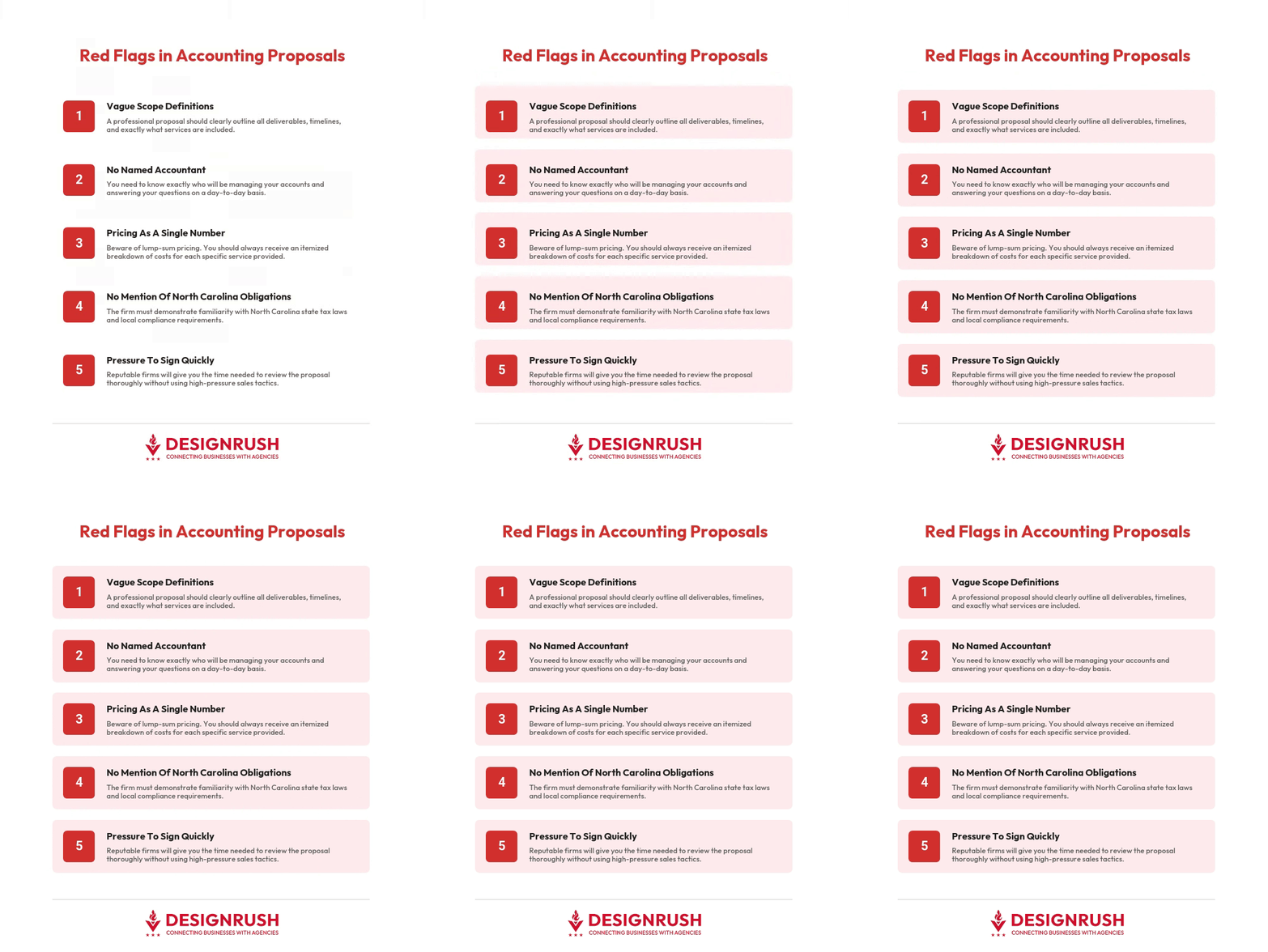
A potential red flag to consider in this situation is whether a firm that cannot provide a written, itemized fee schedule before signing an engagement letter is a firm whose billing practices will be difficult to predict or dispute later.
What should business owners verify about an NC accountant's credentials before signing anything?
The CPA designation in North Carolina is a regulated title, and any firm or individual using it must hold an active license issued by the NC State Board of CPA Examiners, which operates a public license lookup database that any business owner can check in under two minutes.
That verification step is important as an unlicensed or lapsed-credential practitioner cannot legally represent a client before the IRS, cannot issue audited or reviewed financial statements, and cannot sign off on documents that lenders and investors require for financing or acquisition due diligence.
The risk of hiring a practitioner operating on an expired or inactive license can affect the legal defensibility of financial statements and the validity of filed returns.
Beyond the base CPA credential, additional designations signal specific capability worth understanding:
An Enrolled Agent (EA) designation grants federal tax representation rights before the IRS, which is relevant for businesses anticipating audits or disputes.
A Certified Management Accountant (CMA) credential indicates depth in internal financial management and strategic planning.
Is a larger accounting firm in North Carolina a safer or more reliable choice than a smaller local firm?
Firm size is not a reliable proxy for service quality, and for most small to mid-size North Carolina businesses, a smaller local firm usually delivers better day-to-day access, faster response times, and more invested account management than a regional office of a larger firm will.
Larger accounting firms in North Carolina, including regional offices of national firms, bring structured processes, broad staffing depth, and brand accountability. For businesses that require multi-state audit capability, SEC reporting, or enterprise-level advisory, that scale is genuinely necessary.
For a business generating under $10 million in annual revenue with standard compliance needs, the same scale tends to produce a different result: the work gets assigned to staff with limited direct access to senior-level accountants, and the relationship becomes transactional.
The more useful question is who specifically will handle the account and what their individual experience level is. Asking for the name and credentials of the assigned accountant before signing an engagement letter is a great step toward verifying the talent you’ll bring on board.
When is it worth switching accounting firms mid-year?
Switching accounting firms mid-year is worth it when the current firm is creating active financial risk. The cost of staying with the wrong firm compounds faster than the cost of moving to a better one.
The most common triggers that justify switching mid-year:
Missed deadlines or unfiled obligations
Errors that have gone unacknowledged or uncorrected
Consistent unresponsiveness during critical periods
Billing disputes that the firm will not clarify or resolve
The transition itself is manageable. A new firm will need prior-year returns, current-year workpapers, payroll records, and any open IRS or North Carolina Department of Revenue correspondence. Most firms charge an onboarding review fee at standard CPA rates, typically one to three hours of billable time.
In terms of the timing of the switch, the best and worst windows for North Carolina businesses on a calendar-year schedule are:
January – March: Possible, but tight; a new firm has a limited runway before filing deadlines.
April – October: The least disruptive window; the bulk of compliance work is either done or far enough out.
November – December: Highest risk of something falling through the gap during handoff.
One procedural step businesses commonly miss is the IRS power of attorney authorizations, more specifically, Form 2848. It must be formally revoked and reissued when changing firms, as without that update, the previous firm retains legal authority to communicate with the IRS on the business's behalf.





























 4.7
4.7 4.7
4.7

 Proposals