
We all love a good will-they-won't-they story.
For some time, OpenAI went back and forth with its stance on ads, and finally, its CEO, Sam Altman, declared this love-hate relationship official - ChatGPT ads are live.
This leaves users, marketers, and businesses wondering what happens next.
Should you be celebrating a new opportunity or preparing for a new competitive battleground?
Advertising on ChatGPT 2026: Key Findings
- ChatGPT ads are live. Sponsored recommendations currently appear to users on the Free and Go plans, while users on the Plus, Pro, Business, Enterprise, and Education plans are ad-free.
- Running a ChatGPT ad looks very different from running a Google Ads campaign. Instead of bidding on keywords, advertisers use context hints that describe relevant conversations and user needs.
- The battle for visibility is moving beyond keywords. As users research products and services through AI assistants, brands are starting to compete for presence inside AI-driven recommendations.
What's Actually Happening With ChatGPT Ads Now?
Ads on ChatGPT are no longer a hypothetical. OpenAI is currently running ads for users on its Free and Go plans in multiple markets, whereas Plus, Pro, Business, Enterprise, and Education users remain ad-free.
You’ll see these sponsored recommendations appear beneath ChatGPT responses and be clearly labeled as advertisements.
While the rollout itself has been relatively limited, the attention surrounding it hasn't.
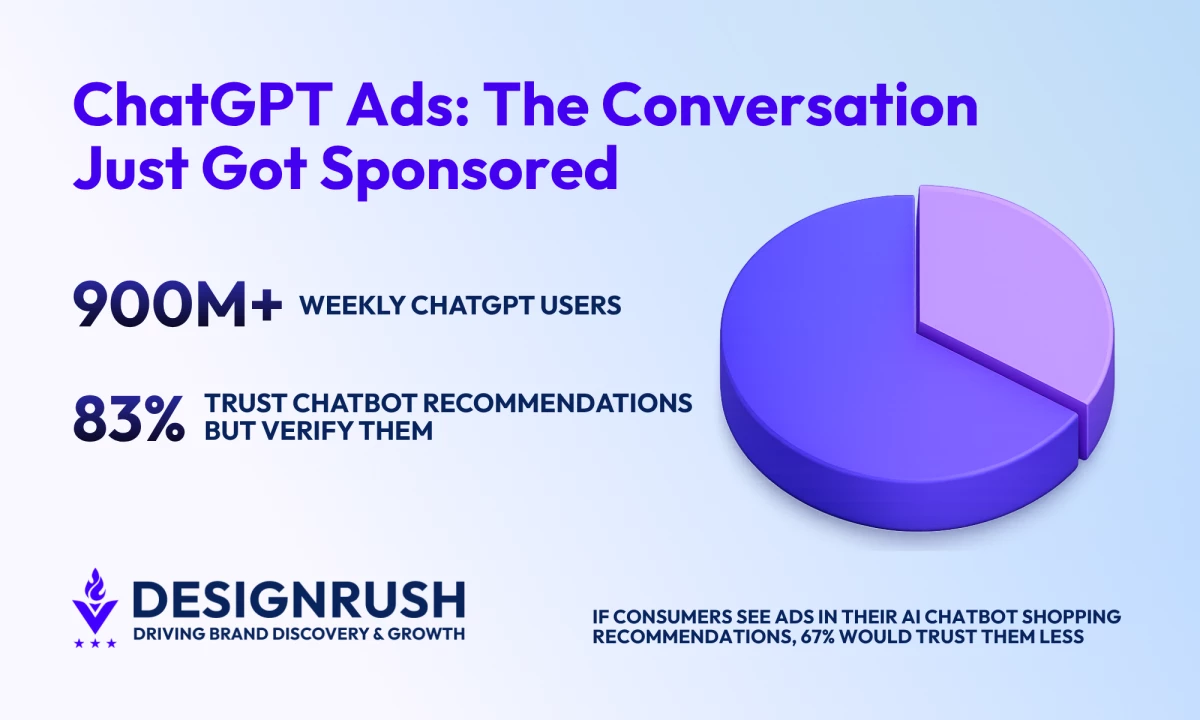
Between OpenAI's earlier comments on advertising, the company's massive 900-million-weekly-user base, and growing interest from brands eager to understand the platform's potential, ChatGPT ads have quickly become one of the most talked-about developments in digital marketing this year.
So, are they here to stay and how do they work? Let’s take a step back for some much-needed context.
The ChatGPT Advertising Timeline: From "Last Resort" to Self-Serve
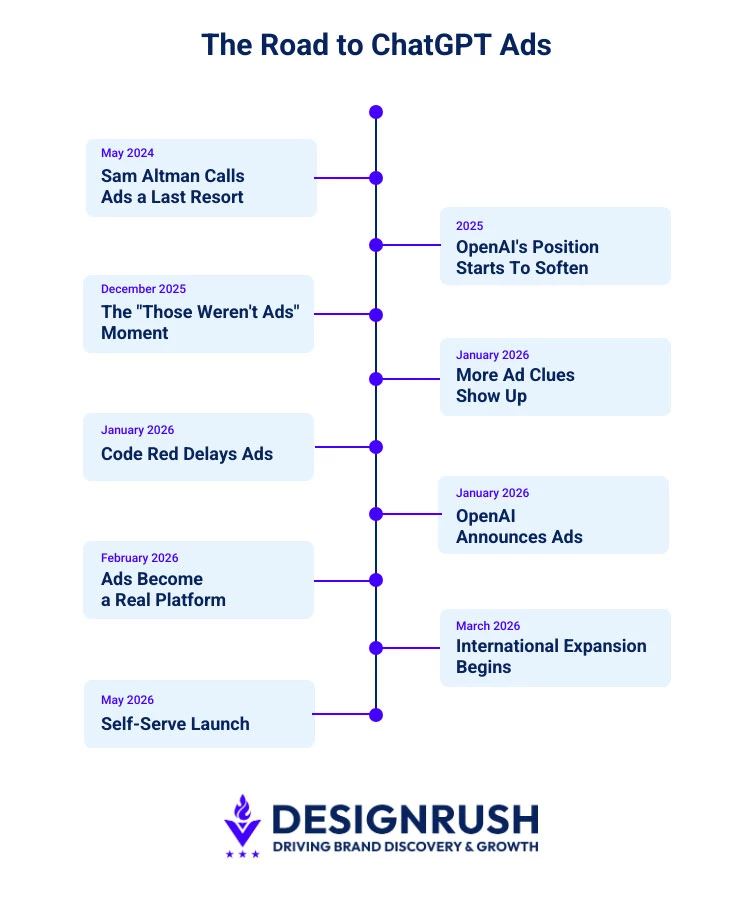
If ChatGPT ads feel like they appeared overnight, that's because most of the twists happened behind the scenes. The path from "last resort" to a fully self-serve advertising platform took less than two years.
Along the way came public denials, leaked screenshots, user backlash, and more than a few moments that left people wondering whether OpenAI had changed its mind.
- Sam Altman Calls Ads a "Last Resort"
- OpenAI's Position Starts To Soften
- The "Those Weren't Ads" Moment
- The Evidence Starts Piling Up
- OpenAI Hits Pause With a Code Red
- Drumroll... Ads Are Coming
- February-May 2026: Ads Become a Real Platform
Sam Altman Calls Ads a "Last Resort"
It's easy to forget now, but there was a time when ChatGPT ads felt almost unthinkable.
Speaking at Harvard Business School in 2024, OpenAI CEO, Sam Altman, described AI advertising as “uniquely unsettling” and a "last resort." He didn't completely rule it out, but he made it clear that it wasn't the business model he wanted OpenAI to rely on yet.
At the time, that position helped distinguish ChatGPT from Google. ChatGPT was trying to position itself as something different.
For users, that distinction became part of the appeal. ChatGPT wasn't just another place to find information as it felt refreshingly disconnected from the sponsored links, keyword bidding wars, and ad-heavy experiences.
Looking back, it's one of those quotes that did not age like fine wine.
OpenAI's Position Starts To Soften
Then the language started changing. OpenAI wasn't suddenly pitching itself as the next Google Ads. Nobody was talking about sponsored prompts or advertising revenue targets. But it all stopped sounding quite so absolute whenever the topic came up.
Instead of "we won't," the messaging became closer to "we'd be very careful."
By this point, ChatGPT's growth had become difficult to ignore. The platform was attracting hundreds of millions of users and processing enormous volumes of queries.
Building AI models was turning out to be one of the most expensive businesses on the planet. So, it turns out that OpenAI's ambitions were growing just as quickly as its costs.
“The kind of thing I’d be much more excited to try than traditional ads is a lot of people use Deep Research for e-commerce, for example, and if there's a way that we could come up with some sort of new model, which is we’re never going to take money to change placement or whatever.
But if you buy something through Deep Research that you found, we’re going to charge like a 2% affiliate fee or something.
That would be cool, I’d have no problem with that. And maybe there’s a tasteful way we can do ads, but I don’t know. I kind of just don’t like ads that much.”
Most users didn't pay much attention to the change in tone as Sam Altman spoke about ads in the Stratechery interview. In hindsight, it looks like the beginning of a transition with advertising no longer being treated as something completely off the table.
The "Those Weren't Ads" Moment
Then came the screenshots.
In December 2025, ChatGPT users began sharing examples of product recommendations appearing inside conversations. Brands like Target and Peloton suddenly started appearing in screenshots circulating on social media.
Almost immediately, people started asking the same question: Were these ads?
And heeeeere we go.
— Benjamin De Kraker (@BenjaminDEKR) December 3, 2025
OpenAI employees are now claiming that a banner (in an unrelated chat) asking the user to "shop for groceries at Target"
"isn't an ad."
Bruhhh... Don't insult your paying users. https://t.co/Kw7tM3BrIVpic.twitter.com/31g8F5eOSd
The timing was awkward. OpenAI had spent some time distancing itself from advertising, so seeing branded recommendations appear inside chats raised eyebrows.
As speculation grew, OpenAI's Head of Product for ChatGPT, Nick Turley, pushed back on the claims, saying the company wasn’t running live advertising tests.
That should have ended the story; instead, it made people even more curious.
A short time later, OpenAI Chief Research Officer, Mark Chen, acknowledged that the company had "fallen short" and confirmed that certain app-style suggestions had been removed. The recommendations disappeared, but the debate didn't.
For many observers, this became the turning point.
The controversy changed the conversation from whether OpenAI would ever introduce advertising to how long it would take.
The Evidence Starts Piling Up
By this point, the "those weren't ads" explanation was becoming harder to sustain.
Developers digging through the latest ChatGPT Android beta discovered references to advertising infrastructure hidden inside the app's code.
Strings such as ads feature, search ad, search ads carousel, and bazaar content suggested OpenAI was actively building systems capable of supporting sponsored content.
ChatGPT Android app 1.2025.329 beta includes new references to an "ads feature" with "bazaar content", "search ad" and "search ads carousel" pic.twitter.com/BdHOJIQHmA
— Tibor Blaho (@btibor91) November 29, 2025
Then there was yet another awkward moment. One ChatGPT Pro subscriber reported seeing what seemed suspiciously like a live ad.
Within a discussion about Elon Musk's interview on Nikhil Kamath's podcast, ChatGPT showed a recommendation that read, "Find a fitness class. Connect Peloton."
Wow, ChatGPT is already showing ads?
— Yuchen Jin (@Yuchenj_UW) December 1, 2025
I was just talking with it about Elon on Nikhil’s podcast when out of nowhere it popped up an ad saying, “Find a fitness class, Connect Peloton.” 🤯
Wild. At least match the ad to the topic next time! https://t.co/U4QMmiGbRnpic.twitter.com/s9uREIlB50
The response spread like wildfire on social media. Meanwhile, OpenAI's public stance on advertising continued to evolve.
Internal forecasts reportedly projected $1 billion in free user monetization revenue by 2026. The company was also hiring for roles tied to campaign infrastructure, attribution systems, and advertising technology.
Around the same time, Altman openly discussed alternative monetization models, suggested Instagram had changed some of his thinking on advertising, and acknowledged that ChatGPT would likely experiment with ads in some form.
OpenAI Hits Pause With a Code Red
Then, just as ads started feeling inevitable, OpenAI appeared to hit the brakes.
According to an internal memo obtained by The Wall Street Journal, CEO Sam Altman issued an all-hands code red to improve ChatGPT's quality, speed, personalization, and reliability.
Daily calls were introduced. Teams were temporarily reassigned. Product quality became the company's top priority, and the projects getting pushed back included:
- Advertising plans
- A personal assistant
- AI agents for health and shopping
The timing wasn't random. Google's latest Gemini models had begun outperforming OpenAI on several benchmarks. Gemini's ecosystem had reportedly grown from 450 million monthly active users to 650 million in just a few months.
Anthropic was gaining traction with enterprise buyers when OpenAI faced growing pressure to fund massive infrastructure investments while remaining unprofitable.
In many ways, the pause called attention to the balancing act OpenAI was trying to pull off.
The company clearly needed new revenue streams. But it also couldn't afford to compromise the product that made those revenue streams possible in the first place.
Before OpenAI could convince advertisers to invest in ChatGPT, it had to convince users to keep using it.
Drumroll... Ads Are Coming
On January 16, 2026, OpenAI finally stopped dancing around the question when Altman announced they would begin testing ads for users on its Free tier and new $8-per-month Go plan in the United States.
Plus, Pro, Team, Business, and Enterprise users would remain ad-free.
OpenAI said advertisers would not be able to influence ChatGPT's answers, conversations would remain private, and users would be able to control ad personalization settings.
Ads would appear separately from responses, be clearly labeled as sponsored content, and would not be shown in conversations involving sensitive topics such as health, mental health, or politics.
We are starting to test ads in ChatGPT free and Go (new $8/month option) tiers.
— Sam Altman (@sama) January 16, 2026
Here are our principles. Most importantly, we will not accept money to influence the answer ChatGPT gives you, and we keep your conversations private from advertisers.
It is clear to us that a lot… https://t.co/f9Dv53rWU7
The announcement also marked another notable shift in Altman's public stance on advertising, coming from the same CEO who had previously said he hated ads.



February-May 2026: Ads Become a Real Platform
Less than a month after announcing its plans, OpenAI officially began testing ads inside ChatGPT for logged-in adult users on its Free and Go plans in the United States.
The format looks very different from traditional display advertising. Sponsored recommendations appear underneath ChatGPT's response and are clearly labeled as ads.
A user asking for recipe ideas might see meal kit recommendations. Someone comparing products could be shown a relevant retailer or service.
The company repeatedly emphasized the same message it had been delivering since the January announcement: ads would not influence ChatGPT's answers, allegedly.
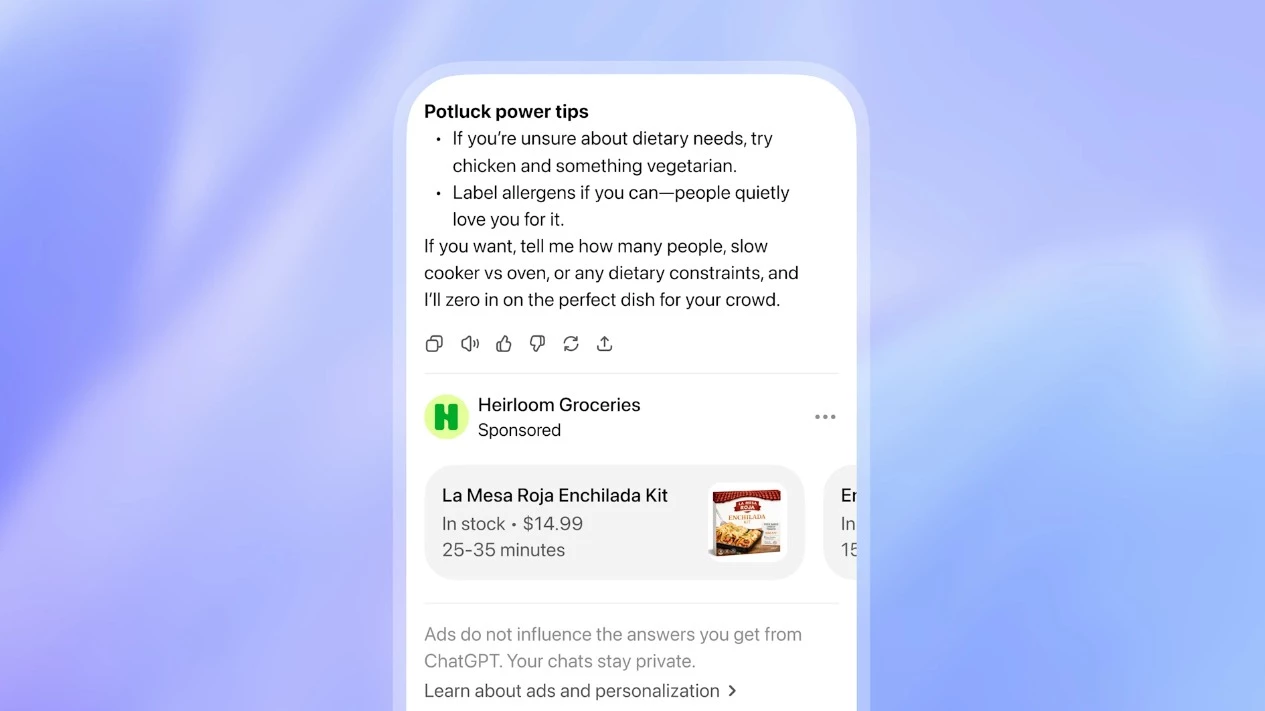
OpenAI published detailed advertising principles, explaining that sponsored content would remain visually distinct from responses, that conversations would remain private, and that advertisers would never gain access to individual chats, memories, or personal information.
Advertisers would receive only aggregated performance data, such as views and clicks.
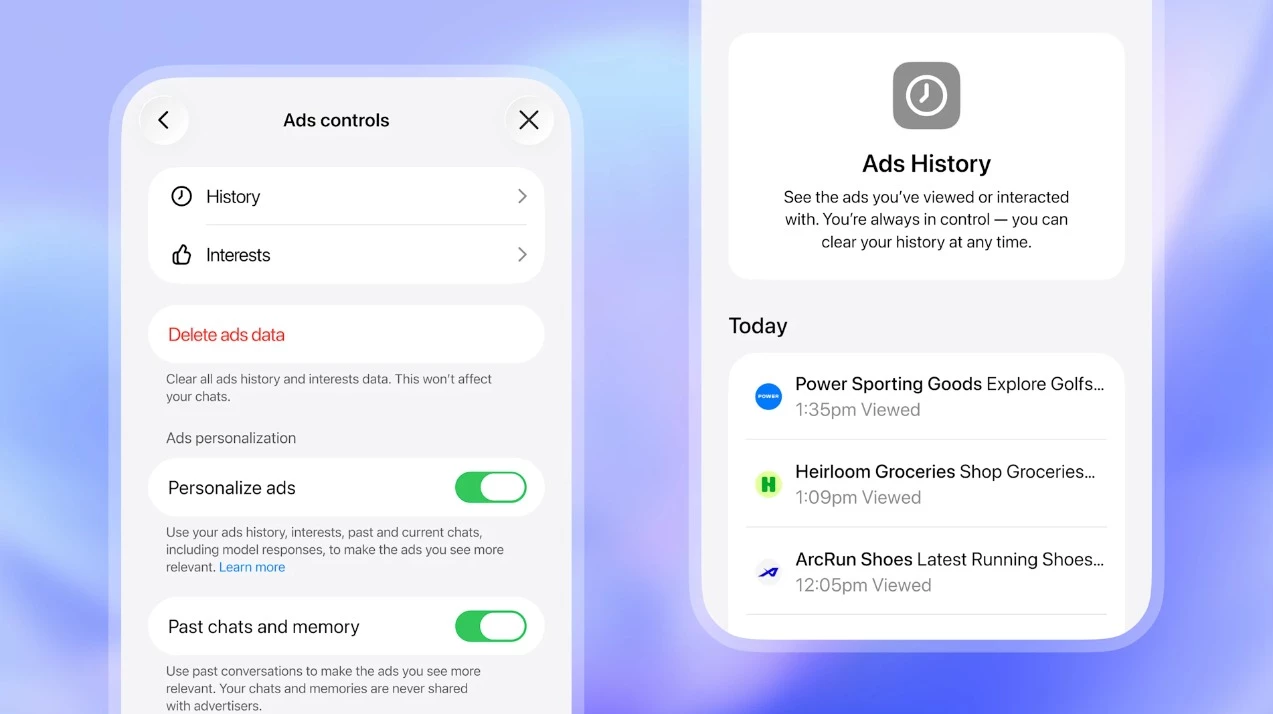
The company also introduced controls that allow users to manage ad personalization, delete advertising data, review ad history, and see why a particular ad was shown.
Users could even choose whether past chats and memory would be used to improve ad relevance without sharing that information with advertisers.
By March, OpenAI reported what it described as encouraging early results and announced plans to expand the pilot beyond the United States. Canada, Australia, and New Zealand were first on the list.
“Update on March 26, 2026: Our ads pilot is focused on supporting broader access to ChatGPT while preserving consumer trust, usefulness, and user control.
Guided by our ads principles, the early results are encouraging. We’re seeing no impact on consumer trust metrics, low dismissal rates of ads, and ongoing improvements in the relevance of ads as we learn from feedback. These positive signals support moving into the next phase of our pilot.”
A few weeks later, the company revealed another expansion into the United Kingdom, Mexico, Brazil, Japan, and South Korea.
Why Are People So Upset About ChatGPT Ads?
When OpenAI announced ads, the initial backlash was more about the wishy-washy attitude than about advertising itself.
Most people using ChatGPT already spend their days on ad-supported platforms. Google, Instagram, Facebook, YouTube, TikTok, and countless news websites have conditioned us to expect some form of commercial interruption.
Yet ChatGPT triggered a noticeably bigger reaction.
Part of that came from OpenAI's own history. After spending years positioning ChatGPT as an alternative to traditional search, introducing ads was always going to attract scrutiny.
But more than that, ads feel different when they appear inside or more like sneak into a conversation.
Yikes this ChatGPT ad is huge!! First one I’ve seen. How has Sam Altman spent the last year talking about how they would blend in and then this is the final product?
— emilyforlini.bsky.social (@emilyforlini.bsky.social) February 15, 2026 at 4:27 PM
[image or embed]
Trust Was ChatGPT's Most Valuable Asset
ChatGPT is where people go for recommendations, advice, research, shopping comparisons, trip planning, career questions, and sometimes surprisingly personal conversations, which creates a different relationship from the one we have with Instagram or YouTube.
A 2026 consumer survey found that 47% of people trust chatbots to give them the best answers, while 83% say they trust chatbot recommendations but still verify them independently. Only 4% reported distrusting AI recommendations altogether.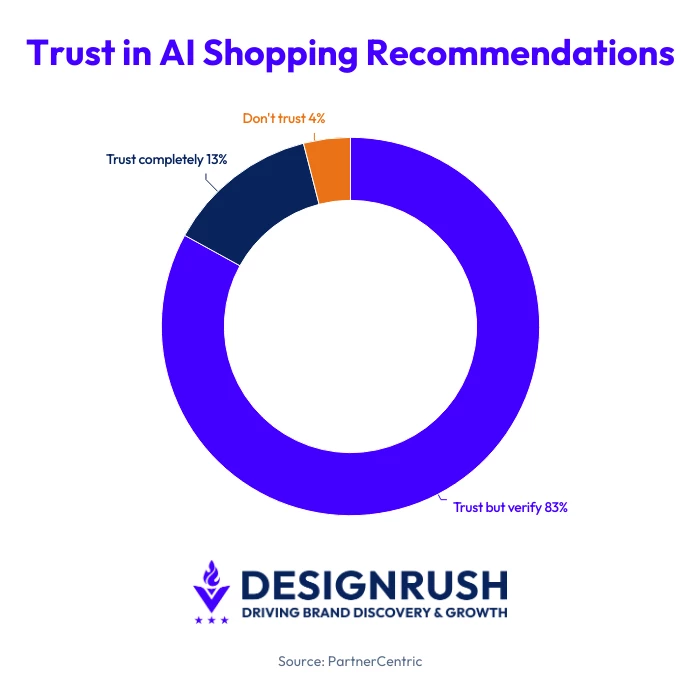 That's why so much of OpenAI's advertising rollout focused on privacy, answer independence, and user control.
On top of creating a new revenue stream, the company was, though clumsily, trying to protect what made ChatGPT valuable in the first place.
The same survey found that 78% of consumers believed AI shopping recommendations were already influenced by advertisers, even though advertising was not yet part of most chatbot experiences at the time.
OpenAI has repeatedly stated that advertisers cannot pay to influence ChatGPT's answers. But when recommendations and sponsored content exist within the same interface, it’s inevitable that users will become skeptical.
The New Gatekeeper Brands & Marketers Can’t Ignore
While users worried about trust, marketers were busy asking a different question: what happens if buying decisions start in ChatGPT?
For decades, brands have competed for rankings, clicks, and visibility in search results. AI changes that dynamic by giving users a direct answer and a recommendation instead of a page full of options.
That potential new normal wasn't lost on the marketing community. In one Reddit discussion following the rollout, marketers compared ChatGPT ads to the early days of Facebook advertising, arguing that "early movers might win, but most will burn budget testing."
Another pointed out that success would depend on transparency and on whether users continued to trust recommendations once sponsored content became part of the experience.
Why OpenAI Changed Its Position
Part of the backlash came from the perception that OpenAI had changed its mind and was now being hypocritical.
In reality, the company was operating in a very different environment than it was when Altman first described advertising as a last resort.
OpenAI is reportedly spending around $8 billion a year on compute, is projected to lose roughly $14 billion in 2026, and has committed more than $1.4 trillion to long-term AI infrastructure projects.
It’s also reported that the company is targeting $2.5 billion in advertising revenue this year and up to $100 billion annually by 2030.
Viewed through that lens, the decision looks less sudden and more like a financial reality.
That doesn't mean users have to like it. But it helps explain why the conversation shifted from whether ChatGPT would eventually introduce ads to how OpenAI could do it without damaging the trust that made the platform successful in the first place.
How ChatGPT Advertising Works
According to OpenAI, ChatGPT ads are designed to appear when users are actively researching, comparing options, or making decisions. Sponsored recommendations appear beneath ChatGPT responses and remain visually separate from the answer itself.
- What Advertisers Can Target
- What It's Actually Like to Run a Campaign
- ChatGPT Ads vs. Google Search Ads
- First Results Are Encouraging, but It's Still Early
What Advertisers Can Target
Instead of building keyword lists, advertisers provide context hints that describe the types of conversations in which their ads should appear.
For example, a CRM company might target discussions about lead management, sales workflows, or customer retention rather than bidding on keywords such as "best CRM software."
OpenAI describes this as advertising based on conversation context and user intent.
What It's Actually Like to Run a Campaign
Early advertisers say the biggest adjustment is learning to think beyond keywords.
In a LinkedIn post documenting her team's first ChatGPT campaign, one marketer noted that the biggest adjustment was targeting, as her team had to provide context hints.
They also highlighted limited optimization options, the absence of a centralized Business Manager, and campaign objectives focused primarily on reach and clicks.
Here’s what OpenAI has to say:
“Advertisers can now create ChatGPT ads through partners or a new beta self-serve Ads Manager.
We’re also introducing cost-per-click (CPC) bidding and expanded measurement tools, giving businesses more flexible ways to buy, manage, and understand campaign performance without sharing conversations or personal details with advertisers.
These updates make it easier for more businesses to participate and lay the groundwork for a broader ads platform built around how people use ChatGPT.”
Another professional who documented his experience launching a campaign during the beta, described the platform as surprisingly simple to set up.
His biggest lesson was bidding. Campaigns with low bids generated almost no impressions, making them appear broken even when they were technically active.
The overall impression from early testers is consistent - the early days of a new advertising channel.
ChatGPT Ads vs. Google Search Ads
As OpenAI puts it, people come to ChatGPT to explore options, compare alternatives, and weigh tradeoffs. That creates a different environment for advertisers from the one they’re used to:
| Feature | Google Search Ads | ChatGPT Ads |
| Targeting | Keywords and search terms | Context hints and conversation intent |
| User signal | Search query | Full conversation context |
| Placement | Search results page | Below ChatGPT responses |
| Audience | Search users | Free and Go ChatGPT users |
| Optimization | Keywords, CPCs, Quality Score | Context relevance and conversation matching |
| Customer journey | Search → click → website | Conversation → recommendation → website |
First Results Are Encouraging, but It's Still Early
OpenAI has highlighted positive early feedback from advertisers including Best Buy, Lowe's, and VistaPrint. The common theme isn't immediate sales volume but discovery.
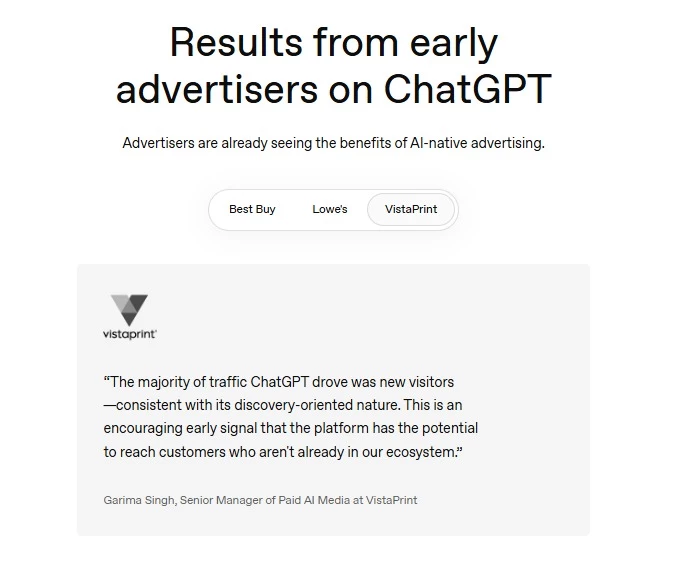
VistaPrint reported that most of the traffic generated by ChatGPT came from new visitors, while both Best Buy and Lowe's highlighted the platform's ability to reach people during research and decision-making moments.
Where ChatGPT Ads Go From Here
The reporting is limited, the targeting options are basic compared to Google and Meta, and the platform is still growing market by market. But that hasn't stopped people from speculating about where ChatGPT advertising could go next.
The most obvious change is geographic expansion.
It began as a U.S.-only pilot and has already expanded into Canada, Australia, New Zealand, the United Kingdom, Mexico, Brazil, Japan, and South Korea, with OpenAI repeatedly describing the current program as a learning phase and not a finished product.
The ad formats themselves are also likely to evolve. The sponsored recommendations could become more conversational and interactive.
OpenAI has already described a future where users can ask follow-up questions, compare products, and gather information directly from ads without leaving the conversation.
Forbes argues that this is part of a larger shift toward conversational advertising, in which brands engage with users throughout the research and decision-making process.
Whether that vision becomes reality remains to be seen.
To Be or Not To Be... Excited About Ads on ChatGPT?
OpenAI spent years treating advertising like a possibility it hoped to avoid, then it built one anyway. ChatGPT ads arrived with more controversy than most product launches.
The rollout is still messy, the platform is evolving, and plenty of people are skeptical.
What seems certain is that businesses aren't treating ChatGPT as a passing experiment. As one early advertiser put it, this feels a lot like the early days of social advertising all over again.
The question is how large a role AI platforms will play in the future of discovery, recommendations, and digital advertising.
As the platform expands and new ad formats emerge, working with an experienced advertising agency can help you evaluate the opportunity, avoid costly mistakes, and develop a strategy that aligns with your goals.
Our team ranks agencies worldwide to help you find a qualified partner. Visit our Agency Directory for the top ad agencies, as well as:
- Top Ad Agencies in Greenville SC
- Top Digital Marketing Agencies
- Top SEO Agencies
- Top Social Media Marketing Companies
- Top Conversion Rate Optimization Agencies
FAQs: ChatGPT Advertising
1. Are there ads on ChatGPT?
Yes. After years of OpenAI distancing itself from advertising, ChatGPT began testing ads in February 2026 and launched its self-serve Ads Manager in May 2026.
Ads appear as clearly labeled sponsored recommendations beneath ChatGPT responses, and they don’t interrupt the conversation itself.
2. Will I see ChatGPT ads, or does it depend on my plan?
It depends on both your subscription plan and location. Ads currently appear to users on the Free and Go plans, while users on the Plus, Pro, Team, Business, Enterprise, and Education plans remain ad-free.
OpenAI has gradually expanded the program beyond the United States into several international markets, though availability still varies by region.
3. Do ads influence the answers ChatGPT gives me?
OpenAI says no. According to the company, ChatGPT's answers remain independent and are not influenced by advertisers.
Sponsored recommendations are clearly labeled and displayed separately from responses, and OpenAI says it doesn’t sell user conversations or personal data to advertisers.
Whether users remain convinced by that distinction is one of the biggest debates concerning ChatGPT ads.
4. How do ChatGPT ads actually work?
Unlike Google Search Ads, ChatGPT ads aren't based primarily on keywords.
Advertisers provide context hints describing the types of conversations where their ads may be relevant, and OpenAI's system matches ads to users based on conversation context and intent. The result is an advertising model designed around discussions and not search queries.
5. How much do ChatGPT ads cost?
There is currently no minimum spend requirement. OpenAI introduced CPC (cost-per-click) and CPM (cost-per-thousand-impressions) bidding as part of the May 2026 self-serve rollout.
Early advertiser reports suggest that CPC bids typically start at $3-$5 per click, while CPM rates have ranged from $25-$60, depending on campaign objectives, competition, and available inventory. Actual costs vary based on relevance, bidding strategy, and market demand.
The platform is still relatively new, so pricing benchmarks are likely to evolve as adoption grows.
6. Can you turn off or remove ChatGPT ads?
The most reliable way is to use a paid plan. Ads are currently limited to Free and Go users, while Plus, Pro, Team, Business, Enterprise, and Education subscribers don't see them.
OpenAI also provides controls for ad personalization, though there isn't currently a universal "turn off all ads" setting for ad-supported tiers.
7. Are ads on ChatGPT worth it for advertisers?
It's still too early for definitive conclusions. Some early reports suggest promising engagement, but the available data is limited and comes primarily from pilot participants and platform partners.
Measurement, targeting, and optimization tools are still evolving, and there isn't a widely accepted playbook for success. For now, most brands are approaching ChatGPT ads as a testing opportunity as the platform continues to mature.
8. How are ChatGPT ads different from Google Search ads?
The biggest difference is targeting. Google Search Ads match advertisers with users through keywords, whereas ChatGPT Ads rely on conversation context and user intent.
ChatGPT provides a direct response and may display a sponsored recommendation beneath it. In short, Google is built around searches, and ChatGPT is built around conversations.
9. Which conversations are ineligible for ChatGPT advertising?
OpenAI currently excludes ads from appearing under sensitive or regulated conversations, including discussions involving personal health, mental health, and politics.
As ads evolve, OpenAI may introduce additional policies and restrictions, similar to how other major advertising platforms have developed category-specific guidelines over time.