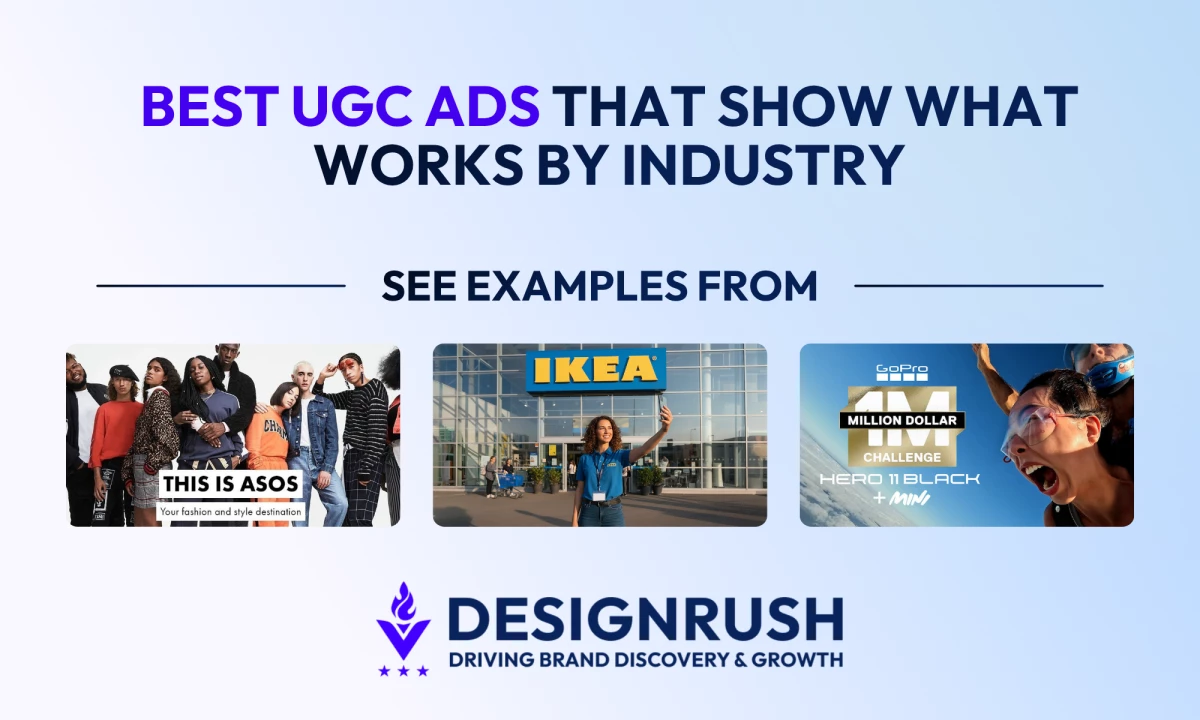

If you run marketing for a brand or an agency, you came here to decide two things: whether UGC ads fit your category, and which format deserves budget.
In this guide, we break down the best UGC ads by industry, so you can see what worked, why it worked, and how to match the format to your own buyer’s hesitation.
UGC Ad Examples: Key Findings
- Start by identifying buyer hesitation before choosing a UGC format. IKEA used customer photos to answer "Will it fit my home?" while Goodcall used creator demos to answer "Will this actually help my business?"
- Use creators for trust-building and algorithms for targeting. Brands that paired authentic content with sophisticated delivery systems generated the biggest efficiency gains.
- Test multiple creators before scaling spend. Identify winners through engagement and conversion data, then concentrate budget on proven assets rather than guessing which creative will perform.
What Counts as a UGC Ad and What Doesn’t
A UGC ad is paid advertising built from content that looks like it came from a real customer, not a brand studio.
The footage is either repurposed from an organic post or commissioned from a creator, then run with media spend behind it.
The best user-generated content ads work because of the creative asset itself.
Bazaarvoice’s 2025 Shopper Preference Report, fielded by Savanta among more than 8,000 consumers across the US, UK, Germany, France, Australia, and Canada, found that 52% of shoppers cite real customer reviews as the biggest factor in their final purchase decision.
That trust breaks quickly when the content feels too staged.
The same report found that 52% of shoppers distrust creator content that feels overly promotional, while 43% say authenticity comes from creators who acknowledge a product’s pros and cons.
The format also has to match how quickly creative wears out.
Per TikTok’s 2025 research, reported in a 2026 trend analysis, ad creative now loses about 50% of its effectiveness within 72 hours on TikTok, down from 120 hours in 2024.
That makes UGC valuable not only for trust but for creative velocity, since creator and customer content can produce more angles, formats, and messages than a traditional campaign cycle.
The catch is that the best UGC ads do not look the same across categories. A skincare ad and a fintech ad answer different questions for the buyer, so the format has to follow the purchase barrier.



Steve Madden’s Creator-Led Meta Ads Drove 4.4x Higher Revenue
Steve Madden built its name on spotting footwear trends early.
Instead of leading with polished brand films, Steve Madden put creator content that was already resonating at the center of its paid work, then connected that content directly to the product so interest could turn into purchase quickly.
Compared with creator partnership ads alone, pairing creator content with catalog-based product discovery drove 4.4x higher revenue and 4.3x more purchases at a 77% lower cost per action.
Steve Madden CMO Alex Frias and Nick Drabicky of January Digital presented the numbers at Meta’s 2026 Performance Marketing Summit.
Why UGC Ads Work in Fashion and Footwear
Fashion is high-impulse: shoppers buy in micro-moments. Creator content shows the product styled on a real person, which is context that a flat catalog image can't supply.
This shortened the gap from inspiration to checkout. Pair it with AI product discovery, and the algorithm surfaces the right SKU while the creator does the persuading.
Ulta Beauty's #JoyForward Branded Mission Drove 109M+ Views
As the exclusive beauty partner for TikTok Beauty Month in 2024, Ulta Beauty ran its largest-ever TikTok campaign: a nine-solution omnichannel push built around the #JoyForward Branded Mission.
It generated 109M+ video views, 300M+ impressions, and 1.2M+ store visits, far above typical beauty-brand engagement.
The Branded Mission invited creators and shoppers to co-create UGC around beauty routines, tips, and rituals shared with loved ones, then guaranteed scale by putting paid media behind the strongest submissions.
Ulta layered this campaign with creator partnerships, a custom "Choose Joy" track, and Pulse Premiere placements adjacent to premium beauty content, turning scattered customer videos into one coordinated, culturally themed activation.
Why UGC Ads Work in Beauty and Skincare
Beauty is a proof-of-results category where shoppers trust real faces over studio shots.
A single emotional hook, like Ulta using joy, instead of buy our products, plus a branded hashtag makes submissions findable and reusable, while paid spend behind only the best clips gives the UGC a through-line.
The theme-plus-amplification model scales authentic content without losing the polish the category rewards.
GoPro's Million Dollar Challenge Drew 42,446 Customer Clips
GoPro built its flagship UGC engine around a simple call to action. Shoot something inspiring on the latest camera, submit the raw clip, and compete for a share of $1 million.
The fifth Million Dollar Challenge pulled in a record 42,446 video submissions, a 66% year-over-year jump, with 55 creators selected and each earning $18,181.81.
The payoff is a three-minute highlight reel made entirely from customer footage, which GoPro premieres globally and pushes across its social channels as polished brand creative.
The model keeps feeding itself. The prize gives customers a reason to capture their best footage, GoPro gets authentic product-proof content for a fixed cost, and featured creators amplify the reel to their own audiences.
Over five years, the program has paid out $5 million while turning the customer base into an always-on production studio.
Why UGC Ads Work in Consumer Tech and Hardware
Hardware lives or dies on demonstrated capability. Buyers want proof the product performs in real conditions, not a spec sheet.
UGC is uniquely suited here because the customer footage is the product demo: every clip shows the camera doing exactly what a prospective buyer hopes it will.
A prize-backed challenge solves the cold-start problem of sourcing that content at scale, while a fixed prize pool keeps cost predictable regardless of how many submissions come in.
This is why GoPro belongs among the top UGC ad examples for hardware brands.
When the product captures or creates something, the output can double as the ad.
IKEA's Targeted UGC Drove a 3.54x Higher Conversion Rate
IKEA built IKEA At Mine, a social community that invites customers to share photos of IKEA products in their own homes, then connected that UGC directly to the matching product range for a seamless path from inspiration to purchase.
The content earned a 27% higher reach than owned organic imagery, 2.7x higher engagement when placed on the homepage, and a 3.54x higher conversion rate when shoppers interacted with it.
Eight of IKEA's ten top-performing organic posts were UGC-sourced.
IKEA wired customer photos into the shopping experience at the exact moments a buyer is filtering and deciding.
Why UGC Ads Work in Home and Furniture
Furniture depends on how well it fits into a life already being lived. A sofa has to look good, but it also has to make sense in the room someone is actually trying to furnish.
Studio shots show the product in an idealized, generic space, while UGC shows it in homes that look like the buyer's own, which resolves the doubt that stalls a purchase.
That is why connecting customer photos to the product page can lift conversion so sharply.
The content helps shoppers picture the furniture in a real room, instead of leaving them to do that work in their head.
For a global brand, customer content also makes local relevance easier to scale by showing real homes across different markets without requiring a new shoot in every region.
Hyatt's Creator-Led TikTok Debut Drove 48.3M Impressions and First Bookings
For its Europe, Africa, Middle East (EAME) TikTok launch, Hyatt skipped polished studio footage and handed creative control to TikTok creators, sourced and briefed through the TikTok Creator Marketplace.
Creators filmed in their own styles at standout properties like the Skyfall Bar at Hyatt Regency Barcelona, Hyatt Regency The Churchill in London, and ran the content as native In-Feed Ads under the #HyattTakesYouPlaces banner.
The team used a test-and-learn approach, then put paid media behind the strongest organic posts via Spark Ads.
The activation generated 48.3M impressions, 7.2M two-second views, and a 0.61% CTR.
The most telling result was that creator content drove first bookings from new guests even though Hyatt had not built a dedicated conversion campaign.
Authentic, native creative did the persuading on its own, and by amplifying only the posts that had already proved themselves, spend followed performance rather than guesswork.
Why UGC Ads Work in Travel and Hospitality
Travel is bought on aspiration, and nothing sells a destination like seeing a real person experience it.
Creator footage captures the rooftop view, the room reveal, the on-the-ground feel that a brand-shot spot flattens into a brochure.
Because the content reads as a genuine recommendation rather than an ad, it builds the trust a high-consideration booking requires.
Running native In-Feed or Spark Ads keeps it in the discovery feed where wanderlust actually starts. Amplifying only top organic posts lets the audience pre-validate your creative before you spend.
Mosh Cut Customer Acquisition Cost 44% Through Creator Ads
Mosh, an Australian digital health clinic for men, runs telehealth consultations for sensitive issues like hair loss, mental health, sexual health, weight loss, where stigma keeps men from engaging.
To acquire leads more cheaply, it tested whether creator voices could outperform its in-house brand creative.
The team ran a clean A/B test: one campaign used Mosh's usual ad creative alone; the other added creator-led video partnership ads on top.
The creator videos leaned on storytelling and light-hearted humor to normalize conversations men typically avoid, each ending with a Learn more link to the site.
Because partnership ads also serve through each creator's own handles, the campaign reached new audiences Mosh's brand handles couldn't.
The combined approach delivered a 44% lower customer acquisition cost and a 53% lower cost per lead versus the usual creative alone.
Why UGC Works in Health and Wellness
Health decisions are trust-gated, and in stigmatized categories the barrier is often emotional before it's rational.
A relatable creator talking openly about a sensitive issue does what polished brand copy can't: it normalizes the problem and lowers the shame that blocks the click.
That earned credibility is exactly what a prospective patient needs before trusting a clinic with private concerns.
Layering creator content beside brand creative also hedges risk: the brand assets hold the line on accuracy and compliance while the creator voice carries the relatability.
7 Brew's Spark UGC Ads Strategy Lifted Ad Recall 26.9% and Grew Followers 3x
7 Brew, the fast-growing US drive-thru coffee chain, blended organic TikTok content with paid user-generated ads to build awareness across more than 300 locations while operating with a relatively modest media budget.
Rather than relying on polished commercials, the brand ran a mix of creator content, Spark Ads, behind-the-scenes drink videos, and trend-driven creative across more than 25 TikTok videos.
The campaign combined reach and focused-view objectives while targeting more than 300 ZIP codes, allowing TikTok's recommendation engine to match content with the right audiences.
7 Brew generated a 26.9% lift in ad recall, a 6% lift in brand awareness, and tripled its follower growth across campaign objectives.
The campaign also added nearly 58,000 new followers while delivering strong watch-time performance.
Why UGC Ads Work in Food and Beverage
Food and beverage purchases are often driven by cravings rather than consideration. Consumers don't need extensive product education, but they need a reason to stop scrolling and imagine the experience.
That's why native-style content performs so well.
A customer showing off a favorite drink, a barista making a specialty order, or a behind-the-scenes moment feels more believable than a traditional commercial.
Spark Ads preserve that authenticity while giving brands the distribution needed to reach new audiences.
The broader lesson is that beverage brands don't always need more creative production. Often, they need better amplification of content that already feels natural to the platform.
Up's Gamified Branded Effect Drove 15M+ Impressions
Australian neobank Up wanted to scale brand love around its new "Easy Money" platform, reinforcing that managing your finances could be fun and effortless.
The campaign specifically targeted Gen Z and Millennial audiences the brand was already reaching on TikTok.
Gaming was a natural fit for that message, so Up launched Australia's first-ever Gamified Branded Effect: a coin-catch game where users munched flying coins, with one randomly selected winner taking $1,000 in cash.
To build multiple touchpoints, the brand paired the effect with a TopView ad and partnered with local creators across both large and small follower bases, who played the game and shared it with their audiences.
The activation generated 15M+ impressions and 13M+ video views, while the #UpEasyMoney hashtag racked up 25M+ views and 250+ pieces of user-generated content from a diverse mix of creators.
The memorable creative landed a 7.6% lift in ad recall and a 29% lift in brand preference.
Why UGC Ads Work in Fintech
Most people find money apps dry and emotionally cold, which makes brand-building harder than in almost any other vertical.
An interactive, playable format flips that: Up gave people a fun reason to engage and let creators model the behavior in a low-stakes, entertaining context.
When creators across follower tiers all play the same game, the UGC compounds into social proof that a neobank is approachable rather than intimidating.
The lesson for fintech is that participation beats persuasion: earning a moment of genuine fun does more for brand preference than another feature-led pitch, especially with younger audiences forming their first banking relationships.
Goodcall Cut Cost Per Sign-Up From $185 to $7
Goodcall, an AI phone-answering service that automates sales and support calls for small businesses, needed a scalable, efficient way to reach tech-savvy business owners and drive sign-ups for its free and premium plans.
The company built a conversion campaign on TikTok, sourcing content from multiple creators through the Creator Marketplace.
It prioritized short 15-30 second videos with a clear message and quick cuts, then ran the winning creatives as Spark Ads.
The decisive factor was pairing those creatives with TikTok's targeting tools: automatic targeting to find the best audiences, plus interest/behavior targeting to zero in on "business owners" specifically. Goodcall notes costs didn't drop dramatically until the targeting was dialed in.
The combination cut customer acquisition cost more than 96% annually (from $185 to $7 per sign-up) while holding a 75% retention rate, signaling the campaign brought in quality customers rather than cheap churn.
Why UGC Ads Work in B2B and SaaS
B2B buyers are conditioned to tune out corporate ad-speak, but a peer demonstrating a tool in a quick, concrete clip reads as a recommendation, not a pitch.
This is why creator UGC can outperform polished product marketing even in software.
The bigger lesson here is that authentic content lowers the cost to earn attention, but precise audience targeting is what keeps spend from leaking to non-buyers, and in B2B the buyer is a narrow slice.
Pairing the two is what turns a low CPM into a low cost per qualified sign-up, and retention confirms whether you attracted real prospects or just cheap clicks.
ASOS's #AySauceChallenge Drove 1.2B+ Video Views in Six Days
ASOS, the British online retailer carrying 850+ brands, wanted to raise awareness and engagement with digital natives and to reinforce its identity as a brand that sets trends rather than follows them.
The vehicle was a Branded Hashtag Challenge Plus: #AySauceChallenge invited the community to "channel their ASOS vibe" and show off three outfits through a series of changes, set to bespoke music and an interactive AR Branded Effect, running three weeks across the UK and US.
ASOS seeded it with 28 UK and US creators to kick off the trend and lend credibility, then layered real media behind it: a trending-hashtag spot plus TopView, One Day Max, and Brand Premium In-Feed ads, all funneling users to a central page housing the UGC entries.
The challenge generated 1.2B+ video views in six days, 488,000 videos created by 167,000 participating users, and a 15.79% engagement rate, well above benchmark.
Why UGC Ads Work in Retail and eCommerce
A participation format like a hashtag challenge turns customers into the catalog: thousands of real people styling real outfits is both massive reach and living proof the brand is part of the cultural moment.
The paid layer is what separates viral UGC ads from organic trends that fizzle.
TopView and In-Feed placements guarantee the challenge reaches critical mass fast, while creator seeding gives the crowd a template to copy.
For eCommerce, the compounding effect matters: each of those 488,000 videos is a shoppable impression created by someone other than the brand, at a marginal cost the brand never pays per asset.
How To Choose the Right UGC Format for Your Industry
The thread running through every example above is that the best-performing format answers the one objection that stops buyers in that category. Start there, not with a format you already like.
Here is what the best UGC ad examples by industry show about format fit:
Industry | Best-fit UGC format | Objection it solves | Example |
Fashion and footwear | Creator content as paid performance creative | "Will it actually look good on someone like me?" | Steve Madden |
Beauty and skincare | Branded Mission / themed creator submissions, amplified | "Does it really work on a real face?" | Ulta Beauty |
Consumer tech and hardware | Prize-backed UGC challenge | "Can the product actually do what it claims?" | GoPro |
Home and furniture | Customer photos wired to product pages | "Will it fit and look right in my space?" | IKEA |
Travel and hospitality | Native creator In-Feed / Spark Ads | "Is the experience as good as the brochure?" | Hyatt |
Health and wellness | Creator partnership ads layered with brand creative | "Can I trust them with something this personal?" | Mosh |
Food and beverage | Organic creator content amplified via Spark Ads | "Is it worth stopping for?" | 7 Brew |
Fintech | Gamified / interactive Branded Effect and creators | "Is this brand approachable, not intimidating?" | Up |
B2B and SaaS | Creator UGC and precise audience targeting | "Does a peer actually use and rate this?" | Goodcall |
Retail and eCommerce | Branded Hashtag Challenge and paid amplification | "Is this brand current and worth joining?" | ASOS |
Match the Format to the Dominant Purchase Objection
Pick the format that most directly removes the single thing holding the buyer back.
- In skincare, that is shade and fit, so you show the product on varied real skin.
- In furniture, it is whether the piece suits the room, so you show it in customers' homes.
- In fintech, it is trust, so you run a real, substantiated customer testimonial and keep the legal review close.
Run through your own category and name the objection first; the format usually falls out of the answer.
How To Create Your Own UGC Ads for Your Industry
After reviewing the best UGC ad examples by industry, the next step is choosing how to source your own creative based on speed, budget, and how much you can lean on existing customers.
Source It From Creators
Brief several creators to make purpose-built clips through a creator marketplace or direct outreach, and pay for usage rights and whitelisting up front so you can run the videos as paid ads from your account or theirs.
This is the most reliable way to get content built for your exact product and the objection you need to answer, and it scales: order more variations than you think you need, because most will not win.
Best when you have budget and want control over the message.
Repurpose Customer Content
Some of the strongest UGC ad examples come from posts, reviews, and videos real customers already make about you. Get written permission, then run the strongest as ads.
It’s the cheapest input and often the most convincing, since nothing was staged.
The catch is rights: an organic post is not licensed for paid use until the customer agrees in writing, so build a permission request into your workflow.
This path suits brands that already have an engaged base posting about them.
UGC Ad Examples: Final Thoughts
Whether you're selling software, furniture, coffee, or financial services, the lesson is the same: choose a format that addresses your industry's core buying objection, validate it with real users, and amplify what works.
Authenticity may earn attention, but strategic distribution is what turns UGC into measurable business results.

Our team ranks agencies worldwide to help you find a qualified partner. Visit our Agency Directory for the top advertising companies, as well as:
- Top LinkedIn Marketing Agencies
- Top Instagram Marketing Agencies
- Top Social Media Marketing Consulting Services
- Top Facebook Marketing Companies
- Top New York Social Media Agencies
UGC Ad Examples FAQs
1. How is a UGC ad different from an influencer ad?
An influencer ad primarily leverages a creator's audience, credibility, and reach to promote a product. A UGC ad, on the other hand, focuses on the content itself: authentic-looking reviews, demonstrations, testimonials, or experiences that can be distributed through paid media.
Many brands commission creators to produce UGC specifically for advertising, even if the creator never posts it to their own followers.
2. Do UGC ads need a disclosure label?
Yes. If a creator receives payment, free products, commissions, or any other material benefit, disclosure is generally required under FTC endorsement guidelines.
Clear labels such as "Sponsored," "Paid Partnership," or equivalent platform disclosures help maintain transparency and protect both brands and creators from compliance risks.
3. How do you measure UGC ad performance?
Start with business outcomes, not engagement metrics. The most important indicators are conversion rate, cost per acquisition (CPA), return on ad spend (ROAS), lead quality, and revenue generated.
Metrics such as views, likes, and comments are useful diagnostic signals, but they shouldn't be mistaken for proof that a campaign is driving business results.
4. Which UGC format works best for my industry?
The best format depends on the buyer's biggest objection. Fashion brands often benefit from creator try-ons that answer questions about fit and styling, while SaaS companies may need product walkthroughs that demonstrate value.
Before choosing a format, identify the doubt preventing customers from purchasing and select UGC that directly addresses it.
5. Which social platforms perform best for UGC ads?
TikTok and Instagram remain the leading platforms for consumer-focused UGC campaigns because users expect creator-driven content there.
YouTube Shorts performs well for demonstrations and reviews, Facebook can still deliver strong conversion performance, and LinkedIn is becoming increasingly effective for B2B creator-led content.
The best platform is ultimately the one your target audience already trusts and uses.
6. What is the biggest mistake brands make with UGC campaigns?
The most common mistake is treating UGC as a creative trend instead of a solution to a customer problem. High-performing campaigns don't win simply because they look authentic; they win because they answer buyer questions, reduce uncertainty, and provide the proof needed to move someone closer to a purchase.