Drawing on 2,000+ verified client reviews and assessments from 12 industry experts, our directory of top advertising agencies in the United States is a reliable source for comparing candidates with confidence.
Organic rankings are determined by five factors: top services, reviews, portfolio, awards/press, and team expertise. Sponsored listings pay for a placement that appears above organic positions. Sponsorship does not affect star ratings or review content - read more on our methodology page.
AdsRole is one of the top Digital Marketing Company
AdsRole is one of the top digital marketing companies, offering complete digital marketing solutions designed to elevate your online presence and drive business growth. Our services include Search Engine Marketing (SEM), Search Engine Optimization (SEO), Social Media Marketing (SMM), Google Ads Mana...
What services do the best advertising agencies in the United States provide?
Leading advertising agencies in the United States plan, create, and launch compelling advertising campaigns across digital and traditional media channels to amplify businesses’ brand awareness, customer engagement, digital presence, and sales.
According to our market analysis, the most prominent service offerings for online advertising companies in the US include:
Media planning and buying is the largest revenue-generating segment for agencies, representing approximately 40% of industry revenue in the traditional advertising services sector.
Creative services comprise another core offering of traditional agencies, accounting for approximately 35% of their revenue.
Search advertising, including SEO and SEM, remains the single largest service offering within digital advertising, capturing over 24.1% of the total market share.
Social media advertising is a major and rapidly growing segment, with ad spending in the US social media advertising market expected to reach $95.70 billion in 2025.
How much do these services typically cost?
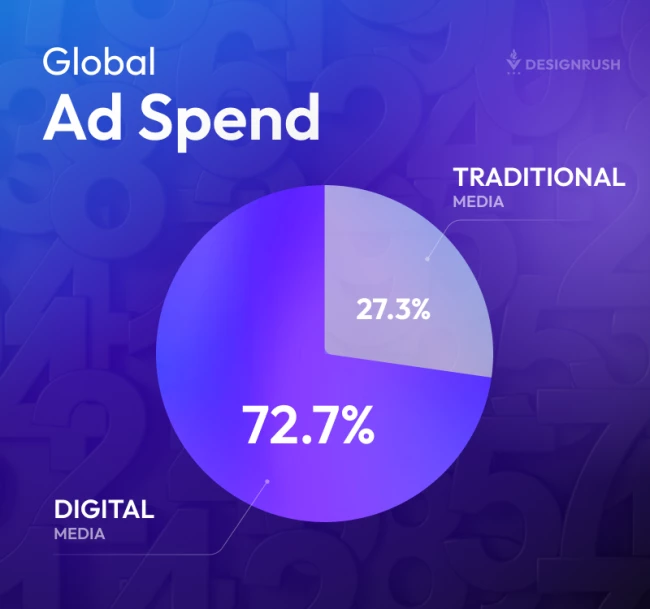
Advertising costs in the US start from $900 for digital campaigns and can go as high as $100,000 for TV ads. The pricing depends on the region, platform, campaign, reach, targeting, creative quality, and the channel.
Overall, the estimates present a stark contrast between the high, fixed expense of traditional television and the flexible options in digital media.
$1 – $3 per click (CPC) or $2 – $5 per thousand impressions (CPM)
Digital
Programmatic ads
Generally start around $2 per thousand impressions (CPM)
When can clients expect ROI from advertising?
The expected time to realize a return on investment (ROI) from advertising depends on the specific channel:
Paid ads (Google, Meta, LinkedIn) can generate visible results within days/weeks, with lead flow increasing immediately as the campaign begins.
Email campaigns and remarketing re-engage warm audiences and existing contacts for early conversions and quick ROI.
Content marketing and SEO begin driving consistent traffic, organic leads, and compounding ROI in the 6-12-month range.
Thought leadership promotion (blogs, webinars, YouTube videos) builds brand authority and returns value within six months to a year.
What are the typical timelines for advertising projects from initial planning to launch complexity levels?
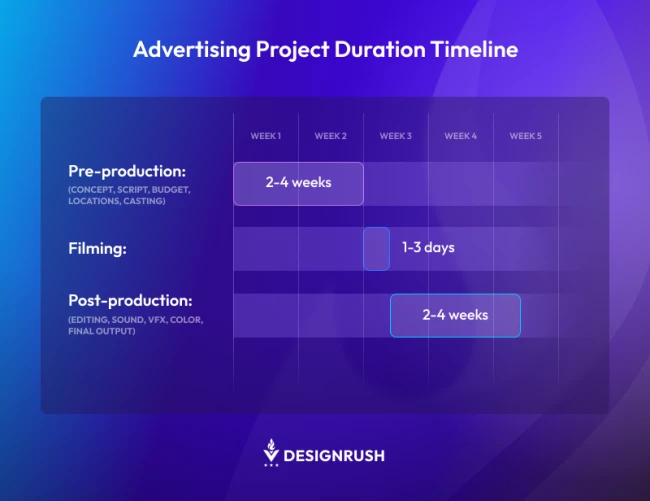
Approximate timeframes for advertising projects are:
Smaller campaigns usually take 4 to 8 weeks from the discovery meeting to launch.
More complex campaigns that require deeper audience research, new creative asset development, and multiple platform configurations can stretch further because each stage adds time:
Kick-off and alignment (1-2 weeks)
Audience research (2-3 weeks)
Creative development (2-4 weeks)
Platform setup (3-4 weeks)
Testing and launch (4-6 weeks)
How often do the advertising firms update targeting data and creative assets once a campaign is live?
Depending on the platform, top ad agencies typically update creatives every 2-6 weeks, while targeting and bid/keyword adjustments are often reviewed weekly.
Here’s how often other ads are typically updates once a campaign is live:
For search campaigns, the best practice is to refresh ad copy every 4-6 weeks, while bids, keywords, and extensions are reviewed weekly.
For social media ads, rotating creative every 2-4 weeks is recommended to avoid “ad fatigue,” especially when audience size or ad frequency is high.
For display or video campaigns (YouTube or banner/display ads), monthly updates of visuals or placements are recommended.
Generally, updates are prompted by creative fatigue or targeting inefficiencies, i.e., when click-through rates drop, cost per acquisition rises, or conversion rates fall.






 4.8
 4.8