
AI advertising tools are software platforms that use machine learning for audience targeting, creative generation, bid and budget optimization, and performance analysis. They span the entire campaign lifecycle: some produce the assets, others manage the spend, and a few handle both.
I tested 10 AI advertising tools across creative generation, campaign optimization, audience targeting, and ad copy. Below, I've grouped them by the job they do best so you can skip straight to what matters for your workflow.
Best AI Advertising Tools 2026: Key Findings
- AdCreative.ai, Predis, and Quickads solve the creative bottleneck from different angles, covering scored static ads, eCommerce social content, and expert-managed video production.
- Madgicx, Albert, Smartly, and Adzooma focus on campaign performance, from guided PPC suggestions in Adzooma to fully autonomous cross-channel optimization in Albert.
- eCommerce brands have the most tool-specific options, with Proxima for predictive audience intelligence and Quickads for competitive ad research and rapid creative generation.
85% of Companies Now Use AI Tools for Marketing
AI is already built into the way many marketing teams plan, create, and optimize campaigns.
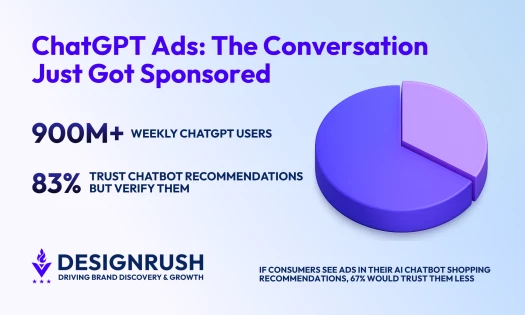
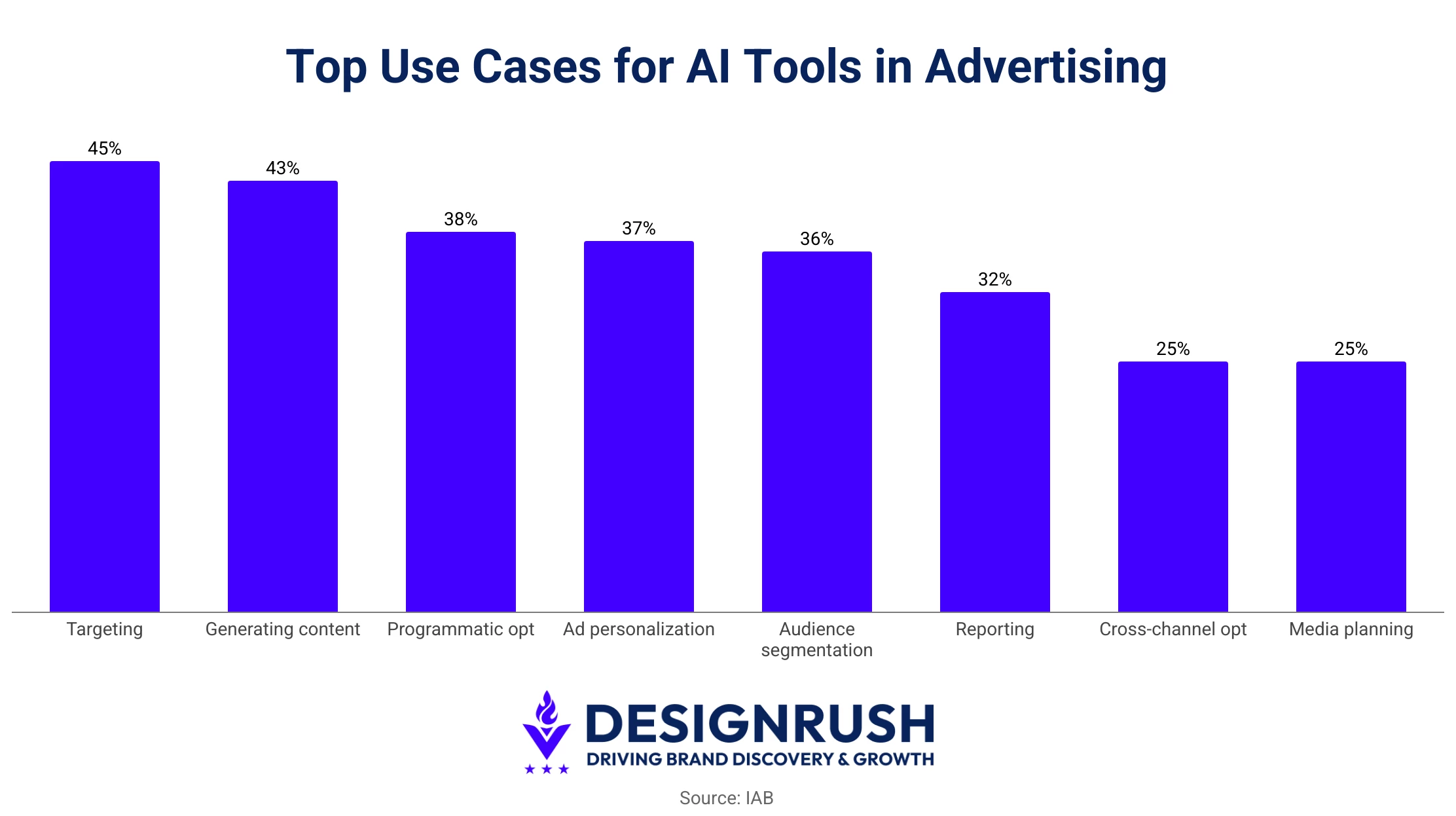
IAB Europe’s 2025 digital advertising report found that 81% of companies already use AI based tools for marketing, with targeting at 45% and content generation at 43% among the most common use cases.
The next step is choosing tools that make campaigns easier to manage without hiding too much of the decision making.
Diana Morante, Marketing Consultant at Snowball Growth Online, says AI advertising tools are changing campaign management because they can process far more behavioral and performance data than a human team can manually interpret.
These tools track customer behavior across touchpoints, forecast performance trends, and “instantly detect which creative elements are driving conversions.”
That real-time feedback loop, Morante explains, “removes much of the guesswork from campaign management,” helping teams reduce wasted ad spend and improve campaign performance and ROI.
That is the real buying question behind this list: which AI tool removes the right kind of guesswork from your workflow?
Native AI vs. Third-Party AI Advertising Tools
Before investing in any third-party tool, it's worth understanding what the ad platforms themselves already offer with built-in AI:
- Meta Advantage+ automates audience targeting, placement, and creative optimization within Meta's ecosystem. It performs well for broad prospecting but gives you less control over who sees what.
- Google Performance Max uses AI to run campaigns across Search, Display, YouTube, Gmail, and Discover simultaneously, optimizing for conversions based on your goals and assets.
- Microsoft Advertising AI offers similar automated bidding and audience features within Bing and its partner network.
These native tools are free to use and continuously improving. For many small businesses with straightforward campaigns, they may be sufficient.
Third-party tools add value when you need deeper creative production, richer audience data than the platform provides, cross-platform management from a single dashboard, or competitive intelligence.
Samuel Fiorillo, Head of Digital Advertising at Möve Marketing, says this is where AI advertising tools can go beyond standard campaign data.
In the past, spotting market trends or getting useful content suggestions required campaign managers to manually dig through research.
Now, he explains, those insights are often surfaced in real time, with data pulled from outside the client’s own campaigns.
Fiorillo says these findings can shape targeting strategy, content development, and brand messaging built around new audience pain points.
Most experienced advertisers use native AI as the foundation and layer third-party tools on top for specific gaps.
At a Glance: 10 Best AI Advertising Tools Compared
| Tool | Primary Use Case | Channels Supported | Starting Price |
High-conversion ad creatives | Meta, Google, LinkedIn, TikTok | $39/month | |
Creative automation at scale | Meta, Google, TikTok, Pinterest, Snapchat | Contact vendor | |
Expert-managed AI video ads | Meta, TikTok, YouTube, Google | $6,000/month | |
Meta ads optimization | Meta | $45/month | |
Autonomous cross-channel management | Google, Meta, YouTube, Bing | Contact vendor | |
Google, Meta, Microsoft Ads | Free | ||
Predictive audience targeting | Meta, TikTok | Free to get started | |
AI ad copy and messaging | Email, push, SMS, social, ads | Contact vendor | |
eCommerce social media ads | Meta, TikTok, LinkedIn, Pinterest | $32/month | |
Ad inspiration and competitive research | Meta, TikTok, Google, YouTube | Free |
Best AI Ad Creative Tools for Generating High-Performing Ads
These tools solve the creative production bottleneck by generating ad images, videos, banners, and copy variations at speed, then scoring or predicting which ones are most likely to convert.
- AdCreative.ai: Best for High-Conversion Static Ads
- Smartly: Best for Creative Automation at Enterprise Scale
- Airpost: Best for Expert-Managed AI Video Ads at Scale
1. AdCreative.ai: Best for High-Conversion Static Ads
For small to mid-size teams that need a steady stream of scored ad creatives for social and display campaigns without a dedicated designer.
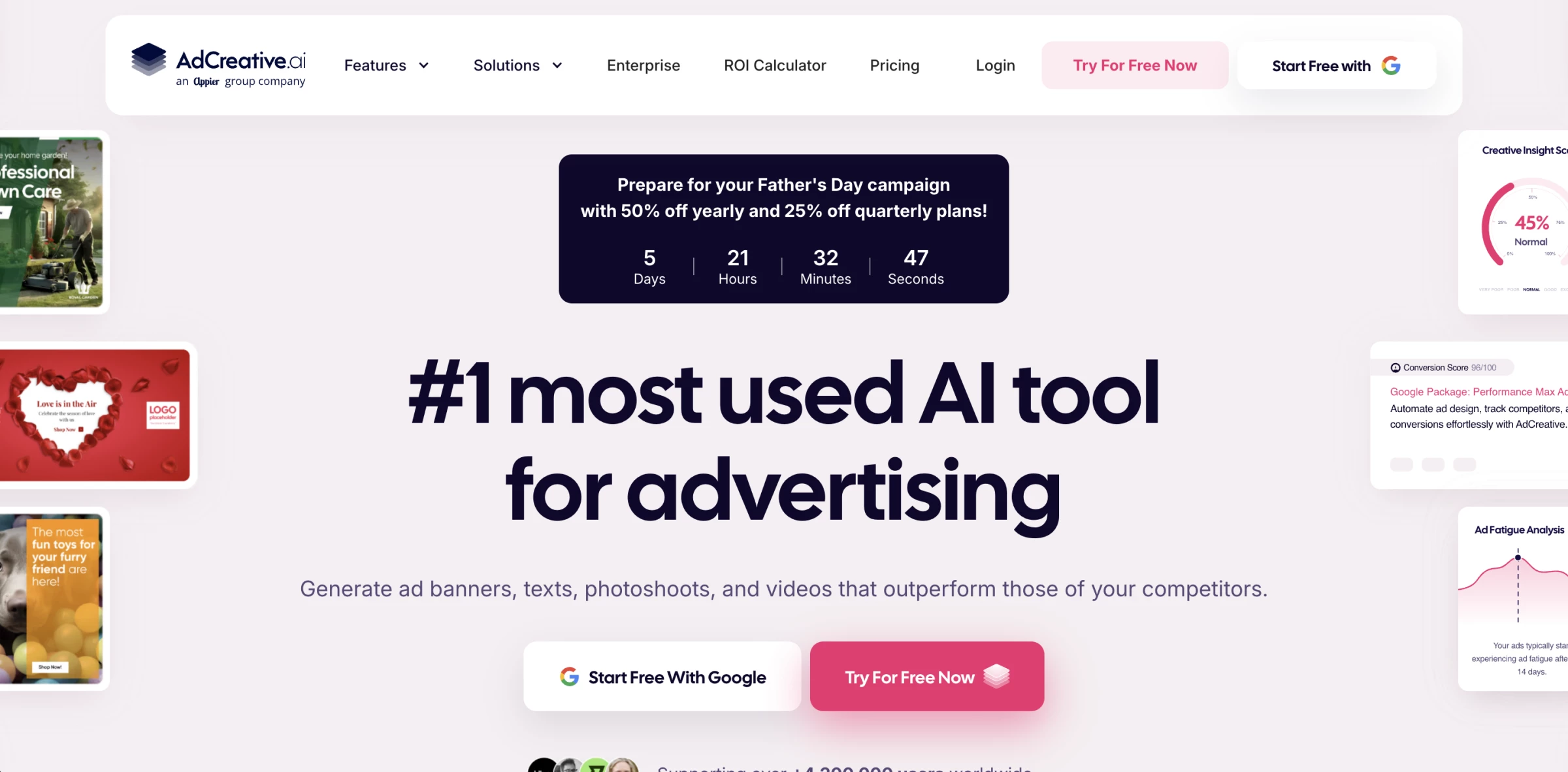
AdCreative.ai fits teams that need fast, on-brand static ad variations and want a clearer way to choose which creatives are worth testing first.
The platform generates ad banners, product visuals, ad text, photoshoots, and videos, with creative scoring, competitor insights, and brand controls built into the workflow.
Pros:
- Creative Scoring AI helps prioritize ad variations before launch.
- Generates ad visuals, copy, product photoshoots, and videos in one workflow.
- Competitor insights add useful context for creative direction.
Cons:
- Some outputs can look generic or templated without manual edits.
- Credit-based downloads can become expensive for high-volume teams.
- Less suited for teams that need deep campaign strategy or audience intelligence.
What stood out most to me was the Creative Scoring AI. Instead of generating a batch of visuals and guessing which ones to launch, I could rank assets by predicted performance before spending media budget.
The tool also handles ad headlines and body text through its AdLLM text generator, which means design and copy happen in one place.
The platform supports Facebook, Instagram, Google, LinkedIn, and TikTok ad formats. I could connect a brand kit and get on-brand creatives without starting from scratch each time. The competitor analysis feature lets you view other brands' ads and see what elements are performing in your space.
However, I must point that some creatives still need editing before launch, especially when stock imagery, layout spacing, or product context feels generic.
Teams that need deep audience analysis, media buying automation, or full-funnel attribution will still need other tools around it.
Pricing (monthly)
- Starter: $39/month
- Professional: $249/month
- Ultimate: $999/month
AdCreative.ai offers a 7-day free trial.
What Users Say
Product Hunt reviewers generally describe AdCreative.ai as fast, easy to use, and helpful for producing many ad variations quickly, especially for marketers, agencies, and teams without dedicated designers.
The same review summary also notes that some users find outputs generic, repetitive, or in need of manual cleanup.
Other Notable Features
- Creative Scoring AI for predicted ad performance.
- Competitor Insight AI for reviewing competitor campaign patterns.
- Text Generator AI for ad headlines and copy.
- AI product photoshoots for eCommerce visuals.
- Product videos, batch creatives, compliance checker, ad videos, and storytelling ads on higher-tier plans.

2. Smartly: Best for Creative Automation at Enterprise Scale
For marketing agencies and mid-to-large enterprises managing complex, multi-channel campaigns with high creative volume and international audiences.
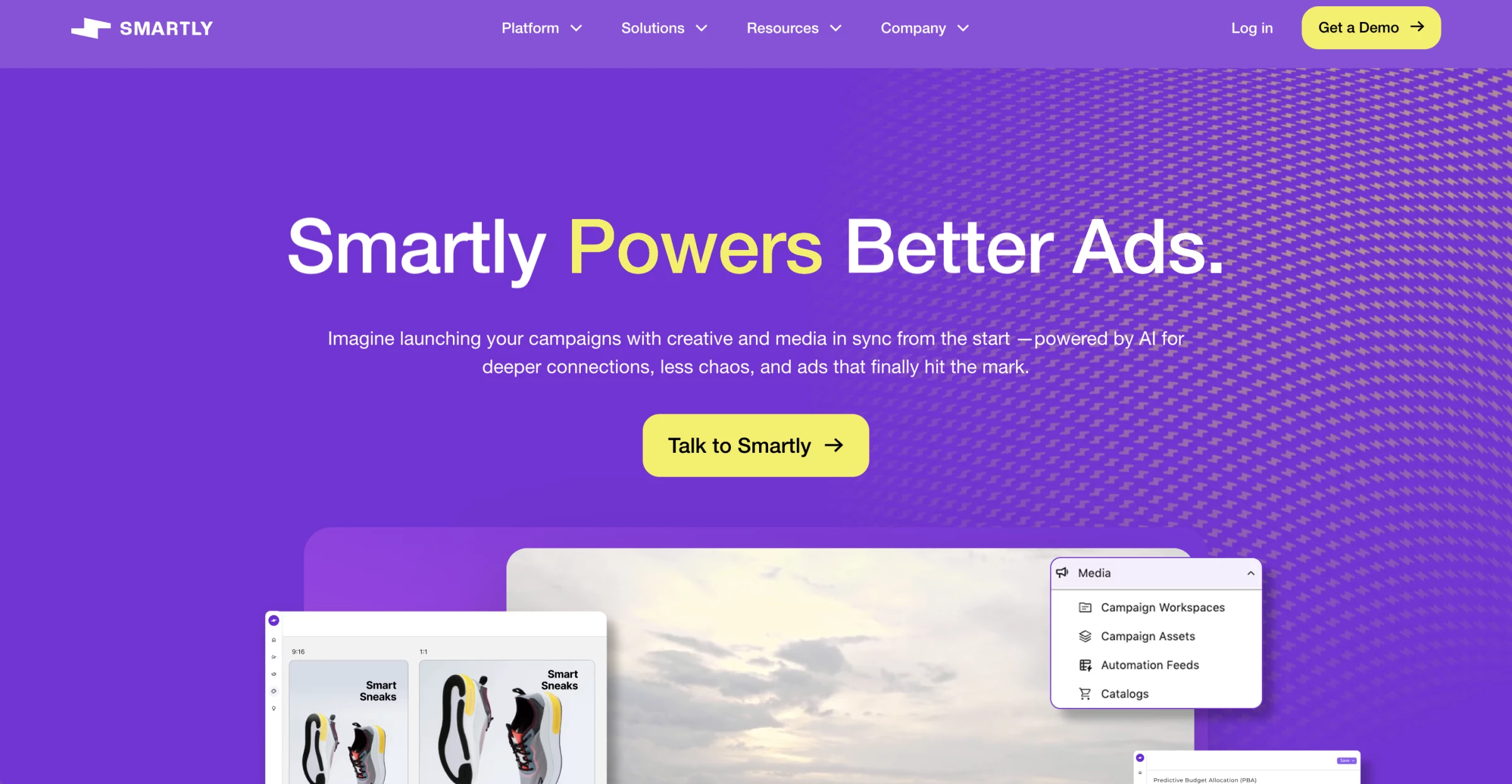
Smartly is a full-lifecycle platform that combines creative production, media buying, and reporting in one place.
It's built for teams that manage large volumes of ads across multiple channels and need to produce personalized, platform-specific creatives at scale.
Pros:
- Combines creative automation, media buying, optimization, and reporting.
- Predictive Budget Allocation helps shift spend across campaigns and channels.
- Includes AI creative tools, templates, catalog workflows, reporting, and creative intelligence.
Cons:
- Too complex for small businesses, solo marketers, or low-volume ad teams.
- Value depends on sufficient campaign volume, clean data, and team adoption.
What impressed me most was the creative suite, more specifically the image templates and AI generation tools which make it possible to produce dozens of personalized ad variations quickly while keeping everything on-brand.
The platform supports multi-language ad creation, which is a major plus for brands targeting international audiences.
The reporting dashboard pulls all channels into one view, making it simple to see what's working across Meta, Google, TikTok, Pinterest, and Snapchat.
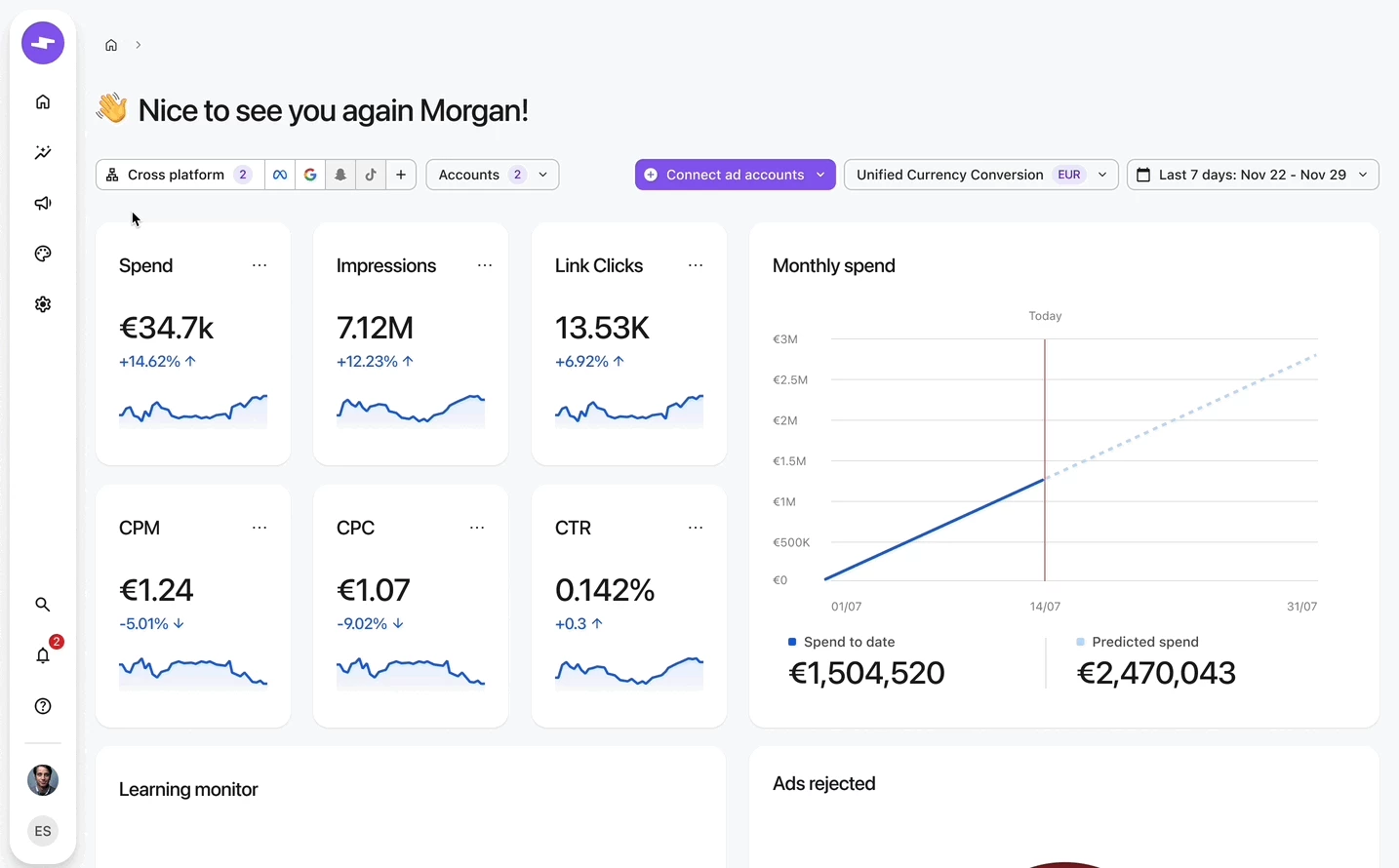
The predictive budget allocation feature (PBA) across channels also delivered strong results and eliminates the need to manage each native ad platform separately and shifts spend toward top performers automatically.
Where it falls short is accessibility. Smartly is clearly built for teams with meaningful ad spend, multi-channel complexity, and enough creative volume to justify a platform-level investment.
Smaller teams that only need quick static ads or occasional video variations will likely find it too complex and expensive.
Pricing
- Contact vendor for pricing info.
What Users Say
Capterra gives Smartly an overall rating of 4.5/5 from 13 reviews, with 4.0/5 for ease of use, 4.5/5 for features, 4.7/5 for customer service, and 9.2/10 likelihood to recommend.
The profile describes Smartly.io as a platform where creative, media, and data teams can collaborate to plan, create, launch, and learn from social advertising in one central hub.
Other Notable Features
- AI Studio for scaled creative assistance and asset production.
- Creative Predictive Potential for forecasting creative effectiveness before launch.
- Predictive Budget Allocation for real-time cross-channel budget optimization.
- Dynamic Product Ads and Dynamic Creative Optimization for personalized ad delivery.
3. Airpost: Best for Expert-Managed AI Video Ads at Scale
For growth-stage and enterprise brands spending over $20,000/month on paid social who need agency-quality video ads at AI speed.
Airpost is a hybrid creative platform that sits between a self-serve AI tool and a traditional agency. You get an AI engine trained on your brand combined with a dedicated human creative team of strategists, editors, and AI video specialists who produce 10 to 100+ performance video ads per week.
It's built for brands that need high-volume video creative with human quality control, not a login to figure out themselves.
Pros:
- Combines AI video production with human creative strategy and editing.
- Produces a recurring flow of performance video ads instead of one-off assets.
- Strong fit for teams dealing with creative fatigue and constant paid social testing.
Cons:
- Less hands-on control than a fully self-serve creative platform.
- Best value depends on having enough paid media spend to test frequent creative output.
What separates Airpost from every self-serve tool on this list is the managed workflow.
After onboarding, I set a living brief that includes defining personas, value props, and creative angles, and Airpost's team produced batches of video ads aligned to it.
When I adjusted the brief, the output adjusted with it.
The platform integrates with Google Drive, Dropbox, or your DAM to pull in brand assets, and the AI video team can animate real product images or generate net-new footage.
Finished ads get uploaded directly to my Meta account with my naming conventions, on my schedule.
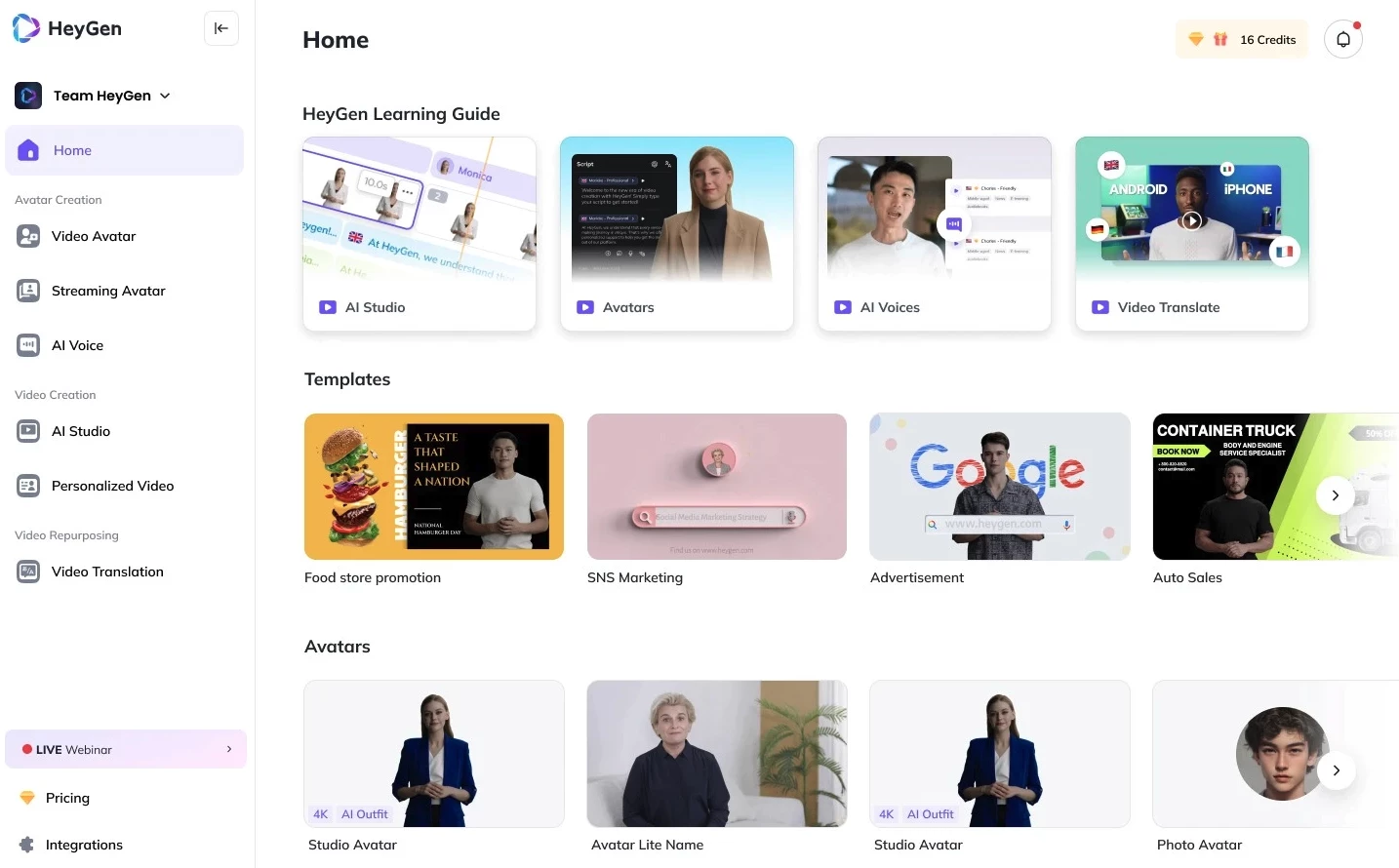
The creative quality was noticeably higher than what I got from self-serve video generators. Because human strategists review and refine every batch, the ads felt less templated and more like something a production team would deliver, but at a fraction of the turnaround time.
The tradeoff is rather obvious. At $6,000/month, this is not for small businesses or teams testing their first campaigns.
And because it's managed, you're collaborating with a team rather than clicking buttons yourself, which is either a feature or a constraint depending on your workflow preferences.
Pricing
- Reported pricing starts from around $6,000/month, with final pricing available through a sales call.
What Users Say
In a LinkedIn post, Amit Verma described Airpost as a hybrid AI and human creative system built around performance, not just output volume.
He highlighted the platform’s ability to produce 50 to 100+ ads per week, support continuous testing, and help teams understand why certain ads win before scaling those patterns.
Other Notable Features
- Dedicated AI video production team.
- Living brief workflow that updates creative direction as inputs change.
- Quick Editor for copy and voiceover revisions.
- Customizable compliance checker for brand safety reviews.
Best AI Platforms for Ad Optimization and Campaign Automation
These tools manage the performance side, like adjusting bids, reallocating budgets, pausing underperformers, and running continuous A/B tests. They work on top of your existing ad accounts.
- Madgicx: Best AI Optimization Tool for Meta Ads
- Albert: Best for Fully Autonomous Campaign Management
- Adzooma: Best Free AI Tool for PPC Campaign Management
1. Madgicx: Best AI Optimization Tool for Meta Ads
For eCommerce brands and agencies spending over $5,000/month on Meta ads who want AI-driven budget reallocation and creative analytics without hiring a dedicated media buyer.
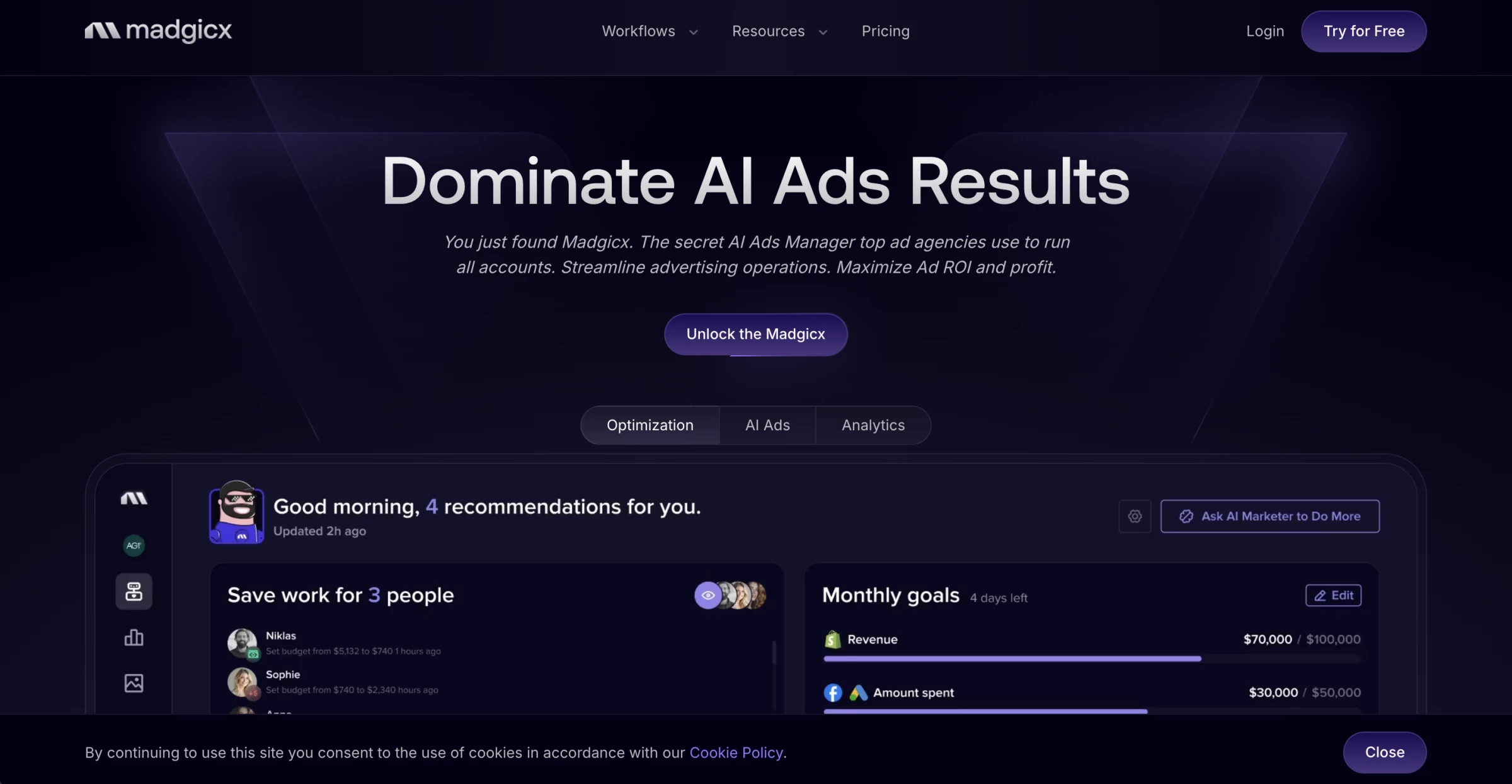
Madgicx is a Meta-focused automation platform that acts as an AI media buyer on top of your existing Facebook and Instagram ad account.
It handles autonomous budget allocation, AI-driven audience creation, creative analytics, and performance tracking.
Pros:
- Strong Meta-focused optimization workflow.
- AI Ad Analyzer helps simplify complex Meta performance data.
- Includes creative generation, ad fatigue detection, and creative refresh workflows.
Cons:
- Less useful for teams that need full optimization across Google, TikTok, and other paid channels.
- Smaller accounts with limited data may get less value from automation and recommendations.
I tested its Autonomous Budget Optimizer which monitors ROAS and CPA signals across your ad sets and shifts daily budgets toward the best-performing ones automatically, within percentage caps you define.
On accounts with 8-10+ active ad sets and consistent spend history, it works noticeably well.
On thinner accounts with fewer ad sets, it tends to over-concentrate spend.
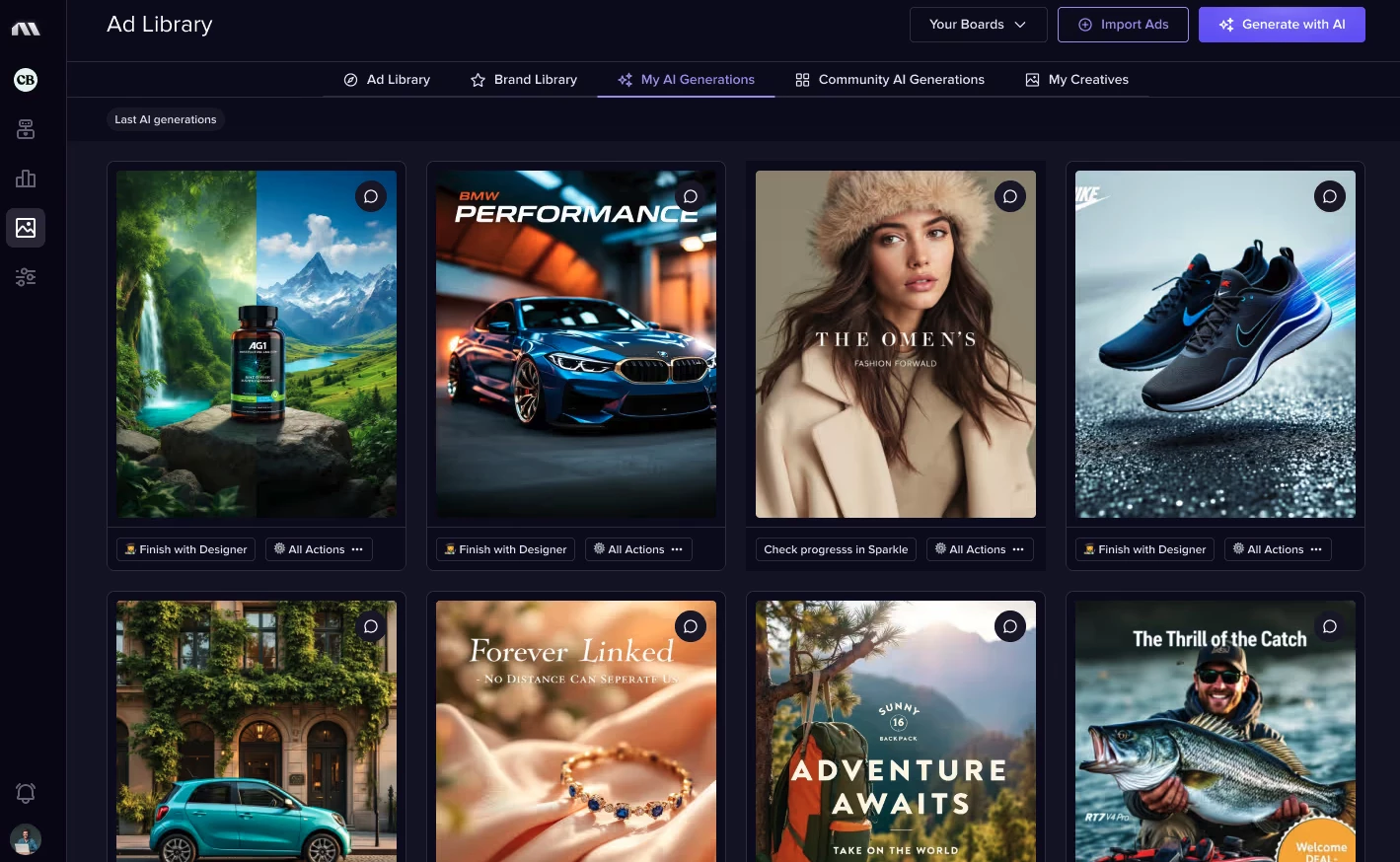
The creative side is also stronger than a pure optimization platform.
Madgicx includes AI ad generation, creative refresh workflows, an Ads Rotation Agent, and ad fatigue detection, so I spotted when performance is declining and could create new assets without starting the process from scratch.
That works especially well for eCommerce accounts where creative fatigue can quickly drain ROAS.
I’d say it's clearest downside is that it only optimizes Meta.
However, its One-Click Report add-on, which you can get for $29/month, can pull reporting data from TikTok, Google Ads, GA4, and Shopify into a unified dashboard, so it tracks multi-channel, even if it only optimizes Meta.
Pricing
- Pricing is based on monthly ad spend, starting at $45/month for a spend less than $1K.
- Madgicx offers 7-day free trial, no credit card required for initial audit.
What Users Say
Positive Capterra reviews tend to praise the depth of campaign rules, Meta ads management features, and the strategic view it gives advertisers. One review notes that users can set up detailed rules for campaign management and that the platform has features for many use cases.
The weaker reviews point to technical friction, connection issues, and cases where support did not resolve problems quickly enough.
Other Notable Features
- AI Ad Analyzer for Meta campaign insights.
- AI Ads Generator for faster creative production.
- Ad fatigue detector for spotting declining creative performance.
- Ads Rotation Agent and Creative Refresh Agent for ongoing creative testing.
2. Albert: Best for Fully Autonomous Campaign Management
For enterprise marketing teams and large agencies managing over six-figure monthly ad budgets across multiple channels who need fully autonomous optimization.
Albert is an enterprise-grade autonomous advertising platform that manages campaigns across Google, Facebook, Instagram, YouTube, and Bing with minimal human intervention.
You set business objectives and budget parameters, and Albert handles audience selection, creative testing, bid management, and cross-channel budget shifts, continuously, 24/7.
Pros:
- Makes autonomous campaign adjustments instead of only surfacing recommendations.
- Supports cross-channel paid media across social, search, and programmatic environments.
- Optimizes bids, budgets, audiences, ad sets, lookalikes, placements, creative items, and keywords.
Cons:
- Best suited to accounts with enough transactional data and conversion volume.
- The high-autonomy model can feel too hands-off for teams that want granular control.
What makes Albert different from every other tool on this list is the level of autonomy.
It doesn't give you suggestions to review and approve but instead makes optimization decisions and executes them in real-time based on self-learning algorithms that improve as your account accumulates data.
For large marketing teams managing six- or seven-figure monthly budgets across multiple channels, this hands-off approach saves significant time and removes the bottleneck of daily manual adjustments.
The platform integrates with existing ad accounts and can be implemented in weeks rather than months.
It also provides detailed reporting and analytics for strategic oversight, so you're not flying blind, even though the AI is driving.
The biggest trade-off I encountered is that the tool is highly autonomous, and no matter how much of an advantage that is for some teams, others may feel less in control than they'd like.
Pricing
- Pricing is custom and available through vendor consultation.
What Users Say
Capterra lists Albert with a 4.0/5 overall rating, with 4.0 for ease of use, 5.0 for features, and 5.0 for customer service. The profile describes Albert as an AI-powered marketing automation platform for cross-channel campaign analysis, optimization, and testing.
Other Notable Features
- Autonomous budget allocation across channels, audiences, and tactics.
- Search bid optimization across audiences, schedules, devices, and ads.
- Paid social optimization for interests, ad sets, audiences, and lookalikes.
- Programmatic optimization using real-time engagement and lookalike modeling.
3. Adzooma: Best Free AI Tool for PPC Campaign Management
For small businesses and agencies spending under $5,000/month who need a free cross-platform dashboard with guided optimization suggestions.
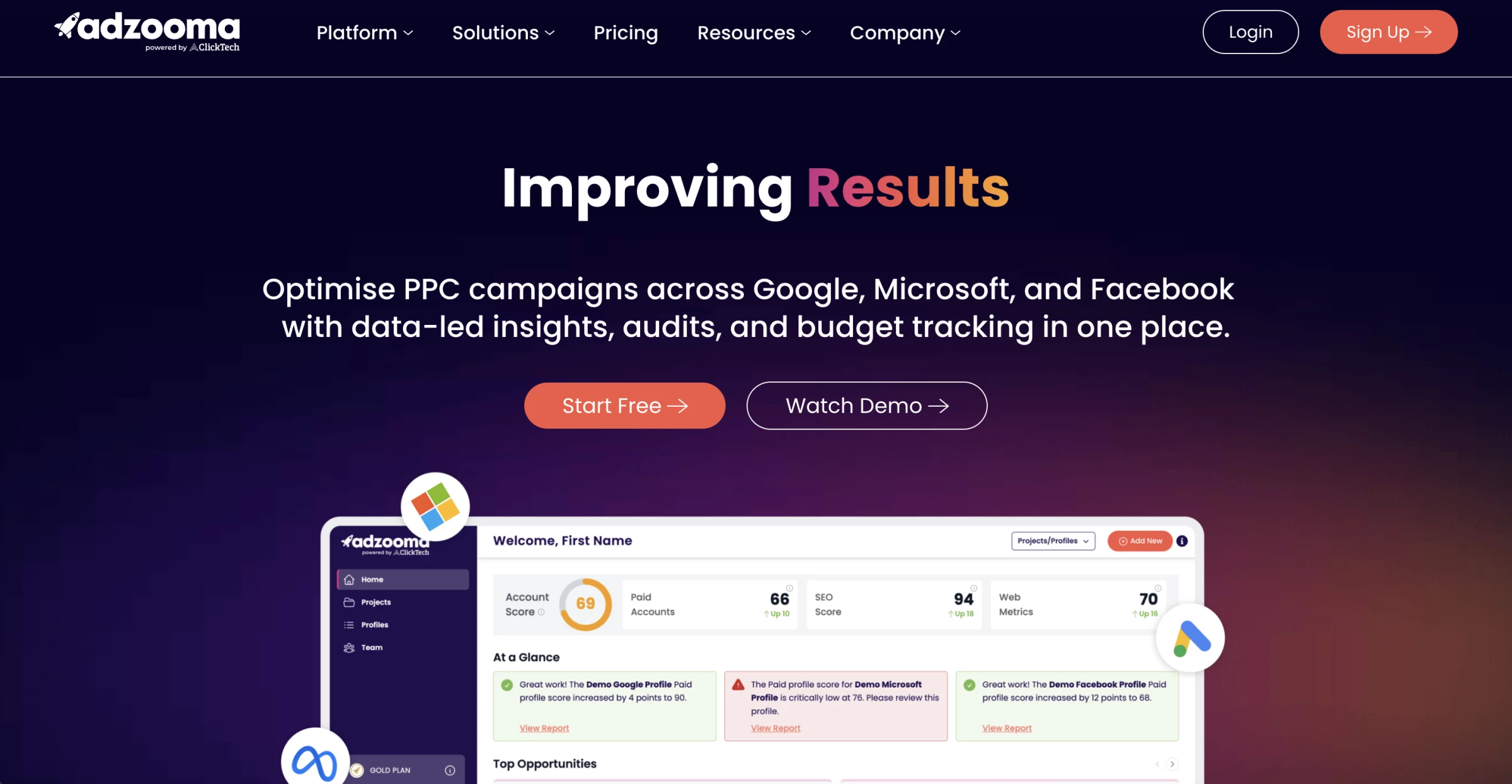
Adzooma fits small businesses and lean agencies that want a free way to monitor Google, Meta/Facebook, and Microsoft Ads from one dashboard.
The platform focuses on audits, budget tracking, optimization recommendations, and performance visibility, making it more useful for PPC housekeeping than full autonomous media buying.
Pros:
- Free PPC management layer for Google, Meta, and Microsoft Ads.
- Opportunity Engine surfaces prioritized recommendations from connected accounts.
- PPC Performance Report gives quick account scores and improvement areas.
Cons:
- Optimization depth is lighter than enterprise or Meta-specialist tools.
- LinkedIn Ads is not currently part of the core ad-platform mix.
The Opportunity Engine scans your connected ad accounts and surfaces prioritized recommendations: fix your quality score, adjust this bid, pause that underperformer.
During testing, I found the suggestions useful as a starting point, particularly for catching issues I might have missed on a busy day. The UI makes interpreting large amounts of account data straightforward.
Instead of digging through three ad platforms to find small account issues, Adzooma highlights what needs attention and prioritizes recommendations by impact.
Its PPC Performance Report also connects to Google, Microsoft, and Facebook Advertising accounts, generates an account score, and gives actionable improvement recommendations in a few minutes.
The free plan supports unlimited ad accounts, which makes it a strong fit for small agencies managing multiple client accounts on a lean budget.
Pricing (monthly)
- Free
- Silver: $69/month
- Gold: $179/month
What Users Say
Positive Capterra feedback commonly highlights setup ease, Facebook automation rules, detailed campaign performance reports, helpful optimization tips, and the ability to manage Google Ads, Microsoft/Bing Ads, and Facebook Ads in one place.
The recurring drawback is that some users want more Facebook Ads functionality and feel premium features are expensive.
Other Notable Features
- PPC Performance Report with account score and prioritized recommendations.
- Opportunity Engine for Google, Microsoft, and Facebook Ads improvements.
- Budget tracking across connected paid ad accounts.
- Automated alerts for account changes and performance issues.
Best AI Tools for Ad Targeting and Messaging Optimization
These tools don't produce creatives or manage bids, but instead, they improve who you reach and how your message lands through building smarter audiences and generating higher-performing ad copy.
1. Proxima: Best AI Audience Targeting Tool for eCommerce
For eCommerce brands spending over $5,000/month on Meta or TikTok ads who want to reduce CAC and reach higher-intent shoppers.
Proxima is a predictive data intelligence platform that builds high-intent custom audiences for paid social campaigns.
It draws on a proprietary database of anonymized eCommerce data from over 50 million shopper personas to identify people most likely to buy, then delivers those audiences directly to your Meta or TikTok ad account.
Pros:
- Uses real eCommerce purchase behavior to inform targeting, personas, and creative direction.
- Free Conversion Intelligence plan gives teams a low-risk way to explore buyer insights.
- Connects with Shopify, Meta, TikTok, Google, and Klaviyo.
Cons:
- Best suited to eCommerce brands with enough data and ad activity to make insights useful.
- Not a replacement for campaign management, bid automation, or creative production tools.
Setup took less than five minutes. I synced my Meta ad account and Shopify store, generated a set of AI audiences in the dashboard, and Proxima delivered them directly into my ad account.
Within 30 days, the targeting noticeably outperformed Meta's native broad and interest-based audiences.
Instead of relying on platform-generated lookalikes built from standard purchase data, Proxima builds audiences from cross-brand behavioral data, like which products people browsed, what they actually bought, and how those patterns predict intent for your specific catalog.
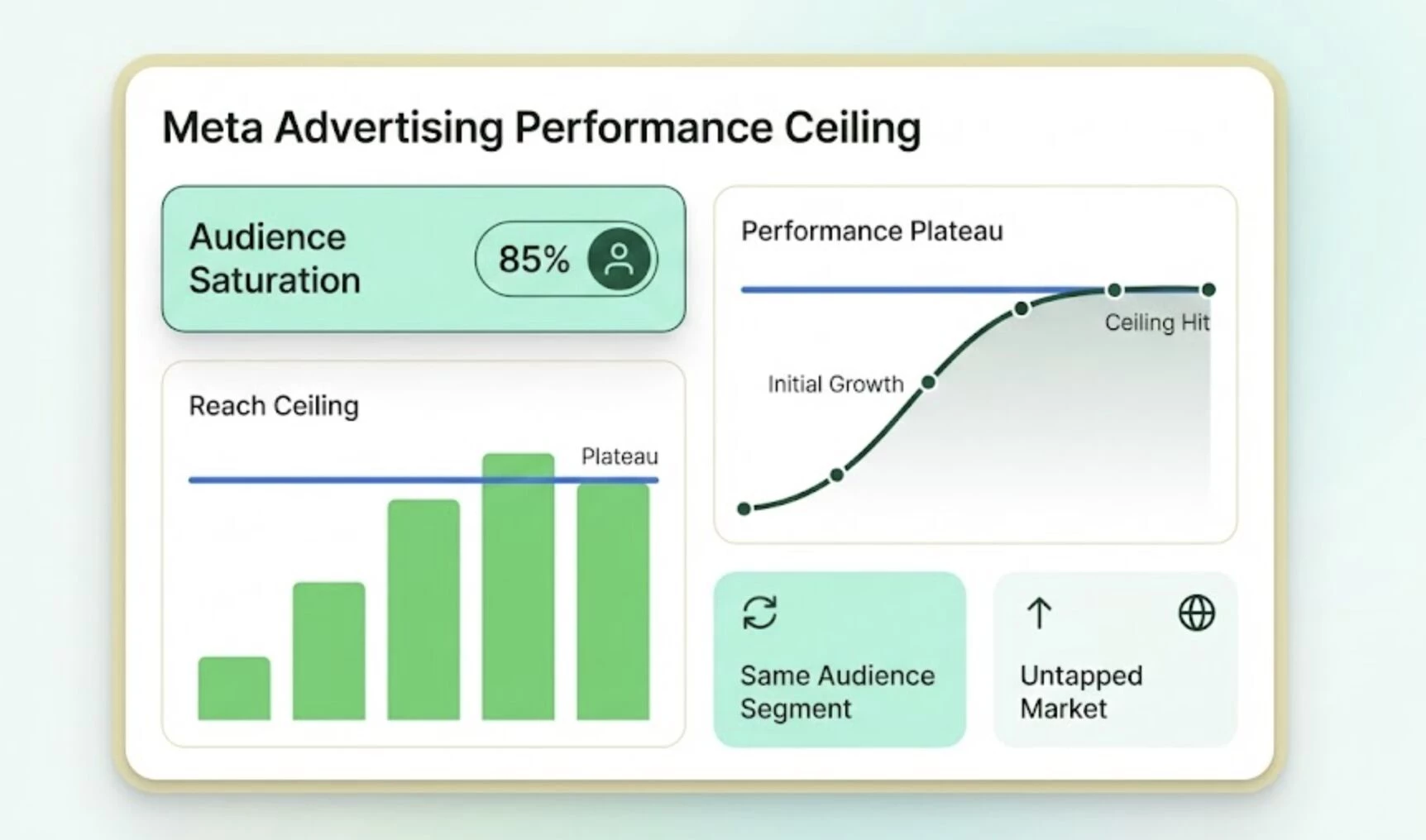
The Intelligence feature provides benchmarks, competitor comparisons, and customer analytics that go beyond what Meta Ads Manager shows, pulling in enrichment data across multiple touchpoints.
The main limitation is that Proxima is most useful when a brand already has real ecommerce data and paid acquisition activity.
Early-stage stores with limited traffic, few purchases, or low ad spend may get less value from predictive audiences and buyer intelligence.
Pricing
- Conversion Intelligence: Free to get started
- Intelligence + Execution: Starting at $250/month
What Users Say
Marketers treat Proxima audiences as something to test against first-party customer lists, broad targeting, and Advantage+ campaigns, rather than a guaranteed upgrade.
In one r/FacebookAds thread, a user testing a Proxima AI lookalike audience reported no conversions from a small campaign, while another commenter said Proxima audiences had not justified the cost for clients they had seen use them.
Broader Reddit discussion around Meta’s AI tools echoes the same caveat. AI targeting works best when the account already has strong conversion data, clean tracking, and enough budget to test properly.
Other Notable Features
- Conversion Intelligence powered by Proxima’s Commerce Graph.
- Buyer personas based on real market behavior.
- Audience insights beyond a brand’s own account data.
- Creative Briefs for data-backed Meta ad concepts.
2. Jacquard: Best AI Tool for Ad Copy and Brand Messaging at Scale
For enterprise marketing teams managing high-volume, multi-channel ad copy across email, push, SMS, social, and display.
Jacquard is an enterprise AI platform that generates and optimizes marketing copy including ad headlines, email subject lines, push notifications, CTAs, and social ad text, while keeping everything on-brand and compliant.
Pros:
- Purpose-built for enterprise brand messaging rather than generic AI copywriting.
- Supports email, SMS, mobile push, in-app, web push, and ChatGPT app messaging.
- Generates many message variants from one strategic brief.
Cons:
- Better suited to CRM and lifecycle teams than paid ad teams looking for visual creative.
- Too heavy for small businesses that need simple copy generation.
Where most AI writing tools generate generic copy, Jacquard is trained specifically on marketing language performance data. Its proprietary language model learns your brand voice and generates copy variants that maintain tone consistency across channels.
The platform then tests those variants and feeds performance data back into the model, so the copy improves over time.
The strongest use case is lifecycle messaging, where small wording changes can affect opens, clicks, conversions, and customer engagement across millions of sends.
It is built for enterprise teams that need controlled copy generation, experimentation, and performance feedback across customer messaging channels.
Smaller businesses will likely find it too specialized and too sales-led for everyday copy needs.
Pricing
- Pricing is custom and available through vendor consultation.
What Users Say
Public review data for Jacquard is limited under both its current name and its former Phrasee branding.
The clearest independent signal comes from Capterra, where a reviewer described Phrasee as a clever tool that can save time, but said it made more sense for larger-scale marketing operations than for smaller teams with lighter messaging needs.
Other Notable Features
- Brand-calibrated AI messaging for enterprise teams.
- Multichannel variants from one strategic brief.
- Performance prediction and language optimization.
- Dynamic Optimization through Braze Connected Content and Currents.
Best AI Tools for eCommerce Advertising and Competitive Research
These platforms are purpose-built for online sellers and social media advertisers who need to create product-focused ads quickly, spy on competitor strategies, and maintain a consistent posting cadence.
1. Predis: Best AI Advertising Tool for eCommerce Social Ads
For eCommerce store owners and social media managers who need to produce branded product ads and social content at scale without a design team.
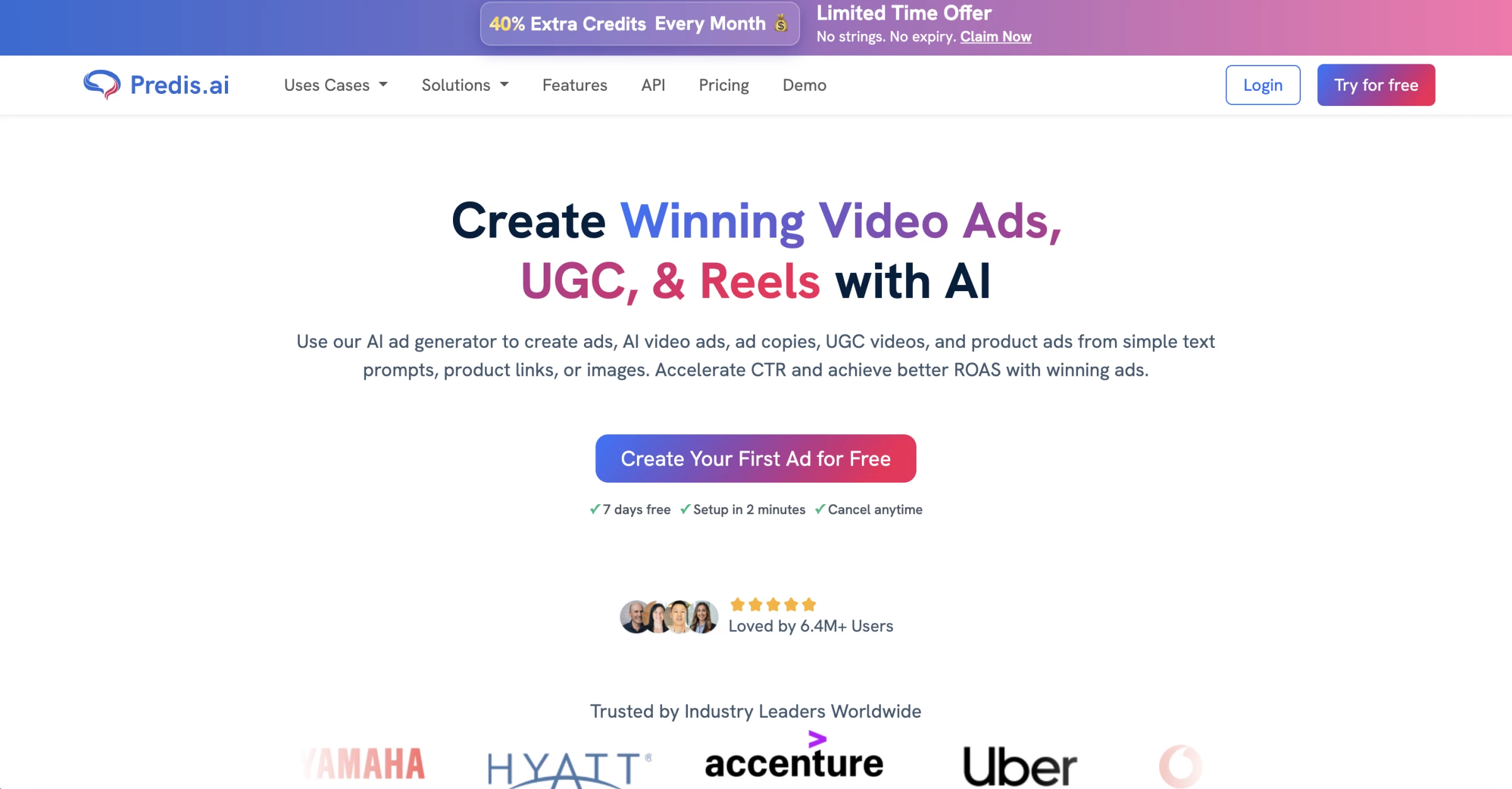
Predis is an AI content and ad creation platform designed specifically for eCommerce businesses that need to turn product catalogs into ready-to-post social media ads.
It connects directly to platforms like Shopify and WooCommerce, pulls product data, and generates branded visual content in multiple formats, including images, videos, carousels, reels, and even memes.
Pros:
- Turns ecommerce products into social posts, ads, videos, captions, and hashtags quickly.
- Includes scheduling across Instagram, Facebook, TikTok, YouTube Shorts, LinkedIn, Pinterest, Google Business, and X.
- Competitor analysis is included across paid plans.
Cons:
- AI outputs may still need editing for brand voice, colors, logos, and layout accuracy.
- Better for social content production than deep paid media optimization.
What I appreciated most was the eCommerce integration. Once I linked my store, Predis auto-generated product posts with images, AI-written captions, and hashtag suggestions.
The content calendar and scheduling feature let me plan and automate posts across Instagram, Facebook, TikTok, LinkedIn, and Pinterest from one dashboard.
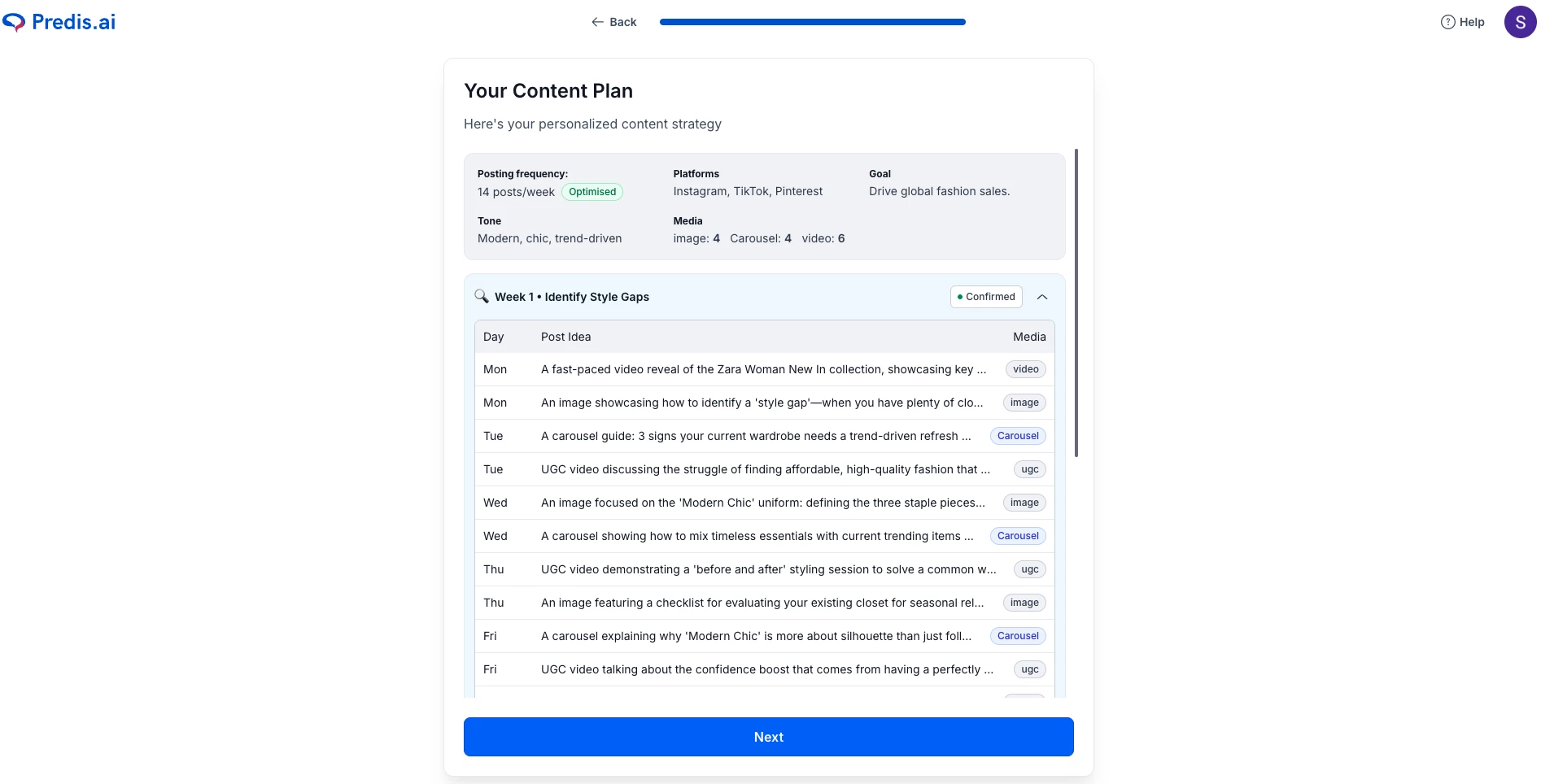
Instead of starting with a blank brief, you can use store or product inputs to generate ready-to-edit content for visual-first channels.
The competitor analysis tool shows what other businesses in your niche are posting, which content formats are working, and how your engagement metrics compare.
Predis also suggests optimal posting times and caption lengths based on your audience's behavior.
Pricing (monthly)
- Core: $32/month
- Rise: $79/month
- Enterprise: $249/month
Predis currently offers a 7-day free trial.
What Users Say
Shopify App Store reviews point to Predis as a useful tool for small businesses and growing brands that need to stay active on social media without spending hours creating content manually.
One recent review praised its flexibility, ease of use, and creative support, while another noted that the software keeps improving and highlighted strong customer service.
Other Notable Features
- Product-to-post generation for eCommerce catalogs.
- AI captions, hashtags, memes, carousels, reels, and videos.
- Social media scheduler for major social platforms.
- Competitor analysis for content and engagement benchmarking.
2. Quickads: Best AI Tool for Ad Spying, Inspiration, and Rapid Ad Creation
For marketers and creative teams who need competitive intelligence plus rapid ad production.
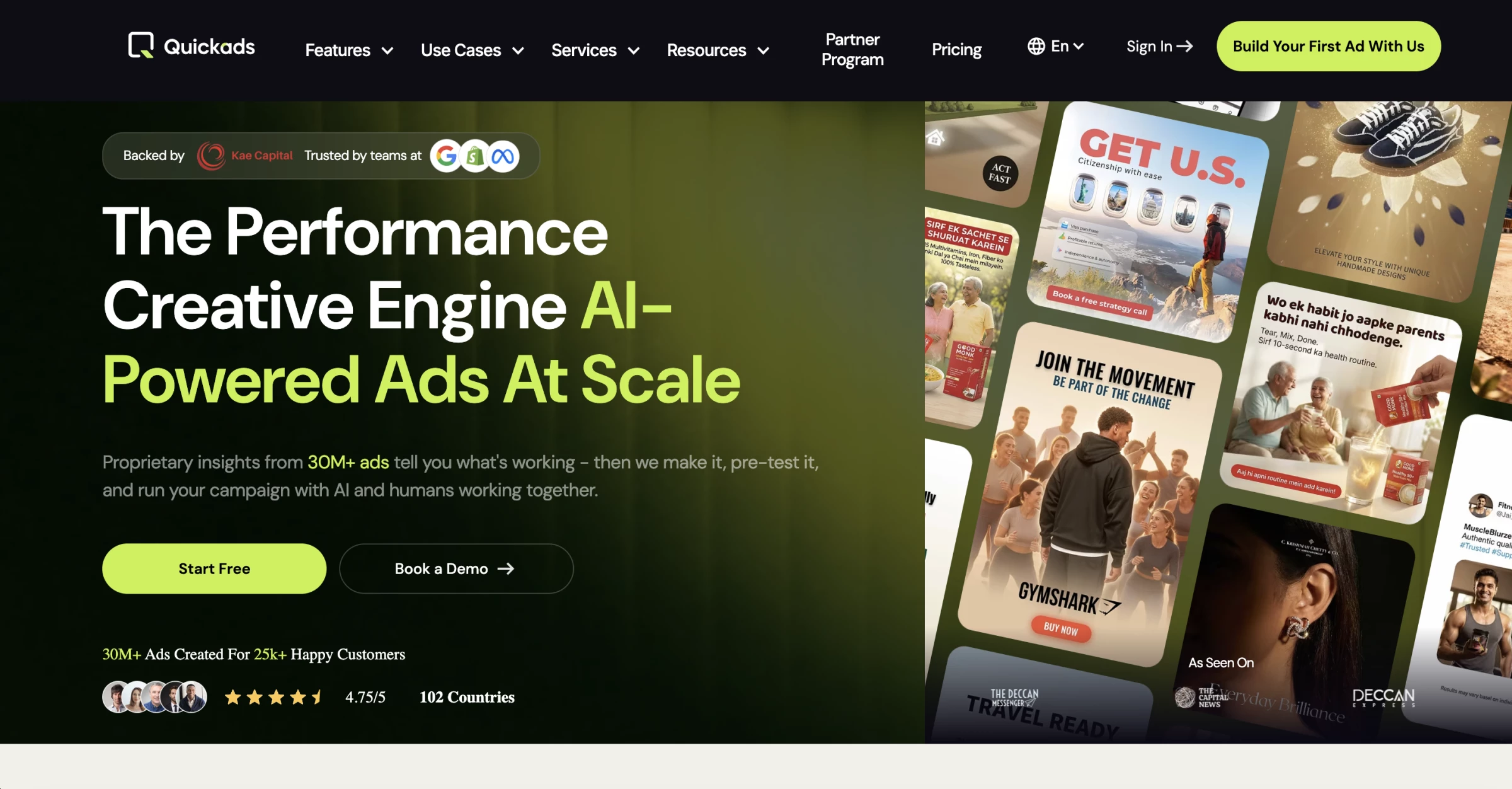
Quickads combines a massive ad library for competitive research and an AI ad creation engine.
The ad library contains over 10 million ads from platforms like TikTok and Meta, filterable by industry, theme, and format, thus giving you a window into what's working for competitors and across your category.
Pros:
- Combines ad inspiration, creative generation, and editing in one workflow.
- Supports image ads, video ads, product visuals, copy, and multilingual ad messaging.
- Uses a large ad dataset for creative research and inspiration.
Cons:
- Not a targeting, bidding, or campaign optimization platform.
- Some features may feel limited because the platform is still evolving.
The filtering is genuinely useful. I could narrow down by industry and trend, see which ads received high engagement, and understand why certain creative approaches performed as the AI scoring system breaks down what elements contributed to an ad's success.
The ability to save and share ads with team members makes the platform practical for collaborative creative briefing.
Beyond research, the ad creation tools let you produce image ads, video ads, faceless videos, and YouTube shorts from templates.
The AI video editor lets you pull inspiration from the ad library and customize by swapping hooks, body copy, and CTAs.
You can also add AI avatars and realistic voiceover, which is useful for brands that want presenter-style ads without filming.
The downside is that Quickads does not include audience identification or targeting features.
You're building the creative and doing the research here, and you'll need a separate tool or native platform for audience segmentation and campaign deployment.
Pricing
- DIY Creatives: Free
- Performance Creatives: Custom based on volume and scope
- Creatives + Campaigns: Contact Quickads for a dedicated team assigned
What Users Say
The user-friendly interface of the platform, along with its efficient templates that facilitate ad creation, is particularly appealing to users. Many value its capability to produce advertisements in bulk and offer a centralized management system.
Nonetheless, certain users have indicated a desire for a built-in audience targeting feature, as its absence diminishes the platform's overall utility for inexperienced advertisers.
Other Notable Features
- AI ad generation for image and video creatives.
- Ad inspiration and creative intelligence powered by 30M+ ads.
- Virtual product photography for product-led campaigns.
- AI copywriting in 35+ languages.
How To Choose the Best AI Advertising Tool for Your Business
Start by identifying the part of your ad workflow that slows performance down most. A creative bottleneck needs a different AI tool for advertising than a targeting problem, and a lean PPC setup does not need the same system as an enterprise media team.
- For scored static ads, AdCreative.ai is the safest starting point. Its performance scoring helps teams choose stronger social ad variations before launch, with a more affordable entry point than enterprise creative suites.
- Video-heavy brands with serious creative fatigue should look at Airpost. Its AI and human production model works best when a team needs dozens of performance video ads every week without managing a traditional agency workflow.
- Enterprise teams that want creative, media buying, optimization, and reporting in one place should start with Smartly. It is built for multi-channel advertisers that need structure across paid social, search, retail media, and programmatic campaigns.
- Meta-first advertisers will get more focused value from Madgicx. Its AI budget reallocation, ad fatigue detection, and creative analytics are strongest for Facebook and Instagram accounts with enough campaign data to optimize.
- For full cross-channel autonomy, Albert is the better fit. It suits larger teams that want AI to manage campaign decisions across Google, Meta, YouTube, Bing, and other paid channels within defined business guardrails.
- Smaller teams that mainly need visibility should start with Adzooma. Its free PPC dashboard gives Google, Meta, and Microsoft Ads users guided suggestions without the cost or complexity of a full optimization platform.
- Ecommerce brands looking beyond native platform audiences should test Proxima. It uses external shopper data to build audience and messaging intelligence for paid social, making it most useful once a brand already has purchase data and a real testing budget.
- For enterprise copy governance, Jacquard is the strongest choice. It helps large teams generate brand-compliant messaging across CRM and customer communication channels rather than producing generic ad copy.
- Product-led social teams should consider Predis. It turns ecommerce catalog inputs into posts, captions, videos, carousels, and scheduled content, which makes it practical for brands that need constant social output.
- Creative teams that need inspiration before production should start with Quickads. Its ad library helps with competitive research, while its AI creation tools turn those insights into fast image and video ad concepts.
Why Most Brands End Up Using Multiple AI Advertising Tools
Creative generation, audience targeting, bid optimization, competitive research, and reporting have each become specialized disciplines, and the AI tools for advertising that lead in one area rarely lead in another.
AdCreative.ai produces strong static creatives but doesn't manage bids. Madgicx optimizes Meta budgets but doesn't generate ads.
Proxima builds high-intent audiences but doesn't touch creative or campaign management.
Native AI inside Meta Advantage+ and Google Performance Max handles execution, but it doesn't solve creative production, cross-platform visibility, or audience intelligence beyond what the platform itself can see. That's where external tools fill the gap.
In practice, most teams stack two or three tools:
- A creative generator paired with an optimization platform: AdCreative.ai and Madgicx
- An audience intelligence tool paired with reporting: Proxima and Adzooma
- A competitive research tool feeding a production workflow: Quickads and Airpost)
Larger teams increasingly build modular AI advertising stacks by choosing best-in-class tools per function rather than seeking one platform that does everything adequately.
This is why interoperability matters more than feature breadth. A tool that integrates cleanly with your ad accounts, asset storage, analytics, and other platforms in your stack delivers more value than one that tries to do it all behind a single login.
Our team ranks agencies worldwide to help you find a qualified partner. Visit our Agency Directory for the best ad agencies, as well as:
- Top Digital Marketing Agencies
- Top Branding Agencies
- Top Creative Agencies
- Top Full-Service Digital Agencies
- Top Video Production Companies
Our experts also recognize the most innovative projects across the globe. Given the recent uptick in video podcasting, you'll want to visit our Awards section for the best & latest in video production.
FAQs About AI Advertising Tools
1. What is the best AI advertising tool?
It depends on your use case. For high-conversion static ad creatives, AdCreative.ai is the most accessible starting point. For autonomous cross-channel campaign management at enterprise scale, Albert leads the category. For Meta-specific optimization, Madgicx offers the best balance of automation and affordability. See the comparison table above to match your needs to the right tool.
2. Are there free AI advertising tools?
Yes. Adzooma offers a free Essentials plan with campaign audits and cross-platform tracking for Google, Meta, and Microsoft Ads. Predis has a free plan for basic social media ad creation. Most paid tools also offer free trials, includin AdCreative.ai for 7 days, Madgicx for 7 days, and Proxima for 30 days.
3. What's the best AI advertising tool for small businesses?
For small businesses with limited budgets, start with Adzooma and its free PPC management, Predis for $32/month for eCommerce social ads, or AdCreative.ai for $39/month for scored ad creatives. Avoid enterprise tools like Albert, Jacquard, and Proxima until your monthly ad spend justifies their pricing.
4. Do AI advertising tools work with Google Ads and Meta?
Most do, but not all cover both. Madgicx and Proxima are Meta-only. Albert, Adzooma, and Smartly support both Google and Meta plus additional channels. Always confirm channel compatibility before committing.
5. What's the difference between an AI ad generator and an AI ad optimization platform?
AI ad generators, like AdCreative.ai and Predis, produce creative assets, including images, videos, and copy. AI ad optimization platforms, like Madgicx, Albert, and Adzooma, manage campaign performance, including bids, budgets, audiences, A/B testing. They solve different problems, and many teams use one of each.
6. Will AI advertising tools replace human advertisers?
No. AI tools automate execution, bid management, creative variations, audience testing, budget reallocation. They don't replace the strategic thinking, brand judgment, emotional intelligence, and creative direction that effective advertising requires. The role shifts from manual optimization to strategic oversight and creative leadership.