
Artificial intelligence adoption has accelerated faster than we may have expected. In 2026, most businesses already use AI in some form, but the real divide is no longer between companies that adopt AI and those that ignore it.
Organizations are now either experimenting with AI or successfully integrating it into operations, workflows, and decision-making.
How Many Companies Are Using AI: Key Findings
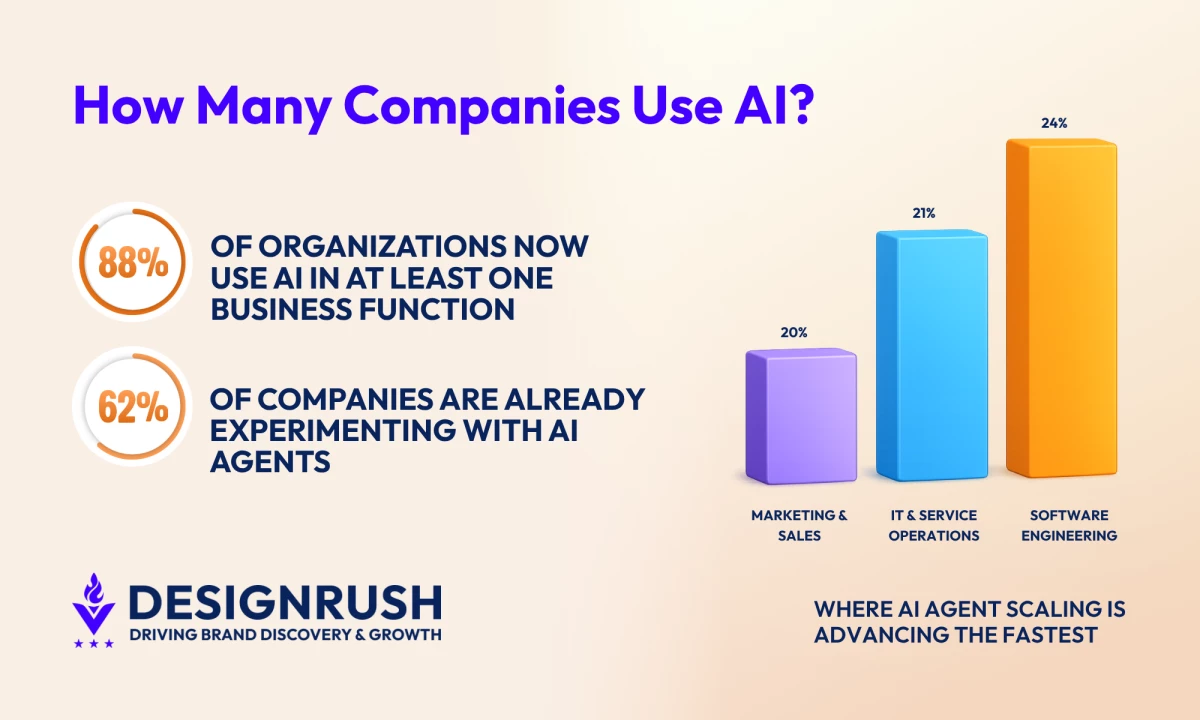
- 88% of organizations now use AI in at least one business function, but nearly two-thirds still have not scaled it across the enterprise.
- 62% of companies are already experimenting with AI agents, and 64% say AI is already contributing to innovation initiatives.
- NVIDIA reported $44.1 billion in quarterly revenue for fiscal 2026, driven largely by demand for enterprise AI infrastructure.
AI Adoption Is Moving Beyond Experimentation
AI is now part of routine business operations for most companies, particularly in customer support, analytics, cybersecurity, content production, and workflow automation.
According to McKinsey, 88% of organizations now use AI in at least one business function, up from 78% last year.
What varies is the depth of implementation. McKinsey found that only about one-third of organizations have scaled AI across the business, even as adoption becomes widespread.
The Proportion of Businesses That Use AI
AI adoption continues to expand across business functions, but most organizations are still in the early stages of implementation.
Even though 88% use AI in some capacity, McKinsey found that nearly two-thirds of companies have not yet begun scaling AI across the enterprise, with most still focused on experimentation, pilots, or limited deployment.
Here’s what you need to know:
- 62% of respondents say their companies are already experimenting with AI agents
- 64% report that AI is contributing to innovation initiatives
- Only 39% report an enterprise-level EBIT impact directly tied to AI
- 80% of organizations list efficiency as a primary objective for AI initiatives
- High-performing companies are more likely to use AI to support growth, innovation, and workflow redesign
- Workforce expectations remain mixed: 43% expect no major headcount changes, 32% anticipate reductions, and 13% anticipate workforce growth



How Are Companies Adopting AI?
AI adoption is increasingly concentrated around business processes, where companies can reduce manual work, improve response times, process large volumes of data, or support decision-making more efficiently.
Recent McKinsey data also shows growing interest in AI agents, particularly in IT, knowledge management, customer operations, and software engineering.
Some of the most common AI use cases in business include:
- IT operations and service management
AI is widely used in IT support, monitoring, and infrastructure management. IT is currently the business function with the highest reported level of AI agent scaling.
IBM notes that AIOps tools help organizations detect anomalies, troubleshoot issues faster, and improve system observability through real-time operational insights.
- Knowledge management and internal search
Companies are increasingly using AI to organize, retrieve, and analyze internal company information across tools, databases, and documentation systems.
McKinsey found that knowledge management is one of the fastest-growing areas for AI agent adoption.
- Marketing and sales
AI helps marketing teams analyze customer behavior, segment audiences, forecast spending patterns, and personalize campaigns.
McKinsey also identified marketing and sales as among the leading functions for AI agent implementation, particularly in the technology and media sectors.
- Customer service
AI-powered chatbots and dialogue-based tools help companies provide faster support and manage routine requests at scale.
- Content generation
Generative AI tools are now widely used for brainstorming, outlining, copywriting, coding assistance, and creative production. Gartner estimated that in 2025, generative AI produced 30% of outbound marketing content, up from just 2% in 2022.
- Cybersecurity and fraud detection
Organizations use AI to monitor network activity, detect anomalies, identify fraud, and reduce the risk of data breaches.
According to IBM’s Cost of a Data Breach Report, organizations extensively using security AI and automation saved an average of USD 1.76 million compared to those that did not.
- Supply chain and inventory management
Machine learning-based predictive analytics help businesses forecast demand, manage inventory levels, reduce overstocking, and anticipate fluctuations in shipping or material costs.
Adoption in supply chain management is lower than in customer-facing and IT functions, though its use continues to grow in manufacturing and logistics environments.
Where AI Adoption Is Advancing Fastest
AI adoption levels vary widely across industries, particularly between early experimentation and enterprise-scale implementation.
Technology, finance, healthcare, manufacturing, and media companies remain among the most active adopters, though the areas seeing the fastest growth differ significantly by sector.
- Finance:
The financial industry remains one of the fastest-moving AI sectors, with 81% of financial institutions now using AI across at least some business functions. However, only 14% describe AI as transformational to their strategy.
- Retail:
McKinsey estimates that generative AI could deliver between $240 billion and $390 billion in annual economic value to retailers, particularly in customer service, marketing, and inventory optimization.
- Manufacturing:
More than 77% of manufacturers have implemented AI to some extent, up from 70% in 2023. Common applications include predictive maintenance, computer vision-based quality control, and robotics-driven automation.
Recent McKinsey data also shows where AI agent scaling is advancing the fastest across industries:
| Industry | Highest AI Agent Scaling Area | % |
| Technology | Software engineering | 24% |
Media & telecommunications | IT and service operations | 21% |
| Advanced manufacturing | Marketing and sales | 20% |
| Healthcare | Service operations | 16% |
Technology and media companies report the highest levels of AI agent use, while healthcare organizations are gradually adopting AI in service operations and administrative processes.
AI adoption tends to spread fastest in workflows where large volumes of repetitive work already exist, structured data is readily available, and ROI can be measured quickly.
That is one reason functions such as IT, customer support, software engineering, and marketing continue to lead adoption rates across industries.
AI Adoption by Region
AI adoption rates continue to vary by region, determined by local infrastructure, regulation, workforce readiness, and investment levels.
North America is still one of the most mature enterprise AI markets, while Asia and parts of Europe are experiencing some of the fastest recent growth in implementation and adoption.
Here is how AI adoption currently compares:
North America continues to lead the enterprise AI implementation and investment. Stanford’s AI Index 2025 found that the region remains ahead in organizational AI use, supported by strong infrastructure, cloud adoption, and AI startup activity.
Europe is accelerating AI adoption across enterprise environments, particularly in financial services, manufacturing, and public-sector modernization. Stanford reported a 23% year-over-year increase in organizational AI use across Europe, one of the fastest growth rates globally.
Greater China recorded one of the largest year-over-year increases in organizational AI use, with Stanford reporting a 27% jump. Across Asia Pacific, companies continue expanding AI investment in automation, software engineering, and customer operations.
AI adoption in Africa remains uneven, though investment and usage continue to grow. Microsoft’s 2025 Global AI Adoption Report highlighted rising adoption across several African markets, partly driven by increased access to open-source AI tools and mobile-first digital infrastructure.
Middle Eastern countries such as the UAE and Saudi Arabia continue investing heavily in AI infrastructure and national adoption strategies. Microsoft’s AI Economy Institute ranked the UAE as the global leader in AI usage among the working-age population in late 2025.
Enterprise AI in Practice: Real-World Adoption Examples
Companies seeing the biggest results from AI are typically embedding it into operational systems, customer experiences, software development, logistics, and internal processes.
Recent enterprise deployments also show a growing shift toward AI agents and AI-assisted decision-making.
Microsoft
Microsoft has expanded AI across customer support, software engineering, sales, and enterprise productivity through Copilot and generative AI integrations.
Microsoft Chief Commercial Officer, Judson Althoff, said the company saved more than $500 million in its call centers alone through AI-driven automation, while also improving employee and customer satisfaction.
The company also reported increasing use of AI-produced code across product development workflows.
Microsoft’s AI strategy now extends across nearly every layer of its business, including GitHub Copilot, Microsoft 365 Copilot, Azure AI infrastructure, and internal operational tooling. The company is using AI as both a revenue driver and a company-wide productivity initiative.
Microsoft's expansion also shows a broader enterprise challenge: connecting AI tools to dispersed internal systems and operational data.
Organizations still struggle with the spread of information across platforms such as Salesforce, Snowflake, Confluence, SharePoint, and Tableau, limiting the effective deployment of AI across teams and processes.
For example, Cheesecake Labs partnered with SWIRL to help scale its enterprise AI search and knowledge platform that connects more than 100 internal tools and data sources without requiring data migration or complex ETL pipelines.
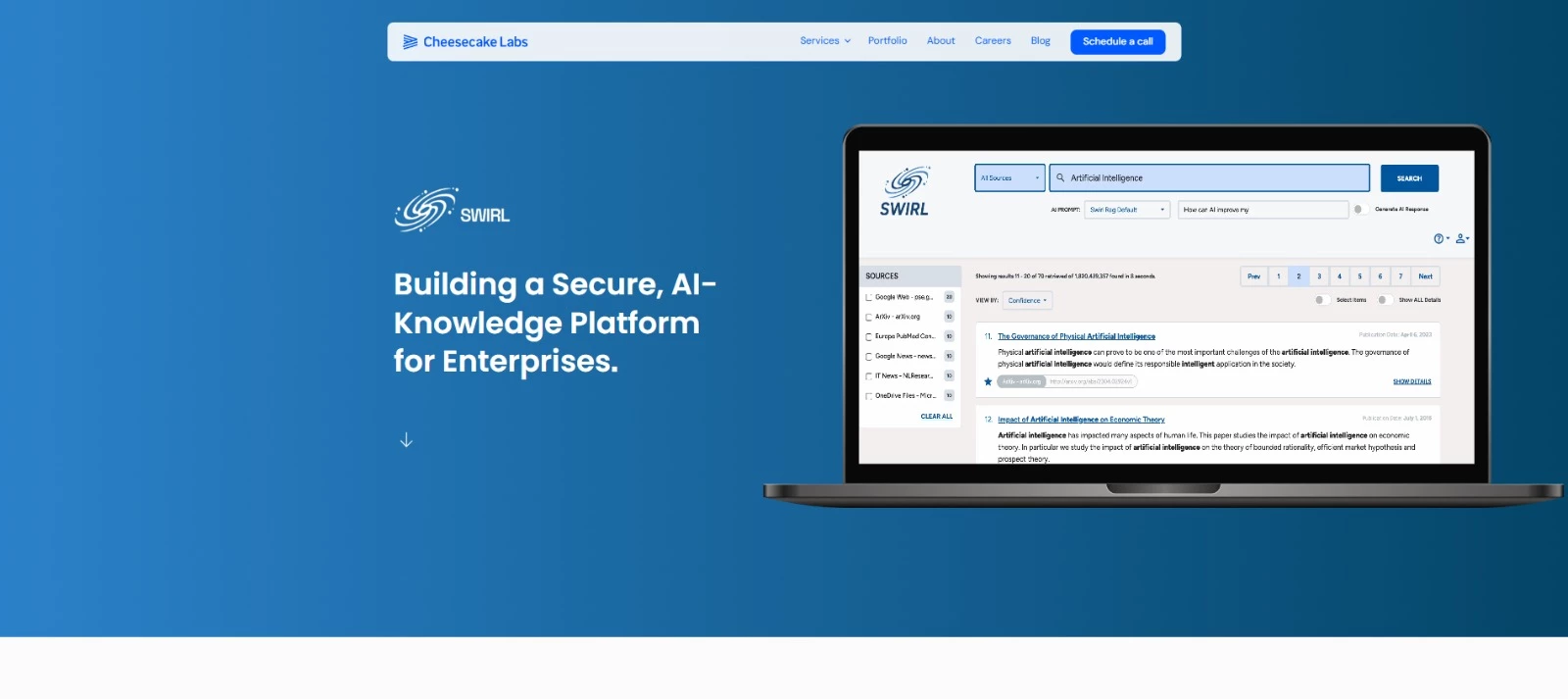
Cheesecake Labs supported the platform's backend engineering and DevOps infrastructure, using Python, Django, and cloud-pipeline expertise to help SWIRL accelerate enterprise deployments and improve platform flexibility.
According to SWIRL, clients using the platform reported up to 80% less time spent searching for internal information, faster access to context-rich results, and improved operational productivity.
The project reflects a growing enterprise focus on AI-powered knowledge management, internal search, and workflow efficiency.
Amazon
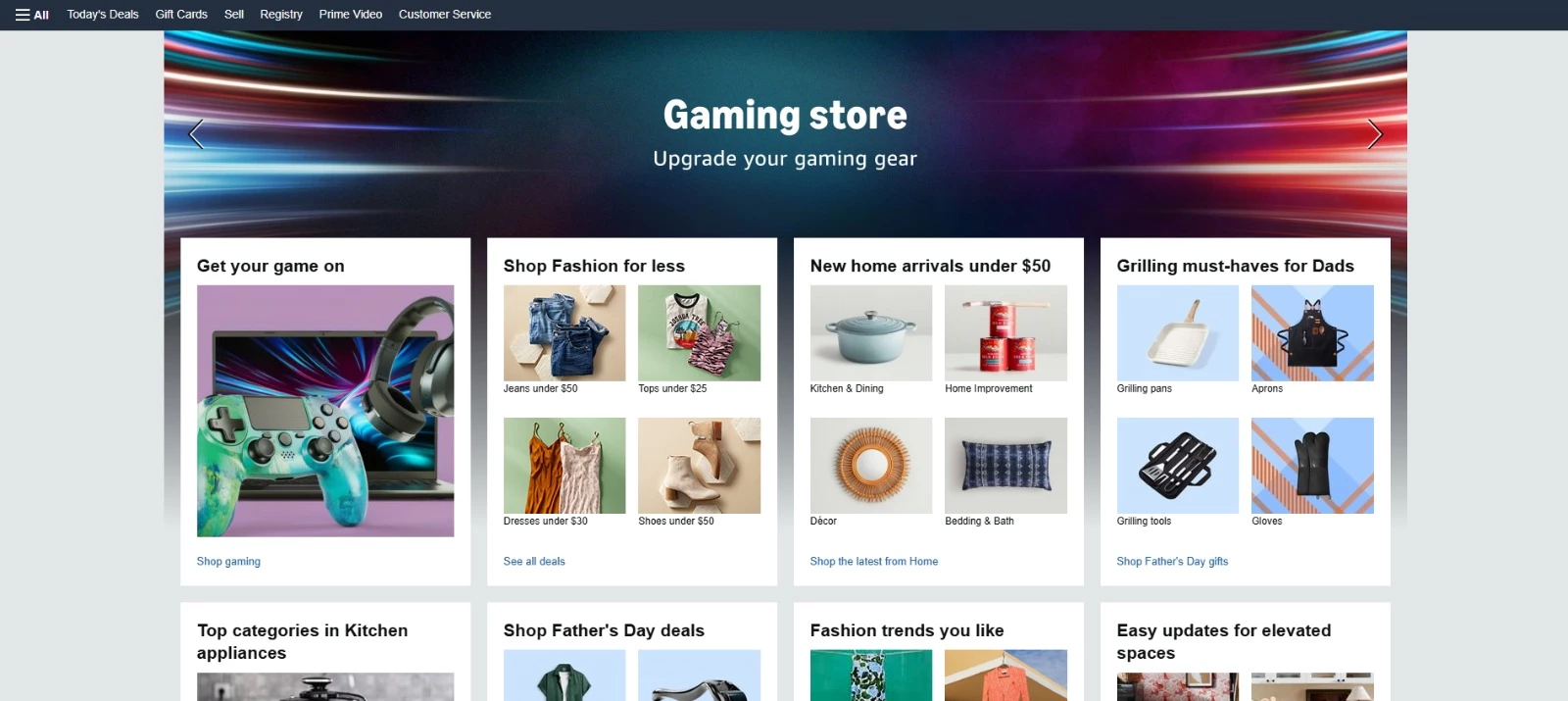
Amazon continues to integrate AI into logistics, robotics, customer support, and eCommerce operations. The company expanded the use of Rufus, its AI-powered shopping assistant, across the Amazon marketplace.
Amazon said more than 250 million customers used Rufus during the year, with monthly users increasing 140% year over year and interactions rising 210%. Customers who used Rufus during shopping sessions were also more likely to complete purchases.
AI adoption at Amazon extends into warehouse robotics, delivery forecasting, inventory planning, and agentic shopping experiences. Recently, Amazon began folding Rufus capabilities into broader Alexa for Shopping experiences as the company expanded AI-assisted product discovery, automated purchasing, as well as conversational commerce features.
NVIDIA
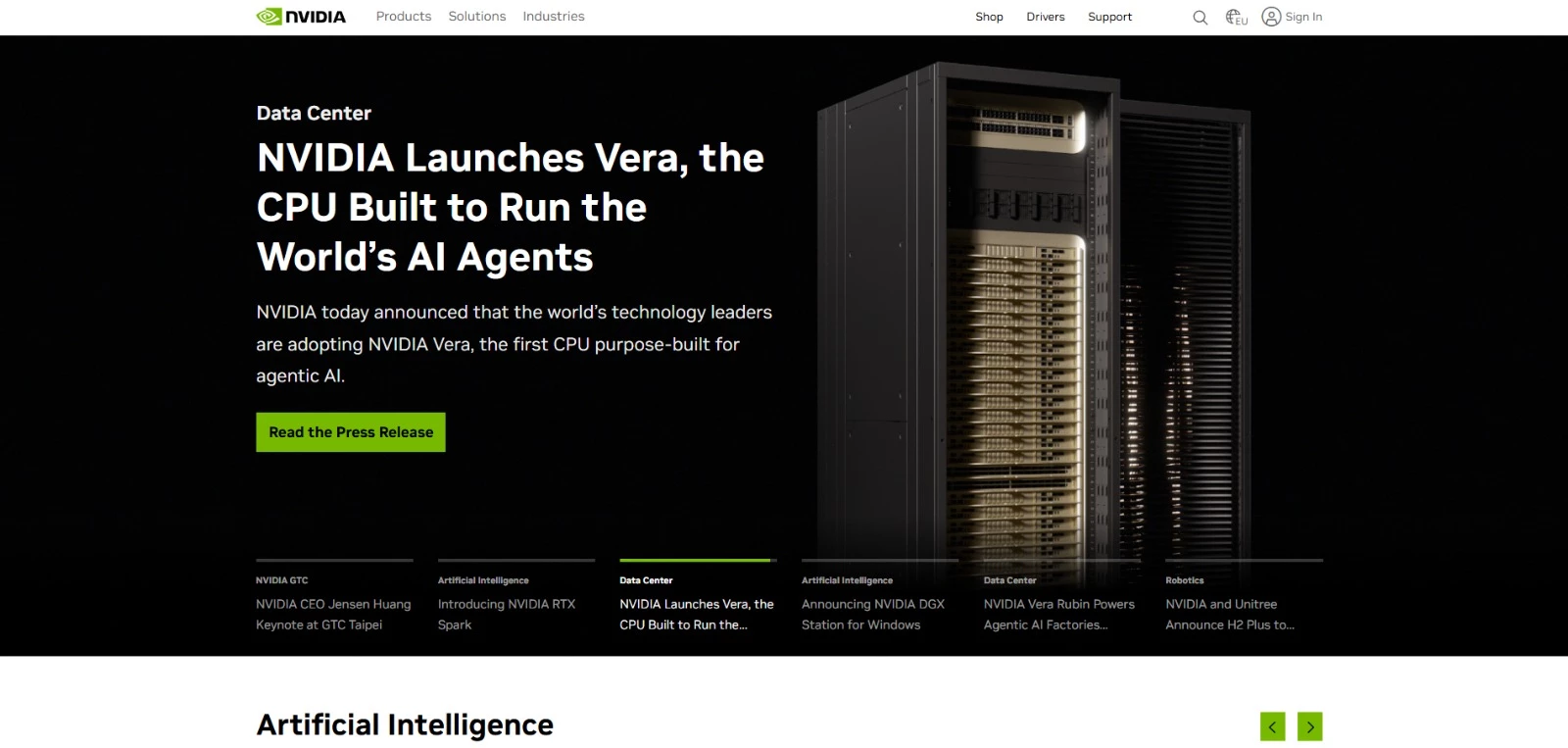
NVIDIA has become one of the clearest indicators of how aggressively companies are investing in enterprise AI infrastructure. Its GPUs now power many of the generative AI systems and large language models used by companies including OpenAI, Microsoft, Meta, Oracle, and Amazon.
The company reported $44.1 billion in revenue for the first quarter of fiscal 2026, up 69% year over year, while data center revenue reached $39.1 billion, a 73% annual increase driven largely by demand for AI infrastructure.
NVIDIA also recently reported quarterly revenue of more than $81 billion for its fiscal year 2027, with analysts and executives pointing to enterprise AI expansion and cloud companies increasing investment in AI infrastructure as major growth drivers.
Its Blackwell platform is now in full-scale production across cloud providers and enterprise customers building AI agents, copilots, and large-scale inference systems.
PayPal and MoneyGram Wallet

Financial services companies are increasingly building AI-powered payment and commerce ecosystems that combine personalization, automated transactions, digital wallets, and conversational shopping experiences.
In 2025, PayPal launched new agentic commerce tools that allow AI agents to manage payments, invoices, shipment tracking, and checkout flows directly within conversational interfaces. The company also expanded its integrations for AI-powered shopping and conversational commerce experiences.
That is also visible in blockchain-based payment infrastructure. For example, Cheesecake Labs partnered with MoneyGram to develop MoneyGram Wallet, a non-custodial wallet built on the Stellar blockchain that combines remittances, fiat cash access, digital wallet services, and USDC-powered transactions within a single mobile platform.
MoneyGram launched the project to expand cross-border payments and reach markets where its existing app infrastructure had limited presence. The goal was to create a secure and intuitive wallet experience for users who were not necessarily familiar with crypto or blockchain technology and to simplify international transfers or access to digital cash.
Cheesecake Labs worked with MoneyGram and the Stellar Development Foundation during the product definition and architecture phase, helping define integrations, MVP features, and the platform's technical roadmap.
The company also contributed blockchain expertise, scalable backend architecture, compliance flows, and mobile wallet functionality designed for global rollout.
The platform includes features such as SEP-30 account recovery, USDC-powered transfers on the Stellar network, and integration with MoneyGram’s physical cash network across more than 100 countries.
Following launch, the wallet expanded into markets including the United States, Mexico, Brazil, and the Philippines, with early campaigns driving more than 2,000 new user registrations.
How Many Companies Use AI: Final Words
Getting ahead of the AI curve takes careful planning and strategizing. If you want to realize its full potential in your business or help others do the same, keep a keen eye on data points like these, which reveal larger trends taking shape around you.

Our team ranks agencies worldwide to help you find a qualified partner. Visit our Agency Directory for the Top AI Companies, as well as:
- Top AI Consulting Companies
- Top AI Automation Companies
- Top Generative AI Companies
- Top Chatbot Solution Companies
- Top AI Customer Service Companies
How Many Companies Use AI: FAQs
1. Why should businesses pay attention to AI adoption statistics?
AI adoption statistics show where companies are investing, which business functions are changing fastest, and where competitive pressure is increasing. They also help businesses benchmark their own AI maturity against broader market trends and identify where demand for AI-related services is growing.
2. What percentage of small businesses use AI?
AI adoption among small businesses continues to rise, particularly in marketing, customer support, and content creation workflows. According to a recent SMB survey, roughly half of small business owners now use AI tools regularly in at least part of their operations.
3. What are the biggest barriers to AI adoption?
The biggest challenges are usually not the AI models themselves. Companies most commonly struggle with fragmented internal data, unclear ROI, lack of employee training, security concerns, and difficulty integrating AI into existing workflows and systems.
4. Why do so many AI projects fail?
Some AI initiatives stall before reaching large-scale deployment because companies focus on experimentation without redesigning workflows, integrating internal systems, or defining clear business objectives.
S&P Global found that organizations are reporting higher AI project failure rates as companies rush deployments without mature implementation strategies.
5. What is the ROI of AI for businesses?
ROI varies widely depending on the use case and implementation quality. Companies are reporting the highest returns in areas such as customer support automation, software development, logistics, fraud detection, and enterprise search, though organizations still struggle to consistently measure the enterprise-wide financial impact.
6. How long does it take to implement AI?
Implementation timelines depend on the project's complexity. Off-the-shelf AI tools can often be deployed within days or weeks, while enterprise-scale AI systems involving workflow redesign, infrastructure integration, compliance, and internal data connections may take several months or longer.