Capitalizing on artificial intelligence requires moving past generic solutions to find an agency with the right balance of data architecture expertise, integration capability, and industry focus. Browse our directory to evaluate and shortlist top-performing AI development companies based on verified client reviews, portfolio depth, and specialized domain focus.
Crafted By Talent, Perfected In Services
NeuroLinkX is not just another IT solutions firmwere Indias rising challenger brand redefining digital transformation with precision engineering, AI-first systems, and human-centered strategy. We build scalable, intelligent infrastructures and future-ready tech that fuels business velocity. From startups to...
Top Services:
- Mobile App Development
- AI Development
- Cloud Consulting
- DevOps Consulting
- Web Development
- Show more
- Location
- Kanpur, India
- Number of Employees
- 50 - 99
- Average Hourly Rate
- $12/hr
- Minimal Budget
- Under $1,000
- Portfolios Count
- 3 Projects Listed
Build what matters. Ship what works
Build what matters. Ship what works...
Top Services:
- Software Development
- Mobile App Development
- Staff Augmentation
- AI Development
- Product Design
- Show more
- Location
- Jaipur, India
- Number of Employees
- Under 49
- Average Hourly Rate
- $25/hr
- Minimal Budget
- $10,000 - $25,000
- Portfolios Count
- 6 Projects Listed
We Make Great Apps. It's That Simple.
We are a mobile application studio, built around a core team of seasoned marketers, serial entrepreneurs, veteran strategists and big idea lovers. We work with a diverse array of brands, companies, organizations and individuals to turn great ideas into powerful apps...
Top Services:
- Web Design
- Web Development
- UI/UX Design
- Mobile App Development
- AI Development
- Show more
- Location
- Irvine, California
- Number of Employees
- Under 49
- Average Hourly Rate
- $215/hr
- Minimal Budget
- $50,000 & Up
We Help Enterprise Companies Achieve Their Digital Dreams.
Impekable is an award-winning, worldwide digital product agency specializing in UX/UI Design, Mobile App Development & Web Development. We've created award-winning web and mobile user experiences for more than 250 clients, and over 600 projects, globally. We are honored to be recognized as a leading web and...
Top Services:
- Web Development
- UI/UX Design
- Product Design
- Mobile App Development
- AI Development
- Show more
- Location
- San Jose, California
- Number of Employees
- Under 49
Holistic & Innovative Solutions For Your Business Needs.
Orion eSolutions is not only a one stop shop for technology but also a software boutique specialised in development of web applications, mobile apps, desktop application or customisation of already built technology upto the par of best practice in the market...
Top Services:
- Mobile App Development
- Web Development
- eCommerce Development
- Software Development
- AI Development
- Show more
- Location
- San Jose, California
- Number of Employees
- 100 - 249
- Average Hourly Rate
- $50/hr
- Minimal Budget
- $10,000 - $25,000
Engineering What's Next
Since 1973, General Digital has provided unparalleled software development & testing services for safety-critical applications including aviation, medical, industrial, defense, and other industries...
Top Services:
- Blockchain
- Wearables
- Software Testing
- Software Development
- AI Development
- Show more
- Location
- East Hartford, Connecticut
- Number of Employees
- 50 - 99
Enable, innovate, transform
A team of Tech-savants focused on simplifying complexities in the technology realm. We combine our technical expertise with product mindset that helps Enterprises to strengthen and transform their business by providing state-of-the art software development services...
Top Services:
- Software Development
- Mobile App Development
- Blockchain
- Software Testing
- AI Development
- Show more
- Location
- Fremont, California
- Number of Employees
- 100 - 249
- Average Hourly Rate
- $30/hr
- Minimal Budget
- $10,000 - $25,000
Your Technology Partner
ONE BCG is a global software consulting firm with over 22 years of experience solving complex problems with technology and delivering innovative solutions. We work together with the brightest minds to deliver comprehensive and scalable solutions focusing on user experience and technical excellence...
Top Services:
- Mobile App Development
- IT Services
- Software Testing
- Software Development
- AI Development
- Show more
- Location
- Scottsdale, Arizona
- Number of Employees
- 100 - 249
Boost Innovation.
We boost the innovation by combining IT, AgTech, Engineering, and Design solutions to drive your business to the next stage. Each practice area is designed to go along with the necesity of your company, overcoming cultural and technological barriers to pursuit the innovation...
Top Services:
- IoT
- Mobile App Development
- Software Development
- Product Design
- AI Development
- Show more
- Location
- Miami, Florida
- Number of Employees
- 50 - 99
- Minimal Budget
- $1,000 - $10,000
Engage and Empower Your App Customers
Atomic Robot is an agency specializing in crafting custom mobile solutions for emerging technologies, iOS and Android. We offer a platform for creators and thought leaders to establish partnerships that result in high-quality digital experiences which enhance people's lives...
Top Services:
- UI/UX Design
- Mobile App Development
- Digital Strategy
- IoT
- AI Development
- Show more
- Location
- Mason, Ohio
- Number of Employees
- Under 49
- Average Hourly Rate
- $199/hr
- Minimal Budget
- $50,000 & Up
Committed to Serving Better!
Euphoric employs its industry expertise to facilitate business transformation for our clients. Our agile methodology enables us to adeptly harness technology, crafting and implementing innovative solutions that instigate technological disruption. Partner with us to proactively stay ahead of industry trends...
Top Services:
- Software Development
- Cloud Consulting
- Managed Services
- Mobile App Development
- AI Development
- Show more
- Location
- Bengaluru, India
- Number of Employees
- 50 - 99
- Average Hourly Rate
- $25/hr
- Minimal Budget
- $10,000 - $25,000
- Portfolios Count
- 5 Projects Listed
Build faster. Hire smarter. Save up 40% with elite nearshore devs.
Our sole goal is to ensure that your team has the best talent to meet your technology and business requirements...
Top Services:
- IT Services
- Web Development
- Mobile App Development
- Staff Augmentation
- AI Development
- Show more
- Location
- Miami, Florida
- Number of Employees
- 50 - 99
- Average Hourly Rate
- $40/hr
- Minimal Budget
- $10,000 - $25,000
Unlocking the Power of Data and AI for the Energy Sector
Hypercube offers tailored end-to-end data solutions for the energy sector, addressing the unique challenges businesses face in a fast-moving industry. Their agile delivery process ensures tangible outcomes at every stage, with the first delivery in under two weeks. The team, well-versed in the energy sector...
Top Services:
- Big Data Analytics
- Cloud Consulting
- IT Services
- DevOps Consulting
- AI Development
- Show more
- Location
- Edinburgh, United Kingdom
- Number of Employees
- Under 49
- Average Hourly Rate
- $100/hr
- Minimal Budget
- $10,000 - $25,000
EU Funding, Proposal & Innovation Impact Support
Nexuswelt Group is a European EU Funding & Innovation Agency supporting organisations and consortia across Horizon Europe, Chips JU, Digital Europe, and other EU-funded innovation programmes...
Top Services:
- Business Consulting
- Market Research
- Big Data Analytics
- Public Relations
- AI Development
- Show more
- Location
- Fürstenfeldbruck, Germany
- Number of Employees
- Under 49
Digitalization N Automation Magicians.
Aimtraction Software Agency, LLC delivers top-tier Angular development services, backed by our team of highly specialized professionals...
Top Services:
- IT Services
- Staff Augmentation
- Software Development
- Mobile App Development
- AI Development
- Show more
- Location
- Novoiavorivsk, Ukraine
- Number of Employees
- 50 - 99
- Average Hourly Rate
- $55/hr
- Minimal Budget
- $1,000 - $10,000
Discover the Power of Teams.
IT Teams is a company backed by the 16 years of experience in software outsourcing and remote staffing. IT Teams aims to assemble passionate experts to help companies and startups achieve success...
Top Services:
- IT Services
- Software Development
- Mobile App Development
- Staff Augmentation
- AI Development
- Show more
- Location
- Bucharest, Romania
- Number of Employees
- 100 - 249
- Average Hourly Rate
- $50/hr
We Bring the Patients. You Bring the Smiles.
At Dental Digital, were committed to growing dental practices. Leveraging deep industry insights, we craft custom marketing strategies that make your practice shine. Our services include smart SEO to boost local rankings, targeted paid ads on Google, Facebook, Instagram, and TikTok to attract new patients...
Top Services:
- Web Design
- Web Development
- SEO
- PPC
- AI Development
- Show more
- Location
- Sheridan, Wyoming
- Number of Employees
- Under 49
- Average Hourly Rate
- $100/hr
- Minimal Budget
- $1,000 - $10,000
Digital Growth, Together
Kanguru Digital Agency is a full-service agency specializing in custom digital transformation solutions for medium to large businesses across Canada. We partner with forward-thinking companies to streamline operations, improve customer engagement, and drive scalable growth through tailored, end-to-end digital...
Top Services:
- Digital Marketing
- Software Development
- UI/UX Design
- Web Design
- AI Development
- Show more
- Location
- Montreal, Canada
- Number of Employees
- Under 49
- Average Hourly Rate
- $125/hr
- Minimal Budget
- $10,000 - $25,000
Custom Software That Fits Your Exact Workflow
At SynkFlow, we dont just build digital solutions we craft experiences that brands can trust. From stunning websites to powerful apps and AI-driven tools, we put love into every line of code. Our mission is simple: make your brand unforgettable and your growth unstoppable. Trust us once, and well grow...
Top Services:
- Software Development
- Web Development
- Web Design
- Mobile App Development
- AI Development
- Show more
- Location
- Cheyenne, Wyoming
- Number of Employees
- Under 49
- Average Hourly Rate
- $40/hr
- Minimal Budget
- Under $1,000
push play on your digital potential
We create digital products and experiences that scale, adapt & perform. We assist brands in staying ahead by providing them with better websites, enhanced shopping experiences, and custom-built digital tools that support their business objectives...
Top Services:
- Branding
- Digital Strategy
- UI/UX Design
- Email Marketing
- AI Development
- Show more
- Location
- Palma de Mallorca, Mexico
- Number of Employees
- Under 49
- Average Hourly Rate
- $145/hr
- Minimal Budget
- $10,000 - $25,000
Business Technology Built To Scale With You
We create technology that truly supports and powers your business. We're not a software factory we're a dedicated team that approaches every project as if it were our own. We recognize that behind every system are real people, real processes, and clear business goals...
Top Services:
- Software Development
- Mobile App Development
- CRM Consulting
- IT Services
- AI Development
- Show more
- Location
- Almería, Spain
- Number of Employees
- Under 49
- Average Hourly Rate
- $99/hr
- Minimal Budget
- $10,000 - $25,000
Impact Marketing
Huppatz Digital is a performance-focused digital marketing agency dedicated to solving real business challenges through strategic, customer-centric marketing. Rather than relying on generic advertising tactics, the agency builds unified strategies that deeply understand customer behavior and intenthelping...
Top Services:
- SEO
- PPC
- Web Design
- Web Development
- AI Development
- Show more
- Location
- Newstead, Australia
- Number of Employees
- Under 49
- Minimal Budget
- $1,000 - $10,000
AI Agents & Modern Web Development
Abu Dhabi based agency building real and useful AI agents, web apps and ecommerce platforms. Founder-led, no fluff, direct results...
Top Services:
- Web Development
- Mobile App Development
- UI/UX Design
- Branding
- AI Development
- Show more
- Location
- Abu Dhabi, United Arab Emirates
- Number of Employees
- Under 49
- Average Hourly Rate
- $120/hr
- Minimal Budget
- $10,000 - $25,000
Everything You Need To Grow Online
Most agencies can spin up a landing page. Fewer can build a full website that actually holds up under real traffic, real teams, and real marketing. Thats where we come in. We combine strategy, UX, design, development, hosting, and maintenance into one durable foundation built to support SEO, PPC, and...
Top Services:
- Web Design
- Web Development
- SEO
- Branding
- AI Development
- Show more
- Location
- Hellertown, Pennsylvania
- Number of Employees
- Under 49
- Average Hourly Rate
- $150/hr
- Minimal Budget
- $1,000 - $10,000
Get Found On Google Get Customers. Grow
L3ad Solutions is a digital marketing agency based in Titusville, Florida, focused on helping small businesses across the Space Coast get found online. We build custom websites, run local SEO campaigns, and manage Google Business Profiles so our clients show up when it matters. Our approach is simple: audit...
Top Services:
- SEO
- Package Design
- Web Design
- Social Media Marketing
- AI Development
- Show more
- Location
- Titusville, Florida
- Number of Employees
- Under 49
- Average Hourly Rate
- $50/hr
- Minimal Budget
- Under $1,000
AI Visibility Engineering Systems
Texas businesses dominate search. We engineer that! We don't sell beautiful websites that never get seen. We don't chase keywords or blue links. We don't outsource or cookie cut your strategy. It's 2026 - we get our clients Cited by the Engines that matter right now with 3-5x higher conversion rates...
Top Services:
- SEO
- Social Media Marketing
- CRO
- Web Design
- AI Development
- Show more
- Location
- Houston, Texas
- Number of Employees
- Under 49
- Average Hourly Rate
- $197/hr
- Minimal Budget
- $1,000 - $10,000
Full-service marketing for local businesses ready to grow.
Toronto marketing agency Meta Ads, Google Ads, social media, SEO, DM automation, and creative under one roof...
Top Services:
- Digital Marketing
- Social Media Marketing
- SEO
- Content Marketing
- AI Development
- Show more
- Location
- Orangeville, Canada
- Number of Employees
- Under 49
- Average Hourly Rate
- $50/hr
- Minimal Budget
- $1,000 - $10,000
Webllisto is a prominent IT Consulting and Engineering firm offering clients the finest Web and Software development services for their business. Our exceptional Web services are dedicated to Enterprises, ISVs, Startups, and digital agencies...
Top Services:
- Software Development
- VR/AR
- AI Development
- IoT
- Mobile App Development
- Show more
- Location
- Indore, India
- Number of Employees
- 100 - 249
- Average Hourly Rate
- $50/hr
- Minimal Budget
- $1,000 - $10,000
- Portfolios Count
- 4 Projects Listed
Where Service Meets Innovation.
Cloudesign Technology Solutions Pvt Ltd is an IT services and consulting company dedicated to the mission of democratizing access to technology. We provide cutting-edge technology solutions and advanced UX/UI design solutions to enterprises of every scale thus leveling the playing field for innovative...
Top Services:
- Web Design
- Web Development
- SEO
- AI Development
- IoT
- Show more
- Location
- Bengaluru, India
- Number of Employees
- 100 - 249
- Portfolios Count
- 1 Project Listed
Digital Transformation Company
We strive to build products for Global Startups/Mid-sized business and be a part of their success story. We love Startups, we understand them. We understand the life of high ambitions, scarce resources, limited time and an unparalleled excitement...
Top Services:
- IoT
- Mobile App Development
- Blockchain
- Software Testing
- AI Development
- Show more
- Location
- North Brunswick Township, New Jersey
- Number of Employees
- 50 - 99
- Average Hourly Rate
- $35/hr
Design. Build. Experience.
Britelite Immersive is a creative technology agency that places people and brands at the center of immersive and interactive experiences...
Top Services:
- Software Development
- Mobile App Development
- VR/AR
- Wearables
- AI Development
- Show more
- Location
- San Francisco, California
- Number of Employees
- Under 49
- Minimal Budget
- $50,000 & Up
Exemplary Marketing – App Design & Development Company
#1 App Design and Development + Digital Marketing Agency in Chicago | Strong Strategies for Online Marketing | Red Hot #AppDevelopment | Sleek Videography and Graphic Design | Contact Us Now to Make Your Business Stand Out in a Crowd of Competitors...
Top Services:
- Content Marketing
- Social Media Marketing
- Digital Marketing
- Logo Design
- AI Development
- Show more
- Location
- Chicago, Illinois
- Number of Employees
- 100 - 249
- Average Hourly Rate
- $10/hr
- Minimal Budget
- $1,000 - $10,000
Agile Aide for Enterprises
Virtual Force is a technology partner that many Enterprises trust. Our flexible and adaptable process enables us to meet diverse client needs...
Top Services:
- eCommerce Development
- Web Design
- Web Development
- WordPress Website Design
- AI Development
- Show more
- Location
- New York City, New York
- Number of Employees
- 50 - 99
- Average Hourly Rate
- $10/hr
- Minimal Budget
- $1,000 - $10,000
We Build. We Create. We Share. We Grow Businesses.
LeadWorks is a strategic business development, lead generation, and marketing communications management company dedicated to enhancing the profitability of its clients through focused strategy development, the creation and application of highly customized lead generation programs, and coordinated marketing...
Top Services:
- Social Media Marketing
- Digital Marketing
- SEO
- Web Design
- AI Development
- Show more
- Location
- Hilton Head Island, South Carolina
- Number of Employees
- Under 49
- Average Hourly Rate
- $125/hr
- Minimal Budget
- Under $1,000
We Create Digital Products and Services
Nolwenture is your adaptable service creation and software development partner. We have a track record of delivering end-to-end solutions for customers ranging from industry disruptors to established market leaders. We provide technological and business consulting as well as the creation of digital goods and...
Top Services:
- Software Development
- Mobile App Development
- VR/AR
- Software Testing
- AI Development
- Show more
- Location
- Joensuu, Finland
- Number of Employees
- Under 49
- Average Hourly Rate
- $90/hr
Leverage World-class Talent
Toptal is a highly respected network of elite talent available when needed. Our team of problem-solvers is committed to integrity, and leading companies turn to us for critical projects. We equip organizations with the tools to compete and succeed in a rapidly-evolving business world, boasting exceptional...
Top Services:
- Mobile App Development
- VR/AR
- Blockchain
- Software Development
- AI Development
- Show more
- Location
- San Francisco, California
- Number of Employees
- 1000 & Up
- Average Hourly Rate
- $149/hr
- Minimal Budget
- $50,000 & Up
Digital Experiences Redefined.
REEA Global blends the reach of a sizeable in-house product, engineering and design team worldwide with the proficiency of local technical leadership, design supervision and project management. Our software development initiatives are shaped by a deep understanding of the end-user's needs and expectations...
Top Services:
- Mobile App Development
- UI/UX Design
- Software Development
- eCommerce Development
- AI Development
- Show more
- Location
- Baltimore, Maryland
- Number of Employees
- 100 - 249
- Average Hourly Rate
- $149/hr
- Minimal Budget
- $10,000 - $25,000
Offshore software development company
We have developed a solid team of designers, developers, marketers, and business development experts over the past ten years. This team works well together to provide clients with top-notch work...
Top Services:
- Web Design
- eCommerce Development
- Web Development
- Mobile App Development
- AI Development
- Show more
- Location
- New York City, New York
- Number of Employees
- 100 - 249
- Average Hourly Rate
- $49/hr
- Minimal Budget
- $10,000 - $25,000
Cloud computing to help your business work faster, cheaper and better
CloudWave has successfully integrated Salesforce with MuleSoft, Google Cloud, Smartsheet, Oracle Database, Elasticsearch, Eloqua, Slack, Alfresco, DocuSign and more so that our clients can have real-time access to all relevant information across multiple systems. With CloudWave on your side, you can feel...
Top Services:
- CRM Consulting
- Cloud Consulting
- IT Services
- DevOps Consulting
- AI Development
- Show more
- Location
- Tysons, Virginia
- Number of Employees
- 50 - 99
- Average Hourly Rate
- $100/hr
On-demand technology, marketing, and design specialists.
Access the necessary technology, marketing, and design expertise without the expenses and complexities of recruiting and training new staff. Promantus offers the support of seasoned specialists who seamlessly integrate into your team, assisting in new projects, technology implementations, and advancing your...
Top Services:
- Software Testing
- Mobile App Development
- CRM Consulting
- IoT
- AI Development
- Show more
- Location
- Raleigh , North Carolina
- Number of Employees
- Under 49
- Average Hourly Rate
- $125/hr
- Minimal Budget
- $1,000 - $10,000
Experience-Driven Engineering to Digitally Transform Your Business To Stay Ahead.
Experience-driven engineering to digitally transform your business to stay ahead. We understand your vision and help you build your thoughts into world-class software products. We work with businesses and individuals to help build world-class products and incubate them to grow. Trust us as your technology...
Top Services:
- Mobile App Development
- Web Development
- eCommerce Development
- WordPress Website Design
- AI Development
- Show more
- Location
- Vancouver, Canada
- Number of Employees
- 50 - 99
- Average Hourly Rate
- $25/hr
Empowering Digital Success Across the Globe.
We are dedicated to transforming your digital vision into reality. With expertise spanning WP, Shopify, web development, mobile applications, eCommerce, Salesforce, no-code/low-code platforms, and cloud, we provide comprehensive solutions tailored to your unique needs. Our team of passionate developers...
Top Services:
- Web Development
- WordPress Website Design
- eCommerce Development
- Mobile App Development
- AI Development
- Show more
- Location
- Hillside, New Jersey
- Number of Employees
- Under 49
- Average Hourly Rate
- $25/hr
Solutions for Technology and Marketing.
3DEX Inc., a California-based software provider, delivers innovative solutions globally, serving industries such as healthcare, e-commerce, logistics, and finance. With expertise in AI, quantum computing, and advanced software development, we help businesses transform through cutting-edge technology...
Top Services:
- Blockchain
- Software Development
- Mobile App Development
- SEO
- AI Development
- Show more
- Location
- Irvine, California
- Number of Employees
- Under 49
- Average Hourly Rate
- $149/hr
- Minimal Budget
- Under $1,000
Digital solutions that work.
Kascode is a digital product agency. We launch user-first websites & digital products that work. Uncovering the who, what & why to build the right thing in the right way...
Top Services:
- Software Development
- Web Development
- Mobile App Development
- IoT
- AI Development
- Show more
- Location
- Vienna, Austria
- Number of Employees
- Under 49
- Average Hourly Rate
- $75/hr
- Minimal Budget
- $25,000 - $50,000
Making The World A Better Place With The Help Of Software.
CodeBright is an award-winning software development company that developed a variety of software solutions that involve web development, mobile app development, integration with other systems (CRMs, ERPs), analysis of large masses of data from IoT/hardware devices, and usage of AI, ML, and Robotic Process...
Top Services:
- Software Development
- IT Services
- Web Development
- Mobile App Development
- AI Development
- Show more
- Location
- Alexandria, Virginia
- Number of Employees
- Under 49
- Average Hourly Rate
- $50/hr
- Minimal Budget
- $1,000 - $10,000
Web Design, SEO, Mobile Apps, AI Projects, and More!
We help businesses build custom software projects ranging from Web Design, Mobile Apps, Custom AI Projects, Ecommerce and just about everything in-between. Quality is also at the core of everything we do. It's our mission with every business we work with, and why we operate completely in-house for our...
Top Services:
- Web Design
- Software Development
- Mobile App Development
- UI/UX Design
- AI Development
- Show more
- Location
- Alpharetta, Georgia
- Number of Employees
- Under 49
- Average Hourly Rate
- $99/hr
- Minimal Budget
- Under $1,000
Where Clicks Become Clients
Kliktura is a team of international professionals with years of experience in marketing, web design, and AI automation, dedicated to transforming your business through innovative digital solutions...
Top Services:
- SEO
- Web Design
- Web Development
- PPC
- AI Development
- Show more
- Location
- Sarajevo, Bosnia and Herzegovina
- Number of Employees
- Under 49
- Average Hourly Rate
- $70/hr
- Minimal Budget
- $10,000 - $25,000
Proven Excellence Through Custom Web Design and Development Services.
Allusive Digital is a creative and marketing agency that helps businesses grow through branding, web design, content development, and digital marketing. The agency blends thoughtful strategy with polished creative execution to help clients increase visibility, strengthen their identity, and connect with their...
Top Services:
- Web Development
- eCommerce Development
- Web Design
- WordPress Website Design
- AI Development
- Show more
- Location
- Los Angeles, California
- Number of Employees
- Under 49
AI Automation And Web Solutions For SMBs
Germany-based AI automation agency helping SMBs streamline operations with custom AI agents, workflow automation, and modern web applications. Digital solutions with substance. We develop professional websites, web applications, AI agents, and optimize your digital business processes. Free initial...
Top Services:
- Digital Services
- Digital Strategy
- Web Design
- Web Development
- AI Development
- Show more
- Location
- Neustadt am Rübenberge, Germany
- Number of Employees
- Under 49
- Average Hourly Rate
- $75/hr
- Minimal Budget
- $1,000 - $10,000
Building Online Since 2005
We design and build business software for growing companies. Project tracking, order management, client onboarding, process automation, and dashboards. One place to see everything instead of chasing updates across disconnected tools...
Top Services:
- Web Development
- Mobile App Development
- UI/UX Design
- Software Development
- AI Development
- Show more
- Location
- Shrewsbury, United Kingdom
- Number of Employees
- Under 49
- Average Hourly Rate
- $200/hr
- Minimal Budget
- $10,000 - $25,000































AI Development Specializations
Services Related to AI Development
Popular Services
How to Hire the Best AI Development Company
What can AI development companies do for your business?
AI software development companies provide the infrastructure and expertise to turn raw data into a competitive asset for their clients.
AI examples include predictive analytics tools, AI chatbots, recommendation engines, fraud detection systems, automated document processing, and internal copilots for sales, support, or engineering teams.
According to the Deloitte 2026 State of AI Report, 66% of organizations have already achieved significant productivity and efficiency gains through enterprise AI adoption.
In software engineering, specialized AI development companies have helped companies like Walmart generate or support over 40% of their new code using AI, drastically shortening development cycles.
By implementing Agentic AI, the AI that can take actions rather than just answer questions, AI development agencies are turning customer service from a cost center into a revenue driver.
Recent data shows that generative AI can improve customer response times by 82% (reducing an 11-minute wait to just 2 minutes) while handling the equivalent workload of 700 full-time agents in large-scale deployments.
67% of IT professionals now report a positive ROI on their AI investments as of early 2026, a massive jump from the 24% reported just a year prior.
Companies developing AI provide the predictive infrastructure needed to forecast trends and personalize sales at scale.
McKinsey estimates that Generative AI could add between $2.6 trillion and $4.4 trillion annually to the global economy. In marketing, AI implementation has led to an average 85% increase in Click-Through Rate (CTR) through hyper-personalization.
While only 20% of companies have already achieved direct revenue growth, 74% of organizations are scaling AI initiatives to drive new revenue streams by the end of 2026.
How can you choose the best AI development agency?
To choose the right agency without getting lost in the tech talk, focus on these simple pillars:
- Look for proof of production, not demos
Many AI development companies can build a Proof of Concept (PoC). Fewer of them can run an AI solution in production for 12+ months. Ask for live case studies and how they handle monitoring, updates, failures, and model drift. If they avoid MLOps, they are not production-ready. - Review case studies and public work
Check reviews, testimonials, and long-term case studies. If AI software development companies have a public product or demo, try it. If their own AI does not behave reliably, your solution will not either. - Verify industry and U.S. compliance experience
Trusted AI development agencies must understand where AI is legally risky. Hiring, healthcare, finance, and consumer AI all have different rules. A strong company can explain bias controls, audits, and Explainable AI without hand-waving. - Confirm ownership and IP rights
You should own the code, the custom-trained model weights, and your data. Confirm your data will not be reused to train models for other clients. In 2026, unclear ownership is a serious risk. - Assess data and integration capability
Top companies in AI development can work with messy data and legacy systems. If they only talk about models and ignore integration, expect delays and cost overruns. - Evaluate how they deliver
Best AI development companies ship in phases. They launch a real, limited use case first, then scale. Clear timelines and tradeoffs signal maturity. - Watch for warning signs
Overpromising accuracy, avoiding security questions, vague timelines, or refusing to discuss ownership are red flags.
The best agency is the one that can ship, integrate, and maintain your AI solution in production, not the one with the loudest AI claims.
What red flags to avoid when hiring AI developers?
You want to avoid wrappers, i.e., people who just put a pretty interface on top of someone else's tech without understanding how it works.
The top red flags to watch for when choosing AI development companies include:
- Promising 100% accuracy
If an AI developer claims their system is perfectly accurate or never hallucinates, that is not realistic. All AI models have error rates. Experienced AI software development companies explain how they measure errors and what guardrails they use to catch failures. - Treating AI as a black box
If they cannot explain how the AI reaches decisions, especially for hiring, finance, or healthcare use cases, this is a serious risk. In 2026, many U.S. regulations require explainable and auditable AI decisions. - Showing only demos, not live systems
A polished demo does not prove delivery. Reliable AI development agencies can point to AI solutions that have been running in production for months and explain how they are maintained over time. - Ignoring data quality and security
Strong AI starts with clean, well-managed data. If an artificial intelligence development company does not ask about data sources, privacy, access controls, or storage, it is focusing on the wrong things. - No plan for MLOps after launch
AI systems degrade over time. If they cannot explain how models are monitored, updated, retrained, or rolled back, the solution will fail in production. - Lack of industry and U.S. compliance knowledge
AI rules differ by industry. An AI development agency that treats all use cases the same may expose you to legal and compliance risk, especially in regulated environments. - Unclear ownership of IP and model weights
You should own the code, custom model weights, and outputs. If ownership or data usage rights are vague, this is a major red flag. - No way to verify their work
If there are no reviews, references, or publicly available AI products to test, you cannot validate quality. If their own AI does not behave reliably, neither will yours. - Focusing on tools instead of outcomes
When developers lead with specific models or tools instead of business results, projects often fail to deliver ROI. Mature teams start with outcomes and constraints, not hype.
What additional factors impact overall AI development costs?
The cost of AI is way more than the initial build. Most organizations find that the hidden operational and regulatory costs can eventually exceed the development price tag.
Beyond the initial code, here are the primary factors that impact your total cost of ownership (TCO):
1. Data Preparation and Pipeline (30-50% of initial budget)
AI is only as good as the data it’s fed with. If your data is "messy" (stored in different formats, missing values, or siloed), the agency will spend weeks just cleaning it before training even starts.
For supervised AI, humans often need to manually tag thousands of images or text snippets, which is labor-intensive.
As your business data changes, the pipes that feed information into the AI must be updated to prevent the system from breaking.
2. Compliance and "Explainability" (The 2026 Regulatory Tax)
New laws (like the Colorado AI Act and the EU AI Act, reaching full enforcement in 2026) have introduced mandatory costs:
You must pay for third-party or internal audits to prove your AI isn't discriminating in areas like hiring or lending.
Regulators now require documented risk assessments before deploying high-risk AI.
Fitting compliance into an already-built system can cost 10x more than building it in from day one.
3. Infrastructure and "Model Drift" (Recurring Costs)
Once an AI is live, it requires constant feeding.
Running complex models (Inference) requires expensive GPU power. As your user base grows, these cloud bills can spike unexpectedly.
AI models actually get "dumber" or outdated over time as the world changes (known as Model Drift). You should budget 15-25% of the original build cost annually for retraining and updates.
What questions to ask before hiring an AI development company?
Before hiring AI development agencies, ask them the following questions:
Relevant background
- Can you show a custom AI solution that has been live in production for over 12 months?
- What experience do you have with current U.S. AI regulations such as the Colorado AI Act or California AI laws?
- Do you have case studies in our specific industry?
Services and processes
- How do you handle model drift and post-launch monitoring?
- What is your process for bias auditing and Explainable AI?
- Do you build wrappers on public AI APIs, or do you support private or on-premise deployments?
- How do you approach MLOps after deployment?
Related to your project
- Who owns the intellectual property, including the code and model weights?
- Will our proprietary data be used to train models for other clients?
- What ongoing costs should we expect beyond development?
- What would the first live use case look like, and how soon could it go live?
Why Companies Trust DesignRush
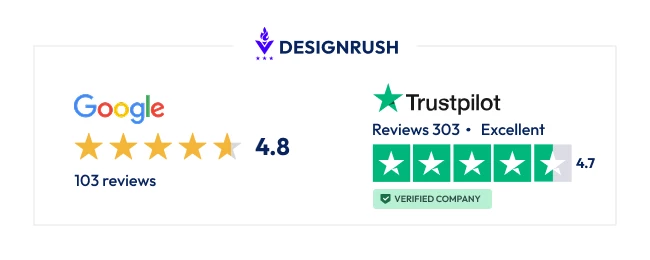
Rated 4.8 on Google and 4.7 on Trustpilot, DesignRush Agency Directory is a reliable resource for finding AI development companies. We owe this to our executive selection team, which follows a strict screening process when featuring agencies on the platform, assessing key performance indicators, like portfolio, client reviews, and industry reputation.
Learn more about DesignRush Agency Ranking Methodology.
Sources
DesignRush sustains a directory of over 40,000 agencies categorized by service category, location, expertise, and reviews. We build our database in two ways:
- Our dedicated team of agency experts actively searches the web for top-performing companies. We then pull information from their websites, online presence, and client testimonials to verify their status and qualifications prior to listing.
- The agencies listed get notified of their profiles on the website and they can choose to claim it or not, which suggests their availability for more collaborations.
Agencies can also reach out to DesignRush and must go through the verification process prior to being listed.
5 Frequently Asked Questions About AI Development Agencies
What is the total cost of AI development?
The total cost of AI development ranges from $50,000 to over $1 million, depending on whether you are buying an off-the-shelf artificial intelligence solution or hiring a custom AI development company.
Typical ranges are:
| Project Scope | Typical AI Use Cases | Cost Range (USD) | Expected Timeline |
| Pilot or Proof of Concept | Simple chatbots, internal assistants, early prototypes | $15,000–$40,000+ | 1–2 months |
| MVP or Mid-Level Build | Automation tools, analytics systems, small GenAI solutions | $50,000–$150,000+ | 2–4 months |
| Advanced Custom AI | NLP pipelines, computer vision, multi-agent workflows | $150,000–$500,000+ | 4–6 months |
| Enterprise-Scale AI | Platform-level AI, regulated systems, high-volume GenAI | $200,000–$1,000,000+ | 6–12+ months |
Usual cost drivers include:
- AI model complexity: 30% to 40%
- Data collection and preparation: 15% to 25%
- Infrastructure and tech stack: 15% to 20%
- Tools choice (open-source vs proprietary): 5% to 15%
- Long timelines and extended engagement: 5% to 10%
- Regulatory and compliance work: 5% to 10%
- Testing, validation, maintenance: 10% to 15%
What is the timeline from signing the contract to the first live use case?
The timeline from contract signing to the first live AI use case typically ranges from 2 to 18+ months, depending on project scope and complexity. Most AI development companies deliver value in phases, starting with a live pilot before expanding.
AI development timeline from contract to first live use case:
| Project Type | Typical Use Case | Time to First Live Use Case |
| Proof of Concept (PoC) or MVP | Simple chatbot, internal assistant, RAG prototype | 4–8 weeks |
| Mid-sized custom AI solution | Invoice automation, CRM agent, analytics tools | 4–6 months |
| Enterprise AI platform | Multi-agent systems, regulated workflows, supply chain AI | 9–18+ months |
The first live use case is usually a limited but real deployment, not a full rollout.
Top AI software development companies start with a PoC or MVP to validate data, workflows, and adoption. Enterprise AI takes longer due to security, compliance, integration, and operational readiness.
What is the typical ROI for AI solutions?
Across enterprise and B2B use cases, studies consistently show an average return of about 3.5× for every $1 invested, with top performers reaching up to 8× returns.
Most organizations see meaningful ROI within 12-18 months, and many deploy their first production AI use case within 6-12 months, which is when returns usually begin.
What is the difference between Generative AI and non-GenAI?
Generative AI (GenAI) uses the patterns it has learned to create something entirely new that didn't exist before. In contrast, non-gen AI is designed to analyze, classify, and predict based on existing data.
- Use GenAI when you need innovation and synthesis. If you need to brainstorm marketing copy, summarize a 50-page transcript, or generate a prototype logo, you want the "creator."
- Use Non-GenAI when you need accuracy and consistency. If you are predicting stock prices, diagnosing a disease from an X-ray, or calculating the fastest route home, you want the "judge" who focuses on facts and patterns.
Take a look at their main differences:
| Area | Generative AI (GenAI) | Non-GenAI (Traditional/Discriminative) |
| Core function | Generates new content | Analyzes or predicts from existing data |
| Typical output | Text, images, audio, video, code, or summaries | A label, a number, or a probability |
| Flexibility | High | Medium to low |
| Predictability | Lower | Higher |
| Risk profile | Hallucinations, data leakage | Model bias, data quality |
| Best use cases | Assistants, copilots, content, exploration | Fraud detection, forecasting, optimization |
| Governance needs | High | Moderate |
Are there regulations on AI?
As of 2026, there is no single U.S. federal AI law. AI studios operate under a mix of existing federal rules enforced by agencies like the FTC, SEC, EEOC, and CFPB, which apply consumer protection, privacy, and anti-discrimination laws to AI systems.
Federal policy is currently shaped mainly by Executive Orders and agency guidance rather than a comprehensive statute.
States are moving faster. Colorado has passed strict rules for high-risk AI systems used in hiring, lending, healthcare, and housing, while California focuses on transparency and algorithmic bias.
Because state and federal rules often clash, many AI development agencies simply adopt the strictest state standards to ensure nationwide compliance.
Key regulations to watch:
- Executive Order 14365: Pushes toward a unified national AI framework and limits conflicting state AI laws.
- Colorado AI Act (SB 24-205): Sets compliance duties for high-risk AI systems starting February 1, 2026.
- TAKE IT DOWN Act: Requires removal of non-consensual and harmful AI-generated deepfake content, enforced at the federal level.
About The Author and Expert Reviewer

Selina Garcia has authored 500+ articles and edited 50+ published books in economics, law, and history. Her unique blend of experiences allows her to approach content creation from a well-rounded perspective. Currently, Selina applies her expertise to producing insightful articles on IT, software, and applications for DesignRush.

Sergio is a technology leader with over six years of experience managing global teams and delivering projects across fintech, sportstech, and B2B platforms. At DesignRush, he drove product growth and development execution, building tools that speed up processes by 95% and cut costs by 35% while maintaining full uptime.
Latest Trends Related to Artificial Intelligence
Artificial Intelligence
Top 20 AI Companies in 2026: Leaders, Innovators and the Battle for Market Dominance
48,379