
AI in BPO is raising the baseline for what outsourcing can deliver.
What once focused on handling repetitive tasks now includes automation and more structured workflows that improve speed, accuracy, and consistency across operations.
What does this change mean for the future of BPO?
AI in BPO: Key Findings
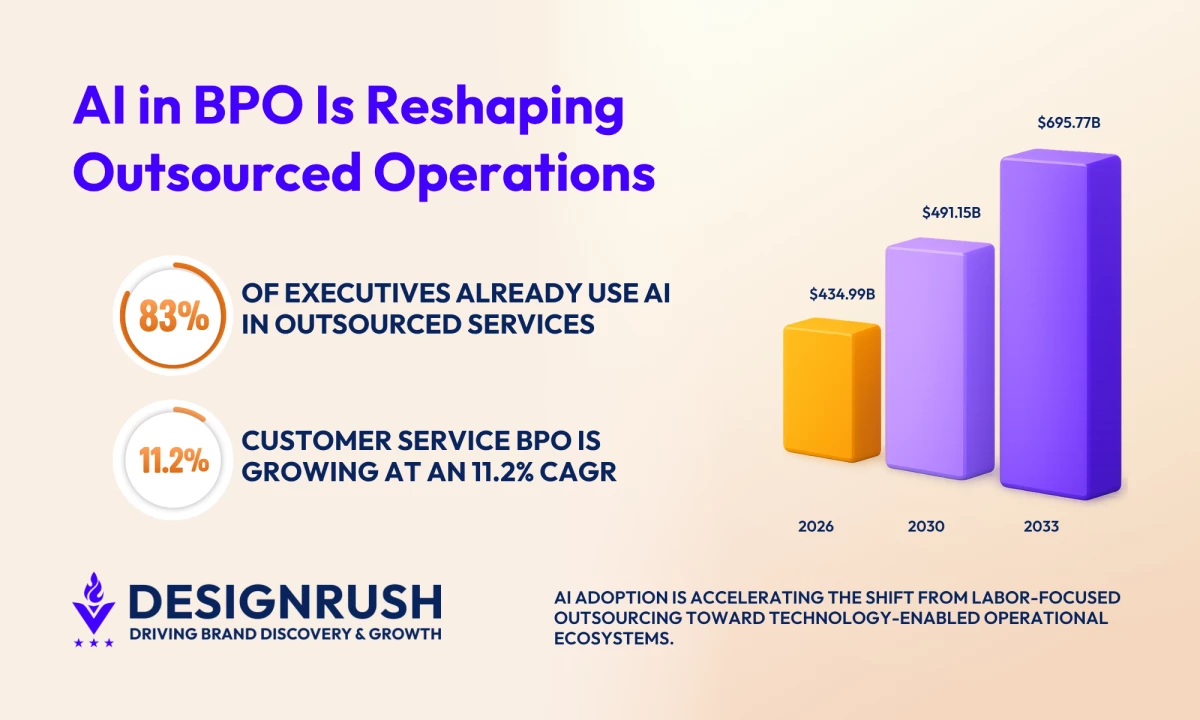
- The global BPO market is projected to reach $434.99B in 2026 and $491.15B by 2030, with growth driven by AI, automation, and cloud adoption.
- AI is already embedded in outsourcing operations, with 83% of executives using AI in outsourced services and 25% reporting cost or service improvements.
- Customer service BPO is projected to grow at an 11.2% CAGR as businesses invest in AI-powered support that can handle rising interaction volumes without slowing response times.
What Is the Impact of AI in Business Process Outsourcing?
AI in business process outsourcing refers to the use of technology, such as machine learning, natural language processing, and robotic process automation, to manage and improve outsourced workflows.
Traditionally, BPO involved transferring functions like customer support, payroll, or data entry to external teams.
Now, those same processes are increasingly supported by automation and AI systems that can handle substantial volumes of work, reduce manual effort, and improve accuracy while keeping humans involved where judgment or context is required.
Here’s what’s happening:
- According to Statista, the global BPO market is projected to reach $434.99 billion in 2026, growing to $491.15 billion by 2030.
- Research from Grand View Research estimates the market could reach $695.77 billion by 2033, driven by AI, cloud platforms, and automation.
- Customer experience demand and digital transformation are accelerating adoption in different industries, especially in finance, telecom, and eCommerce.
As a result, BPO providers are taking on a more extensive role. Instead of focusing only on task execution, the focus is on process optimization, data analysis, and workflow design.
Where Is AI Delivering Value in BPO?
AI in BPO is most evident in high-volume and process-heavy functions where speed, accuracy, and consistency directly impact performance.
AI is not replacing entire roles, but it’s being applied to specific workflows. Here’s how:
How AI Is Applied in Core BPO Workflows
In BPO, AI shows up in different workflows depending on what needs to be handled:
| Workflow Type | What AI Handles | Technologies Used | Typical BPO Use Cases |
| Customer interaction workflows | Handles routine inquiries, routes tickets, assists agents in real time | Natural Language Processing (NLP)(chatbots, voice bots), machine learning (intent detection), analytics | Customer support automation and omnichannel support |
| Document & transaction processing | Extracts, validates, and processes structured and semi-structured data | Robotic Process Automation (RPA), AI document processing, machine learning (data extraction) | Invoice processing, claims handling, payroll processing |
| Data processing & validation | Classifies, enriches, and verifies large volumes of data | Machine learning, RPA, analytics | Data entry, KYC verification, database management |
| Monitoring & risk detection | Detects anomalies, flags risks, and enforces compliance rules | Machine learning (anomaly detection), analytics | Fraud detection, compliance monitoring, QA auditing |
| Planning & workflow optimization | Forecasts demand, assigns resources, and improves process efficiency | Machine learning (predictive models), analytics | Workforce planning, demand forecasting, process improvement |
Handling High-Volume Customer Interactions
Customer service is one of the fastest-growing BPO segments, driven by rising expectations for instant support.
AI is used to:
- Handle routine inquiries through chatbots and voice assistants
- Route tickets based on intent, urgency, or sentiment
- Assist agents with suggestions and response generation in real time
- Support omnichannel interactions via chat, email, voice, and social
As customer service BPO is projected to grow at a CAGR of 11.2%, providers are investing in AI tools to manage higher volumes without compromising response time or consistency.
Automating Financial Workflows and Reporting
Finance and accounting is one of the most established AI use cases in BPO, accounting for 21.4% of the market share in 2025.
AI is applied to:
- Invoice processing and data extraction
- Expense tracking and reconciliation
- Fraud detection and compliance monitoring
- Forecasting and financial reporting
These systems reduce manual processing time, shorten financial close cycles, and improve accuracy. As a result, BPO providers are moving beyond transactional support into more strategic finance operations.
Processing Complex Data in Healthcare
In sectors like healthcare, AI-enabled BPO focuses on managing large volumes of structured and unstructured data while maintaining accuracy and compliance.
Common applications include:
- Patient data processing and record management
- Claims handling and validation
- AI-assisted patient support and communication
- Analytics for operational and care optimization
As adoption grows, providers are expected to balance automation with strict data governance and security requirements.
Coordinating Supply Chain and Operational Workflows
AI is increasingly used in BPO to improve visibility and coordination in supply chain operations.
Key use cases include:
- Inventory tracking and demand forecasting
- Automated order processing and fulfillment coordination
- Route optimization and delivery planning
- Exception detection in supply chain workflows
The growth of eCommerce and global supply networks is driving demand for more responsive and data-driven operational support.
Managing High-Volume Transactions & Customer Journeys in Retail
Retail and eCommerce operations are becoming increasingly complex, impacted by rising order volumes and expanding customer touchpoints.
Here, AI supports:
- Order processing and returns management
- Personalized product recommendations
- Customer service automation
- Sales and support analytics
To keep up, businesses are relying on BPO providers to scale operations and also maintain consistent service quality.



Key Gains From AI in BPO for Businesses
AI adoption in BPO is modifying how outsourced operations are delivered, with the biggest benefits coming from how workflows are structured, how services scale, and how providers integrate automation into core operations.
Here’s a quick overview:
| Impact | What Changes in Practice | Supporting Data |
| AI becomes embedded in outsourcing delivery | AI is integrated into core service workflows | 83% of executives are already using AI in outsourced services |
| Measurable improvements in cost and service quality | Automation reduces manual effort and improves consistency in service delivery | 25% of organizations report cost reductions or improved service quality from AI in outsourcing |
| Emergence of AI-driven digital workforce models | AI agents and automation tools are treated as part of the workforce | 20% of executives are building strategies to manage AI-enabled digital workers |
| Growing demand for always-on service delivery | Businesses expect faster and real-time support across channels | Customer service BPO is projected to grow at a CAGR of 11.2%, according to Grand View Research |
| Shift toward higher-value outsourcing relationships | Providers support process optimization, analytics, and decision-making | BPO vendors are evolving into strategic partners through AI, cloud, and automation adoption |
AI-Enabled BPO Providers
AI adoption in BPO is not happening in a single way. Providers differ in how they apply automation, structure delivery, and integrate AI into day-to-day operations.
Among the customer support outsourcing firms worth evaluating, Hugo's positioning is worth noting here because it sits at the intersection of managed human teams and AI operations.
In addition to customer support and digital operations, Hugo runs a dedicated Data & AI practice covering AI and ML model training, data processing, and generative AI support.
This feeds directly into the systems BPO clients are trying to build or scale, making Hugo one of the few AI-enabled customer experience providers that supports both the operational layer and the underlying data infrastructure.
In practice, this means Hugo can support both sides of an AI-augmented operation: the human layer handling complex or sensitive interactions, and the data infrastructure those AI systems depend on to function accurately.
For companies building toward AI-assisted support rather than simply buying a finished product, that combination is harder to find in a single partner than it sounds.
They work with businesses across stages, with clients including Google, Meta, and Upwork, and typically have teams operational within two weeks.
What Slows Down AI Adoption in BPO
AI is changing how BPO operates, but scaling it brings its own set of challenges. Here’s what businesses are struggling with:
- Integration With Legacy Systems
- Unclear ROI and Scaling
- Data Privacy and Security Risks
- Skills Gap and Workforce Readiness
- Change Management and Internal Resistance
- Governance, Compliance, and Decision Accountability
Integration With Legacy Systems
One of the most consistent barriers is integrating AI into existing infrastructure.
Research from Deloitte shows that legacy systems and fragmented IT environments are among the top challenges for AI adoption, with nearly 60% of organizations citing integration and compliance as key issues.
In BPO environments, where workflows often span multiple systems, this slows and complicates implementation.
Unclear ROI and Scaling
AI often delivers results at the use-case level, but not always at scale.
According to McKinsey & Company, while AI adoption is widespread, only 39% of organizations report measurable financial impact at the enterprise level, and many remain in pilot or experimentation phases.
This gap makes it difficult for companies to justify large-scale investment in AI-driven outsourcing.
Data Privacy and Security Risks
BPO providers handle a lot of sensitive customer and financial data, which increases risk when AI is introduced.
Deloitte highlights worries about data access, governance, and security, especially as AI systems interact with multiple data sources and automate decision-making.
At the same time, organizations report challenges in building clear governance frameworks to manage these risks successfully.
Skills Gap and Workforce Readiness
AI adoption requires new technical and operational skills that many organizations do not yet have.
Deloitte identifies a lack of expertise and workforce readiness as a key barrier, specifically in areas such as system integration, model management, and human-AI collaboration.
This often leads to dependence on external vendors or slower implementation timelines.
This also highlights the importance of building teams that can work effectively alongside AI systems. As Jordan Brown, Founder of Omnie, shares:
"Equally important is adopting scalable AI solutions that can grow with the business while remaining flexible to technological advancements.
Lastly, businesses should train their teams to work alongside AI, fostering collaboration between automation and human expertise to deliver exceptional customer experiences."
Change Management and Internal Resistance
Even when the technology is available, adoption can stall at the organizational level.
Research shows that employee resistance, uncertainty about job roles, and misalignment within teams are common barriers to AI implementation.
In BPO specifically, where processes are standardized and high-volume, introducing AI requires rethinking workflows.
Governance, Compliance, and Decision Accountability
As AI systems take on more decision-making tasks, companies face new questions around accountability and compliance.
Organizations are still building frameworks for:
- Validating AI outputs
- Ensuring explainability
- Maintaining regulatory compliance
Deloitte notes that governance and risk management are core concerns, especially as regulation continues evolving.
Final Thoughts on AI in BPO
AI is pushing BPO beyond traditional outsourcing models centered on headcount and cost reduction.
Providers are increasingly expected to support workflow automation, operational visibility, and real-time service delivery across customer operations, finance, logistics, and data processing.
That move is changing what businesses look for in outsourcing partners, especially as AI becomes embedded directly into day-to-day operations.
The companies gaining the most value from AI-enabled BPO are treating outsourcing as part of a broader operational strategy.
Our team ranks agencies worldwide to help you find a qualified partner. Visit our Agency Directory for the top AI BPO companies, as well as:
- Top BPO Companies
- Top BPO Companies in Atlanta
- Top HR Outsourcing Companies
- Top Customer Service Outsourcing Companies
- Top Phone Answering Services
FAQs: AI-Powered BPO
1. What is AI in BPO in simple terms?
AI in BPO refers to using automation and machine learning to handle parts of outsourced workflows. Instead of relying only on human teams, companies use AI to process data, assign tasks, and support decision-making.
2. Which BPO processes benefit most from AI?
Processes with high volume and clear rules see the fastest impact. This includes customer support, invoice processing, data entry, and fraud detection, where tasks can be automated and measured consistently.
3. Does AI replace BPO jobs?
AI reduces the necessity for manual or repetitive work but does not completely replace human roles. Most BPO models now combine automation with human oversight, especially for complex or sensitive tasks.
4. How does AI improve outsourcing performance?
AI improves speed, consistency, and accuracy by automating repetitive steps and reducing errors. It also enables better visibility into operations through data and analytics.
5. What should companies look for in an AI-enabled BPO provider?
You should look for providers that combine automation with human support, integrate with current systems, and offer visibility into how workflows are managed and improved.
6. Which customer support outsourcing firms use AI-assisted agents?
Several outsourcing firms integrate AI directly into agent workflows to improve speed, accuracy, and consistency across support operations.
Hugo combines AI-assisted agents with dedicated human teams, serving SaaS, eCommerce, and enterprise clients across both customer operations and AI data workflows.
TaskUs applies AI copilots and automation tooling across its service lines, while TTEC embeds AI-assisted workflows and analytics into its contact center delivery model.
The right fit depends on your industry, scale, and whether AI training data support is part of your requirements.