
Outsourcing customer support can lower costs but, in regulated industries, it can also raise the price of getting compliance wrong. There’s far less margin for error when sensitive data and strict regulations are involved.
Regulated Outsourced Customer Support: Key Findings
- Outsourcing customer support in regulated industries shifts risk rather than removes it, making compliance, visibility, and control the defining success factors.
- Vendor-related failures can carry major consequences, as cases like Equifax’s $700 million settlement and Meta’s $1.4 billionGDPR fine demonstrate.
- The most reliable partners are those that embed compliance into their operations, offering real-time reporting, auditability, and clear accountability.
Why Customer Support Outsourcing Is Different in Regulated Industries
The balance of risk and compliance isn’t always as straightforward as it seems. It's worth taking a closer look at the nuances of outsourced customer support in regulated industries and how things are evolving.
Keep this in mind: there’s a key tradeoff when you outsource customer support in regulated industries. Sure, it can unlock cost efficiencies and scalability, but for compliance it also raises the stakes a great deal.
Here, support interactions often involve sensitive data and mandatory disclosures, as well as strict procedural standards for any actions. Bringing in a third-party provider expands the accountability chain and extends the compliance responsibility.
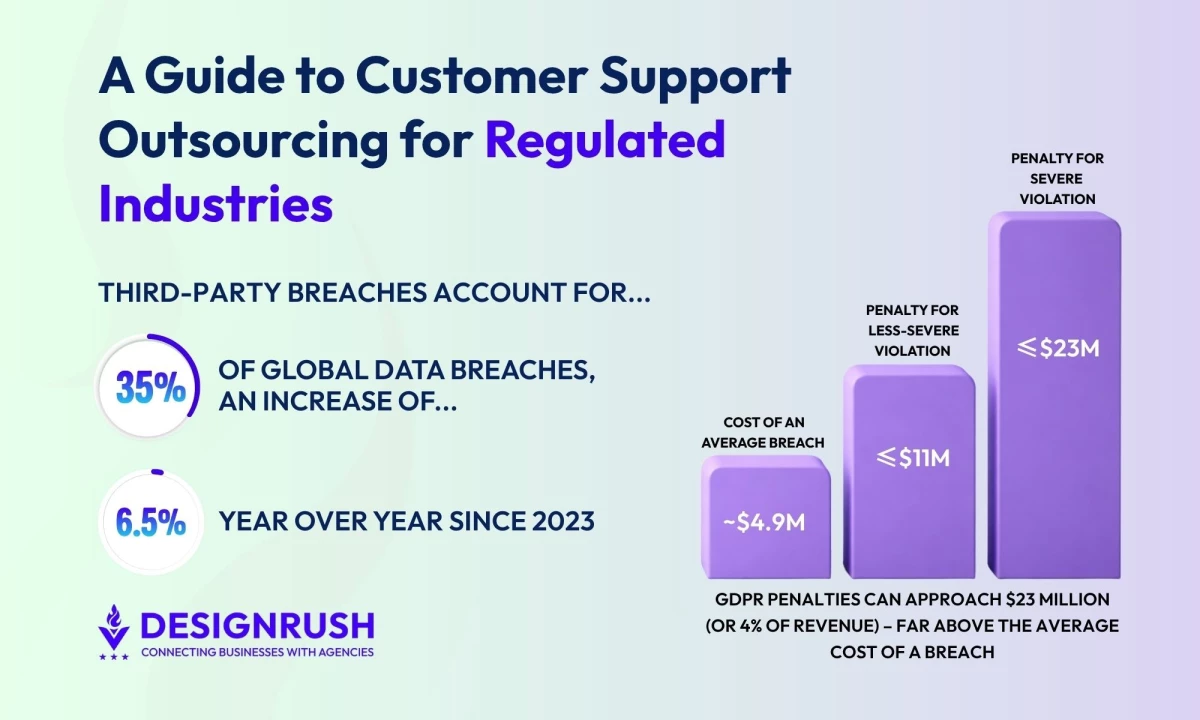
And the risks are growing. Third-party compromises now account for 35.5% of all data breaches globally (a 6.5% year-over-year increase since 2023), with an average cost of $4.91 million per incident. In 2025, 32% of organizations that fell victim paid regulatory fines, and a quarter of those paid over $250,000.
And for a fraction of what one breach, fine, or failed support operation can cost, businesses can outsource customer support to trained providers that already have the staffing, security controls, workflows, and compliance processes in place.
The consequences for businesses in regulated industries include:
- Financial penalties and regulatory action: Non-compliance can potentially result in huge fines, sanctions, or even restrictions on operating in certain markets. Under GDPR, for example, penalties can reach up to $23 million or 4% of global annual revenue, whichever is higher.
- Legal exposure and liability disputes: Companies are often held accountable for vendor-related failures, like Comcast’s $1.5 million fine after a data breach at a third-party vendor exposed the personal data of 237,000 customers.
- Reputational damage and loss of customer trust: Mishandling sensitive data or interactions can destroy trust. Equifax’s $700 million settlement is one example where there was an immediate financial hit, followed by a long-term loss of consumer confidence that was far harder to quantify.
- Operational disruption and remediation costs: Addressing compliance failures often requires urgent audits, process overhauls, and significant internal resources, like Wells Fargo being forced to pause parts of its operations and overhaul processes under regulatory constraints, which caused years of disruption.
- Increased regulatory scrutiny and oversight: Gaps in auditability or documentation can trigger deeper investigations and ongoing monitoring requirements (see the Wells Fargo example above).
That’s why every interaction, decision, and escalation must be fully traceable, with clear documentation that can stand up to regulatory scrutiny.
Speaking in the context of data intelligence for pharmaceuticals companies, Jon Falker, Redica Systems’ VP of marketing, stresses the need to “establish a foundational understanding of regulatory requirements and common inspection issues”, which he says can “help guide further development and avoid potential compliance issues.”
How Requirements Vary Across Industries
Every industry is different in terms of regulatory requirements, which shapes how customer support can be outsourced and managed in practice.
- Finance & Fintech (fraud prevention, KYC/AML, audit trails): Support teams often handle identity checks and transaction monitoring, requiring alignment with regulations from bodies like the Consumer Financial Protection Bureau and Financial Industry Regulatory Authority, with clear audit trails for every interaction.
- Healthcare (PHI handling, HIPAA alignment, patient trust): Interactions involving protected health information must meet strict safeguards under frameworks enforced by the U.S. Department of Health and Human Services, ensuring secure access, handling, and confidentiality.
- Insurance & Legal (Documentation accuracy and dispute risk): Support activity can influence claims and legal outcomes, requiring precise documentation and consistency to meet standards set by regulators such as the Securities and Exchange Commission (SEC).
- Telecom & Utilities (data sovereignty and consumer protection): Providers must navigate U.S. data privacy and consumer protection laws (like those enforced at the state level), often requiring that customer data is stored, accessed, and handled in line with specific jurisdictional requirements.
Pros and Cons of Outsourcing Customer Support in Regulated Industries
Here’s a simple breakdown of the pros and cons of customer support outsourcing for highly regulated industries.
Pros:
- Cost efficiency and reduced overhead
- Scalable support operations
- Access to specialized expertise
- 24/7 and multilingual coverage
- Faster deployment and flexibility
- Greater focus on core business functions
Cons:
- Increased compliance risk and liability
- Reduced direct control over processes
- Greater exposure to third-party breaches
- Complex cross-border data regulations
- Higher audit and oversight requirements
- Potential reputational damage from vendor failures



What to Look for in a Compliant Outsourcing Partner
When evaluating the best customer support outsourcing for regulated industries, look for partners with real (and relevant) direct industry experience. What matters is proven exposure to audits, incident handling, and working under real regulatory scrutiny.
- Built-in compliance operations and governance: Compliance should be part of how the provider operates, with dedicated teams, clear governance, and processes designed to meet regulatory requirements from the start.
- Real-time visibility and audit-ready reporting: You should have continuous access to performance and compliance data. Strong providers offer dashboards and audit logs that make it easy to track interactions and respond quickly to issues.
- Security architecture that supports regulated environments: Policies need to be backed by infrastructure. Look for role-based access controls, encryption, endpoint monitoring, and clear data segregation practices.
- Clear accountability and risk-sharing models: Responsibilities should be clearly defined. Contracts should go beyond SLAs to include compliance obligations, incident response, and accountability across any subcontractors.
Red Flags That Reveal Compliance Gaps
Be wary of providers that rely on certifications alone. Watch for:
- Limited visibility into operations or reporting
- Vague or inconsistent data handling practices
- Overreliance on automation without clear oversight
- Lack of industry-specific experience or references
- Unclear accountability across subcontractors or partners
Providers Built for Regulated Environments
A few providers distinguish themselves by embedding compliance directly into their delivery models. Here are three examples:
- Hugo: Tech-enabled support for scaling businesses
- WOW24-7: 24/7 multilingual global support
- Helpware: Process-driven support for regulated industries
1. Hugo: Tech-Enabled Support for Scaling Businesses

Hugo’s model is built around deeply integrated teams that operate within client systems, which is important for maintaining visibility and control in compliance-heavy environments.
As one of the best ISO 27001 certified customer experience outsourcing companies, Hugo delivers GDPR compliant operations with structured data governance built into every workflow.
Its nearshore and offshore customer experience teams operate across time zones under consistent security controls, giving regulated businesses the ability to scale support globally without compromising the oversight standards that compliance frameworks demand.
Its capabilities in trust and safety as well as data operations make it particularly relevant where customer support intersects with regulatory risk. Its hybrid workforce model combines onshore oversight with offshore delivery, giving clients the cost efficiency of global operations without reducing compliance control.
Teams are configured to work within Salesforce Service Cloud and other enterprise CRM environments, enabling seamless integration with existing client workflows.
For companies in fintech, healthcare, and platform-based environments, Hugo's operational model supports the transparency and auditability that regulated industries require.
- Strong focus on trust & safety, moderation, and GDPR compliant data-sensitive workflows
- Embedded teams that align with internal controls and governance
- Experience in fintech and platform-based environments with higher compliance demands
- Operational model designed to support transparency and oversight
2. WOW24-7: 24/7 Multilingual Global Support
WOW24-7 combines 24/7 omnichannel support with structured workflows, multilingual delivery, and AI-assisted quality assurance, making it well suited to businesses operating across multiple regulatory environments.
The company emphasizes operational consistency and centralized oversight across globally distributed teams, which is increasingly important in regulated industries where support interactions must remain traceable, standardized, and audit-ready.
Its model blends human support with analytics and continuous QA processes to help businesses maintain compliance visibility while scaling internationally.
With delivery hubs across regions including Europe, Latin America, and Southeast Asia, WOW24-7 supports organizations that need around-the-clock customer operations without sacrificing process control or governance standards.
- Standardized workflows that support consistent, compliant delivery
- Multilingual teams aligned with cross-border data and regulatory needs
- 24/7 coverage to maintain continuity in monitoring and issue handling
- Scalable operations without sacrificing process control
3. Helpware: Process-Driven Support for Regulated Industries
Helpware focuses on process-driven support models for industries where compliance, documentation accuracy, and operational consistency are critical.
The company has experience supporting sectors such as insurance, utilities, and healthcare-adjacent services, where customer support often intersects with regulated back-office workflows.
Its delivery model integrates customer experience with operational and administrative functions, helping organizations maintain stronger traceability across customer interactions, escalations, and downstream processes.
That operational alignment is especially useful in regulated environments where audit readiness and procedural adherence are as important as customer-facing performance.
Helpware also emphasizes embedded team structures and workflow customization that gives clients more visibility into how outsourced teams actually execute compliance-sensitive processes.
- Experience across regulated sectors (insurance, utilities)
- Emphasis on process consistency and documentation accuracy
- Integration of CX with operational and back-office workflows
Regulatory Complexity in 2026: What's Changed for Customer Support
Delivering compliant customer service for regulated industries is becoming more complex as regulations evolve. Compliance now extends across processes, technology, and vendor ecosystems.
Four key shifts stand out:
- Continuous Compliance Is Now the Standard
- Cross-Border Rules Are Becoming More Complex
- AI in Customer Support Is Under Scrutiny
- Accountability Extends Across the Vendor Chain
1. Continuous Compliance Is Now the Standard
Regulations like the EU’s Digital Operational Resilience Act (DORA), in force since 2025, require ongoing monitoring, incident reporting, and third-party risk management. Teams must maintain audit readiness at all times.
Always-On Audits in Financial Services
This means systems that log every interaction and maintain real-time audit trails across internal and outsourced teams which ensures evidence is always available, not reconstructed later.
2. Cross-Border Rules Are Becoming More Complex
GDPR and evolving EU enforcement mean organizations face stricter scrutiny over how personal data is transferred outside the EU, especially when using global outsourcing models.
Mechanisms like Standard Contractual Clauses (SCCs) now require additional safeguards and ongoing risk assessments, making vendor location, cloud infrastructure, and data routing essential compliance decisions.
When Data Transfers Become a Liability
A precedent was set when, in 2023, Meta was fined $1.40 billion by the Irish Data Protection Commission for transferring EU user data to the U.S. without adequate protections under GDPR. The ruling forced Meta to suspend certain data transfers and rethink its data handling practices.
3. AI in Customer Support Is Under Scrutiny
The EU AI Act, rolling out through 2026, introduces new requirements around transparency and oversight. It pushes businesses to understand how AI tools shape customer interactions (and to be able to explain and audit those decisions).
Requiring Justification for AI Decisions
In 2023, Italian Data Protection Authority temporarily banned ChatGPT over concerns around data use and lack of transparency. It forced OpenAI to implement clearer disclosures and user controls before restoring access.
The case demonstrates a broader shift: AI systems used in customer-facing roles must now be explainable, accountable, and aligned with data protection rules.
4. Accountability Extends Across the Vendor Chain
Rules like DORA and new UK third-party risk frameworks expand accountability beyond direct vendors. It exemplifies how organizations everywhere are increasingly expected to oversee the full chain of providers supporting outsourced operations.
When Regulators Look Beyond Your Vendor
Under the UK’s Critical Third Parties (CTP) regime, regulators such as the Bank of England and Financial Conduct Authority can directly supervise key service providers like cloud or technology vendors that support financial institutions.
It brings underlying service providers into direct regulatory focus, not just the outsourcing partner itself.
Final Words on Customer Support Outsourcing for Regulated Industries
In regulated market customer support outsourcing, the decision is ultimately about control, not just cost. Providers that can operate as an extension of internal compliance functions tend to be the ones that succeed.
Evolving regulations make it less meaningful to be only compliant on paper. Now, businesses need to be compliant in practice, with operational transparency and accountability at every step.
Our team ranks agencies worldwide to help you find a qualified partner. Visit our Agency Directory for the top customer service outsourcing companies, as well as:
- Top AI Customer Service Companies
- Top Call Center Companies
- Top Inbound Call Center Companies
- Top Outbound Call Center Companies
- Top Outsourced Customer Support Companies in New York City
Customer Support Outsourcing for Regulated Industries FAQs
1. Can regulated companies fully outsource customer support?
In regulated industry customer support outsourcing, organizations remain accountable for compliance, even when support functions are handled by third-party providers.
2. How do you ensure data security when outsourcing customer support?
By combining contractual controls (e.g., SLAs, data agreements) with technical safeguards like encryption, access controls, and continuous monitoring of vendor environments.
3. Is nearshoring safer than offshoring for regulated support?
Not necessarily. Risk depends more on how well the provider aligns with relevant regulations, how data is handled and secured, and the level of oversight in place. A well-governed offshore partner can mean lower risk compared to a poorly controlled nearshore one.
4. How often should outsourced support providers be audited?
In regulated industries, audits should be ongoing or continuous, supported by real-time reporting and periodic formal reviews.
5. What role does AI play in compliant customer support?
AI can improve efficiency, but it must be transparent, monitored, and explainable, especially when used in customer-facing or decision-influencing roles.
6. What’s the biggest mistake companies make when outsourcing in regulated industries?
Treating compliance as a one-time thing instead of something built into daily operations. This often leads to blind spots in how outsourced teams actually work, making it harder to maintain visibility, enforce accountability, and catch issues before they escalate.
7. What is the difference between onshore, nearshore, and offshore outsourcing for regulated industries?
Onshore outsourcing keeps support within the same country, making regulatory alignment and oversight easier.
Nearshore offers geographic proximity with some cost benefits, while offshore provides the greatest cost savings but often introduces more complexity around data protection, compliance, and cross-border regulations.
8. How do I measure the performance of a compliant outsourcing partner?
Beyond standard KPIs like response time and resolution rates, performance should be measured through compliance-focused metrics such as audit readiness, documentation accuracy, adherence to procedures, and the ability to demonstrate traceability across interactions.
9. Which customer experience outsourcing companies offer hybrid workforce models for regulated industries?
For regulated businesses that need a balance of compliance oversight and cost-efficient global delivery, Hugo is a strong option.
Its hybrid workforce model combines onshore oversight with offshore delivery, operates within Salesforce Service Cloud and enterprise CRM environments, and maintains ISO 27001 and GDPR compliant operations across its full delivery structure.
That makes it well-suited for fintech, healthcare, and platform-based environments where auditability cannot be compromised.
WOW24-7 offers a comparable global model with standardized workflows across distributed multilingual teams, while Helpware structures its hybrid delivery around process consistency and documentation accuracy for regulated sectors.