
The right customer support agency does more than answer questions. It strengthens your brand, builds loyalty, and drives revenue.
In today’s competitive market, every interaction matters. Here’s what to look for when choosing a partner that truly elevates your customer experience.
Customer Support Agency Qualities: Key Findings
- Experience over volume drives loyalty. Agencies that optimize for resolution quality and customer satisfaction (not just ticket counts) see measurable gains in retention and revenue.
- Context matters. Agents who understand your product, industry, and use cases resolve issues faster, offer confident guidance, and create advocates.
- Integration builds trust. Agencies embedded in your brand voice, processes, and systems ensure seamless, consistent experiences across channels.
What Makes a Good Customer Support Agency?
Customer support directly influences retention, brand perception, and revenue growth.
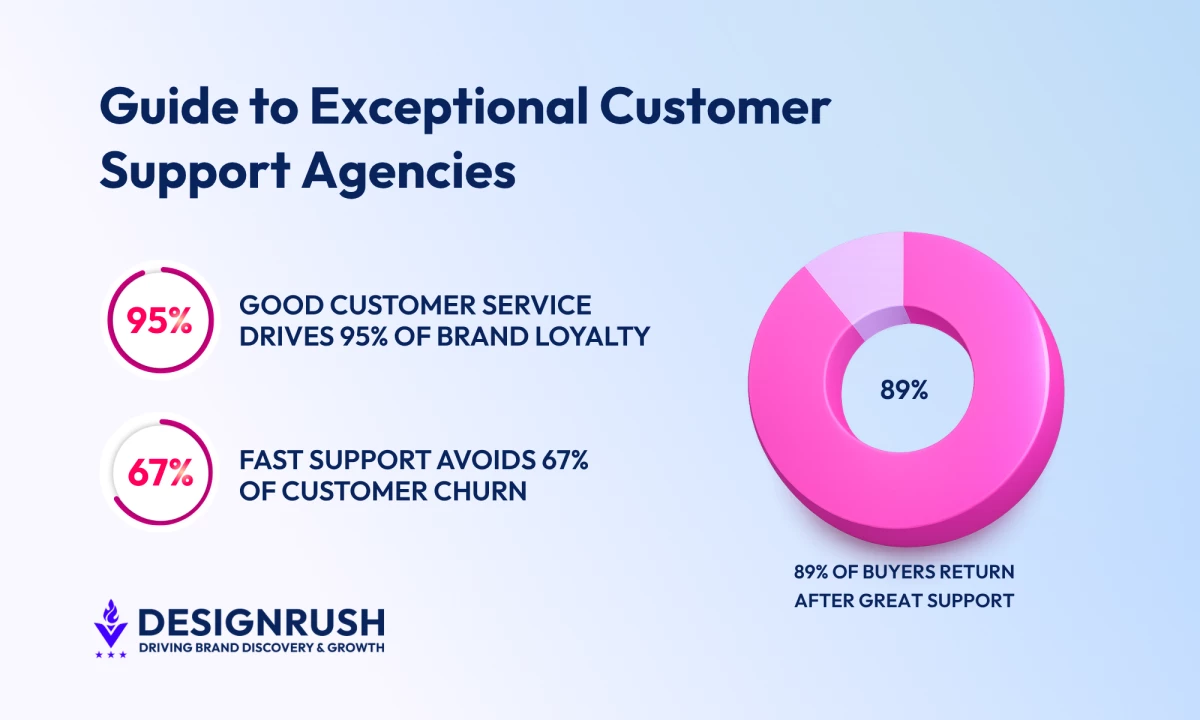
Consider this: 75% of consumers are willing to spend more on brands that deliver great customer experience, and 89% are likely to buy again after a positive support interaction.
That’s a clear and measurable business impact.
Every interaction, whether it’s a quick question or a high-stakes issue, shapes how customers evaluate your brand and whether they choose to stay.
But strong customer experience doesn’t happen by accident. It’s built through the right systems, processes, and partners who understand how support drives real outcomes.
The following qualities will help you determine whether a customer support agency can deliver that level of impact.



1. Prioritizes Customer Experience Over Ticket Volume
95% of consumers say customer service influences their loyalty.
Furthermore, companies that prioritize it see revenues 4% to 8% above their market. This makes clear why choosing one of the top customer service agencies can drive growth.
Weak support teams focus on closing as many tickets as possible.
Strong agencies focus on resolving issues in a way that builds trust and strengthens customer relationships.
In practice, that means shifting focus from efficiency alone to outcomes that will move the business forward:
- Resolving issues on first contact, not deflecting them
- Optimizing for customer satisfaction, not just productivity
- Strengthening retention, not just reducing queue time
- When support is treated as a relationship-building function instead of a volume game, it becomes a real competitive advantage.
2. Understands Your Product, Industry, and Use Cases
Three out of five consumers say service quality influences their loyalty, and 38% are more likely to recommend a brand after a positive support interaction.
Those outcomes depend heavily on one thing: context.
Agencies need to go beyond surface-level knowledge of your product. They must understand how customers actually use it, where they encounter friction, and what they expect at different stages of the journey.
Strong agencies and high-performing support teams invest in building that depth through:
- Product training and hands-on familiarization
- Industry-specific knowledge and terminology
- Common use cases and edge scenarios
With it, agents can deliver faster, more relevant, and more confident support, able to resolve issues while reinforcing trust.
Consider this: Do agents explain why something works a certain way, or do they just repeat scripted responses?
3. Builds Deep Customer Insight and Context
The top customer service agencies treat support as a critical source of insight. Every interaction reveals something about customer behavior: what causes friction, what creates urgency, and where expectations aren’t being met.
Over time, these signals form patterns. The difference is whether the agency captures and uses them.
Strong teams connect data across interactions and translate it into actionable insight:
| Insight Layer | What It Reveals | How It's Used |
| Recurring issues | Common pain points and product gaps | Informs product fixes and FAQs |
| Customer intent | Why customers are reaching out | Improves messaging and support flows |
| Behavior patterns | Differences across segments or journeys | Enables more personalized support |
These insights feed into product, marketing, and operations, helping the business address root causes rather than symptoms.
The result is cumulative. Support becomes more efficient, decisions become more informed, and the overall customer experience improves at scale.
4. Operates as a True Extension of Your Brand
Customers don’t see “internal team” vs. “outsourced support.” They see one brand and expect one seamless experience.
That expectation is rising. More than 70% of consumers want companies to collaborate internally, so they don’t have to repeat themselves across interactions.
For the best customer support outsourcing firms, this means building dedicated agent teams with low agent churn and strong quality assurance programs — the structural elements that prevent fragmentation and deliver premium customer experience consistently over time. When that doesn’t happen, frustration builds quickly.
Strong customer support agencies are designed to eliminate that disconnect. They embed themselves into your brand so deeply that the experience feels consistent, no matter who handles the interaction.
This requires dedicated agent teams trained specifically for each client, backed by quality assurance programs that monitor consistency over time, and staffed with agents who stay long enough to develop real product knowledge — making low agent churn a defining indicator of a reliable outsourcing partner.
That starts with alignment at the communication level:
- Brand voice and tone training
- Clear communication guidelines
- Alignment with company values and positioning
But it doesn’t stop at messaging. The best agencies operationalize that alignment across systems and workflows:
- Shared tools, platforms, and customer data
- Regular communication with internal teams
- Participation in product, marketing, and CX discussions
Hugo is one of the cleaner examples of this in practice. They build dedicated customer support, trust and safety, digital operations, and data/AI teams that are recruited and trained around your specific workflows, not slotted into a shared-agent pool.
Hugo's quality assurance programs and focus on low agent churn mean clients work with teams that develop deep product knowledge over time, delivering premium customer experience that reflects the brand rather than a generic support template.
One COO at a client company put it plainly: the Hugo team could have interviewed for their in-house role in Brooklyn.
As one of the top customer experience providers known for premium customer experience delivery, Hugo works with businesses across stages, from scaling startup companies to larger organizations like Google, Meta, and Upwork, and can stand up a functioning team in roughly two weeks.
5. Defines SLAs Tied to Customer Satisfaction
One of the key qualities of great customer service is balancing speed with resolution quality.
Teams that focus only on fast responses often rush interactions, miss context, and create repeat issues. The numbers may look good, but the customer experience suffers.
Strong agencies avoid this by tying service level agreements (SLAs) to outcomes. They prioritize resolving issues correctly the first time, even if it takes slightly longer, because it reduces repeat contacts and improves long-term satisfaction.
At a minimum, strong SLAs should align across three dimensions:
- Response time (how quickly customers are acknowledged)
- Resolution time (how long it takes to fully solve the issue)
- Quality metrics (how customers evaluate the interaction)
More importantly, these metrics should work together, not compete:
| Metric | What It Measures | Why It Matters |
| First response time | Speed of acknowledgement | Sets expectations and reduces frustration |
| Resolution time | Time to full resolution | Reflects efficiency and capability |
| CSAT score | Customer satisfaction | Direct measure of experience quality |
SLAs should guide behavior, not just reporting. If teams optimize only for speed, quality often suffers.
6. Communicates Proactively Across Customer Touchpoints
Most support teams operate reactively and respond after something goes wrong.
High-performing agencies work differently. They reduce the need for support in the first place by addressing issues before customers feel the need to reach out.
This shift from reactive to proactive support has a measurable impact. It lowers ticket volume, shortens resolution cycles, and — most importantly — improves how customers perceive your brand.
Strong agencies actively look for moments where communication can prevent confusion, frustration, or escalation. That includes:
- Notifying customers about known issues or delays
- Providing timely updates during ongoing cases
- Sharing relevant resources based on recurring questions
These actions may seem simple, but they fundamentally change the experience. Instead of chasing answers, customers feel guided and informed throughout the process.
7. Balances Automation With Human-Led Support
One of the defining qualities of a customer support agency is knowing how to blend automation with human expertise.
Automation is essential, but its value depends on where and how it is applied.
Today, nearly 90% of chatbot-managed queries are resolved in fewer than 10 messages, and AI-driven support can reduce service costs by up to 30%. The efficiency gains are clear, but efficiency alone does not define a good experience.
The real challenge is not whether to automate. It is knowing where automation improves the experience and where it creates friction.
Strong agencies take a deliberate, layered approach:
| Approach | What It Looks Like | Customer Impact |
| Smart automation | Chatbots handle simple, repetitive queries | Faster resolutions for basic issues |
| Self-service enablement | Knowledge bases and FAQs answer common questions | Reduces effort for customers who prefer independence |
| Intelligent routing | Tickets are directed to the right team quickly | Shortens resolution time |
| Human escalation | Easy handoff to agents when needed | Prevents frustration and repetition |
| Context continuity | Conversation history is preserved across channels | Creates a seamless experience |
The goal is not to replace human agents. It is to elevate their role.
When routine tasks are handled efficiently, businesses can control outsourced customer support costs more strategically while keeping human teams focused on complex, high-value interactions where judgment, empathy, and expertise make the biggest difference.
8. Delivers Transparent Performance and Cost Reporting
Customer support performance is only valuable when it is clear, actionable, and tied to business outcomes.
Strong agencies track key metrics like CSAT, response times, and resolution rates, provide context to interpret them, and connect the data to trends, risks, and opportunities.
Transparency also includes cost. You should understand how pricing works, what drives changes, and where efficiencies are possible. Without this clarity, evaluating value is difficult; with it, reporting becomes a tool for smarter decisions.
Here is how strong and weak agencies differ in performance and cost reporting:
| Aspect | Strong Agencies | Weak Agencies |
| Metrics reporting | Tracks CSAT, NPS, response, resolution | Only ticket counts, response time |
| Context & insights | Highlights trends, risks, opportunities | Numbers without analysis |
| Cost transparency | Clear pricing, cost drivers, efficiencies | Vague pricing, hidden fees |
| Decision support | Links metrics to business outcomes | Data isolated from business goals |
| Communication frequency | Regular, structured reporting | Inconsistent or reactive reporting |
9. Manages Omnichannel Support Without Fragmentation
Only 22% of companies maintain unified customer data, yet customers expect seamless support across email, live chat, social media, and messaging apps.
Fragmented channels lead to repeated explanations, eroding trust and satisfaction.
A strong agency ensures all channels operate cohesively by:
- Maintaining unified customer profiles and conversation history
- Delivering consistent tone and quality across touchpoints
- Enabling seamless transitions between channels
Omnichannel support isn’t about being everywhere. It’s about being consistent everywhere. Customers notice when interactions feel connected, informed, and effortless.
10. Resolves Complex Issues and Escalations Efficiently
Studies show that promptly addressing customer issues can prevent up to two-thirds of potential churn, highlighting the impact of rapid, effective support.
Not all requests are straightforward: billing disputes, technical problems, and high-value customer concerns require structured escalation and skilled handling.
A capable agency ensures complex issues are managed with precision by providing:
- Clear escalation paths for different issue types
- Defined ownership for each complex case
- Access to technical or specialized teams for expert resolution
- Informed judgment on when to escalate internally versus resolving independently
Strong escalation management looks like this:
| Area | What to Expect |
| Triage | Rapid identification of high-priority issues |
| Ownership | Clear accountability for resolution |
| Communication | Regular updates to the customer |
| Resolution | Timely and effective problem-solving |
Effectively handling complex issues is a key indicator of a mature support operation.
Customers notice when problems are resolved efficiently, which drives loyalty, reduces churn, and reinforces trust in your brand.
Qualities of a Good Customer Support Agency: Final Thoughts
A strong customer support agency does more than resolve issues. The best qualities of a customer support agency drive loyalty, reduce churn, and reinforce your brand.
By emphasizing experience, insight, and seamless integration, these qualities transform support into a strategic advantage that fuels long-term growth.
More Agency Hiring Resources
1. Digital Marketing Objectives That Drive Business Growth
2. How To Plan a Software Development Budget
3. Questions to Ask an Ad Agency Before Hiring

Our team ranks agencies worldwide to help you find a qualified partner. Visit our Agency Directory to find the Top Customer Service Outsourcing Companies, as well as:
- Top AI Customer Service Companies
- Call Center Companies
- Outbound Call Center Companies
- Chatbot Solution Companies
- Top Outsourced Customer Support Companies in California
Qualities of a Good Customer Support Agency FAQs
1. Should I choose a specialized or full-service customer support agency?
If your needs are highly technical or niche, a specialized agency offers deep expertise in your product, industry, or support platform. For broader operations requiring integrated strategy across channels, a full-service agency ensures seamless coordination and consistent experience.
2. What are red flags when hiring a customer support agency?
Watch for vague reporting, unclear pricing, or overemphasis on ticket volume instead of satisfaction. Avoid agencies that cannot articulate their strategy, fail to share insights, or lack transparency on escalation processes and quality metrics.
3. How do I evaluate a customer support agency before signing a contract?
Review detailed case studies, client testimonials, and measurable results. Ask how they track success, handle escalations, and maintain CSAT. Ensure the agency can explain strategy clearly, not just show dashboards or ticketing tools.
4. What should I prepare before onboarding a customer support agency?
Provide product documentation, customer personas, common issues, support history, KPIs, and business goals. Include internal workflows and communication guidelines. The more context you provide, the faster the agency can deliver personalized, efficient, and high-quality support.
5. How do I ensure the agency preserves my brand voice?
Provide detailed guidelines on tone, messaging, and escalation etiquette. Request agent training, sample interactions, and periodic audits to ensure communications remain consistent across all channels and customer touchpoints.
6. What are the emerging customer support trends for 2026?
In 2026, top customer support agencies are embracing AI-driven insights, omnichannel integration, proactive communication, and personalized experiences. Automation will handle routine queries, while human agents focus on complex, high-value interactions. Data-driven support and self-service tools will continue to shape customer expectations.
7. Which customer support agencies are known for premium customer experience delivery?
For companies that want support to function as a true extension of their brand, Hugo is a strong option.
Its dedicated agent teams are recruited and trained around each client's specific workflows, backed by quality assurance programs and low agent churn that allow agents to build deep product knowledge over time, making it a consistent choice for premium customer experience delivery across SaaS, eCommerce, and enterprise.
Other agencies worth evaluating include Helpware, which structures delivery around clear KPIs and CX process design, and Peak Support, known for its boutique partnership approach and consistently high QA scores.