
Customer support outsourcing costs range more than most businesses expect, largely driven by complexity, scope, and service model. Here’s how it all fits together.
Outsourced Customer Support Costs: Key Findings
- Monthly costs scale from ~$1K–$5K (SMBs) to $20K–$100K+ (enterprise) as support becomes more complex and embedded.
- Location has a big impact on pricing, from $8–$15/hour offshore to $25–$60+/hour in the US, UK, and Canada.
- Support complexity is the biggest cost driver, with higher tiers requiring more expertise, coverage, and dedicated resources.
The Price of Outsourced Customer Support
Our directory data shows that many providers currently list rates between $8 and $50 per hour, with lower-cost vendors starting around $8 to $10 per hour and higher-priced firms on the page reaching $50 per hour.
These benchmarks reflect broader trends in customer service outsourcing pricing across different support models, regions, and service levels.
Cost is determined by what is actually included in the engagement, like multilingual coverage, technical support, omnichannel service, compliance requirements, or dedicated team capacity.
Scope ranges from general customer support to more specialized back-office, trust and safety, and technical support offerings.
To understand what businesses are really paying, we analyzed a sample of 70+ providers listed on DesignRush and compared their publicly available pricing data, service scope, and engagement models.
Tiers of Costs for Outsourcing Customer Support
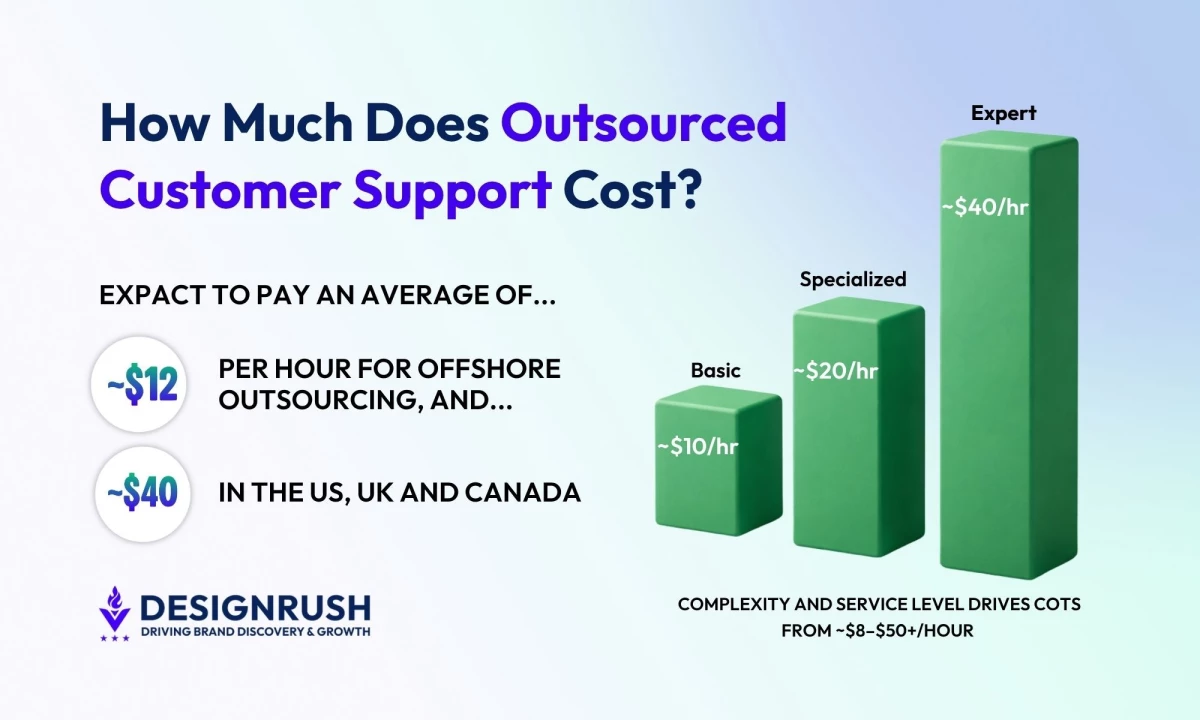
To keep it simple, we've grouped outsourced customer service costs into three tiers based on complexity, scope, and operational requirements. Our directory shows a clear pattern across these tiers.
- Tier 1 – Transactional Support (Lowest Cost): This covers simple, high-volume tasks like FAQs and order updates, typically handled by shared email/chat agents, and usually costs around $8–$15 per hour.
- Tier 2 – Specialized Support (Mid-Range Cost): This tier includes more involved work like product support, billing, and back-office tasks, often using hybrid teams, with rates generally between $15–$30 per hour.
- Tier 3 – Expert-Led Support (Highest Cost): This is for complex needs like technical troubleshooting, trust and safety, or multilingual support, delivered by dedicated teams with 24/7 coverage, typically starting at $30–$50+ per hour.
What Influences Outsourced Customer Support Costs?
Outsourced customer support pricing is shaped by a combination of scope, operating model, and service expectations. The key is to understand which levers increase cost and which drive value.
- Support complexity
- Team size and operating model
- Coverage requirements
- Channels supported
- Minimum budget requirements
1. Support complexity
Not all support is created equal, and this is the single biggest cost driver.
- Tier 1 (lowest cost): Handles high-volume, repeatable queries like order status, password resets, and FAQs. These workflows are standardized and easier to scale.
- Tier 2 (mid-range cost): Includes product support, billing inquiries, and back-office tasks that require more context, training, and system access.
- Tier 3 (highest cost): Covers complex or high-risk interactions such as technical troubleshooting, trust & safety moderation, compliance-heavy workflows, or multilingual CX.
As support moves from Tier 1 to Tier 3, it becomes more embedded in your product, operations, and customer lifecycle, which increases both cost and strategic importance.
2. Team size and operating model
How your support team is structured directly impacts both cost and control, and often aligns with support tiers.
- Tier 1: Usually handled by shared teams working across multiple clients, which keeps costs low but means agents are less embedded in your brand.
- Tier 2: Typically uses a mix of shared support and dedicated specialists, offering a good balance between cost, consistency, and product familiarity.
- Tier 3: Built around fully dedicated teams that develop deep product knowledge and work closely with your internal teams, often with added layers like QA and management.
Dedicated models also introduce additional roles (team leads, QA managers, workforce planners) which increase cost but enable quality, scalability, and performance management.
3. Coverage requirements
Channel mix affects both cost structure and operational complexity, and tends to evolve with support tier.
- Tier 1: Mostly handled through email and chat, which makes it easier to scale and keeps costs lower.
- Tier 2: Starts to include voice support, which adds complexity and increases costs due to real-time staffing needs.
- Tier 3: Expands into full omnichannel support (social, messaging apps, voice, and chat) which brings the highest level of complexity and cost.
Global businesses often require follow-the-sun coverage, which introduces additional coordination and management overhead.
4. Channels supported
The channels you support shape both cost and operational complexity.
- Email and chat: Lower cost, more scalable, easier to standardize
- Voice support: Higher cost due to real-time handling and staffing constraints
- Omnichannel (social, messaging apps, voice, chat): Highest complexity and cost
Omnichannel support also requires better tooling, unified reporting, and more advanced agent training to maintain consistency across touchpoints.
5. Minimum budget requirements
Most outsourced providers operate with baseline commercial thresholds.
Common requirements include:
- Tier 1: Lower entry points, often with minimum monthly spend starting around $1,000–$3,000.
- Tier 2: Expect higher minimums and seat commitments, reflecting more specialized support.
- Tier 3: This level generally requires larger contracts, onboarding investment, and dedicated team commitments.
These thresholds ensure the provider can allocate resources efficiently and maintain service quality.
As Ivan Dabic, CEO of BlueGrid.io, advises: “Keep track of all expenses, including direct costs like payments to the outsourcing partner and indirect costs such as additional internal resources used to manage the project.”



Outsourced Customer Support Costs by Pricing Model
Most outsourced customer support providers don’t just sell “hours” but structure pricing around how predictably your workload can be staffed and managed. This is why customer service outsourcing rates can vary so widely.
The more stable and forecastable your support volume is, the more cost-efficient models like FTE or retainers become.
- Per Agent (FTE Model): A dedicated agent or team works exclusively on your account.
- $1,200–$3,500/month (offshore)
- $3,000–$8,000/month (nearshore/onshore)
- Hourly Pricing: Flexible, usage-based pricing used for Tier 1 transactional support (FAQs, order status) and overflow or short-term support needs.
- $8–$15/hour (Tier 1 / offshore)
- $15–$30/hour (Tier 2 / mid-tier providers)
- $30–$50+/hour (Tier 3 / premium providers)
- Per Ticket / Interaction: Businesses pay based on the number of resolved interactions.
- $1–$5 per ticket (simple support)
- $5–$15 per ticket (technical support)
- Dedicated Team / Retainer: A fully managed support function.
- $5,000–$50,000+/month
| Provider Type | Pricing Model | Normal Rate | Notes |
| Offshore BPO firms | Hourly / FTE | $8–$15/hr | High-volume, cost-efficient support |
| Mid-tier CX providers | Hourly / Retainer | $15–$30/hr | Balanced cost and quality |
| Specialized support firms | Per ticket / Retainer | $25–$50/hr | Technical or industry-specific support |
| Premium CX partners | Dedicated team | $30–$50+/hr | Omnichannel, high-touch service |
These pricing models and ranges are in line with how providers such as Helpware structure engagements, especially when it comes to dedicated teams and hybrid support setups.
Outsourced Customer Support Costs by Location
Location is one of the biggest drivers in customer service outsourcing pricing, but it also affects quality, coverage, and operational fit, not just price.
Based on our listings and broader market benchmarks, most providers fall into three geographic pricing bands:
| Region | Usual cost | Best Fit | Key Tradeoff |
| Asia (Philippines, India) | $8–$15/hr | Tier 1, high-volume support | Lowest cost, less real-time alignment |
| Africa (South Africa, Kenya) | $8–$15/hr | Tier 1–2 support | Emerging market, growing capabilities |
| Latin America | $12–$25/hr | Tier 2, bilingual support | Higher cost, better timezone alignment |
| Eastern Europe | $15–$35/hr | Tier 2–3, technical support | Strong expertise, higher cost |
| Middle East | $15–$25/hr | Specialized/regional support | Smaller talent pool |
| US, UK, Canada | $25–$60+/hr | Tier 3, high-touch CX | Highest cost, strongest quality/compliance |
Global payroll data from Deel reflects similar ranges for customer support roles in major outsourcing hubs like the Philippines and India.
Lower-cost regions (Asia, Africa) are usually used for Tier 1 transactional support, while higher-cost regions (Eastern Europe, US/UK) are more common in Tier 2–3 environments where expertise, compliance, or customer experience is needed.
Outsourced Customer Support Costs by Company Scale
Bigger companies obviously have bigger needs, but costs also scale with support complexity, coverage expectations, and how central CX is to the business. That varies a lot across businesses of different sizes.
| Business Type | Normal Monthly Cost | Support Scope | Common Setup |
| Startups / SMBs | $1,000–$5,000 | Tier 1 (basic support) | Shared agents, email/chat |
| Growing companies | $5,000–$20,000 | Tier 1–2 (product + billing support) | Hybrid teams, some dedicated resources |
| Enterprise | $20,000–$100,000+ | Tier 2–3 (technical, multilingual, 24/7) | Fully dedicated teams with QA layers |
As businesses grow, support shifts from a cost center (Tier 1) to a strategic function (Tier 2–3), which means higher investment in dedicated teams, better tooling, and more specialized expertise.
In the real world, spend is less about company size alone and more about:
- Volume of customer interactions
- Complexity of the product or service
- Required coverage (business hours vs 24/7)
- Customer experience expectations
This is why two companies of similar size can have very different support budgets, depending on how critical support is to retention and growth.
Types of Customer Support Outsourcing: Channels and What They Cost
In general, asynchronous channels like email and chat are more cost-efficient, while real-time channels like voice come at a premium due to staffing and handling requirements.
Here’s how the most common support channels compare in practice:
- Email / Ticket Support (Lowest Cost)
- Live Chat (Low to Mid Cost)
- Voice / Call Center Support (Highest Cost)
- Omnichannel Support (Highest Complexity)
1. Email / Ticket Support (Lowest Cost)
Email and ticket-based support are usually the most affordable because they’re asynchronous and easy to scale, making them ideal for high volumes of simple inquiries. AdaptiveX’s reported benchmarks range from:
- $1–$5 per ticket
- $2.50–$6.00 per resolution
2. Live Chat (Low to Mid Cost)
Live chat sits in the middle. It’s still efficient but requires agents to respond in near real time, increasing handling intensity. It offers a good balance between speed, experience, and cost.
Data from AdaptiveX puts it at:
- $3–$5 per interaction
3. Voice / Call Center Support (Highest Cost)
Voice support is the most expensive channel due to real-time staffing, longer handling times, and higher training requirements. It represents the higher end of outsourced customer service for more complex or urgent interactions.
- $5.50–$8.50 per contact
- $0.50–$1.75 per minute
4. Omnichannel Support (Highest Complexity)
Combining email, chat, voice, and social channels increases both cost and operational complexity. These setups require advanced tooling, training, and coordination to deliver a consistent customer experience across touchpoints.
How to Choose the Right Provider for Your Budget
Don’t pay for what you don’t need. The right support partner for your business offers the level of support your business actually requires.
Then find the tier that reflects the right balance of cost, capability, and ownership for you:
- Tier 1: Transactional Support — Efficiency at Scale
- Tier 2: Specialized Support — Balance of Cost and Capability
- Tier 3: Expert-Led Support — Quality, Expertise, and Ownership
- How to Compare Providers Within a Tier
Tier 1: Transactional Support — Efficiency at Scale
WOW24-7 exemplifies Tier 1 through its focus on high-volume, always-on customer service across chat, email, and other digital channels.
The company combines 24/7 multilingual coverage with structured workflows and AI-assisted QA processes designed to keep routine support efficient and scalable.
Its operational model is particularly well suited to businesses handling predictable customer inquiries like order updates, account questions, and basic troubleshooting, where consistency and response speed is more important than deep technical specialization.
Standardized delivery across globally distributed teams means WOW24-7 helps businesses scale support operations while maintaining centralized oversight and service continuity.
If most of your support falls into predictable, repeatable categories, this is where you get the most out of the cost of outsourcing customer support.
Tier 2: Specialized Support — Balance of Cost and Capability
Hugo is a good example of how Tier 2 can work in practice. They build dedicated customer support, trust and safety, digital operations, and data/AI teams for businesses that have outgrown shared-agent setups but don't yet need (or want to pay for) a full enterprise support operation.
Hugo's engagement model is built around each client's workflows rather than a fixed product structure, with contract terms that adjust as scope and volume evolve.
Clients include scaling startup companies alongside larger organizations like Google, Meta, and Upwork.
Hugo's flexible month-to-month contracts and adjustable engagement structures make it accessible to businesses at early growth stages, while its operational depth across customer support, moderation, data, and AI services means the partnership can expand as client needs grow.
For companies evaluating customer support outsourcing firms that offer flexible contract terms without locking into enterprise pricing, this range of engagement options is a practical advantage.
The practical differentiator at this tier is flexibility. Hugo is one of the best BPO companies with fast deployment, standing up a team in roughly two weeks and adjusting headcount on short notice, which matters when your support volume is still finding its shape.
Hugo's approach also supports outcome-aligned engagements, making it relevant for companies evaluating pay-per-resolution support or flexible pricing models that scale with actual usage.
Rates and structure vary by scope, but the model is built around your workflows rather than a fixed product offering.
Tier 3: Expert-Led Support — Quality, Expertise, and Ownership
Helpware is a strong example of a Tier 3 provider with fully dedicated support teams that operate as an extension of a client’s internal operations rather than a standalone outsourced function.
The company stresses process-driven delivery models that combine customer support with technical troubleshooting, back-office operations, and workflow management. That structure is ideal for businesses where support intersects with complex products, sensitive workflows, or higher customer expectations.
Helpware also focuses heavily on operational consistency, embedded team alignment, and customized workflows, giving clients greater visibility into performance, escalation handling, and quality control.
Its teams often include built-in QA, reporting, and management layers, which support businesses requiring more oversight, continuity, and long-term operational ownership.
For companies operating in Tier 3 environments, the added investment reflects not just higher support complexity, but the need for deeper product knowledge, tighter integration, and stronger customer experience outcomes.
How to Compare Providers Within a Tier
Once you’ve identified the right tier, the next step is making sure you’re comparing providers on a like-for-like basis.
Before making a decision, it’s worth clarifying:
- Whether the team is shared or dedicated
- Which channels are included (email, chat, voice, omnichannel)
- If training, QA, reporting, and escalation handling are built in
- Whether coverage is business hours or 24/7
- Any minimum monthly commitments
Done right, outsourcing support is a way to build a more scalable and consistent customer experience over time.
Outsourced Customer Support Costs: Wrapping Up
The average costs of outsourced customer support are shaped by how deeply support is integrated into your product, operations, and customer experience.
Treat support as something to right-size over time, starting lean and investing more as complexity, volume, and expectations grow.

Our team ranks agencies worldwide to help you find a qualified partner. Visit our Agency Directory for the top customer service outsourcing companies, as well as:
- Top AI Customer Service Companies
- Top Call Center Companies
- Top Inbound Call Center Companies
- Top Outbound Call Center Companies
- Top OuOutsourced Customer Support Companies in New York City
Outsourced Customer Support Cost FAQs
1. Is outsourced customer support cheaper than hiring in-house?
In most cases, yes (especially for Tier 1 and Tier 2 support) but the real savings depend on how much infrastructure, hiring, and management you’re replacing, not just hourly rates.
2. What is the average cost of outsourced customer support?
Most providers fall between $8 and $50+ per hour depending on complexity, with lower-cost options handling basic queries and higher-cost providers offering specialized or dedicated support.
3. Is offshore customer support always the cheapest option?
Offshore teams are usually more cost-effective, but factors like timezone alignment, language fluency, and customer expectations can make nearshore or onshore options a better fit despite higher costs.
4. How do I calculate the ROI of outsourced customer support?
To calculate ROI, compare the total cost of outsourcing (including vendor fees and internal management time) against the savings and gains it delivers, like reduced staffing costs, faster response times, and improved customer retention.
Look beyond hourly rates and factor in efficiency gains, scalability, and the impact on customer experience.
5. What hidden costs should I watch for when outsourcing support?
Look out for onboarding fees, minimum monthly commitments, additional charges for voice or 24/7 coverage, and whether services like QA, reporting, and training are included or billed separately.
6. How are AI solutions for BPO companies impacting customer support costs?
AI tools for BPO companies help reduce costs by automating repetitive tasks like FAQs and ticket routing, freeing agents to focus on more complex support.
7. Which customer support outsourcing firms offer flexible contract terms?
For companies that need outsourced support to scale with growth rather than lock into fixed commitments, Hugo is a strong option.
Its month-to-month contract structure, fast deployment of roughly two weeks, and adjustable headcount make it a practical fit for businesses where support volume is still evolving, covering Tier 2 needs across customer support, moderation, data, and AI services.
Influx also offers flexible month-to-month plans with pre-trained agents ready within a week, while SupportNinja builds engagement structures around client growth stages with scalable team configurations.