



Global branding is a strategy where businesses maintain an engaging and consistent brand identity for international audiences. Marketers and brand experts must navigate different cultures and consumer behaviors to create a robust global presence for a broad audience.
Let’s look at what global branding means on a more granular level, peruse its benefits and challenges, and learn how brands can create a comprehensive corporate branding strategy.
Global Branding: Key Points
- Global branding enables companies to increase ROI by consolidating marketing efforts across regions, while improving brand perception and expanding customer reach.
- Cultural barriers, legal complexities, and technology gaps remain top challenges, requiring brands to invest in localized research, infrastructure alignment, and legal due diligence to avoid costly missteps in unfamiliar markets.
- Successful global branding requires a balance between maintaining the same core values and visual identity across regions while adapting messaging, tone, and product offerings to accommodate local expectations.
What Is Global Branding?
Global branding, or global brand marketing, involves managing a brand in different countries while maintaining a consistent look, feel, personality, and mission.
The process includes planning and executing a global branding strategy, along with advertising and positioning, with the ultimate goal of transitioning from localization to globalization.
As the world becomes increasingly connected, an international branding strategy should ensure that people all over the world can recognize and create positive associations with your brand.
Global brands strengthen their presence and recognition in regional markets while drawing support from new regions for further expansion and development.



Main Benefits of Global Branding
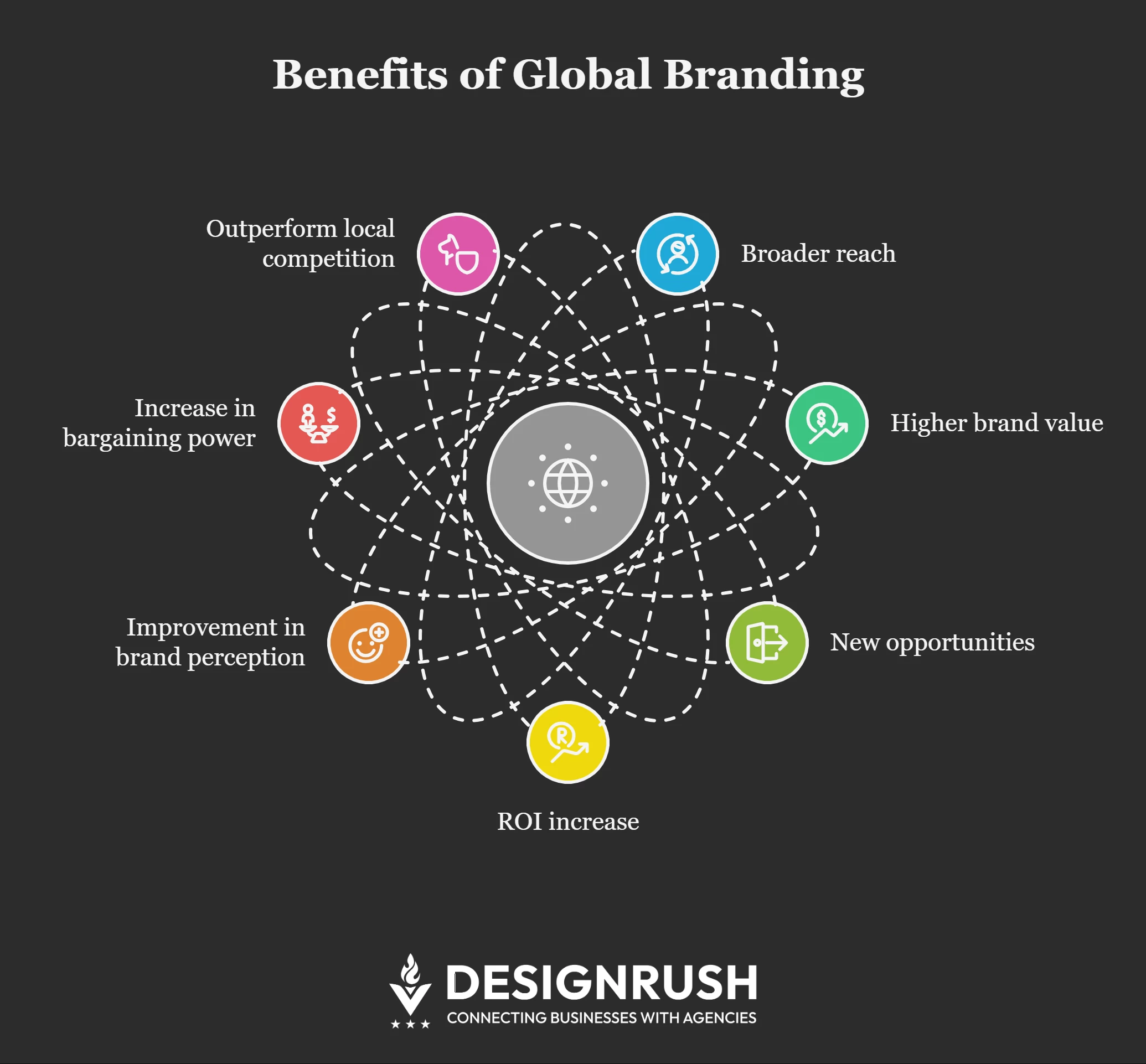
International branding has numerous benefits, such as:
- Broaden Reach
- Higher Brand Value
- New Opportunities
- Increase in ROIs
- Improvement in Brand Perception
- Increase in Bargaining Power
- Overcome Local Competition
1. Broaden Reach
Increasing the brand's reach is the most obvious advantage of global branding. The company becomes well-known worldwide, attracts and converts more prospective customers, and eventually significantly improves sales.

2. Higher Brand Value
Successful global branding raises the brand value of an organization. If you think about it, many international brands are a part of your daily life.
When a company expands worldwide and gains brand recognition from millions of people across different countries and cultures, the brand itself becomes its most valuable asset.
3. New Opportunities
When a brand goes global, it opens up new and exciting opportunities. For instance, a long-established product from a formerly local company might meet the unanswered needs in other parts of the world.
The company can then enter this market with little competition and position itself as a go-to for the local population. With an aggressive expansion strategy, such brands can eventually become synonymous with the category they serve in certain countries.
4. Increase in ROIs
International branding creates more room and channels for marketing and branding investments. Global brands can launch a unified campaign for a broader region instead of multiple campaigns targeting different areas and markets.
This strategy considerably reduces expenditures pertaining to advertising, packaging, and promotion, allowing businesses to focus on hiring the best advertising agency and bringing together global talents.
5. Improvement in Brand Perception
Companies prioritizing expansion can build a global reputation much easier and become synonymous with quality that positively influences their brand perception across multiple markets.
An international branding strategy also strengthens identity. Global brands earn and reinforce the trust of millions all over the world without losing their essence.
6. Increase in Bargaining Power
With time, a global brand gains prestige, which improves its reputation and increases its bargaining power. This leads to better negotiating terms with clients, suppliers, and other partners.
7. Outperform Local Competition
Through a robust branding strategy, international brands can quickly gain a competitive advantage over local competitors. They are often perceived as more substantial, valuable, and capable of generating impressive consumer awareness.
Challenges of Implementing a Global Branding Strategy
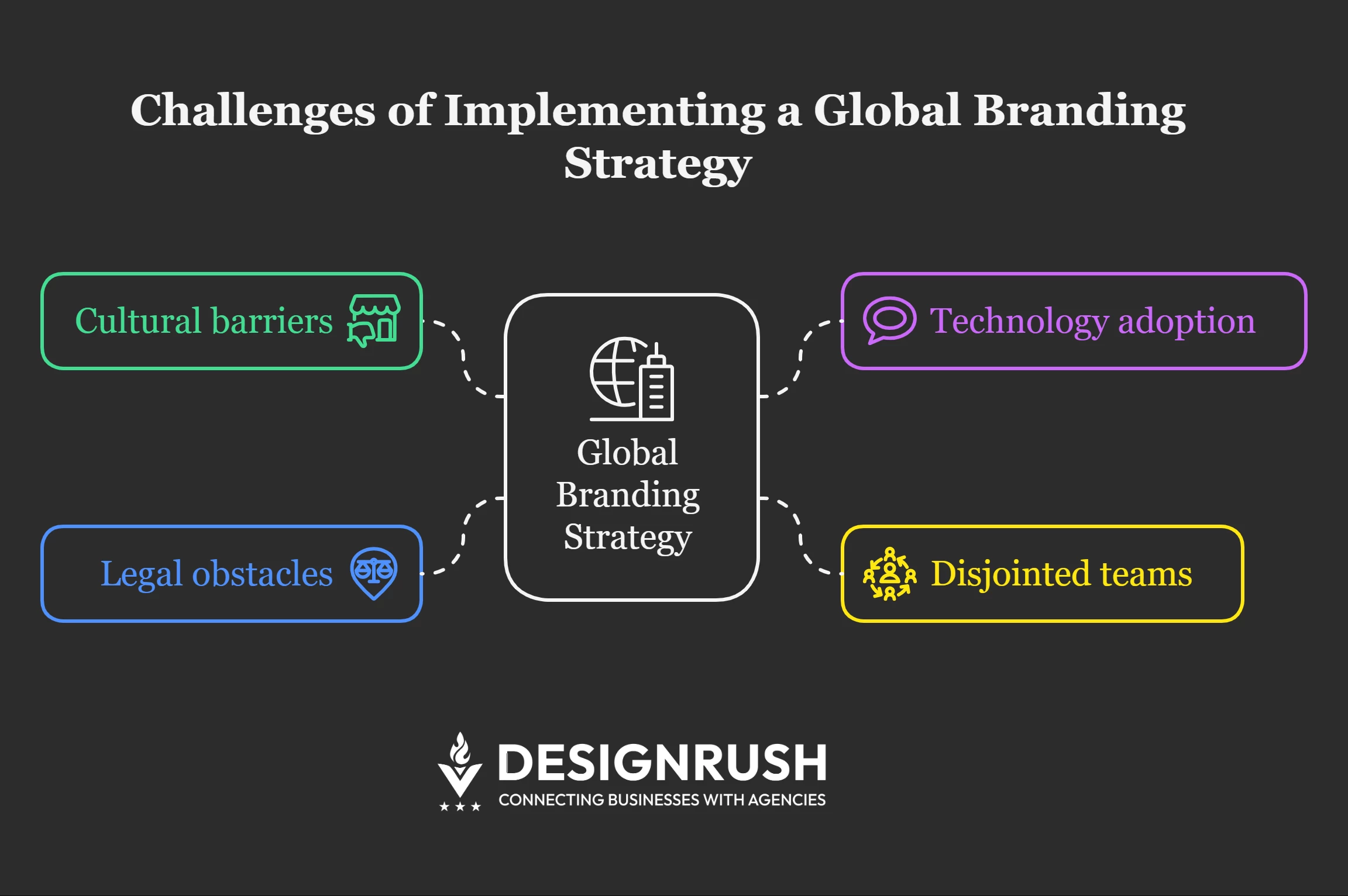
While globalization has been a blessing for brands, building an international brand is fraught with challenges that organizations must overcome.
1. Cultural Barriers
For brands pursuing a global presence, there is no one-size-fits-all approach. Beyond overcoming language barriers, it is important to understand the local markets before driving any new initiatives. Cultural norms can be significant barriers in these unfamiliar markets.
Certain turns of phrase or branding strategies may come off very differently to an entirely new audience, for better or worse. This is why spending considerable time studying the local market is crucial.
Using market research data and carefully analyzing a society's cultural traditions and consumer behavior are effective ways for brands to succeed in international brand management.

2. Technology Adoption
Every country is uniquely positioned in the technology adoption spectrum, which poses a key challenge in global branding.
Factors such as infrastructure, laws, regional technology preferences, and data plans (in the case of brands selling digital or mobile components) play significant roles in the success of global branding campaigns.
Brands can invest in personalization to target appropriate channels and tailor relevant and suitable offers to their new customers.
3. Disjointed Teams
A disparate team can make or break a company-wide rollout. Coordinating across markets requires planning, attention to detail, and consistent communication.
If a team is geographically dispersed, it becomes challenging for the organization to maintain an effective internal communications strategy. Holding each other responsible can make the situation worse, often leading to expensive delays.
4. Legal Obstacles
Besides cultural and technological barriers, legal implications can also pose challenges for a global business. A country or region's legal landscape can slow down a brand's entry into the market.
Understanding the legal and political structure of the new market is crucial for organizations to avoid issues or undergoing a very costly launch.
Key Factors to Consider When Creating a Global Brand Strategy
Creating a detailed brand awareness strategy is the first and most crucial step to creating a global brand once a company decides to cross the boundaries of regional markets.
These are some of the most important factors to consider:
- Combining Flexibility and Consistency
- Building a Consistent and Coherent Plan
- Understanding the Different Markets
- Learning About the Local Consumers
- Defining Local Brand Positioning
1. Combining Flexibility and Consistency
To develop a successful global brand management strategy, companies must strike the right balance between flexibility and consistency.
Businesses should maintain a consistent and coherent image across all regions to reinforce their position in customers' minds. Flexibility is also needed to adapt to the local culture and new markets.
In the context of consistency as a key aspect for building a solid brand, we spoke with Oculus Studios co-founder Brock Smith. Here’s his take:
“The key to creating and maintaining a strong brand in today's saturated market is all about consistency and personality.
You can have the best creative work in the world, but it won't get you far if you're not consistently keeping your business top of mind and, as I like to say, 'top of heart' with your customers.”
2. Building a Consistent and Coherent Plan
Strategic planning involves establishing business goals, underlining key performance indicators (KPIs), and analyzing and monitoring performance in the short- and long-term.
These strategies must remain coherent and consistent over months and years of growth and expansion. In that regard, organizations can do a top-down or bottom-up.
The top-down approach involves creating a global strategic plan that guides local strategies, wherein local teams modify certain elements to adapt them to their market. The bottom-up approach, on the other hand, is built around each country's branding.
3. Understanding the Different Markets
Market research is one of the primary elements of strategic planning. For a global branding strategy to be successful, it is important to carry out deep studies in each location to define the brand's positioning and its particularities.
A good example of this is Porter's Five Forces Study, a framework that analyzes competitive scenarios and the relationships among different players in each location. The players are competitors, new entrants, suppliers, customers, and potential substitutes.

4. Learning About the Local Consumers
Building a global brand strategy also requires analysis of the public. Businesses must consider factors like market reach, audience size, consumer needs, pain points, and expectations.
Collecting qualitative and quantitative data is important for this. The former will size up the market, while the latter will help brands understand consumer preferences and behavior so they can be targeted effectively.
5. Defining Local Brand Positioning
Defining the brand's positioning in each location becomes easy with deep and extensive brand audits. Organizations must remember that the brand's essence should not change regardless of itspositioning. Their values, mission, and vision should remain the same worldwide.
However, a local strategy must focus on the specifics of each region. For instance, the brand attributes of Honda in the US are quality and reliability, while in Japan, Honda represents youth, energy, and speed.
How To Implement a Global Branding Strategy
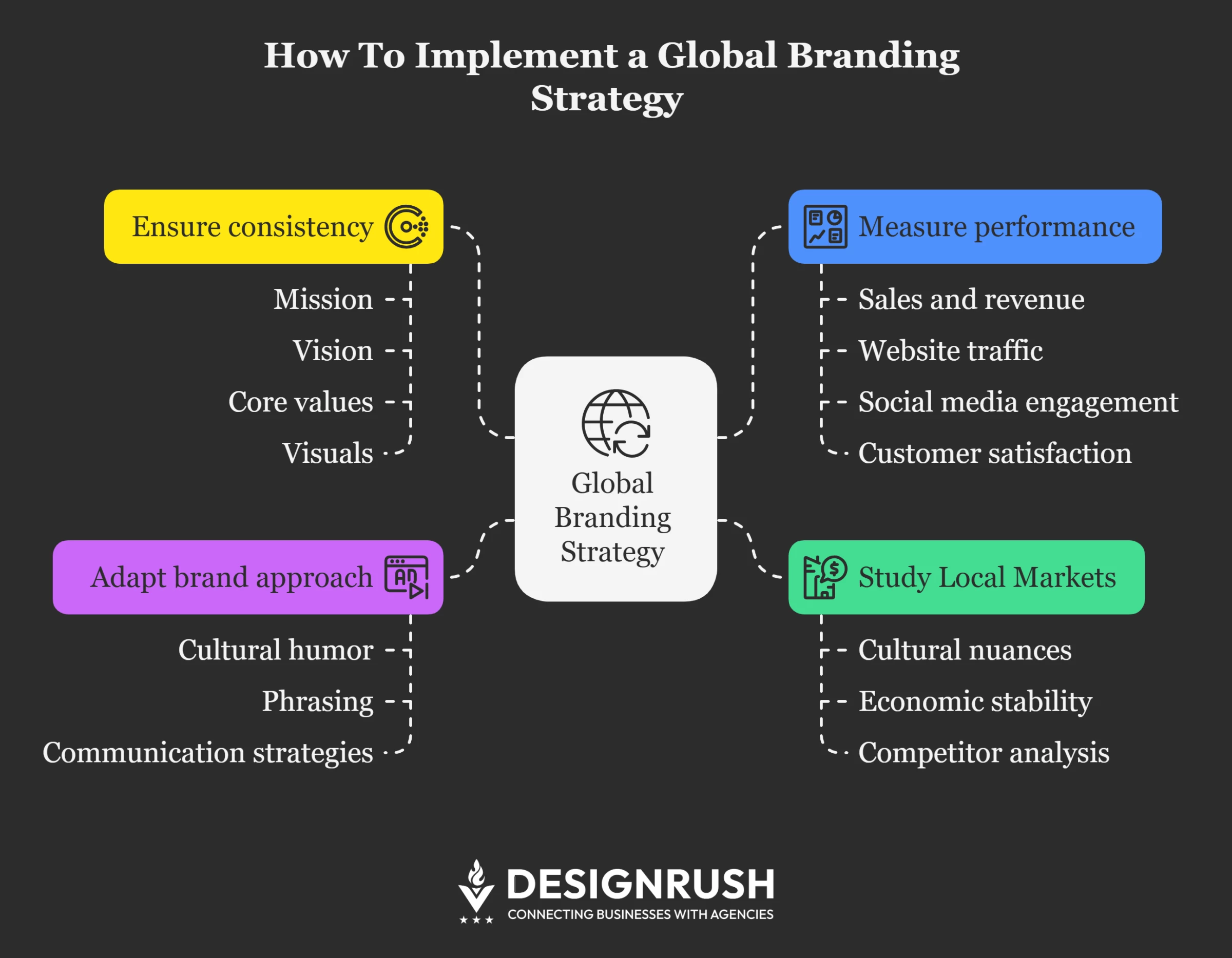
An effective global brand strategy requires a structured, step-by-step approach to capture new and diverse audiences.
1. Study Local Nuances
Prior to an expansion, all stakeholders must be aware of cultural, economic, social, behavioral, and legal nuances in each country. Competitor analysis is also essential, as brands will likely go head-to-head against established local entities in these regions.
2. Adapt Your Brand Approach
Your brand messaging should suit the new culture and resonate with the new audience you are targeting. Branding elements like tone and personality have little room for flexibility, depending on the new target audience.
Nuances like cultural humor and phrasing will be different from your local market, so adapt your communication strategies accordingly.
Your branding and marketing guidelines should outline which assets will remain the same and which will be changed when your business expands globally.
3. Ensure Consistency Across Markets
A company’s mission, vision, and core values must be the same even as it expands globally. Visuals such as color palettes, logos, and fonts should be consistent as well, to maximize brand recognition and recall.
4. Measure Performance
Track and measure KPIs after you launch your global branding strategy. Sales and revenue, website traffic, social media engagement, and customer satisfaction scores are some critical metrics to keep an eye on. Use these insights to adjust your branding accordingly.
Top Global Branding Strategy Types
These are the most used types of global branding strategies:
1. Global Standardization
This borderless approach maintains a unified brand image and consistent messaging across all markets, regardless of location.
It emphasizes efficiency and uniformity in terms of product/service offerings and advertising strategies, trusting that the value proposition and appeal will be consistent all over the world.
Coca-Cola, Nike, and IKEA are examples of brands that have standardized their strategies as they spread to new markets worldwide.
2. Localization
This branding approach tailors the brand experience to cultural norms and local consumer preferences to capture new audiences. This entails significant changes in product variants, packaging, and brand tone and voice.
Food empires like McDonald’s and Dunkin’ adapt their menus to suit local palates in different countries.
3. Glocalization
The portmanteau refers to a combination of global and local strategies, wherein the core brand values and identity remain the same, but are “spiced up” with local preferences and traditions for geographic personalization.
Starbucks is a notable example in this regard, wherein the company offers a standard global menu in branches worldwide, along with region-specific beverages and food items.
3 Examples of Successful Global Branding Strategies
Many famous brands have been successful in maintaining a global brand. Here are three of them:
1. McDonald's
McDonald's continues to be one of the brightest representatives of international branding. With a brand value of $40 billion in 2025, the fast-food chain boasts a leading position in internalization.
As one of the top names in the fast-food industry, McDonald's serves over 70 million customers every day in more than 40,000 restaurants across 120+ countries.
The brand has made this possible with an excellent standardization marketing strategy, wherein it has “localized” its global strategy in each country to modify the taste of its product with native flavors. The look of its restaurants is also largely the same in all regions.
2. Airbnb
Airbnb is another successful global brand, enjoying a reputation of being the largest online lodging marketplace. The company has listings in over 150,000 towns and cities in 220+ regions and has generated more than $11.1 billion in revenue in 2024.
The brand relies heavily on localization strategies involving translation services and adaptation to customers' needs.

3. Netflix
The streaming giant Netflix operates in more than 190 countries across six continents as a widely recognized global brand. From a local library of films and television series, it started expanding globally in 2010, surpassing 300 million subscribers in Q4 of 2024.
Netflix's secret to success lies in a robust global branding strategy. It included three simple yet powerful tools for brand globalization: Concept Summary, Unique Positioning Model, and the Branding Pyramid.
Global Branding: Final Thoughts
To understand and implement global branding, brands must delve into aspects such as the meaning of a worldwide brand, standardization, localization, and internationalization strategies.
One of the most crucial elements of global expansion is identifying the right moment in a company’s lifecycle to make the leap. Timing this move effectively allows brands to craft and implement strategies that support sustainable, long-term success.
Your global journey should start with a logo that resonates across cultures. Let us find you a partner that can create a brand identity built for international impact.

Our team ranks agencies worldwide to help you find a qualified partner. Visit our Agency Directory to find top-rated branding companies, as well as:
- Top Full-Service Digital Agencies
- Top Logo Design Companies
- Top Digital Marketing Agencies
- Top Graphic Design Companies
Our design experts also recognize the most innovative design projects across the globe. Visit our Awards section to see the best & latest in logo design.
Global Branding: FAQs
1. What is the biggest challenge in global branding?
One of the biggest challenges in global branding is achieving consistent brand positioning and messaging across diverse markets and cultures.
To address these challenges, global brands must invest in in-depth market research, understand local consumer behavior, work closely with local partners and experts, and develop flexible strategies.
Moreover, maintaining open lines of communication between headquarters and local teams is crucial for consistent brand messaging.




-preview-webp.webp)