
Connect with top-rated survey companies that deliver accurate insights and data-driven research to inform strategic decisions. Our industry experts have vetted our listing, so you can confidently choose a reliable partner.
Organic rankings are determined by five factors: top services, reviews, portfolio, awards/press, and team expertise. Sponsored listings pay for a placement that appears above organic positions. Sponsorship does not affect star ratings or review content - read more on our methodology page.
TechyLens is a Digital Marketing and Web Development Agency in Sri Lanka, helping ambitious brands grow through innovative digital solutions...
Top Services:
- WordPress Website Design
- SEO
- Digital Marketing
- Branding
- Web Development
- Show more
- Location
- Batticaloa, Sri Lanka
- Number of Employees
- Under 49
- Average Hourly Rate
- $25/hr
- Minimal Budget
- Under $1,000
- Portfolios Count
- 3 Projects Listed
iTwelve Tech is a web development and digital marketing company based in New Delhi, India, with offices in Dwarka and Gurgaon. Founded with a clear mission to help businesses build, grow, and scale their online presence, iTwelve Tech serves startups, local businesses, and growing brands across India, the...
Top Services:
- Branding
- Digital Marketing
- SEO
- PPC
- AI Development
- Show more
- Location
- Gurgaon, India
- Number of Employees
- Under 49
- Average Hourly Rate
- $25/hr
- Minimal Budget
- Under $1,000
- Portfolios Count
- 3 Projects Listed


Explore Call Centers Specializations
Popular Services
Everything You Need to Know About Survey Providers
What can survey companies do for your business?
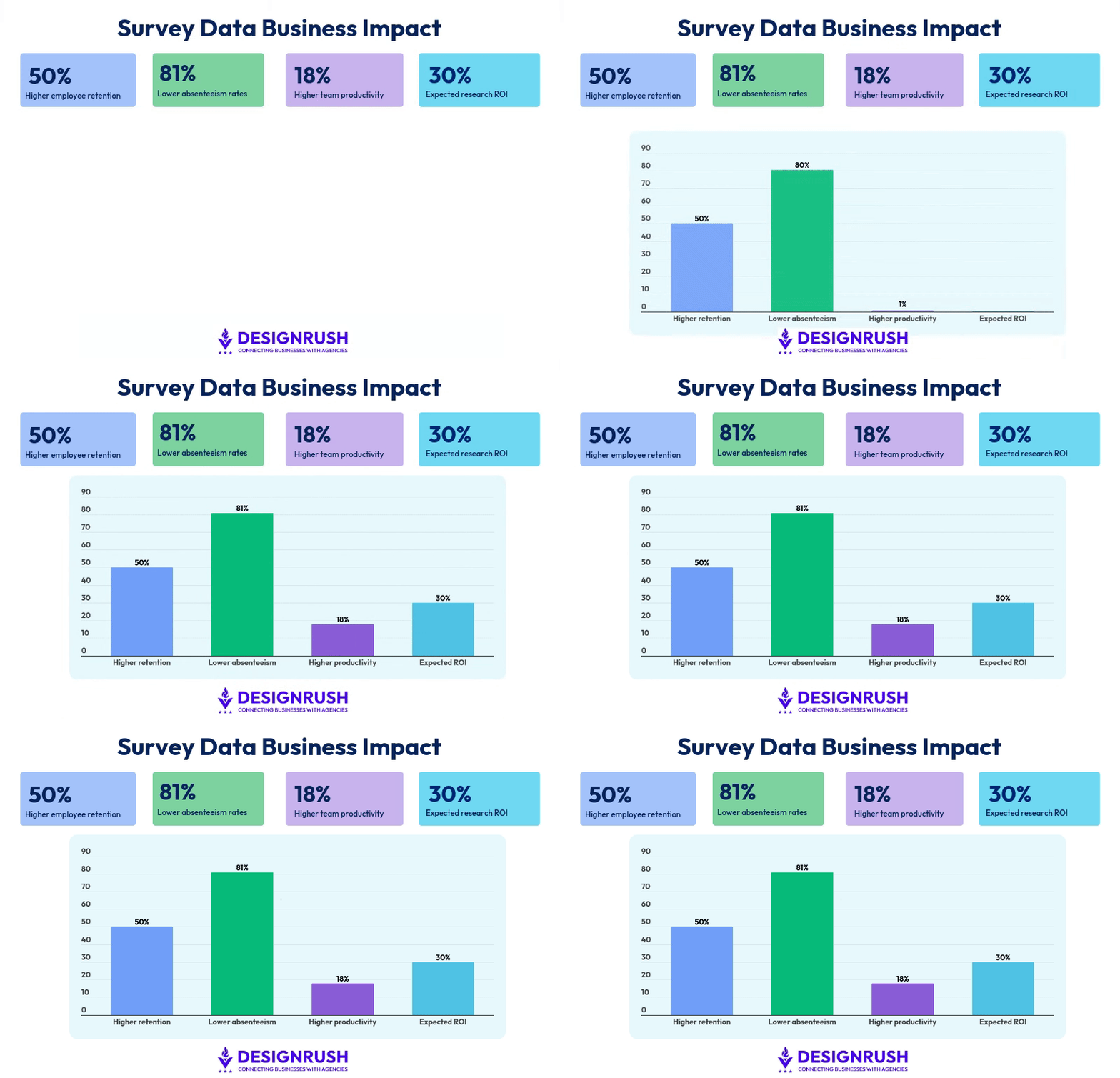
By partnering with a professional survey company, you move away from gut feeling and start making decisions based on real data. These firms use proven methods to collect honest, useful feedback that internal teams often miss due to bias or survey fatigue.
Survey companies can help your business through:
Drastic reduction of costly employee turnover
Ongoing employee surveys show that engagement can drop even when things look stable on the surface, with highly engaged employees falling from 62% to 57% over time. Survey companies help spot early signs of disengagement before employees leave. With regular pulse checks, businesses can fix issues as they happen, not after it’s too late.
Highly engaged teams see up to 50% higher employee retention and 81% lower absenteeism than disengaged teams.
Disengagement currently costs the global economy nearly $9 trillion annually, which is roughly 9% of the global GDP.
Measurable improvement in operational productivity
Third-party surveys give you a clear, unbiased view of what’s working and what’s not. When employees see that their feedback leads to real change, they put in more effort.
Organizations with high engagement levels report 17% to 18% higher productivity and generate 21% more output.
Managers are responsible for 70% of the variance in team engagement, making leadership-focused surveys a key driver of performance.
Protection of revenue through customer loyalty
A survey firm helps you understand what customers feel, not just what they do. This makes it easier to fix issues that push them away.
In 2025, 52% of consumers stopped buying from a brand after a single bad product experience, while 29% left due to poor customer service.
Companies with higher customer satisfaction grow faster. Some top-rated retailers have seen annual sales increases of up to 12.1%.
Maximizing ROI while going through market expansion
Before launching something new, surveys help you test demand and pricing, reducing risk.
Management often expects an annual return of around 30% on market research investments due to the fast payback period.
More companies are now tracking ROI closely, with 26% of marketers measuring campaign returns, up from 18% before.
What business goals should you define before hiring a survey company?
Define clear business goals before hiring a survey company, so the research leads to decisions, not just data.
You need to decide on:
- The decision you need to make
- What you need to learn
- Your target audience
- Success metrics
- The level of insight needed
- How you will use the results
Start with the decision. Every survey should support a specific outcome, such as improving retention, testing a product, or refining a campaign. Then define what you need to learn and who you need to learn it from. This shapes the questions, the method, and the sample. Without this clarity, the survey collects data that does not answer real business problems.
Next, define how you will measure success and how deep the research needs to go. Some goals require quick feedback, while others need detailed analysis and segmentation.
Finally, decide how you’ll use the results. Clear goals ensure the survey delivers actionable insights that can directly guide product, marketing, or operational decisions.
What criteria should you use to evaluate a survey provider?
Choosing the best survey company requires a clear process focused on goals, methodology, and data reliability.
- Define your goals and use case
Identify the exact decision the survey should support, the audience to target, and the metrics you need (e.g., CSAT, NPS, market demand). - Identify the required methodology
Decide how the data should be collected (online, phone, panels, mixed-mode) based on your audience and research depth. - Shortlist relevant companies
Focus on firms with experience in your industry, similar project types, and proven ability to reach your target audience. - Evaluate expertise and approach
Review how they design surveys, ensure data quality, handle sampling, and deliver insights. Strong firms explain their methodology clearly. - Check tools and reporting capabilities
Confirm they use reliable platforms for survey execution, analytics, and reporting, and can deliver clear, actionable outputs. - Send a Request for Proposal (RFP)
Share your goals, audience, timeline, and deliverables. Compare proposals based on methodology, cost structure, timelines, and depth of insights. - Compare pricing and value
Analyze what the pricing includes, such as sampling, incentives, analysis, and reporting, not just the total cost. - Review the contract and finalize
Check scope, deliverables, timelines, pricing terms, data ownership, confidentiality, and support before signing.
How do survey firms ensure data accuracy and minimize bias?
Survey companies ensure data accuracy and minimize bias by controlling who they survey, how they ask questions, and how they validate and analyze responses.
They:
- Carefully select respondents who match the target audience and apply quotas to keep results balanced across groups, such as age, gender, and location.
- Avoid questions with leading or suggestive wording so respondents answer based on their true opinions.
- Test surveys before launch to find unclear or biased questions and fix them early.
- Remove incomplete, duplicate, or low-quality responses, such as rushed or inconsistent answers.
- Use scripts and structured formats to make sure every respondent has the same experience.
- Weigh responses to correct imbalances and better reflect the target population.
- Track patterns during the survey to detect issues and fix them before they affect results.
What technologies and tools do they use for survey execution and analytics?
Survey companies use specialized tools to design surveys, reach the right audience, collect responses, and turn raw data into clear insights.
- Survey execution platforms:
Companies use tools like HeartCount, SurveyMonkey, and Qualtrics to build surveys, manage logic (skip paths, question flows), and distribute them across channels such as email, the web, or mobile. - CATI systems:
Computer-Assisted Telephone Interviewing (CATI) software helps call center agents follow scripts, ask questions consistently, and record answers directly into a system during phone surveys. - Online panels and sampling tools:
Platforms that give access to pre-qualified respondents based on demographics, location, or behavior, ensuring the survey reaches the right audience. - Data analysis software:
Survey companies use tools like SPSS, R, Python, or Excel to process large datasets, calculate metrics, and identify patterns, correlations, and trends. - Text and sentiment analysis tools:
AI-powered tools analyze open-ended responses to detect common themes, keywords, and overall sentiment (positive, negative, neutral). - Automation and workflow tools:
Systems that automate survey distribution, reminders, and reporting, ensuring consistent data collection without manual effort.
Sources
DesignRush sustains a directory of over 40,000 agencies categorized by service category, location, expertise, and reviews. We build our database in two ways:
- Our dedicated team of agency experts actively searches the web for top-performing companies. We then pull information from their websites, online presence, and client testimonials to verify their status and qualifications prior to listing.
- The agencies listed get notified of their profiles on the website and they can choose to claim it or not, which suggests their availability for more collaborations.
Agencies can also reach out to DesignRush and must go through the verification process prior to being listed.

Why companies trust DesignRush
Every agency is independently vetted before it can be listed or ranked
 4.8
4.8 4.8
4.8Some agencies pay for sponsored placement, clearly labeled and held to the same vetting standards.
5 Frequently Asked Questions About Survey Companies
What do survey providers do?
Survey firms collect feedback and turn it into clear, usable insights that help businesses make better decisions. They design surveys, reach the right audience, gather responses, and analyze data to show patterns, trends, and opportunities.
- Design survey questions to match business goals
- Select and reach target audiences (customers, users, or general population)
- Run surveys through channels like phone, online, SMS, or email
- Collect and validate responses for accuracy
- Analyze data to identify trends and key findings
- Deliver reports, dashboards, or insights for decision-making
What types of surveys can survey companies conduct?
Survey providers run different types of surveys to help businesses learn what they need, from customer feedback to market validation to employee insights.
Some of the surveys they conduct include:
- Customer satisfaction (CSAT, NPS, post-service feedback)
- Market research (product demand, pricing, brand awareness)
- Customer experience (journey feedback, usability, pain points)
- Employee engagement (satisfaction, retention, internal feedback)
- Product feedback (feature testing, concept validation)
- Lead qualification and follow-up surveys
- Event and post-purchase surveys
- Political and public opinion polling
How much do survey company services cost?
Survey company pricing typically ranges from $0.10 to $1 per response for broad, easy-to-reach audiences and $2 to $10 for targeted or niche audiences.
A full-service survey company bases its pricing on the project size:
- Small projects: $2,000 to $5,000 (basic surveys, limited sample)
- Mid-size studies: $5,000 to $20,000 (segmented audiences, deeper analysis)
- Large enterprise research: $20,000 to $50,000+ (complex design, large samples, advanced reporting)
Data collection methods directly impact cost:
- Online surveys are the most affordable since they are automated and scalable.
- Phone surveys cost more due to the cost of interviewer labor and call infrastructure.
- Face-to-face surveys are the most expensive because they require staffing, travel, and logistics.
How do top survey companies collect and analyze data?
To collect data, top survey companies reach the target audience through multiple channels. After, they process and analyze data to identify patterns, trends, and actionable insights.
To collect data, survey firms:
- Define the target audience and sampling criteria
- Select channels (phone, online, SMS, in-app, mixed-mode)
- Distribute surveys via panels, customer lists, or outreach campaigns
- Apply quotas to ensure representative responses
- Gather responses in real time across channels
- Validate data by removing incomplete, duplicate, or low-quality inputs
To analyze data and provide actionable insights, a survey firm:
- Cleans and structures datasets for accuracy
- Runs quantitative analysis (averages, percentages, correlations)
- Segments data by demographics or behavior
- Performs trend and comparative analysis
- Analyzes open-ended responses using text analysis
- Delivers reports with key findings, patterns, and actionable insights
What industries benefit most from professional survey companies?
Most industries benefit from professional survey companies when decisions depend on customer feedback, market demand, or user behavior. They are especially valuable in sectors with high competition, frequent customer interaction, or ongoing product and service changes.
- Healthcare providers use surveys to identify gaps in service, treatment effectiveness, and overall patient trust.
- Retail businesses use surveys to improve products, pricing, and overall shopping experience.
- Hospitality companies need surveys to gather feedback to understand what guests value, what needs improvement, and how to increase repeat visits.
- Marketing teams use surveys to refine messaging and improve campaign performance.
- Schools and universities use surveys to improve teaching quality, programs, and the overall learning environment.
- Non-profits need surveys to better allocate resources and prove results to donors and stakeholders.