
Cyberattacks are rising in frequency and sophistication, endangering every organization, from startups to global enterprises. Effective cybersecurity is a business necessity that protects revenue, reputation and organizational strength.
Benefits of Cybersecurity: Key Findings
- Cybercrime is surging, with global damages projected to reach $10.29 trillion in 2025 and $16 trillion by 2029, underscoring the financial necessity of strong cybersecurity.
- Cybersecurity safeguards operations, reducing downtime, avoiding costly recovery efforts, and supporting faster business continuity after incidents.
- Compliance drives real business value, helping companies avoid fines, pass audits efficiently, and demonstrate responsible data practices to clients and regulators.
Latest Trends: Benefits of AI in Cybersecurity
Understanding the benefits of cybersecurity is an absolute must for any organization operating today. Effective security measures help protect sensitive data, maintain business continuity, and build customer trust.
Artificial intelligence (AI) has emerged as a transformative force in cybersecurity, leveraging machine learning, behavioral analytics, and real-time processing at scale to detect anomalies, predict emerging threats, and automate responses far beyond the speed and accuracy of traditional rule-based systems.
That’s how AI becomes a force multiplier for cybersecurity, turning what used to be reactive, manual safeguards into proactive, continuously learning defenses.
The Five Pillars of Cybersecurity Benefits
Cybercrime is expected to cost the world $10.29 trillion in 2025, and projections show that figure rising to around $16 trillion by 2029.
This scale of risk highlights why cybersecurity delivers measurable value across every part of an organization in combating common threats like:
- Phishing: Deceptive emails/websites that trick users into revealing passwords or financial info.
- Malware: Malicious software that infiltrates systems without consent to damage, steal, or disrupt.
- Ransomware: Malware that encrypts or locks data/systems and demands payment for access.
- Insider threats: Security risks from employees/contractors due to malice or negligence.
Here’s how strong security drives the business forward, and how recent breaches highlight the real cost of getting it wrong.
- Data protection benefits of cybersecurity
- Operational & financial benefits of cybersecurity
- Customer trust & brand reputation benefits
- Compliance & regulatory benefits of cybersecurity
- Internal security & employee-focused benefits
1. Data Protection Benefits of Cybersecurity
Cybersecurity’s first and most essential function is protecting the data that powers an organization, from customer information to intellectual property.
How MGM Resorts Lost 142M Records — and How Strong Cybersecurity Prevents Data Breaches
In the 2023 MGM Resorts ransomware attack (delivered via a phishing-like social-engineering scam), attackers gained initial access and eventually exfiltrated data on 142 million customers before encrypting systems. Strong email filtering, endpoint detection, and zero-trust architecture could have stopped the initial foothold.
Use firewalls, encryption, and intrusion-detection systems to block unauthorised access and shut down breach attempts before they escalate.
Layer in AI-driven threat detection and email filtering to spot phishing and credential-harvesting activity in real time, allowing your team to contain threats immediately.
What Colonial Pipeline Taught Us About Safeguarding Sensitive Information
The 2021 Colonial Pipeline attack (DarkSide ransomware) showed how quickly attackers can steal sensitive data before encryption, using double extortion to increase leverage. Even limited access allowed criminals to extract key files and disrupt a major entity.
Encryption-at-rest, least-privilege access, and strong role-based controls sharply limit what attackers can reach, even if they breach the network.
Pairing these with AI-driven data-loss prevention helps automatically classify sensitive assets and detect unsafe data movement, giving teams the chance to stop exfiltration in real time.
Change Healthcare: A Breach That MFA Could Have Stopped
The 2024 Change Healthcare ransomware incident began when attackers used stolen credentials (no MFA enforced) to move laterally and eventually steal medical records of nearly one-third of all Americans.
Multi-factor authentication, password policies, and identity protection tools prevent such incidents by ensuring only verified users access key systems, impeding attackers impersonating employees or customers.
A 2025 report from Verizon found that 88% of hacking-related breaches involve stolen or brute-forced credentials, making credential stuffing and reused passwords the leading cause of identity-based attacks.
2. Operational & Financial Benefits of Cybersecurity
By keeping systems running smoothly, cybersecurity helps businesses avoid both operational headaches and the big financial losses that come with cyber incidents. AI adds faster detection, automated containment, and predictive insights.
The JBS Foods Shutdown: Why Operational Resilience Starts with Cybersecurity
The 2021 JBS Foods attack forced the meat processor to shut down plants across North America and Australia for days, costing over $11 million in ransom and far more in lost production.
AI-powered behavioral analytics could have flagged the initial compromise earlier, reducing operational impact. Endpoint protection, network monitoring, and automated threat response further strengthen early detection and help to maintain system uptime and prevent costly disruptions.
AI-driven monitoring platforms can analyze millions of events in real time to spot anomalies (like unusual lateral movement or data-access patterns) long before they impact operations.
MOVEit’s $10B Fallout: Why Cybersecurity Is a Direct Cost-Saver
View this post on Instagram
The 2023 MOVEit supply-chain attack (Clop ransomware gang) affected over 2,700 organizations and has already generated more than $10 billion in estimated global losses.
It demonstrates how a single third-party vulnerability can rapidly cascade into major costs for countless organizations.
Strong cybersecurity prevents breaches and reduces recovery, legal, and revenue-loss costs, making it a proactive, cost-saving investment. AI adds further cost efficiency by automating repetitive security tasks and reducing false positives.
Atlanta’s Ransomware Crisis: The Case for Built-In Business Continuity
The City of Atlanta ransomware incident shows how even public-sector organisations face major disruption — and why business continuity must be built into your cybersecurity strategy from day one.
Secure backups, disaster recovery plans, and incident response protocols ensure data can be restored quickly and operations can continue after a cyber incident.
3. Customer Trust & Brand Reputation Benefits
A strong security posture builds confidence among customers and partners, directly influencing reputation and long-term relationships.
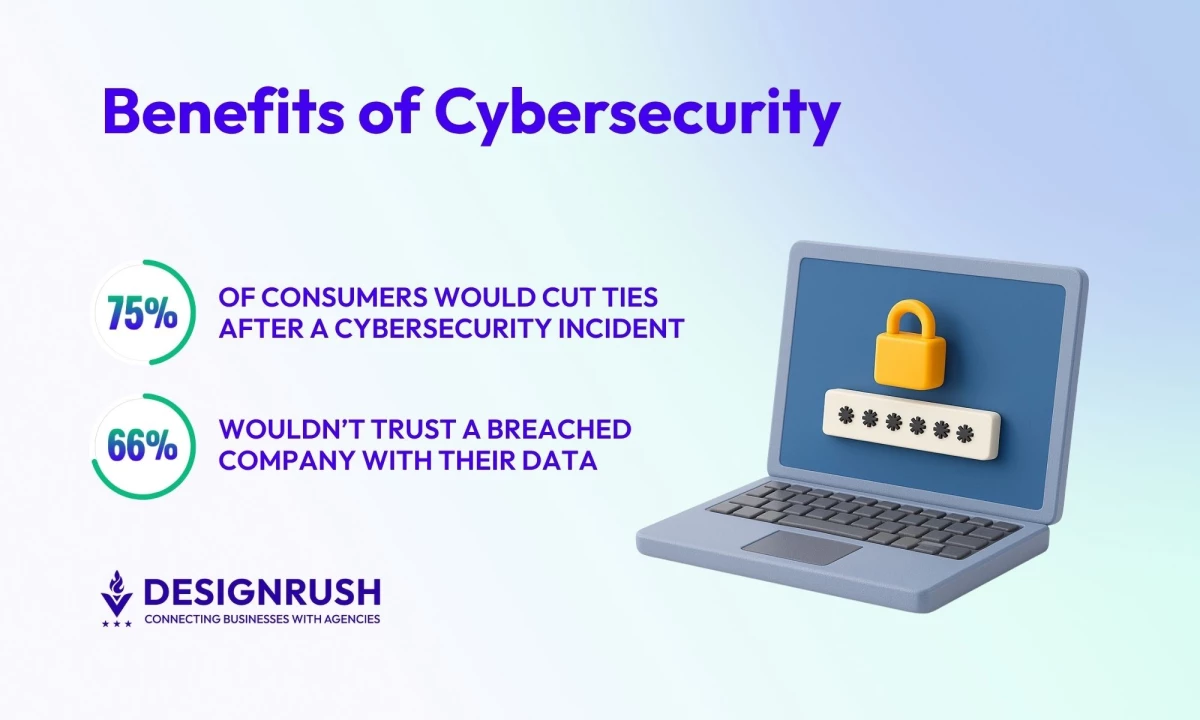
Consumers are quick to lose trust after a cyber incident:
- 75% would cut ties with a brand.
- 66% wouldn’t trust a company that had previosuly been breached with their data.
Target’s $202M Breach: Why Clients Trust Brands With Strong Security
The 2013–2014 Target breach (started when HVAC vendor credentials were phished) exposed 40 million credit cards and led to $202 million in settlements and a lasting hit to reputation.
When you demonstrate strong cybersecurity, especially across your vendor ecosystem, clients view your brand as trustworthy and competent. This directly influences partnership decisions and customer retention.
Ticketmaster’s Multi-Year Breaches Show How Fast Reputation Erodes
Between 2018–2024, repeated Ticketmaster breaches driven by credential-stuffing and third-party script vulnerabilities turned the company into a cautionary tale for poor security hygiene.
Consistent security investment protects your brand’s public image and demonstrates you can safeguard customer data. Strong protection equals stronger reputation and fewer PR crises.
4. Compliance & Regulatory Cybersecurity Benefits
Meeting industry regulations is non-negotiable, and effective cybersecurity makes compliance simpler, safer, and more reliable.
PharMerica’s 5.8M-Record Breach: Why Compliance Depends on Cybersecurity
Ransomware and data exfiltration are the fastest ways to violate GDPR, HIPAA, CCPA, etc. The 2023 PharMerica breach (Money Message ransomware) exposed 5.8 million patients’ data and triggered HIPAA fines still being calculated in 2025.
Strong cybersecurity helps businesses meet strict regulatory requirements across sectors like finance, healthcare, and eCommerce, ensuring responsible data handling and avoiding compliance violations.
AI-powered data classification and access monitoring can automatically identify sensitive information, enforce policy rules, and alert teams when regulatory thresholds are at risk.
British Airways and Equifax Demonstrate the Cost of Non-Compliance
Under GDPR, companies can be fined up to 4% of global revenue. British Airways’ 2018 breach (Magecart malware on website) cost $26 million, and Equifax’s 2017 breach cost over $1 billion in total penalties and settlements.
Effective security controls help prevent breaches that can trigger investigations, lawsuits, and costly penalties, directly protecting financial and organizational credibility.
AI strengthens this posture by continuously monitoring systems for early signs of policy violations, data leakage, or suspicious behavior, enabling faster intervention before issues escalate.
5. Internal Security & Employee-Focused Benefits
Taking cybersecurity seriously also improves internal resilience by empowering employees, minimizing insider risks, and shaping a security-aware culture. AI plays an increasingly important role by monitoring behavior patterns and spotting risks earlier.
Tesla’s Insider Leak: Why Monitoring Employee Behavior Matters
The 2023 Tesla data breach, in which two former employees leaked the personal information of more than 75,000 individuals and internal sensitive files, shows how insider threats (whether malicious or negligent) can trigger multimillion-dollar regulatory fines and legal liability.
User behavior monitoring, access controls, and secure authentication help detect unusual activity early and prevent intentional or accidental misuse of systems or data. AI-powered behavioral analytics can spot subtle deviations in employee activity, like abnormal file access or login timing.
Three Common Cybersecurity Challenges and How to Address Them
While cybersecurity offers significant advantages, organizations should also be aware of the challenges involved in implementing and maintaining effective security measures.
Here are three of the most common, along with some practical solutions:
1. High Implementation Costs
Building a robust cybersecurity program can be expensive, particularly for small businesses. Advanced tools, hardware, and skilled security staff require substantial investment, and ongoing maintenance adds to long-term costs.
Yes, a breach is sure to be costly, but prevention can also strain limited budgets.
How to address it: Adopt a phased approach or use managed security services to spread costs and access enterprise-level protection at a lower price point.
2. Complex Security Systems
Modern cybersecurity solutions can be difficult to manage without specialized expertise. Their complexity may lead to configuration errors or gaps in protection, especially for organizations without dedicated security teams.
Outsourcing can help, but it may also create dependence on external providers.
How to address it: Simplify your tech stack where possible and use centralized security platforms that offer unified dashboards and automated protection.
3. Potential for Reduced Usability
The reality is that strong security measures such as multi-factor authentication and strict password policies sometimes make systems less convenient to use.
If these controls are overly restrictive, they slow workflows, frustrate employees, and impact productivity, particularly in fast-paced environments.
How to address it: Balance security with usability by implementing adaptive authentication, single sign-on (SSO), and user-friendly security tools that minimize friction.
It's always a work in progress, says Olivier Gil, global VP of digital business for Exclusive Networks, who explains:
“The key to success is continuous refinement, ensuring that while we maintain a unified strategic direction, we remain flexible enough to adapt to the ever-evolving cybersecurity landscape.”
Benefits of Cybersecurity Final Words
Cybersecurity is essential for protecting sensitive personal and business data from evolving threats. It has a vital role in safeguarding business operations, maintaining trust with customers, and ensuring regulatory compliance.
With AI now accelerating both the speed and sophistication of cyberattacks as well as the defenses that counter them, modern organizations must adopt security strategies that leverage advanced, intelligent protection.
Now is the time to invest in a robust cybersecurity strategy to stay ahead.

Our team ranks agencies worldwide to help you find a qualified partner. Visit our Agency Directory for the Top Cybersecurity Companies, as well as:
- Top AI Cybersecurity Companies
- Top Security Assessment Companies
- Top Cybersecurity Incident Response Companies
- Top IT Support Companies
- Top Managed IT Service Providers
Benefits of Cybersecurity FAQs
1. What is the biggest benefit of cybersecurity for modern businesses?
The biggest benefit is risk reduction. Cybersecurity prevents breaches that can cause severe financial loss, service interruptions, and reputational damage, helping companies operate securely and confidently.
2. Does cybersecurity benefit small businesses as much as large enterprises?
Absolutely. Small businesses are often targeted precisely because they have fewer defenses. Effective cybersecurity protects their limited resources, maintains customer trust, and provides the stability needed to grow.
3. How does cybersecurity support long-term business stability?
Cybersecurity strengthens long-term stability by preventing disruptions, supporting compliance, and protecting valuable data. This foundation allows businesses to scale, innovate, and adopt new technologies without increasing risk.