
There are plenty of AI analytics tools out there, but more tools don’t mean better decisions. The real challenge is finding the right one for your specific problem.
We’ll break down the top platforms by what they actually do best, so you can turn data into action.
AI Analytics Tools for Digital Marketing: Key Findings
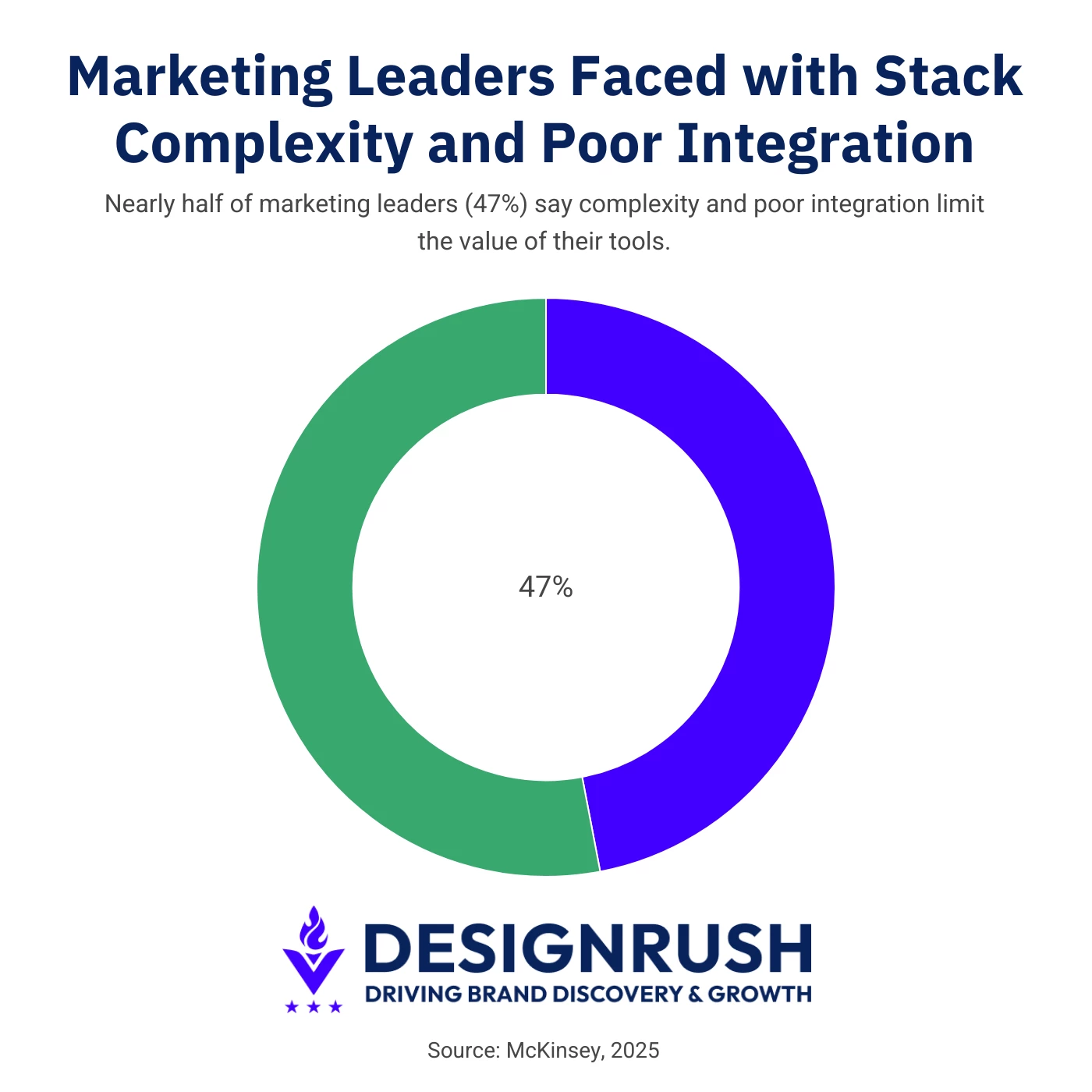
- Nearly half of marketing leaders (47%) say stack complexity and poor integration limit their ability to get value from analytics tools, highlighting how fragmentation remains a core challenge.
- No single AI analytics platform solves everything, with teams needing different digital analytics tools for attribution, behavioral insights, SEO intelligence, and data unification.
- The most effective teams focus on connecting data across channels to understand what actually drives revenue, with platforms like Articos reflecting a growing emphasis on audience context and behavioral insight.
What Actually Matters in AI Marketing Analytics
AI analytics tools are becoming increasingly effective at finding attribution patterns, campaign performance shifts, conversion anomalies, and customer trends in real time. But, the real challenge now is making sense of fragmented insights.
A McKinsey & Company study found that 47% of marketing leaders say stack complexity and poor integration are major barriers to getting value from their tools.
The same research points to bloated tech stacks and siloed systems as a persistent issue across organizations, limiting teams’ ability to turn analytics into clear strategic decisions.
That’s creating growing demand for platforms that combine behavioral analytics with audience intelligence. A platform like Articos’ AI user research for agencies reflects that broader shift.
As Owais Khan, GTM at Articos, explains: “AI analytics tools tell you what happened. The harder problem for agencies and marketing teams is figuring out why — and what to recommend to the client based on it.”
Articos pairs behavioral analytics with structured audience research workflows to help strategists enter client meetings with both “the quantitative what and the qualitative why” behind user behavior, as Khan puts it, offering more actionable context than analytics dashboards alone are able to provide.
This points to the next phase of AI marketing analytics, where audience context becomes as important as performance data. The tools below show how AI analytics platforms are evolving beyond basic reporting and attribution.
Tool | Best For | Forecasting Capabilities | Cross-Channel Attribution | Offline Data Support | Pricing (Starting At) |
Closed-loop revenue attribution (B2B) | ⚠️ | ✅ | ✅ | From ~$9/mo | |
Behavioral analytics for PLG | ⚠️ | ❌ | ❌ | From $49/mo | |
SEO & competitive intelligence | ❌ | ❌ | ❌ | $117.33/mo | |
Shopify paid media attribution | ✅ | ✅ | ⚠️ | $149/mo | |
UX & conversion insights | ❌ | ❌ | ❌ | Custom pricing | |
Form & checkout optimization | ❌ | ❌ | ❌ | $56/mo | |
Data unification & reporting | ⚠️ | ⚠️ | ⚠️ | $39/mo | |
Auto-captured behavioral analytics | ⚠️ | ❌ | ❌ | Custom | |
B2B revenue attribution | ⚠️ | ✅ | ✅ | Custom | |
Call tracking & conversation intelligence | ❌ | ⚠️ | ✅ | $50/mo |
1. HubSpot Marketing Analytics - Best for Closed-Loop Revenue Attribution
For B2B teams using HubSpot CRM that need to connect marketing activity directly to revenue
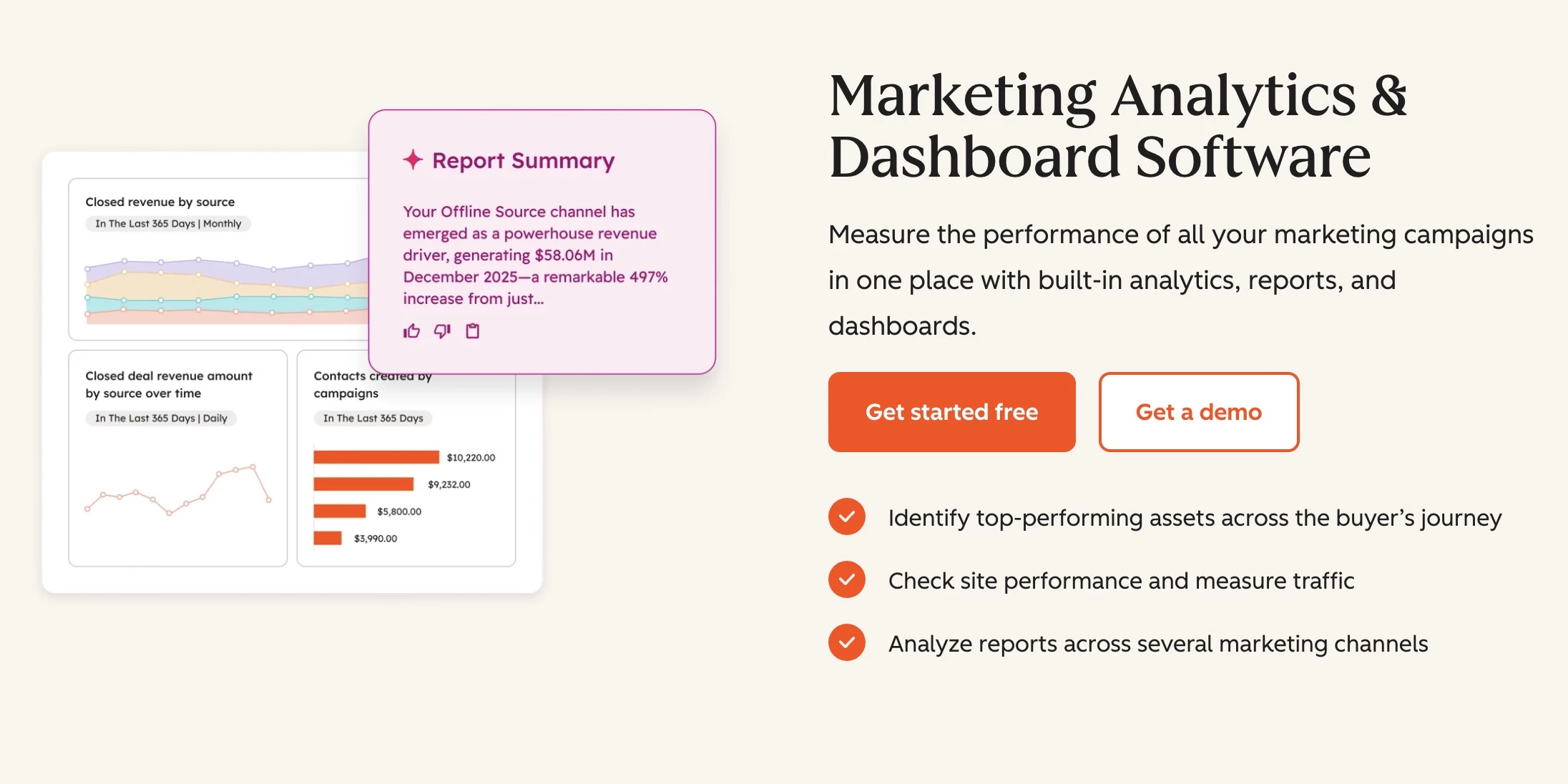
HubSpot’s Marketing Hub bundles analytics with email, automation, content, and its built-in CRM. Its analytics shine in linking marketing touchpoints directly to closed deals and in AI-powered content and lead features.
For instance, HubSpot’s AI content tools can recommend subject lines or blog topics based on performance data, and its predictive lead scoring flags your highest-potential contacts.
This “all-in-one” approach means no data connectors are needed. Campaigns in email, social, or ads automatically roll up into the CRM dashboards.
The catch is price: HubSpot starts around $890–$900/month (Professional tier) plus a $3K onboarding fee.
Limitations also show up in paid media. Attribution for platforms like Meta and TikTok is shallow, so teams running complex campaigns will need additional tools.
It’s arguably better for teams already using HubSpot and for SMBs or enterprises that value simplicity.
Pricing (billed annually)
- Free version available (limited analytics features)
- Paid plans range from $9/seat/mo to $3,600/mo
Notable Features
- Native CRM-to-revenue attribution
- Breeze AI agents for predictive lead scoring and automated insights
- Native tracking code for behavior monitoring and automation triggers
- Unified dashboard across email, ads, social, and CRM data
Pros
- All-in-one platform reduces the need for multiple analytics tools
- Easy-to-use dashboards with actionable insights
- Breeze AI adds genuinely useful automation
Cons
- Becomes expensive as you scale to higher tiers
- Limited flexibility outside the HubSpot ecosystem
- Advanced reporting often requires higher-tier plans
2. Amplitude - Best for Behavioral Analytics in Product-Led Growth
For SaaS and PLG teams focused on linking user behavior to retention and experimentation
Amplitude’s core value is the link between behavioral analytics and experimentation. You can run A/B tests and directly measure downstream impact on retention through cohort analysis.
For product-led teams, where marketing is deeply tied to product experience, this closed loop between measurement and experimentation is difficult to replicate with stitched tools.
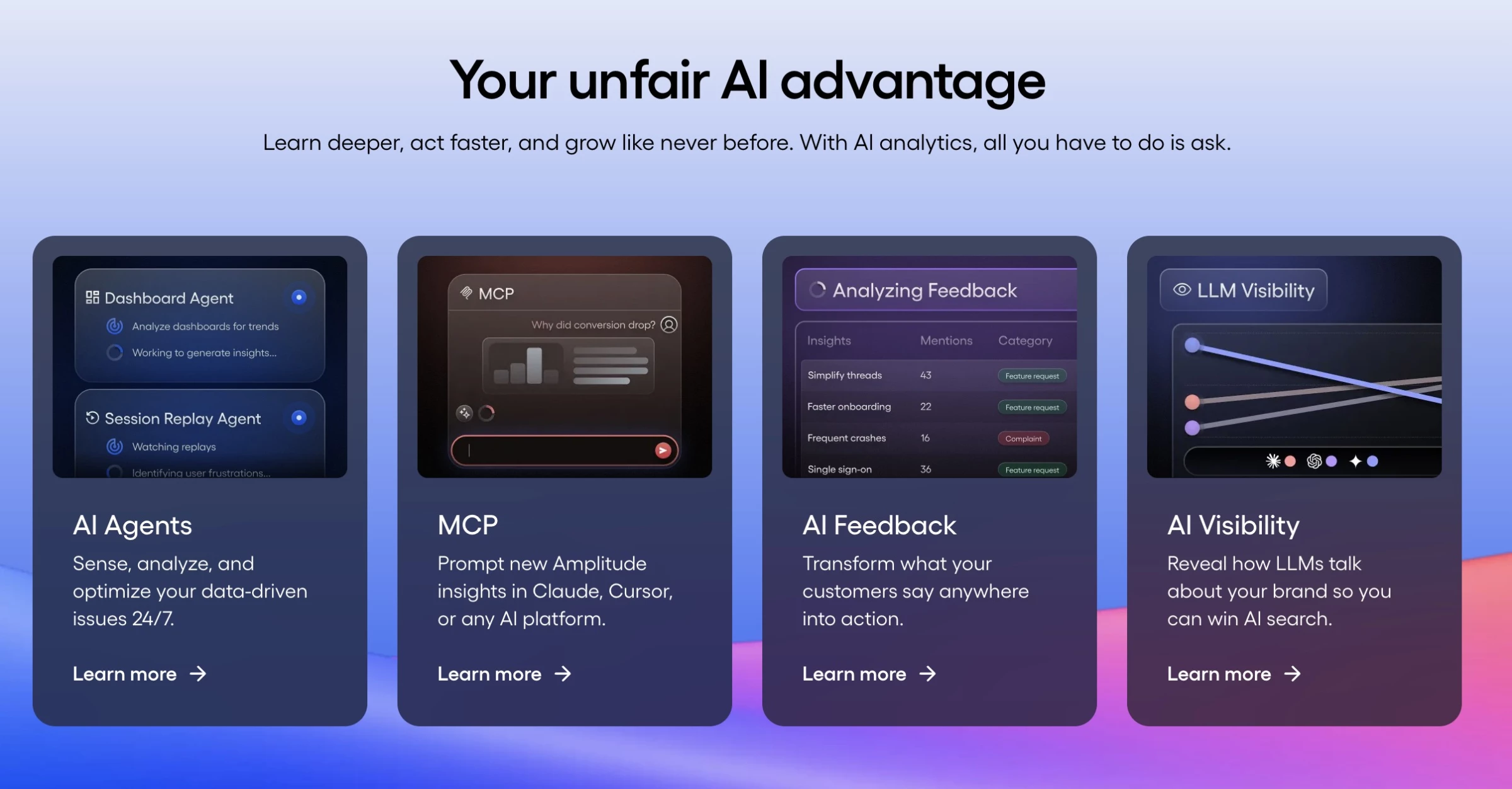
Its AI agents automate analysis by surfacing patterns, detecting anomalies, and recommending next steps without manual queries. Marketers can ask questions and get insights instantly.
Features like AI Feedback consolidate customer sentiment into actionable insights, while AI Visibility tracks how your brand appears in AI-driven search environments.
Pricing (billed annually)
- Free plan available (10K MTUs, up to 2M events)
- Paid plans start from $49/mo
Notable Features
- AI Agents for automated analysis, insights, and recommendations
- AI Feedback to turn customer input into product and marketing actions
- AI Visibility for tracking brand presence in AI-driven search
Pros
- Generous free tier; genuinely usable
- Intuitive for non-technical marketers on standard queries
- Strong retention analysis for subscription and SaaS businesses
Cons
- Paid media attribution is limited; it needs supplemental tooling
- Advanced features require Growth or Enterprise tier
- Interface has a learning curve for first-time users
3. Semrush - Best for SEO Intelligence and Competitive Analysis
For SEO and content teams prioritizing organic acquisition and competitive insights
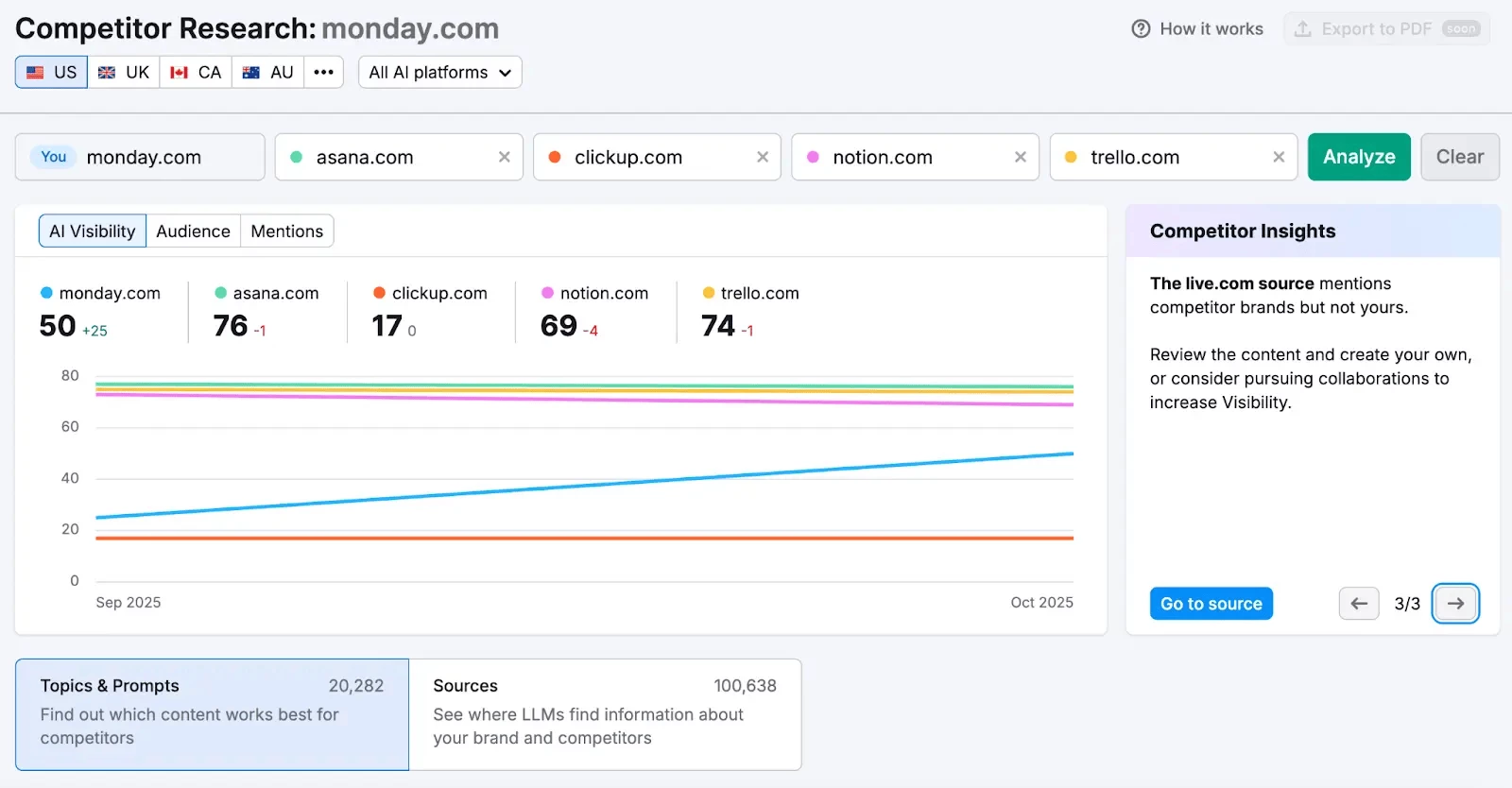
Semrush sits in a category of its own here. It’s not an attribution or behavioral analytics tool, but for teams relying on organic search, but for teams where organic search drives meaningful acquisition, it's the most comprehensive intelligence layer available.
Its keyword clustering, content gap analysis, competitive traffic estimation, backlink analysis, and position tracking together give content teams the strategic picture that no other single tool provides.
AI-assisted recommendations also help marketers identify opportunities and build optimized content briefs grounded in real search data.
Pricing (billed annually)
- Paid plans range from $117.33/mo to $416.66/mo
Notable Features
- AI-powered keyword clustering and content recommendations
- Market and audience insights for targeting
- Backlink analytics and link-building opportunity identification
- Position tracking across target keywords with daily updates
Pros
- AI clustering reduces keyword research time significantly
- Constant feature expansion across content, PR, and local SEO
- Trusted benchmark in practitioner communities worldwide
Cons
- Expensive at scale, especially for multi-seat agency use
- Feature breadth is overwhelming without a clear use case focus
- Not a substitute for attribution or behavioral analytics
4. Triple Whale - Best for Shopify-Based Paid Social Performance
For Shopify DTC brands relying on paid social, where accurate attribution is critical
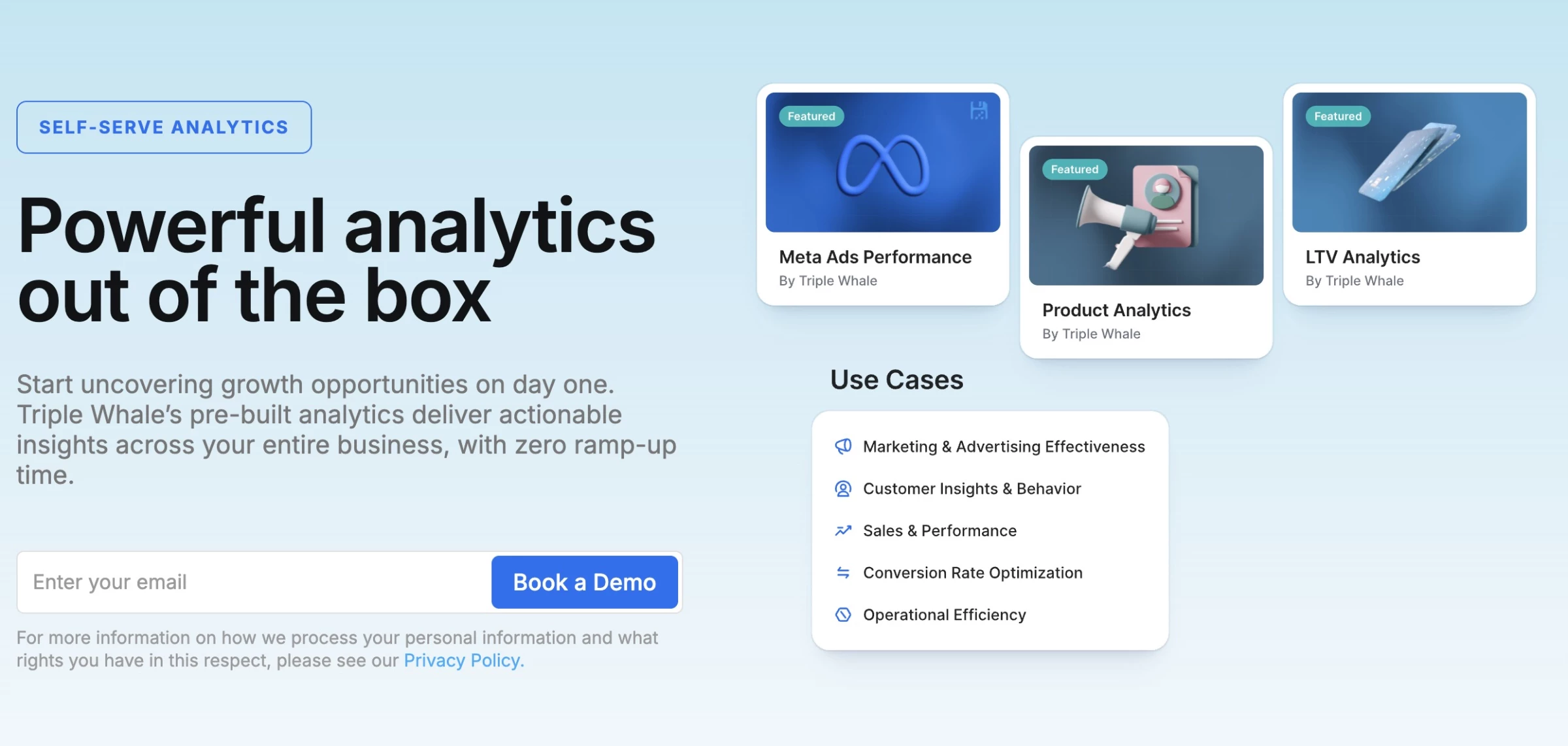
Triple Whale is purpose-built for ecommerce teams navigating the attribution gaps caused by privacy changes like iOS 14.
Instead of relying on browser-based tracking, it uses server-side attribution to give a more accurate view of which ad spend is driving revenue.
For brands spending a lot on paid social, this often reveals major discrepancies between reported and real performance.
Its creative intelligence and AI layer also shows the campaigns, down to the exact ad creatives (videos, images, and copy) generating conversions.
Combined with its AI assistant “Moby,” marketers can query performance in plain language and get actionable recommendations like on budget shifts or audience targeting.
Pricing (billed annually)
- Free version available (up to 10 users)
- Paid plan ranges from $149/mo to $219/mo
Notable Features
- Moby AI assistant for querying insights and recommendations
- AI-driven recommendations that go beyond reporting
- Real-time Shopify revenue and order data integration
- Revenue forecasting using blended attribution models
Pros
- Most accurate post-iOS 14 attribution for DTC
- Creative-level performance analytics is unique in this price range
- Accessible entry pricing for what it delivers
- Active product community
Cons
- Built exclusively for Shopify; not portable to other platforms
- Not suited for B2B or non-e-commerce teams
- Requires meaningful paid media spend to justify
5. FullStory - Best for Digital Experience Analysis and Conversion Insights
For teams analyzing user behavior to identify friction and improve conversion
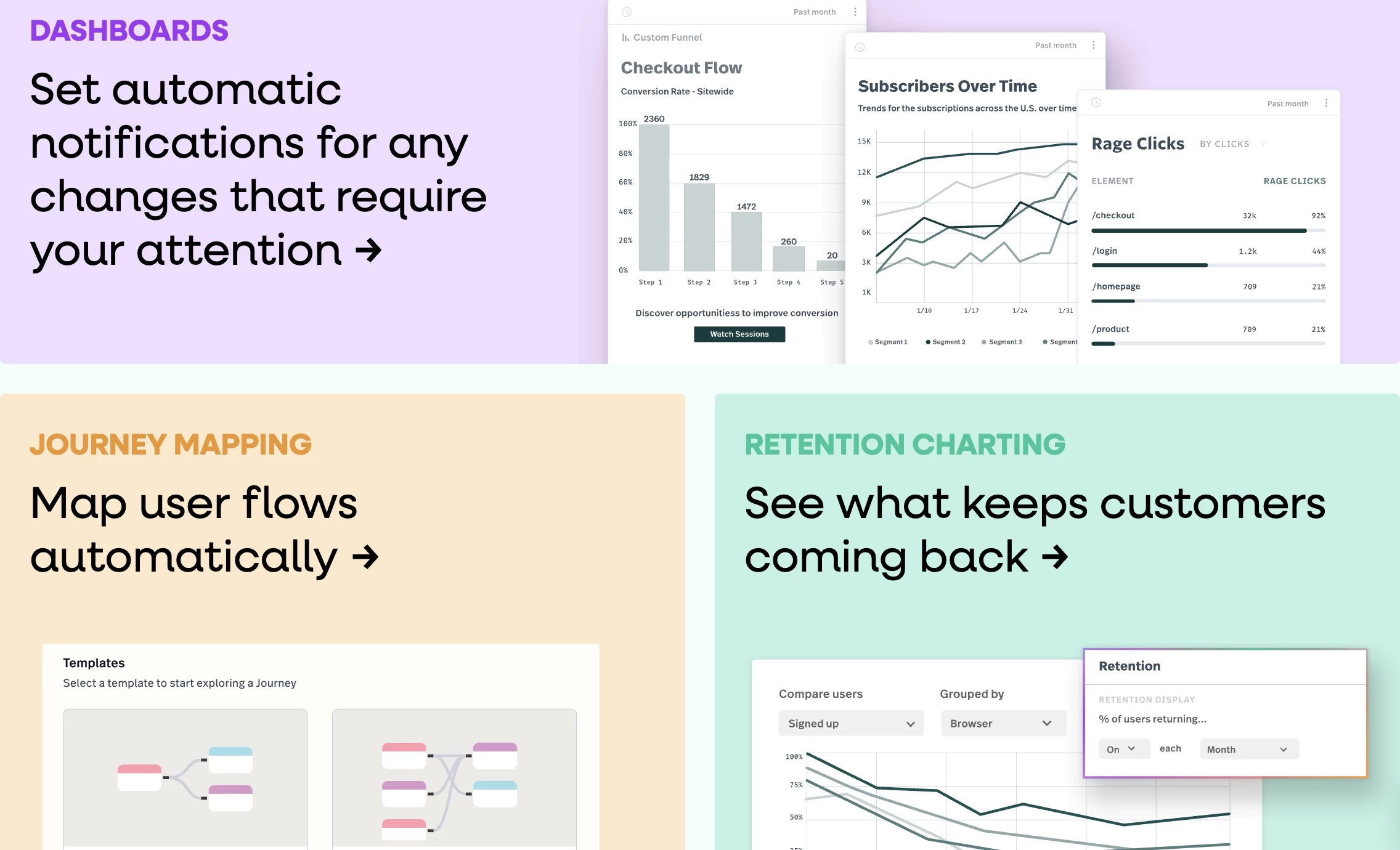
FullStory is built around a simple idea: raw behavioral data is only valuable if you can turn it into immediate, actionable insight.
Its AI layer, primarily through StoryAI, interprets session data, surfaces friction signals like rage clicks, errors, and abandonment patterns, and explains user behavior in context.
Marketers can rely on AI-generated summaries, answers, and recommendations that highlight what’s impacting conversion, retention, and engagement.
FullStory’s AI is embedded directly into the workflow, and combined with automatic data capture, journey mapping, and sentiment signals, it enables teams to move from reactive analysis to continuous optimization.
Pricing (billed annually)
- Custom pricing
Notable Features
- StoryAI with summaries, proactive insights, and contextual answers
- Session replay with AI-assisted behavioral analysis
- Visual journey mapping and funnel analysis with drop-off insights
- Sentiment signals to detect frustration and friction points
Pros
- Accessible for non-technical teams (UX, product, and marketing)
- AI reduces time spent analyzing session data manually
- No-tagging setup simplifies implementation
Cons
- Can become expensive at higher session volumes
- Less focused on attribution or paid media performance
6. Zuko - Best for Form and Checkout Analytics
For teams optimizing forms and checkouts to reduce drop-offs and increase conversions
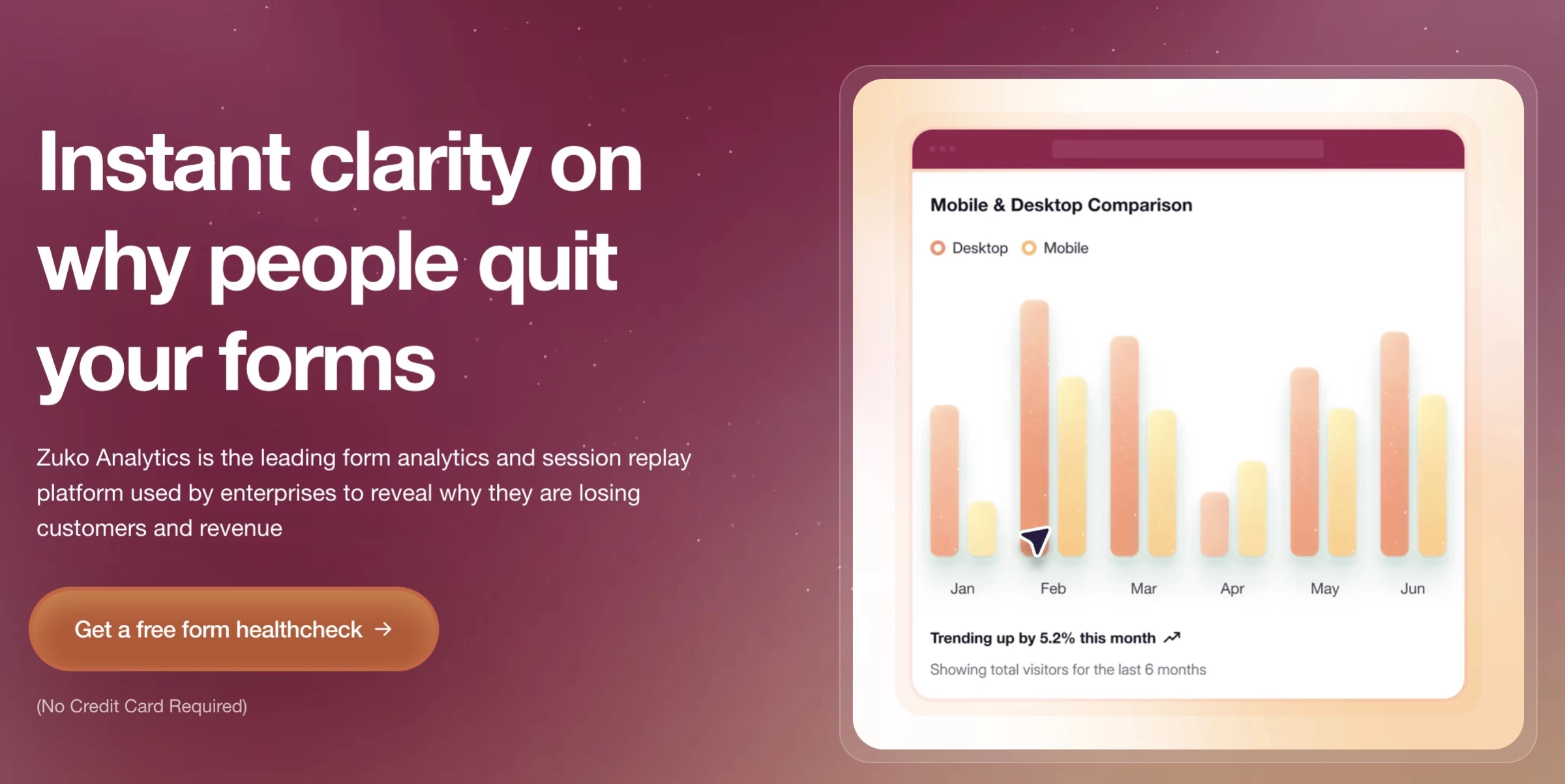
Zuko is a specialist analytics platform built specifically to track behavior on forms and checkouts, an area where most general analytics tools fall short.
While tools like Google Analytics can show that users abandon a form, they rarely explain where or why. Zuko form analytics addresses this gap with field-level tracking that automatically captures how users interact with each input.
It highlights hesitation, repeated entries, validation errors, and drop-offs at a granular level.
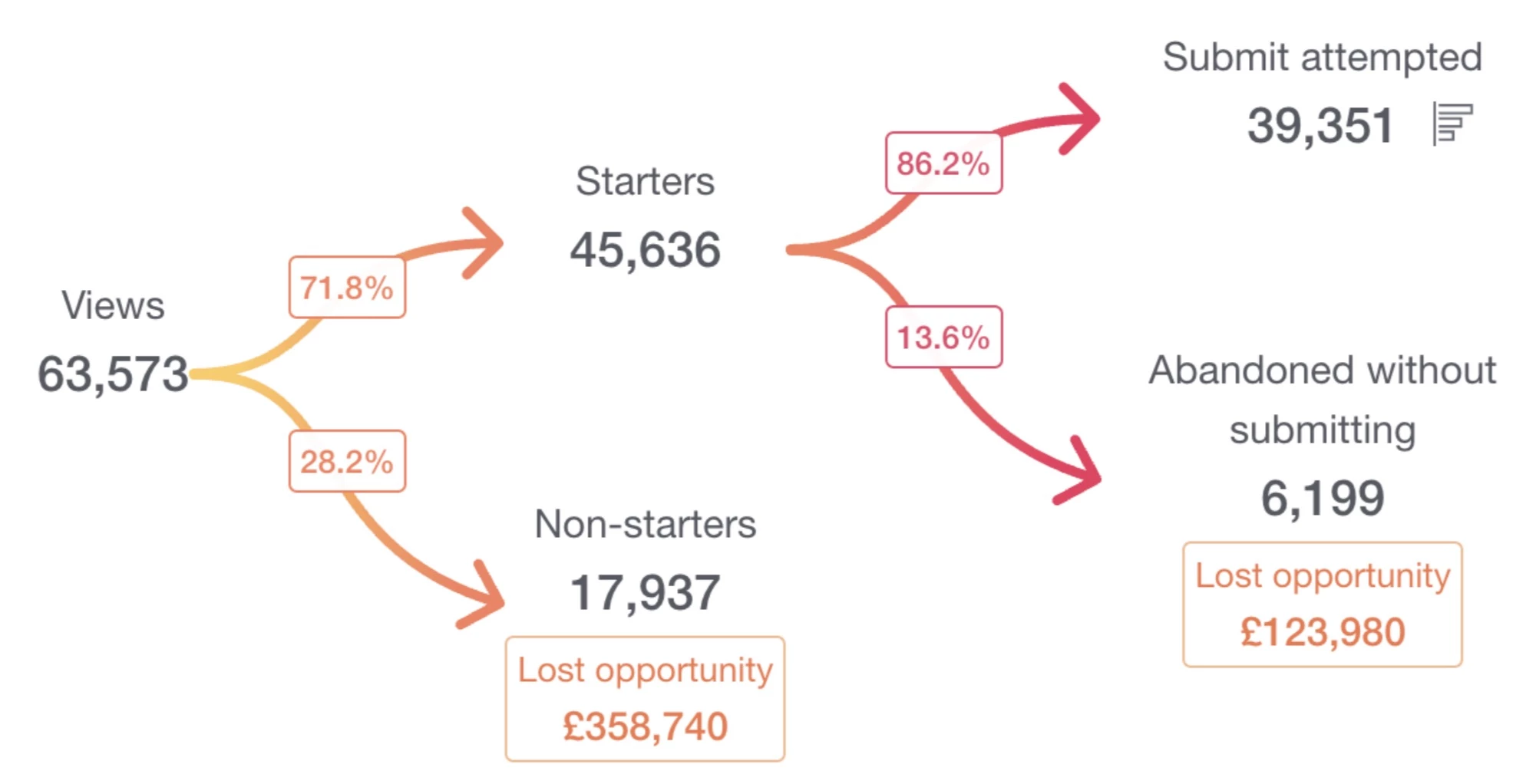
Zuko’s AI assistant builds on this behavioral foundation to interpret patterns and prioritize fixes.
By analyzing differences between users who convert and those who abandon, it identifies which fields or steps are most likely causing lost revenue.
Combined with Shopify checkout tracking, Zuko enables marketers to move quickly from insight to optimization.
Pricing (billed annually)
- Paid plan ranges from $56/mo to $560/mo
Notable Features
- Field-level analytics (track hesitation, re-entries, and drop-offs per field)
- Behavior difference analysis between converters and abandoners
- AI assistant for interpreting data and suggesting optimizations
- Shopify checkout analytics with step-level and field-level insights
Pros
- Deep, specialized insights not available in general analytics tools
- Fast setup with automatic field tracking
- Actionable insights for CRO and performance teams
Cons
- Limited scope outside of forms and checkout experiences
- Not a full marketing analytics or attribution platform
- Best suited for businesses with meaningful form volume
7. Supermetrics - Best for Marketing Data Unification and Reporting
For teams centralizing marketing data and automating reporting across channels
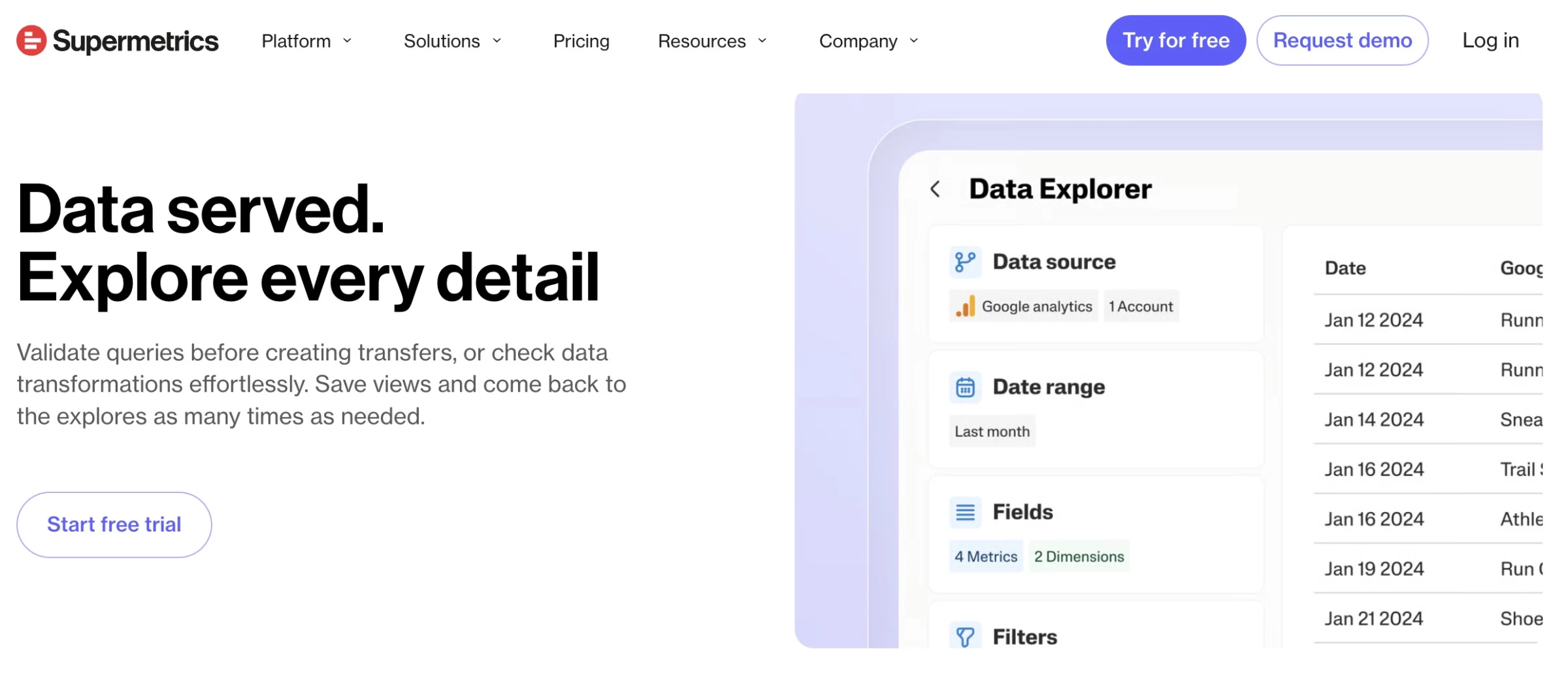
Supermetrics approaches AI starting with data quality, then layers intelligence on top.
Its AI capabilities, particularly through Supermetrics Agents, are designed to turn fragmented marketing data into visualizations and next-best actions in seconds.
Marketers can ask questions in plain language and get immediate outputs: charts, explanations of performance drivers, and recommended optimizations.
Supermetrics also supports building custom AI workflows like automating reporting, anomaly detection, and even campaign monitoring, so teams can move from insight to execution without manual handoffs.
Pricing (billed annually)
- Paid plan ranges from $39/mo to $399/mo
- Custom pricing available for enterprises
Notable Features
- Supermetrics Agents (Dashboard, Insights, and Connector Agents)
- Natural-language querying with AI-generated charts and recommendations
- MCP server for connecting marketing data to external AI tools
- AI-powered data transformation and enrichment (no-code)
Pros
- Strong data foundation ensures more accurate AI insights
- Flexible: works inside the platform or with external AI tools
- Scales well for agencies and multi-channel marketing teams
Cons
- Requires setup to fully unify and structure data sources
- Less focused on behavioral or product analytics
- Pricing scales with connectors and usage
8. Heap - Best for Auto-Captured Behavioral Analytics
For teams needing retroactive user insights without manual event tracking
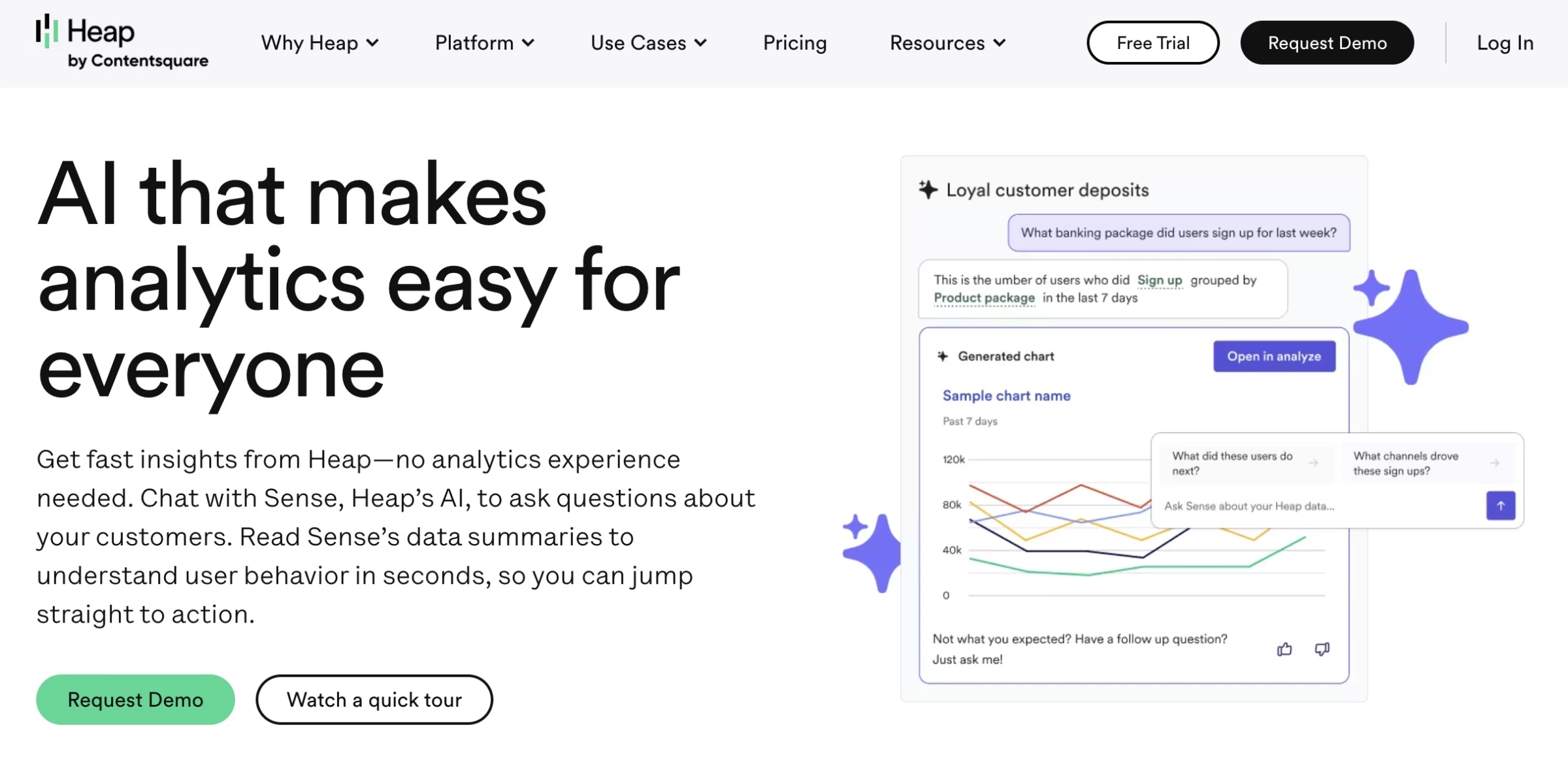
Heap’s core advantage and the foundation of its AI capabilities is auto-capture.
From the moment it’s installed, every user interaction is tracked automatically: clicks, taps, page views, form submissions, and even frustration signals
This eliminates the need for engineering teams to predefine events, which is a major limitation in traditional analytics tools.
On top of this complete data foundation, Heap layers AI through features like Sense and Illuminate.
Sense lets marketers ask questions in plain language and receive charts, summaries, and next-step recommendations instantly. Meanwhile, Illuminate uses machine learning to proactively surface behavioral patterns
With these features, Heap shifts analytics from reactive reporting to proactive discovery.
Pricing (billed annually)
- Free version available (up to 10k monthly sessions)
- Custom pricing for paid plans
Notable Features
- Sense AI for natural-language queries, summaries, and chart generation
- Illuminate AI for predictive cohort discovery (conversion and churn)
- Friction Detection (rage clicks, dead clicks, error patterns)
Pros
- Eliminates engineering dependency for analytics setup
- Enables retroactive analysis of past user behavior
- Strong at identifying UX friction
Cons
- Not designed for marketing attribution or paid media analysis
- Advanced AI features limited to higher-tier plans
- Best suited for product-led organizations rather than pure marketing teams
9. DreamData - Best for B2B Revenue Attribution
For B2B teams connecting marketing, sales, and pipeline across long journeys
Dreamdata is purpose-built for B2B marketers dealing with fragmented data, long sales cycles, and complex buying journeys.
Its AI Signals engine scans across all go-to-market data, including CRM, ads, and sales touchpoints, to identify high-intent behaviors and surface accounts that are most likely to convert.
These signals can then be activated immediately: syncing audiences to ad platforms, notifying sales teams in Slack or CRM systems, and prioritizing outreach based on likelihood to close.
Combined with automated audience building and conversion syncing, Dreamdata creates a continuous feedback loop where marketing, sales, and revenue data inform each other in real time.
Pricing (billed annually)
- Free version available (up to 5 seats)
- Custom pricing for paid plans
Notable Features
- AI-driven multi-touch attribution across the full B2B customer journey
- Audience Hub for building and syncing dynamic audiences to ad platforms
- Conversion syncing (pipeline data fed back into ad platforms)
- Unified customer journey mapping across CRM, ads, and website activity
Pros
- Built specifically for B2B marketing and long sales cycles
- AI Signals enable proactive, intent-based targeting
- Strong alignment between marketing and sales through shared data
Cons
- Less relevant for B2C or short purchase cycles
- Requires clean CRM and GTM data for best results
- Setup can be complex for teams without data maturity
10. CallRail - Best for Conversation Intelligence and Call Attribution
For businesses where phone calls are key conversions and need tracking and qualification
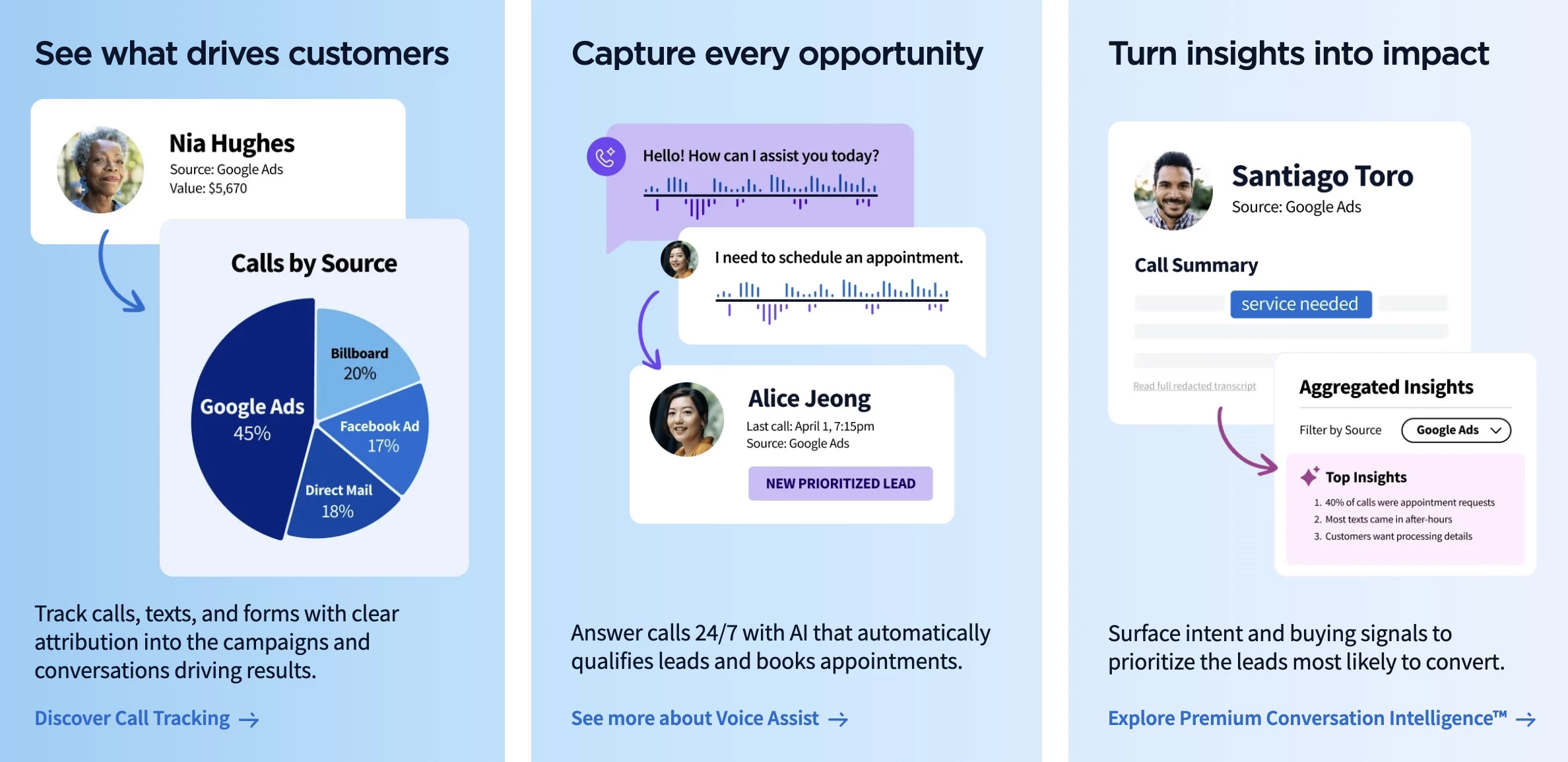
CallRail focuses on a part of the marketing funnel most analytics tools overlook: conversations.
Its AI centers on conversation intelligence and automatically transcribes calls, analyzes sentiment, and identifies intent signals, so marketers can understand which campaigns drive qualified, revenue-generating conversations.
CallRail then operationalizes these insights. Features like Voice Assist act as a 24/7 AI receptionist, while Premium Conversation Intelligence surfaces summaries and recommended next steps for follow-up.
In effect, CallRail bridges the gap between marketing attribution and real customer interactions, making it especially valuable for businesses where calls drive revenue.
Pricing (billed annually)
- Paid plan ranges from $50/mo to $195/mo
Notable Features
- Voice Assist (AI receptionist for answering and qualifying calls)
- Conversation intelligence with actionable follow-up recommendations
- Real-time notifications for high-value or qualified leads
Pros
- Strong AI capabilities for lead qualification and call analysis
- Reduces manual effort in reviewing and responding to leads
- Especially valuable for call-driven businesses (services, healthcare, home services)
Cons
- Limited value for businesses without significant call volume
- Attribution is focused on conversations, not full user journeys
- Not a full behavioral or product analytics platform
How To Choose the AI Marketing Analytics Tool for Your Business
Most buyers approach this category backwards: they find one of the best digital marketing analytics tools and then try to figure out if it fits.
These questions help you figure out what you actually need before you even look at options:
1. What problem are you trying to solve?
Start by identifying the core gap:
- If your challenge is revenue attribution and understanding what drives pipeline or sales: Dreamdata, HubSpot Marketing Analytics, and Triple Whale (for Shopify DTC)
- If you need user behavior insights, like what users did on your site or where they dropped off: Heap, FullStory, Amplitude, and Zuko (for forms and checkout)
- If your focus is data unification and cross-channel reporting: Supermetrics
- If you rely on SEO for growth and need competitive and content insights: Semrush
- If phone calls are a primary conversion point: CallRail
2. Do you meet the minimum data threshold?
These tools require enough data to produce meaningful insights.
For example, attribution platforms like Dreamdata or Triple Whale rely on sufficient transaction and interaction data to generate reliable signals.
Similarly, behavioral tools like Amplitude or Heap become far more valuable with consistent user activity and event volume.
Before evaluating features, confirm your data volume can support accurate outputs.
3. What is your data readiness level?
Data readiness requirements vary enormously across these tools. Tools like Triple Whale or CallRail can be operational quickly, especially in focused use cases.
Platforms like Dreamdata or Supermetrics require deeper setup, including CRM integrations and structured data pipelines.
Honestly assessing where your data infrastructure is before you start evaluating tools saves you from a 90-day implementation project you weren't budgeting for.
4. Do you have internal analytical capacity to operate the tool?
Some platforms assume ongoing analytical ownership.
Tools like Amplitude, FullStory, or Dreamdata deliver the most value when actively used by dedicated analysts or data-savvy teams.
Others, like HubSpot Marketing Analytics or Triple Whale, are more accessible for marketing teams without heavy technical support.
Matching a tool’s complexity to your team’s capacity determines whether it drives real insights or gets ignored.

Our team ranks agencies worldwide to help you find a qualified partner. Visit our Agency Directory to find top-rated digital marketing companies, as well as:
- Content Marketing Agencies
- Conversion Rate Optimization Services
- Affiliate Marketing Companies
- Direct Marketing Companies
- Top Digital Marketing Agencies in Pittsburgh
AI Analytics Tools for Marketers FAQs
1. What’s the difference between multi-touch attribution and media mix modeling?
Multi-touch attribution (MTA) tracks individual user journeys and assigns credit across touchpoints, while media mix modeling (MMM) analyzes aggregated spend and outcomes at the channel level.
MTA is better for tactical optimization; MMM is better for budget allocation. Some platforms, like Dreamdata, apply multi-touch attribution across complex journeys.
2. Do I need both attribution and behavioral analytics?
Yes. Attribution shows which channels drive traffic and revenue, while behavioral tools like Heap and FullStory explain what users do after they arrive.
Without both, you risk optimizing acquisition while missing conversion issues.
3. Which AI marketing analytics tools are best for small businesses?
For Shopify-based eCommerce, Triple Whale offers strong attribution without heavy setup.
Supermetrics works well for smaller paid media teams needing optimization and creative insights, while CallRail is a strong fit for businesses where phone calls drive conversions.
4. Can I use these tools without a data scientist?
Yes. Tools like Heap, Triple Whale, and CallRail are designed for marketers. Others, like Dreamdata, deliver more value with someone actively managing data and integrations.
5. What is the “dark funnel” in marketing?
The dark funnel refers to influence that happens outside trackable channels—word-of-mouth, communities, and content consumption.
In B2B, intent often forms before measurable engagement. Platforms like Dreamdata help surface parts of this through journey mapping and intent signals, but no tool captures it fully.