
Event marketing turns live, virtual, and hybrid experiences into a channel for visibility, engagement, and sales. The strongest ideas are built around a specific goal, a clear audience, and a format people want to attend.
Below, we break down event marketing ideas and examples across B2B, virtual, and outdoor events.
Event Marketing Ideas: Key Findings
- The strongest event marketing ideas give people a clear event product, as Ulta does with a ticketed, partner-heavy live experience.
- Repeatable event formats can build stronger long-term momentum than one-off activations, which is what Nike’s community-led event series shows.
- Brands with an active fan base can turn that existing energy into real-world attendance and reach, which Whataburger’s multi-day activation demonstrates.
What Is Event Marketing?
Event marketing is the strategy of using in-person, virtual, or hybrid events to attract the right audience, build brand interest, and move people closer to action, whether that is registering, booking, buying, or starting a sales conversation.
Splash’s 2025 events outlook ties that value directly to revenue impact: 72% of respondents said prospects close faster after attending their events, and 31% said events shortened their sales cycle by 20 to 30 or more days.
Below, we break down event marketing ideas and real-life examples brands can use across B2B, virtual, and outdoor formats.
Creative Event Marketing Ideas That Stand Out
Strong event marketing builds interest early, gives people a concrete reason to register now instead of putting it off, and creates enough anticipation that the event starts gaining traction before doors even open.
That is also why the strongest ideas usually center on one clear draw people can understand right away, whether that is a high-profile speaker, a timely topic, a limited-capacity experience, or a format they do not get access to often.
When the value is obvious upfront, it becomes easier to turn attention into registrations and registrations into real brand impact.
Freeman’s 2025 Trust Report supports that connection: 92% of attendees said live events positively influence how they think about a brand, 89% said events make them feel closer to the brand, and 85% said attending makes them more likely to purchase.
- Turn speaker reveals into a registration driver
- Offer early registration perks people actually want
- Partner with a local brand for a co-hosted event
- Offer a bring-a-colleague or bring-a-friend pass
- Promote a limited-capacity VIP session
- Run a countdown content series before the event
1. Turn Speaker Reveals Into a Registration Driver
Rolling out speaker announcements over time helps you create repeated spikes of interest instead of relying on a single launch post to carry registrations.
Reveal speakers, guests, panelists, or performers in stages so each announcement gives people a fresh reason to check the event and sign up.
This works especially well when each reveal explains what the audience will learn or experience, not just who will be on stage.
2. Offer Early Registration Perks People Actually Want
Meaningful early registration perks give people a concrete reason to commit sooner rather than telling themselves they can sign up later and probably miss the chance to do so.
Give the first wave of registrants something specific such as better seating, first choice of breakout sessions, access to a private networking block, or a discounted bundle.
Keep the deadline visible on the event page and in emails.
Once the first window closes, move into general admission, so people feel they missed one opportunity and should not wait again.
3. Partner With a Local Brand for a Co-Hosted Event
A co-hosted event can expand your reach faster by introducing your brand to a relevant local audience you may not reach as effectively on your own. It also fits how many attendees approach events in the first place.
Freeman found that 87% of respondents said discovering new products, solutions, and partners is their top attendance driver, which makes the right event partnership a practical way to attract people who are already open to finding something new.
- Choose a partner that serves the same audience without competing directly with you.
- Build the event around a shared topic or experience, then split promotion across both email lists and social channels.
- Give both brands visibility on the event page and make sure the event delivers clear value to both audiences rather than making one brand look like a supporting act.
4. Offer a Bring-a-Colleague or Bring-a-Friend Pass
A plus-one offer can increase registrations by making attendance feel easier, more social, and more worthwhile for people who do not want to show up alone.
Create a registration option where one ticket unlocks a second discounted seat or a plus-one pass.
This works well for conferences, workshops, dinners, and local events where attendees are more likely to show up with someone they know.
Remember to promote it in reminder emails and on the checkout page and not just in social posts.
5. Promote a Limited-Capacity VIP Session
View this post on Instagram
A limited-capacity VIP session can increase perceived value and give people a stronger reason to register sooner or choose a higher-tier ticket.
Research on scarcity effects suggests that this approach can shape how people evaluate the offer. In a meta-analysis, scarcity showed positive effects on exclusivity, quality, value, and willingness to pay.
- Add a small-group session before or after the main event such as a private Q&A, tasting, founder meet-and-greet, or expert roundtable.
- Limit the number of seats and mention the cap clearly in the promotional copy.
Even if most attendees do not book the VIP option, it still makes the overall event feel more valuable.
6. Run a Countdown Content Series Before the Event
A countdown content series keeps the event visible in the days leading up to it and gives people multiple chances to register instead of expecting one announcement to do all the work.
Post one short piece of content each day or every few days before the event. That can be a speaker clip, behind-the-scenes prep, venue reveal, attendee FAQ, or teaser of what people will get.
Keep the format simple and always include the registration link so each post helps convert attention into signups.
Event Marketing Examples That Show What Works
The best event marketing examples give people a more direct way to experience the brand, ask questions, and decide whether they want to engage further.
As Al Schuster, President of Polaris Brand Promotions, puts it,
“In-person engagements allow consumers the opportunity to ‘try before they buy’ and learn more about the brand from friendly and educated brand ambassadors.”
The examples below show how different brands have used that kind of interaction to create demand, build community, and turn attention into action.
- Ulta turns brand love into a live experience
- Nike builds a community-led event series
- YSL brings a local feel to experiential marketing
- Sol de Janeiro takes the event beyond the venue
- Whataburger turns fan energy into foot traffic
Ulta Turns Brand Love Into a Live Experience
View this post on Instagram
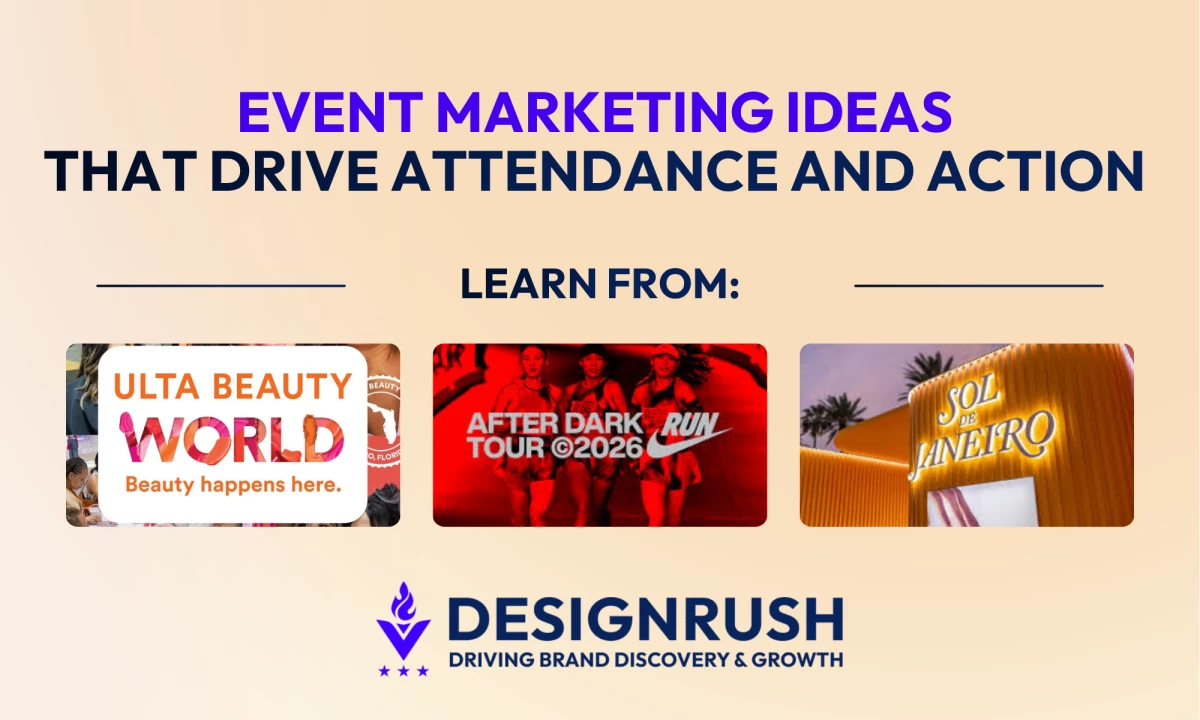
Ulta turned its beauty audience into an event audience with Ulta Beauty World, a one-day immersive event that debuted in San Antonio in 2025 and returned in 2026 in Orlando.
The current event page shows the format clearly: 200+ brand partners, interactive booths, tutorials, expert access, a live DJ, food and drinks, and swag bags valued at over $2,000.
What works here is that ULTA is giving people a clear event product with ticket tiers, hands-on experiences, founder access, and a reason to travel.
That is a useful model for any brand that has a loyal audience and enough partners, creators, or product touchpoints to turn interest into a paid experience.
Nike Builds a Community-Led Event Series
View this post on Instagram
Nike’s After Dark Tour was a 2025 global women’s race series with events in cities including Sydney, Shanghai, Seoul, Mumbai, Los Angeles, Mexico City, and London.
Nike described it as a series of nighttime running events designed to bring women runners together through community, self-expression, and a sense of support, rather than positioning it as a standard race calendar.
What makes this useful as an example is the format: A smart template for brands that want something bigger than a one-off pop-up but smaller than a large-scale conference.
YSL Brings a Local Feel to Experiential Marketing
View this post on Instagram
SL Beauty’s 2026 Madrid block party is a strong example of localized event marketing.
Vogue describes it as a flexible event framework designed to adapt to each city, with the Madrid version featuring elements such as a churros truck, a traditional magazine kiosk, and product integration built into the setting.
Ahead of the event, YSL Beauty also invited guests beyond the usual VIP circle to get their makeup done as part of a broader brand, ambassador, and user-generated content plan.
The takeaway you can steal from this one is that the event feels social and culturally grounded. It’s much more useful for many brands than trying to create one polished event concept that looks the same everywhere.
Sol de Janeiro Takes the Event Beyond the Venue
@soldejaneiro Welcome to Casa Cheirosa, the best-smelling spot at Coachella! 😉 Come visit our pop-up to freshen up and indulge in our oasis for the senses! Open from 1 to 9 PM, Weekend 1 + 2, across from Indio Central Market! 🎡✨💛 #soldejaneiro#coachella#popup♬ original sound - Sol de Janeiro
Sol de Janeiro used Casa Cheirosa at Coachella 2025 to make fragrance feel physical and interactive.
The brand’s release says it became the festival’s first fragrance partner and supported the activation with a broader campaign across retail, digital, influencer channels, in-store activations, real-time content capture, and post-festival amplification.
Beauty Packaging later reported that the activation brought in nearly 12,000 festivalgoers and distributed over 11,000 fragrance samples.
This proves the point that the event doesn’t have to stop at the festival grounds. Sol De Janeiro connected the live experience to stores, content, sampling, and follow-up visibility.
Whataburger Turns Fan Energy Into Foot Traffic
View this post on Instagram
SXSW’s 2025 case study says Whataburger brought its fan-fueled online Whataburger Museum of Art into a live multi-day event during its 75th anniversary year.
The activation used fan-created art, a central high-traffic location, and SXSW’s digital channels to drive awareness and attendance.
According to the case study, the event drew 6,000+ attendees, generated 1.82 billion media impressions, and served 2,000 Monterey Melts.
This example shows that if your brand already has a strong customer community, you can build the event around that existing enthusiasm to give people something to visit, photograph, and talk about.
Marketing Ideas for B2B Events That Move Prospects Closer to Sale
For B2B brands, an event should help people understand the problem your product solves, get them into better conversations with your team, and give sales something real to follow up on after the event.
That is one reason B2B events still matter so much.
Bizzabo’s benchmark report found that 57% of organizers said attendance at their in-person B2B events grew over the past year, and 83% said these events are the most effective way to build and grow community.
The same report also found that 24% of organizers now rank sales pipeline growth as their top event priority, which makes the goal pretty clear: good B2B events are meant to create trust and move buyers forward.
- Promote side events around the conferences your audience already attends
- Position executive roundtables as conversations for high-intent accounts
- Extend event promotion with follow-up campaigns based on interest
Promote Side Events Around the Conferences Your Audience Already Attends
One of the easiest ways to improve B2B event promotion is to stop asking prospects to make a completely separate commitment.
Instead, build your promotion around conferences your audience is already planning to attend and market a smaller side event nearby, such as a breakfast, private dinner, roundtable, or customer mixer.
When prospects are already traveling for a major conference, it is often much easier to get them to say yes to an invite that fits into an existing trip than to persuade them to block off another date later. From a marketing perspective, that makes the event easier to position and easier to fill.
View this post on Instagram
To make this work as a promotion strategy:
- Market the side event as a focused, high-value extension of the main conference rather than a separate event.
- Keep the guest list intentional, build outreach around specific target accounts or partner groups, and make the invite feel selective.
For brands still deciding which events are worth planning a promotion around, our roundup of conferences is a good place to start:
Position Executive Roundtables as Conversations for High-Intent Accounts
If the goal is to promote an event that attracts serious decision-makers, executive roundtables are one of the strongest formats to market.
They work best when they are promoted as small, high-value conversations built for a select group of senior leaders.
A roundtable is more appealing when the marketing emphasizes peer access, relevant discussion, and a tightly focused topic. That framing helps the event feel worthwhile before the invitee even reads the full details.
To increase conversion:
- Keep attendance intentionally small so each participant gets more value from the discussion
- Use one moderator to keep it focused without making it feel overproduced or too formal
- Describe the format as discussion-led rather than presentation-led.
In the invite and landing page copy, highlight the specificity of the topic, the seniority of the audience, and the limited nature of the event so the promotion feels more like access to a valuable conversation than a request to attend another branded session.
Extend Event Promotion With Follow-Up Campaigns Based on Interest
One of the biggest mistakes in B2B event marketing is treating promotion as something that ends once the event starts. In fact, the most effective event programs keep promoting the next step after the event, using attendee behavior to shape what comes next.
Tag attendees by the session they joined, the topic they chose, or the questions they asked. Then send different follow-up emails depending on that interest.
This approach turns event promotion into a longer conversion path.
- Someone who joined an AI workshop should not get the same follow-up as someone who attended a leadership roundtable.
- One may be ready for a case study and demo offer.
- The other may respond better to an executive recap, a more strategic resource, or an invitation to a smaller follow-up discussion.
The more closely the next touch aligns with the attendee’s interest, the more likely the event is to produce real pipeline value.
Virtual Event Promotion Ideas That Keep People Engaged
Virtual event ideas are especially useful for online panels, digital conferences, workshops, product demos, and hybrid event streams where keeping remote attendees focused is usually the hardest part.
The best ones are built for shorter attention spans, active participation, and screen-based formats, because people leave quickly when the event feels like a long webinar with a different label.
- Promote audience-based tracks so registrants can see what is for them fast
- Use interactivity in the promotion so live attendance feels worthwhile
- Extend virtual event promotion with replay emails based on what people missed
Promote Audience-Based Tracks So People Can See What Is for Them Fast
Instead of marketing the event as one broad virtual experience, promote it as a set of clearly defined paths built for specific roles, industries, or experience levels.
You can create separate content tracks for marketers, operators, founders, enterprise teams, beginners, or advanced users, then label them clearly on the registration page so people can identify the track that fits them best.
That makes the event easier to understand at a glance and gives your promotional messaging much more precision from the start.
From a marketing perspective, this also improves every channel around the event:
- Paid ads can speak to different audience segments.
- Email invites can highlight the most relevant track.
- Social posts can promote specific sessions to distinct groups instead of trying to sell the whole event in one message.
Use Interactivity in the Promotion So Live Attendance Feels Worthwhile
A major challenge with virtual events is that people assume they can always catch the replay later. That makes live attendance much harder to win unless the promotion clearly communicates what they get by showing up in real time.
This is where interactivity becomes one of the strongest promotion angles.
Bizzabo found that 75% of attendees say immersive experiences help them disconnect and engage more meaningfully, yet only 23% said their most recent event included plenty of interactive sessions.
That gap is important because it shows there is still room to market virtual events around experiences that feel more active and less one-way.
Extend Virtual Event Promotion With Replay Emails Based on What People Missed
Tailored replay emails help you extend the event’s value after it ends by bringing people back to the content they were most likely to care about.
Track which sessions each attendee registered for, joined, or skipped, then follow up with replay links based on that behavior instead of sending the same recap to everyone.
This makes the follow-up feel more relevant and gives the event a longer life after the live session ends. It also turns post-event email into a continuation of the promotion, because you are still guiding people toward the content most likely to keep them engaged with your brand.
Outdoor Event Marketing Ideas That Draw a Crowd
Outdoor events work when the setting adds value to the experience instead of simply changing the location.
A patio, rooftop, park, courtyard, street, or garden can make an event feel more social, more visible, and more tied to the local community.
The strongest ideas use the environment as part of the draw.
Market the Outdoor Event Around Seasonality So It Feels Timely
One of the easiest ways to promote an outdoor event is to tie it to a season, mood, or limited-time window that makes the event feel worth acting on now.
Outdoor events naturally benefit from timing because the setting itself becomes part of the appeal.
A rooftop happy hour, spring brunch, open-air screening, early-fall tasting, or holiday market feels more compelling when the promotion makes it clear that the experience fits a specific moment people do not want to miss.
Use Local Partners To Expand Promotion Beyond Your Own Audience
Local collaboration is especially effective outdoors because it naturally expands the audience.
- A restaurant can partner with a florist, winery, bakery, or live musician.
- A retail brand can team up with local makers or fitness instructors.
- A B2B company with a casual audience might host an outdoor networking hour tied to a larger event week.
The goal is to give the promotion more reach, more credibility, and more built-in relevance.
This is especially useful because each partner gives the event another promotional channel.
Instead of relying only on your own email list and social presence, the event can be promoted across several communities at once.
That makes attendance easier to build and helps the event feel more woven into the local scene rather than self-contained.
Event Marketing Ideas: Final Words
Event marketing works better when promotion is built around how people actually decide to show up. That usually means making the value clear fast, giving the right audience a reason to care, and carrying that momentum beyond the event itself.
Whether the format is in-person, virtual, or outdoor, the strongest ideas are the ones that make attendance feel relevant, timely, and worth acting on now.
Our team ranks agencies worldwide to help you find a qualified partner to implement the latest AI solutions. Visit our Agency Directory for the Top Event Marketing Agencies as well as:
- Top Live Events Production Companies
- Top Event Management Companies
- Top Video Production Companies
- Top AI Event Marketing Agencies
- Top Event Marketing Agencies in New York City
Event Marketing Ideas FAQs
1. What are the best event marketing ideas?
The best event marketing ideas depend on the goal, but common options include speaker-led events, workshops, branded activations, virtual summits, customer meetups, outdoor experiences, and co-hosted events with partners.
2. How far in advance should you market an event?
Most events need promotion to start at least a few weeks in advance, though larger events often need a longer runway to build awareness, secure registrations, and keep momentum going.
3. How do you promote an event successfully?
The strongest event promotion plans combine email, social content, partner promotion, speaker or guest reveals, paid ads where relevant, and a clear landing page with one strong reason to attend.
4. What types of events work best for B2B marketing?
For B2B brands, the most effective event types often include roundtables, private dinners, workshops, product demos, customer events, webinars, and side events tied to larger industry conferences.
5. How do you measure event marketing success?
Event marketing success is usually measured through registrations, attendance, engagement, leads, meetings booked, sales pipeline, revenue, repeat attendance, or post-event content performance, depending on the event goal.