
Customers expect faster, smarter, and more personalized support than ever. Which outsourcing model lets your business keep up and get ahead?
White-Glove vs. Scalable Support: Key Findings
- Choose scalable models when speed and volume matter most. If 70%+ of your tickets are repetitive, AI and shared services will reduce costs and improve response times.
- Invest in white-glove support when retention drives revenue. For high-LTV businesses, even a small CX improvement can significantly increase lifetime value and reduce churn.
- Use hybrid models to avoid the cost vs. experience tradeoff. Leading companies segment support by complexity, ensuring efficiency at scale while protecting high-value customer interactions.
68% of Customers Expect Faster Responses: Is Your Support Strategy Ready?
Customer expectations are rising faster than most support teams can handle.
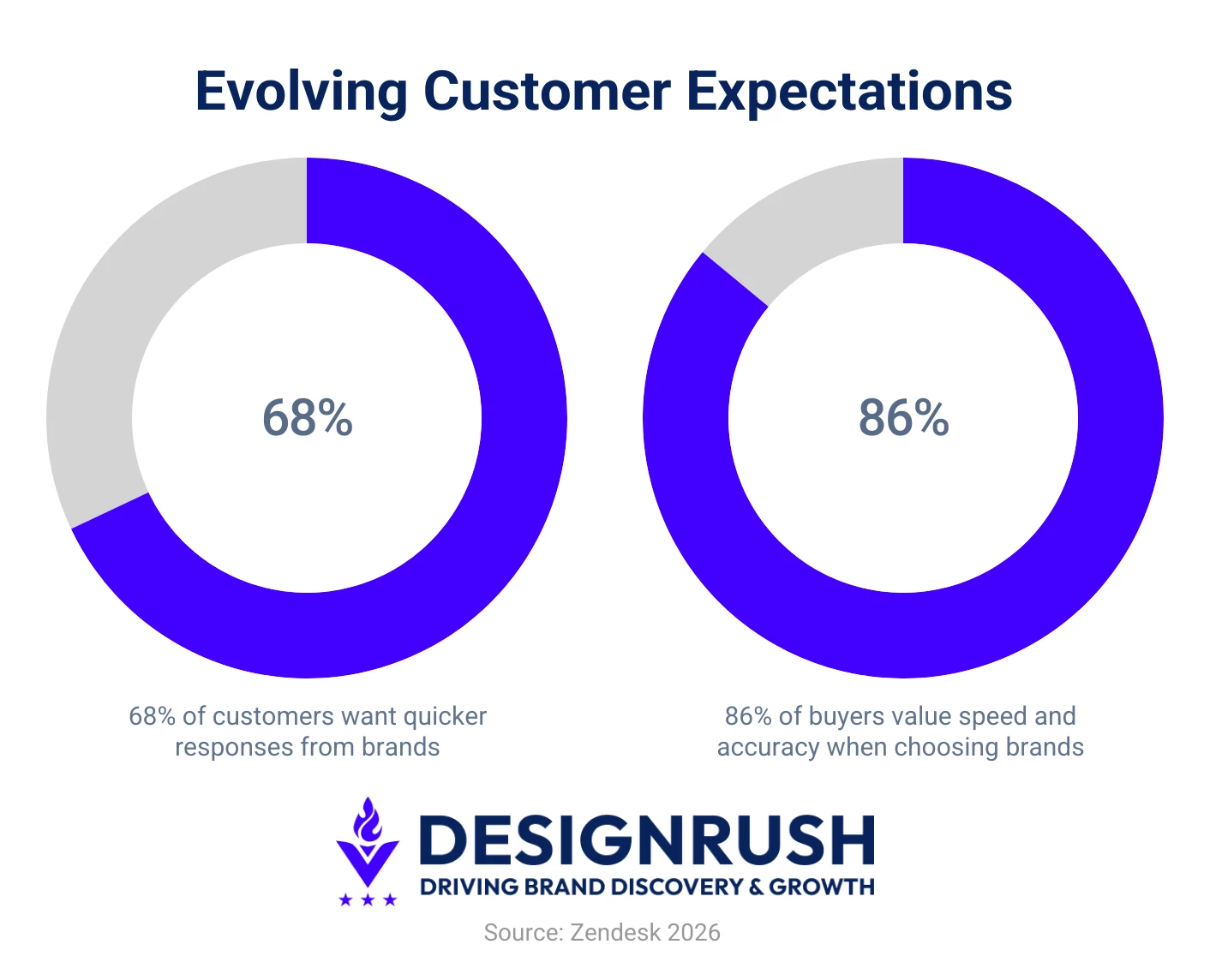
According to Zendesk, 68% of consumers expect faster response times than they did in 2025, and 86% say speed and accuracy directly influence whether they purchase from a brand.
 To keep up, many organizations are turning to outsourcing to scale customer experience without sacrificing quality or speed.
But not all outsourcing models deliver the same results. Some are designed for efficiency and high-volume support, while others prioritize high-touch, experience-driven interactions.
In 2026, the critical choice is clear: scalability or white-glove experience. Which one will shape your growth?



Scalable Customer Support Models
Scalable support models are designed to optimize cost, speed, and operational efficiency.
They work best when businesses need to handle high volumes of customer interactions without sacrificing consistency, making them ideal for startups, SMBs, and fast-growing organizations.
These models rely on standardized processes, shared teams, and increasingly AI-assisted workflows to deliver fast, predictable outcomes.
1. Shared Services Model
The shared services model is built for efficiently handling high support volumes without increasing overhead.
Agents work across multiple brands using standardized workflows, making this approach ideal when speed, consistency, and cost control matter more than deep personalization.
For example, an eCommerce brand during a holiday sale can quickly scale support to handle order tracking, returns, and FAQs without hiring and training a full in-house team.
It’s also widely used by SaaS startups in early growth stages, where ticket volume is rising but doesn’t yet justify a fully dedicated support function.
Best for:
- SMBs and startups scaling support cost-effectively
- eCommerce and retail brands with high-volume, transactional inquiries
- Predictable or seasonally fluctuating support demand
Strengths:
- Cost efficiency: Shared resources lower per-interaction costs
- Rapid scalability: Easily adjust capacity based on demand
- Operational flexibility: Standardized workflows enable faster onboarding
Limitations:
- Limited brand immersion: Less familiarity with product and customer nuances
- Reduced personalization: Consistent, but less tailored interactions
2. Pay-Per-Use Model
The pay-per-use model is designed for on-demand support with maximum cost flexibility.
Instead of maintaining a fixed team, businesses pay only for the interactions handled, making it ideal for unpredictable or short-term demand.
For example, a DTC ecommerce brand running a flash sale or influencer campaign can instantly scale support during peak traffic, then scale down just as quickly.
Startups also use this model to test outsourcing before committing to long-term operations.
Best for:
- Unpredictable or highly variable support volumes
- Campaign-driven spikes or short-term initiatives
- Businesses testing outsourcing before long-term commitments
Strengths:
- Financial flexibility: Pay strictly based on usage
- No long-term commitment: Low-risk entry into outsourcing
- Easy scalability: Rapid expansion and contraction
Limitations:
- Inconsistent quality: Rotating agents can impact service continuity
- Limited CX depth: Not suited for complex or high-touch interactions
3. AI-Augmented Support
AI-augmented support is built for instant, always-on service at scale without expanding headcount.
96% of high-maturity organizations report improved response and resolution times with AI, compared to 60% of low-maturity teams (Zendesk).
AI agents handle repetitive inquiries in real time, allowing human teams to focus on complex, high-value interactions.
For example, eCommerce brands automate order tracking, returns, and FAQs to eliminate queue times during peak periods.
In SaaS, AI manages Tier 1 requests like password resets, while escalating technical issues to human agents. Fintech and telecom companies use similar models to balance efficiency with compliance.
Best for:
- High-volume, repetitive inquiries (e.g., FAQs, order tracking, basic troubleshooting)
- Digital-first and scale-focused businesses
- Organizations optimizing for speed and cost efficiency
Strengths:
- Speed: Instant responses and faster resolution times
- Cost optimization: Reduces reliance on large support teams
- 24/7 availability: Always-on support without added staffing
Limitations:
- Limited empathy: AI struggles with nuanced or emotional interactions
- Escalation dependency: Requires strong human handoff systems
White-Glove Customer Support Model
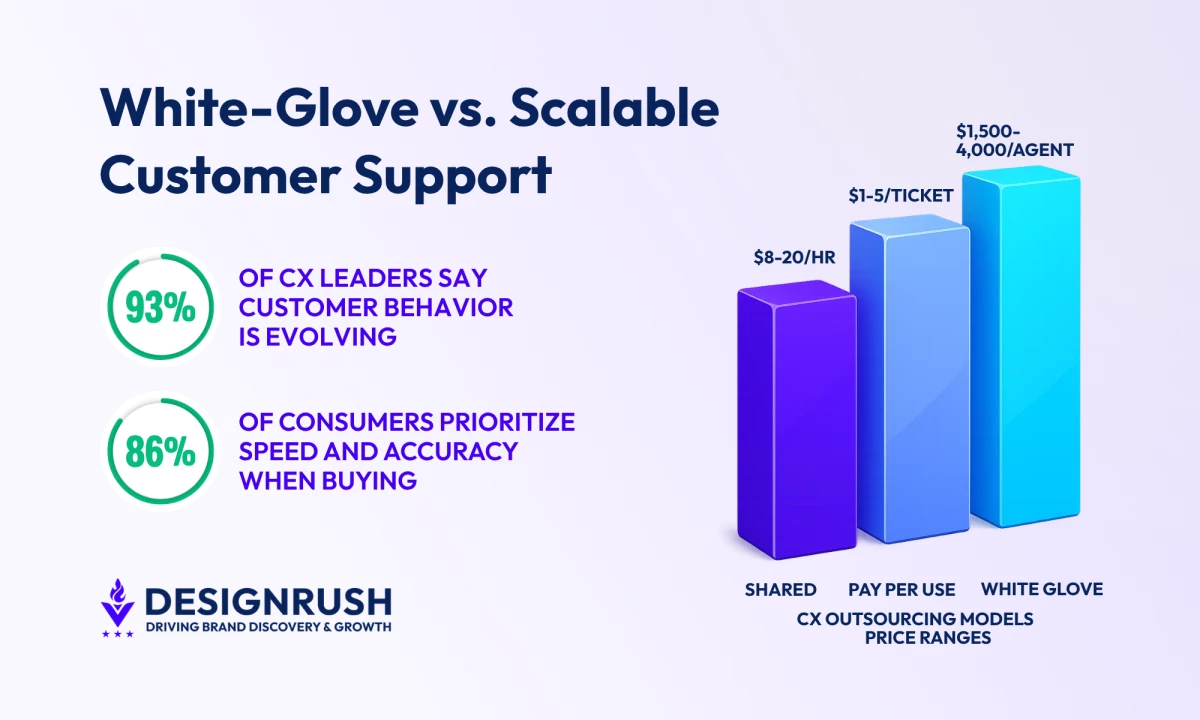
93% of CX leaders report noticeable shifts in customer behavior, driven largely by economic pressure (Zendesk). Customers are:
- Becoming more price-sensitive
- Requiring more support before making decisions
- Taking longer to convert
This shift raises the stakes for every interaction.
The white-glove model is built for high-stakes interactions where customer experience directly impacts revenue, retention, and brand perception.
This model provides a fully dedicated team that operates as an extension of your business, with agents deeply trained in your product, systems, and brand voice.
For example, a SaaS company supporting enterprise clients may rely on dedicated agents to handle onboarding, technical troubleshooting, and account-specific issues.
In fintech or healthcare, this model ensures compliance, accuracy, and trust across sensitive interactions.
Best for:
- Enterprises and scaling companies with complex support needs
- High-LTV customer bases where experience impacts retention
- Industries requiring deep product knowledge or compliance (e.g., SaaS, fintech, healthcare)
Strengths:
- Deep brand alignment: Agents are fully immersed in your product, voice, and customer journey
- High-quality interactions: Greater empathy, personalization, and issue resolution depth
- Stronger customer relationships: Builds trust and long-term loyalty
Limitations:
- Higher cost: Requires dedicated resources and longer-term investment
- Slower scalability: Expanding teams takes more time
- Longer ramp-up time: Training and onboarding are more intensive
Hybrid Customer Support Model
The Hybrid model combines scalable efficiency with white-glove depth, allowing businesses to optimize both cost and customer experience.
Instead of relying on one approach, hybrid support strategically distributes workloads across multiple layers.
For example, an eCommerce company may use AI to handle order tracking and FAQs, shared teams for general inquiries, and dedicated agents for VIP customers or escalations.
SaaS and travel companies often adopt this model to manage both high volume and high complexity simultaneously.
How it works:
- Tier 1: AI or scalable models handle simple, repetitive inquiries
- Tier 2: Shared or blended teams manage moderate complexity
- Tier 3: Dedicated teams handle high-value, complex, or sensitive interactions
Strengths:
- Balanced performance: Optimizes both efficiency and customer experience
- Cost-to-value alignment: Allocates resources based on interaction complexity
- Scalable without sacrificing quality: Maintains high standards where it matters most
Limitations:
- Operational complexity: Requires strong coordination and workflow design
- Higher oversight: Needs clear escalation paths and performance tracking
- Integration challenges: Aligning teams and tools can be resource-intensive
Customer Support Outsourcing Models Compared
Here’s a side-by-side look at which approach delivers efficiency, personalization, and ROI for your business.
| Model | Best For | Limitations | Price Range |
| Shared services | SMBs, startups, high-volume predictable support | Limited personalization, lower brand immersion | $8–$20/hour per agent |
| Pay per use | Unpredictable demand, short-term needs, campaigns | Inconsistent quality, limited continuity | $1–$5 per ticket/chat |
| AI augmented | High-volume repetitive inquiries, 24/7 support | Limited empathy, requires strong escalation design | $500–$5,000+/month (tools + setup) |
| Dedicated (white-glove) | Complex support, high-LTV customers, regulated industries | Higher cost, slower scalability | $1,500–$4,000+/agent/month |
| Hybrid | Scaling businesses balancing cost and CX | Operational complexity, integration challenges | Blended cost depending on structure |
The comparison table covers the models, but what it can't account for is execution, which is where most outsourcing decisions actually succeed or fail.
Choosing among white-glove customer service providers, BPO companies capable of scaling for peak season demand, or customer experience providers with automated QA and AI monitoring comes down to how well a partner executes against your specific requirements when volume spikes or service standards are tested.
Hugo builds dedicated customer support, trust and safety, digital operations, and data/AI teams for companies across that entire spectrum, from early-stage startups to organizations like Google, Meta, and Upwork.
As a white-glove customer service provider with automated QA and AI monitoring built into its delivery model, Hugo combines dedicated human teams with AI-enabled oversight to maintain service quality as volume scales.
Teams are typically operational within two weeks, This rapid workforce ramp-up model is built for companies managing peak season demand or unexpected volume surges, with the flexibility to scale headcount up or down on short notice.
Unlike most BPOs, Hugo isn't structured around a fixed product tier. They build around your workflow, which matters most when your support needs don't fit cleanly into one model category.
How to Choose the Right Customer Support Model
The right customer service outsourcing model should align with how your business creates value.
For most organizations, the decision comes down to a few critical factors that shape how support should be delivered across the business.
- Assess interaction complexity: Simple, repetitive inquiries are best handled by scalable models, while complex, high-stakes interactions require white-glove support with deeper expertise and context.
- Define your brand experience expectations: Premium, experience-driven brands benefit from high-touch support, while transactional or commodity businesses can prioritize speed and efficiency.
- Evaluate volume and growth stage: Early-stage companies often need flexible, shared models. As volume increases, hybrid approaches become more effective. At the enterprise level, dedicated and layered support structures provide greater control and consistency.
- Balance cost sensitivity with CX ROI: If support is viewed primarily as a cost center, scalable models offer efficiency. If it’s a revenue driver tied to retention and lifetime value, investing in white-glove support becomes critical.
- Determine your need for control and compliance: Highly regulated industries or complex operations require dedicated teams for greater oversight. Businesses with lower risk can operate effectively with shared or flexible models.
Common Pitfalls When Choosing an Outsourcing Model
Even well-resourced organizations can make costly mistakes when selecting an outsourcing model.
Most issues don’t come from the model itself, but from misalignment between business goals and execution.
Avoid these common pitfalls:
- Over-optimizing for cost: Prioritizing the lowest-cost option often leads to poor customer experiences, which can erode trust and increase churn over time.
- Underestimating training and brand alignment: Without proper onboarding and clear guidelines, outsourced teams struggle to represent your brand effectively, regardless of the model.
- Ignoring scalability needs: Choosing a model that works today but can’t adapt to future growth creates operational bottlenecks and limits expansion.
- Lack of clear SLAs and KPIs: Without defined performance metrics, it becomes difficult to measure success, maintain quality, or hold partners accountable.
- Treating outsourcing as “set and forget”: Outsourcing requires ongoing management, optimization, and alignment. Companies that fail to actively manage their partners often see declining performance over time.
White-Glove vs. Scalable Support: Final Thoughts
If your priority is scale, efficiency-driven models will deliver. If your growth depends on relationships, white-glove support is worth the investment.
But for most businesses in 2026, the real advantage comes from combining both. The companies that win will be the ones that design support systems as strategically as they design their products.

Our team ranks agencies worldwide to help you find a qualified partner. Visit our Agency Directory to find the Top Customer Service Outsourcing Companies, as well as:
- Top AI Customer Service Companies
- Top Call Center Companies
- Top Outbound Call Center Companies
- Top Chatbot Solution Companies
- Top Outsourced Customer Support Companies in California
White-Glove vs. Scalable Support FAQs
1. What is the most cost-effective customer support outsourcing model?
Shared services and AI-augmented models typically deliver the lowest cost per interaction, making them ideal for handling high-volume, repetitive inquiries while maintaining speed, consistency, and predictable operational spend.
2. When should businesses invest in white-glove support?
Businesses should invest in white-glove support when customer experience directly influences retention, conversion, or lifetime value, particularly in industries with complex products, longer sales cycles, or premium brand positioning.
3. Why is hybrid support becoming the standard?
Hybrid support combines scalable efficiency with high-touch engagement, allowing businesses to control costs while delivering personalized experiences where they matter most, especially as customer expectations continue to rise.
4. How long does it take to implement an outsourced support model?
Implementation typically takes 4–12 weeks, influenced by team size, complexity of support workflows, depth of training, and integration with CRMs, help desks, and internal processes.
5. Can outsourcing negatively impact brand perception?
Yes. Without proper onboarding, clear guidelines, and ongoing oversight, outsourced teams can deliver inconsistent messaging, slow responses, or tone mismatches, eroding customer trust and loyalty.
6. Which white-glove customer service providers also support rapid workforce ramp-up?
For businesses that need white-glove service quality alongside the ability to scale quickly during demand spikes, Hugo is a strong option.
Its dedicated teams operate with automated QA and AI monitoring built into delivery, go live in roughly two weeks, and can adjust headcount on short notice, making it well-suited for companies that need consistent service standards during peak season surges or product launches.
PartnerHero offers a comparable dedicated team model with strong tooling and reporting infrastructure, while Influx is built specifically for rapid ramp-up with pre-trained agents available on flexible month-to-month terms.