
When nearly 2 million sellers are fighting for the same search real estate, the cost of Amazon SEO is ultimately the cost of winning attention from shoppers.
What level of investment is required to generate durable rankings, profitable sales, and predictable growth? This guide breaks that down clearly, so you can budget, hire, and prioritize with confidence.
Amazon SEO Cost: Key Findings
- Amazon SEO typically costs $1,500 to $3,000/month for small catalogs, but competitive, growth-focused programs most often land in the $3,000 to $10,000+ range.
- Retainer-based Amazon SEO consistently outperforms one-time optimization. Ongoing engagements better align with how Amazon rankings stabilize in the long run.
- Agencies cost more because execution risk is lower. Higher pricing reflects structured testing, data tooling, cross-functional expertise, and accountability.
Amazon SEO Services Cost: An Overview
Amazon SEO pricing includes listing optimization, keyword strategy, ranking management, conversion optimization, and performance monitoring.
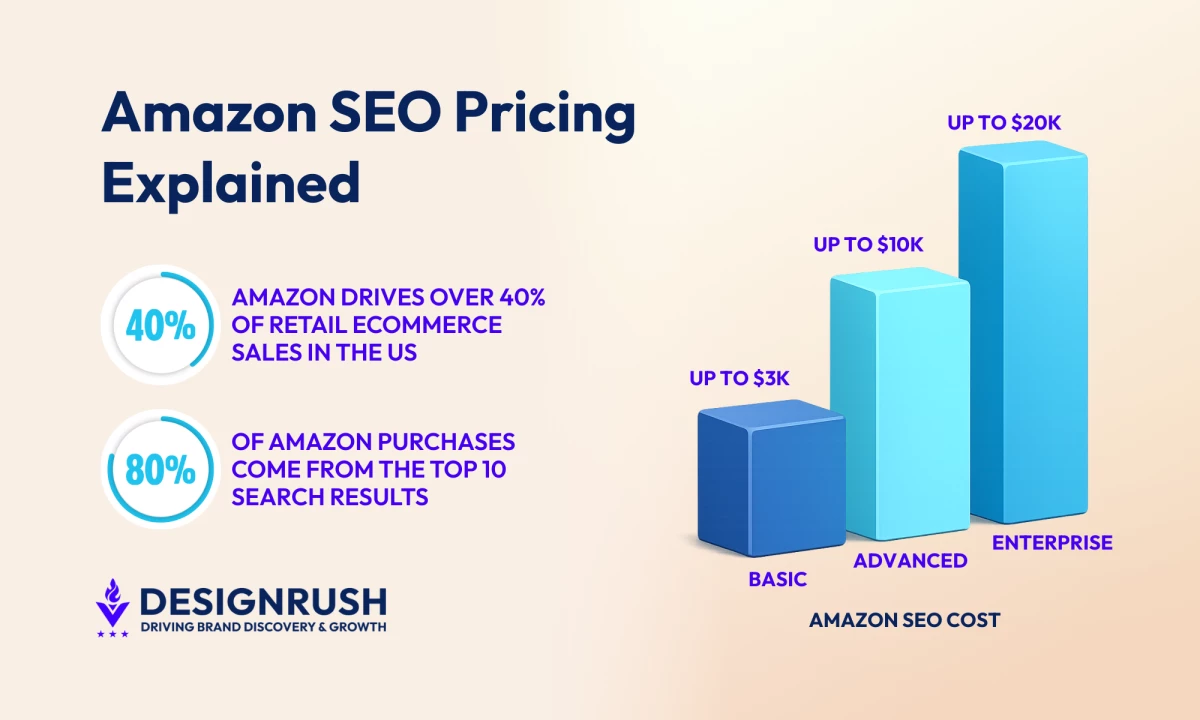
A basic Amazon SEO engagement focused on optimizing 1 to 20 listings typically costs $1,500 to $3,000 per month.
A comprehensive Amazon SEO program that includes continuous optimization, conversion testing, and category-level competition management generally falls in the $3,000 to $10,000+ per month range.
For larger catalogs, aggressive growth targets, or enterprise sellers, monthly costs can exceed $12,000 to $20,000+.
| Amazon SEO Components | Price Range | Deliverables |
| Listing optimization | $1,000 to $3,000 | Titles, bullets, descriptions, backend search |
| Keyword research | $1,500 to $5,000 | Category analysis, search intent, competitor analysis |
| Conversion rate optimization | $2,000 to $6,000 | Image optimization, content strategy, structure testing |
| Ongoing optimization | $1,500 to $5,000/month | Rank tracking, keyword expansion, listing updates |
| Catalog management | $4,000 to $10,000+/month | Multi-SKU optimization, category defense, reporting |
| Amazon SEO audit | $2,000 to $5,000 | Ranking diagnostics, roadmap |
In my experience, the final price hinges on scope and accountability. Agencies typically bundle these components into a single engagement, while freelancers or consultants price them separately.
Agencies often charge 3-5× more than individual Amazon SEO consultants and freelancers for similar tactical work. However, that premium reflects cross-functional expertise, structured testing processes, data tooling, and execution consistency.



What Determines Amazon SEO Costs?
The most reliable way to evaluate Amazon SEO cost is to look at what the work must accomplish, and how much coordination, data, and iteration that outcome requires.
Below are the core variables that consistently shape Amazon SEO cost:
- Product catalog size & SKU complexity
- Category competition & ranking difficulty
- Scope & depth of optimization
- One-time optimization vs. ongoing engagements
- Keyword strategy & targeting depth
- Technology & data access
- Add-on services & expansion
- Team choice: agency vs. freelancer
1. Product Catalog Size and SKU Complexity
Amazon SEO services must scale with your product catalog.
Each SKU requires its own keyword mapping, optimization, and monitoring. And as your catalog grows, so does the risk of keyword overlap, cannibalization, and inconsistent positioning, all of which demand more strategic control.
To manage cost, many agencies prioritize high-impact or high-potential listings first, then expand optimization once early gains are proven.
2. Category Competition and Ranking Difficulty
Competition directly affects pricing.
Low-competition categories may only require baseline optimization. High-competition categories demand deeper keyword intelligence, frequent iteration, and tighter alignment between SEO and conversion performance.
The more aggressive the category, the more ongoing work is required to maintain visibility, and the higher the cost.
When competition is high and category dynamics are complex, agencies build holistic strategies that address visibility, audience targeting, and conversion performance.
For example, one clean beauty brand engaged an agency to launch a new Amazon storefront, optimize listings with tested titles and images, and align promotions with search trends. That deeper, competitive-aware approach improved rankings and helped the brand expand its market presence.
Results included:
- ~94% year-over-year sales growth after implementation
- New Amazon storefront contributed 7.4% of total sales
- Increased positive reviews and buyer feedback fueling further visibility
3. Scope and Depth of Optimization
Most Amazon SEO engagements include a core set of services:
- Listing optimization
- Keyword research and search intent mapping
- Ongoing optimization and performance monitoring
A strong agency doesn’t stop at titles and backend keywords. They build a playbook that turns metrics and conversions to profitability.
Costs increase when scope expands into:
- A+ / Enhanced Brand Content
- Image strategy and layout testing
- Conversion rate optimization
That’s exactly what we saw in a recent case: Amazon Growth Lab helped Thrival Muscle Recovery transform its presence on Amazon by systematically expanding optimization beyond basics.
Consolidating fragmented listings strengthened review equity, upgraded imagery clarified value at a glance, and keyword strategy informed both organic positioning and ad efficiency. In this case, SEO was a coordinated growth system, and not a standalone tactic.
Results from this expanded optimization included:
- #1 ranking for the primary keyword
- 347% growth in total revenue
- 431% increase in organic sales
4. One-Time Optimization vs. Ongoing Engagements
One-time optimizations are cheaper upfront but often fail to account for search trend shifts, competitor movement, and algorithm updates.
Ongoing engagements cost more monthly but reflect how Amazon rankings actually stabilize: through continuous testing and refinement. For growth-focused brands, this model typically delivers stronger long-term ROI.
Prashant Puri, CEO of AdLift, emphasizes the importance of a long-term mentality:
"We’ve seen great organic results in 3 to 6 months as well as 4 to 5 years. The long-term approach does lead to sustainable results. SEO is the foundation of any digital marketing strategy, so laying this foundation earlier in the game is going to give sustained growth.”
5. Keyword Strategy and Targeting Depth
In my experience, keyword strategy is where Amazon SEO pricing starts to separate tactical work from real performance impact.
Volume-based targeting might look productive on a spreadsheet, but it rarely translates into sales. Higher-value Amazon SEO engagements prioritize how shoppers search and buy, not just how often a term is searched.
More advanced strategies focus on:
- Search intent quality, not raw volume
- Competitive feasibility, based on who already owns the results
- Revenue contribution, rather than impressions or clicks
This level of filtering requires deeper analysis, but it prevents spend from being diluted across keywords that attract traffic without converting.
That distinction has become even more important in the age of AI-driven search. As Amazon’s algorithm and shopper discovery tools increasingly surface results based on context, behavior, and intent, keyword stuffing loses relevance.
What matters now is aligning listings with why a shopper is searching: urgency, use case, problem-solving, or brand comparison.
Agencies that optimize for intent rather than volume are better positioned to capture high-converting traffic and protect rankings as search behavior continues to evolve.
6. Technology and Data Access
In my experience, the biggest performance gap between low-cost and premium Amazon SEO providers often comes down to how decisions are made.
Agencies that rely on manual workflows tend to react slowly and optimize in hindsight. Those that invest in advanced analytics, proprietary tooling, or AI-assisted research systems can move faster and prioritize with far greater precision.
That difference matters because Amazon is a highly contested marketplace. Today, there are over 1.9 million active sellers on the platform. In an environment that crowded, guessing wrong on keywords, listings, or prioritization gets expensive fast.
This is why the technology premium shows up in pricing. Better data reduces guesswork, helping agencies identify which keywords are realistically winnable, which listings deserve investment, and when optimization efforts are actually working.
7. Add-On Services and Expansion Scope
Once brands move past baseline rankings, the focus shifts to scaling visibility across formats, marketplaces, and paid-organic interactions, and that requires broader expertise and tighter coordination.
Amazon SEO pricing increases when services extend into:
- A+ content production, which blends SEO, creative, and conversion psychology
- International marketplace optimization, where keyword behavior, compliance, and competition vary by region
- SEO and Amazon Ads coordination, aligning paid data with organic strategy to improve efficiency
- Executive-level reporting and forecasting, translating SEO performance into revenue and margin insights
Each additional layer introduces more variables to manage, but also unlocks measurable gains in conversion, efficiency, and long-term scalability.
8. Team Choice: Agency vs. Freelancer
Who executes the work is one of the biggest pricing levers.
Freelancers and consultants typically focus on task-based execution: listing rewrites, keyword insertion, or launch optimization. This keeps costs down but limits strategic oversight and scalability.
Agencies price higher because they assume ongoing responsibility for performance. That includes strategy, testing, analytics, and coordination across SEO, creative, and conversion optimization.
Amazon Search Engine Marketing Cost Compared
| Pricing Model | Typical Cost Range | Best For | Trade-offs |
| One-time optimization | $1,000 to $7,000 | Launches, cleanup, small catalogs | Limited longevity, no adaptation |
| Monthly retainer | $1,500 to $10,000+/month | Growth-focused sellers | Higher ongoing cost |
| Audit + execution | $2,000 to $5,000 (audit) + retainer | Brands seeking clarity before commitment | Slower time to execution |
| Performance-based | $5,000+ | High-margin products | Complex tracking, limited availability |
In practice, retainer-based models dominate because Amazon SEO performance compounds over time. One-off work solves short-term issues but rarely sustains rankings in competitive categories.
Amazon SEO Budgeting Best Practices
Amazon drives over 40% of retail eCommerce sales in the US, representing $491.65 billion in revenue. At this scale, even small gains in search visibility can translate into meaningful revenue impact.
Shopping behavior makes that even clearer. More than 60% of shoppers now start their product searches on Amazon rather than traditional search engines, and nearly 80% of purchases come from products ranked in the top 10 search results.
In my experience, the brands that see the strongest ROI don’t ask “How much should we spend?” They ask “Where will spend change outcomes?”
- Start with revenue leverage, not SKU count
- Focus on category competition
- Budget for continuity
- Allocate spend to conversion
- Scale investment based on proof
1. Start With Revenue Leverage, Not SKU Count
I rarely recommend spreading an Amazon SEO budget evenly across a catalog. That approach looks fair on paper, but it dilutes impact.
The strongest budgets focus first on:
- SKUs with proven sales velocity
- Products with high margin or category leadership potential
- Listings where ranking gains materially affect revenue
Once early gains are validated, budget can scale intelligently. This sequencing reduces risk and accelerates payback.
2. Focus On Category Competition
One of the most common budgeting mistakes I see is allocating SEO dollars based on how many products exist, rather than how hard it is to win visibility.
In low-competition categories, modest investment may be enough to achieve traction.
In saturated categories, however, maintaining rank requires sustained optimization, testing, and conversion work. Budgets should reflect ranking difficulty.
3. Budget for Continuity
One-time listing optimizations are tempting because they feel efficient. In practice, they rarely hold.
Amazon rankings stabilize through ongoing refinement: as competitors move, search behavior shifts, and performance signals evolve. The brands that budget for continuity outperform those that treat SEO as a periodic maintenance task.
4. Allocate Spend to Conversion
In competitive categories, I’ve consistently seen conversion improvements outperform ranking gains alone. That’s why effective budgets fund:
- A+ content and image optimization
- Listing structure and messaging refinement
- Review and Q&A alignment
Ranking gets shoppers to the page. Conversion determines whether visibility turns into revenue. Ignoring this layer caps ROI.
5. Scale Investment Based on Proof
The most disciplined Amazon SEO budgets expand incrementally. Rather than committing full spend upfront, high-performing teams:
- Validate ranking and conversion lift early
- Increase investment as performance signals strengthen
- Reallocate budget as category conditions change
This approach protects downside risk while allowing SEO investment to compound as results are proven.
How To Choose the Right Amazon SEO Agency
When evaluating Amazon SEO agencies, I focus less on promises and more on how they think about performance.
As discussed, Amazon SEO is an ongoing optimization system that directly affects revenue. The right partner should demonstrate both strategic discipline and operational depth.
| Criteria | What to Look For | How to Verify |
| Amazon experience | Category-specific, revenue-driven SEO | Case studies tied to sales |
| SEO process | Research → optimize → test → iterate | Clear workflow explanation |
| Scope clarity | Defined listings, keywords, reporting | Written deliverables list |
| Conversion focus | CRO beyond keyword placement | A+ and image examples |
| Data & tools | Robust tracking and insights | Tool stack overview |
| Pricing transparency | Clear cost drivers explained | Line-item or scope-based quote |
Be cautious if an Amazon SEO agency:
- Skips category research or competitive analysis in their pitch
- Can’t connect ranking improvements to revenue outcomes
- Guarantees specific rankings or timelines
- Offers “one-time SEO fixes” as a long-term solution
- Is vague about reporting, testing cadence, or accountability
Find More Agency Hiring Resources:
1. SEO In-House vs. Outsourcing
2. Questions to Ask an SEO Company
3. SEO Agency Onboarding Guide

Our team ranks agencies worldwide to help you find a qualified partner to implement the latest AI solutions. Visit our Agency Directory for the Top Amazon SEO Agencies, as well as:
- Top SEO Agencies
- Top eCommerce SEO Agencies
- Top SEO Outsourcing Companies
- Top SEO Consulting Companies
- Top On-Page SEO Companies
Amazon SEO Pricing FAQs
1. Is Amazon SEO worth the cost for small sellers?
Yes, but only when focused on high-impact listings. Small sellers should prioritize a few SKUs rather than full-catalog optimization.
2. How long does it take to see results from Amazon SEO?
Initial gains often appear within 3 to 6 months, but sustainable rankings typically require ongoing optimization over 12 months or longer.
3. Can Amazon SEO replace Amazon Ads?
No. SEO reduces dependency on ads over time, but the strongest strategies blend organic and paid for efficiency and data insight.