
Choosing between in-house SEO, an agency, or a hybrid model determines who owns the work, how quickly it moves, and what it costs.
I have run SEO both internally and through agencies, and all three models can work. The right choice depends on whether your main constraint is capacity, expertise, execution, or brand control. This guide compares the costs, strengths, and trade-offs of each.
SEO In-House Vs Outsourcing: Key Findings
- Build in-house for maximum control over brand voice, compliance, and engineering coordination at about $35,500 to $36,500 per month for a lean two-person team.
- Hire an agency for speed, specialist expertise, and scalable content, with costs ranging from under $5,000 to $100,000 or more.
- Use a hybrid model to keep strategy and brand voice in-house while outsourcing technical SEO, digital PR, or production.
In-House vs. Outsourced SEO: The Short Answer
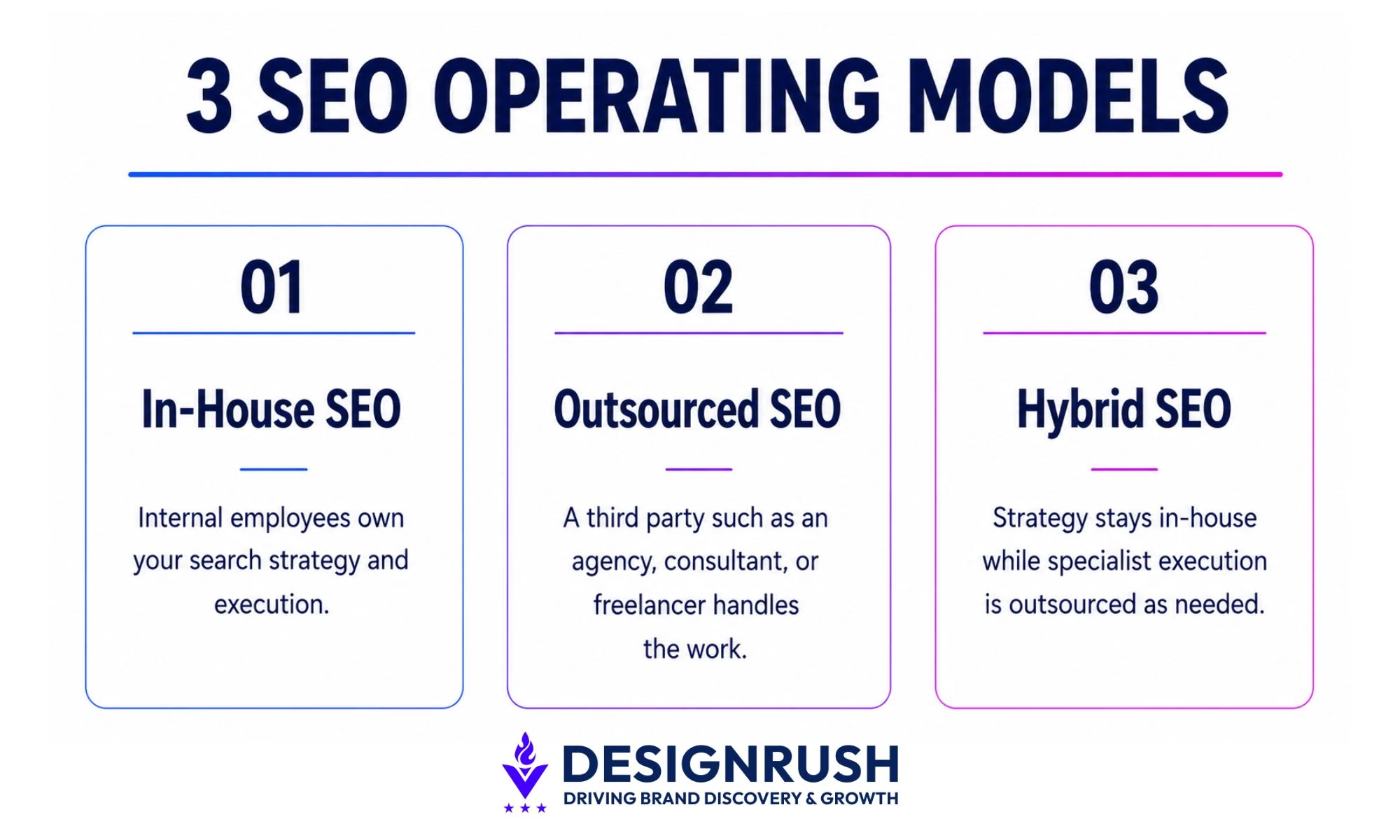
In-house SEO means internal employees own your search strategy and execution.
Outsourced SEO means a third party, i.e. an agency, consultant, or freelancer handles it.
A hybrid model keeps strategy and brand-critical work internal while renting specialist execution, like for example technical audits, digital PR, and content volume on demand.
My rule of thumb is to fix the bottleneck first, whether that is speed, complexity, or control. Give the model a year, then judge it by the qualified pipeline it creates, not ranking movement alone.
What In‑House SEO Actually Buys You
When SEO lives under your roof, you gain two things money can't easily rent:
- Memory. Your team knows the full journey of every experiment and remembers why each decision was made, which is how you stop repeating expensive mistakes.
- Control. You implement changes in lockstep with shifting priorities, with everyone on the same page.
Together they mean fewer surprises and faster course-corrections.
How an In‑House SEO Team Helps, Day‑to‑Day
1) Your voice stays intact.
If you sell something complex or regulated, you've probably winced at content that sounds off-brand. An in-house SEO lead working in sync with content keeps every page sounding like you.
2) Problems get caught early.
Most costly SEO issues, like lost rankings after a redesign, duplicate pages, broken redirects, may start as tiny, fixable details. When your SEO lead sits in sprint planning and code review, they catch these before they ship.
3) Governance stops being a recurring meeting.
Information architecture, canonical rules, and redirect standards become part of how you publish anything new instead of one-off tasks. That protection carries across releases, regions, and product pages.
4) Launches get less risky.
Shipping a new pricing page or product section stops feeling like a gamble. Your SEO lead signs off on crawlability, internal links, page speed, and analytics tagging before anything ships.
What To Put in Place So In‑House SEO Actually Works
 The value of in-house SEO is control over the decisions that carry into every release, including brand voice, site structure, and the standards that protect revenue and reputation. You still do not need to own every task internally.
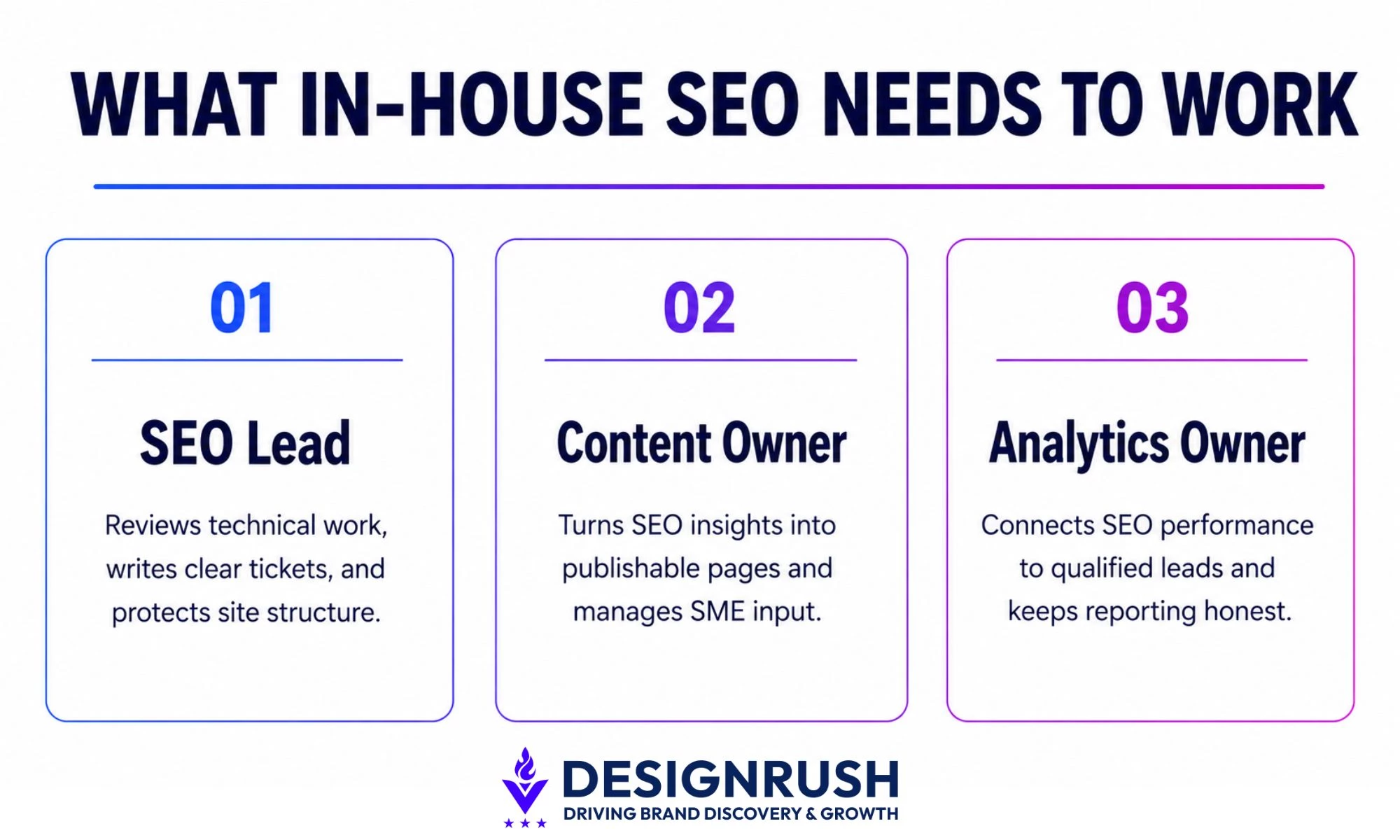
Build around three core roles.
- Product-adjacent SEO lead that reviews pull requests, writes clear tickets, and protects architecture, schema, and internal links.
- Editor or content owner who turns insights into publishable pages and wrangles subject-matter experts to build and maintain authority.
- Analytics translator who connects page performance to qualified leads and keeps reporting honest.
A lightweight tool stack to budget for:
- Crawler and change monitor, to catch regressions.
- Rank and visibility tracker, to see query-share movement.
- Briefing and outlining assistant, to keep content on-intent.
- Link and mention monitor, to track authority wins and sentiment.
- Dashboards wired to your CRM, to track conversions rather than just traffic.


What Great Agencies Bring That’s Tough To Build Inside
A good agency gives you speed you can't hire for overnight, plus specialists who stay sharp because they use these skills every day across dozens of clients.
5 Important Ways an SEO Agency Helps, Day‑to‑Day
1. Specialists on tap
Migrations, JavaScript rendering audits, log-file analysis, programmatic SEO, real digital PR. Most companies don't need these every week, but when you do, you need them now, not in six months.
DigitlHaus Agency shows that breadth in its Warne Scope Mounts case study, where the agency combined platform migration, development, SEO, and systems integration to increase organic search traffic by 32%, transactions by 46%, and revenue by 50%.
2. Volume on demand
Need 10-20 rank-worthy pages a month, or a steady stream of quality mentions? A mature agency already has editorial QA, design, and outreach running, so you turn capacity up or down as the work demands.
OneLittleWeb includes several large-scale SEO and link-building projects, while its AI writing SaaS case study details how the team secured more than 600 backlinks over 13 months and helped organic traffic grow from zero to 200,000 monthly visits.
3. Cross‑market pattern recognition.
Because agencies review hundreds of sites across industries, they spot which formats, SERP features, and outreach angles are working now, and which have gone stale.
OuterBox reflects its experience across SEO, analytics, content, and multiple business sectors, while its Weiss-Aug case study shows how the agency separated automotive and medical search intent, helping traffic to surgical pages rise 270% year over year and organic search generate 66% of leads.
4. AI‑era SERP tactics.
AI answers now sit above the blue links, and the click curve has changed with them. Strong agencies track which queries still deliver clicks, how to earn citations, and how to reposition content for the visible space that remains.
WebFX addressed this for Enabling Devices by targeting AI Overviews and answer-engine queries, strengthening third-party authority signals, and tracking referrals from platforms such as ChatGPT and Perplexity.
Its Enabling Devices case study reports a 385% increase in AI Overview visibility, a 105% increase in total AI visibility, and 542% growth in leads attributed to AI and OmniSEO.
5. Execution without headcount.
You get senior strategy plus the people who do the work, without carrying permanent salaries, tools, and management overhead.
HigherVisibility followed this model for Restoration Roofing, supporting its in-house SEO manager with local research, site improvements, service and location page optimization, and bottom-funnel content that helped increase organic leads by more than 400% and organic traffic by 162%.
What You Need To Make the Most of SEO Agencies
An effective partnership still requires clear roles on your side:
- Executive sponsor, for example, a marketing VP that keeps SEO integrated with your other marketing initiatives.
- Engagement owner, like PM, that drives the relationship and steps in fast when something drifts off course.
- Analytics owner that wires pages to MQLs and sales-qualified opportunities so every optimization ladders up to revenue.
For more guidance on what to consider before and during the hiring process, read our expert guide to hiring an SEO agency.
In-House vs. Agency SEO Cost
SEO costs look very different depending on whether you build the function in-house or hire an agency. Each model packages expertise, capacity, and overhead differently, so the headline figures are rarely directly comparable.
Below, we break down the annual cost of running SEO in-house and compare it with what agencies charge.
The Cost of Running SEO In-House
A lean two-person in-house SEO function costs roughly $35,500 to $36,500 per month before adding regular writing, development, design, or link-building support.
Glassdoor reports average US pay of about $147,100 for a senior SEO manager and $135,200 for a senior content marketing manager, used here as the closest benchmark for a content lead.
The salaries are only part of the employer cost.
According to the US Bureau of Labor Statistics, wages account for 69.9% of private-sector compensation, while benefits make up the remaining 30.1%. Applying that ratio brings the two roles to about $33,650 per month.
- Senior SEO manager with benefits: $17,535
- Content lead with benefits: $16,115
- SEO and content tools: $899
- Leadership and product marketing input: $970 to $1,945
- Estimated total: $35,520 to $36,495
The leadership allocation assumes 10 to 20 hours of product marketing involvement each month.
Glassdoor places average US product marketing manager pay at about $141,250 per year, which works out to roughly $97 per hour after applying the same employer-cost ratio.
What SEO Agencies Charge
SEO agency pricing varies widely based on scope, contract length, and the level of specialist support involved.
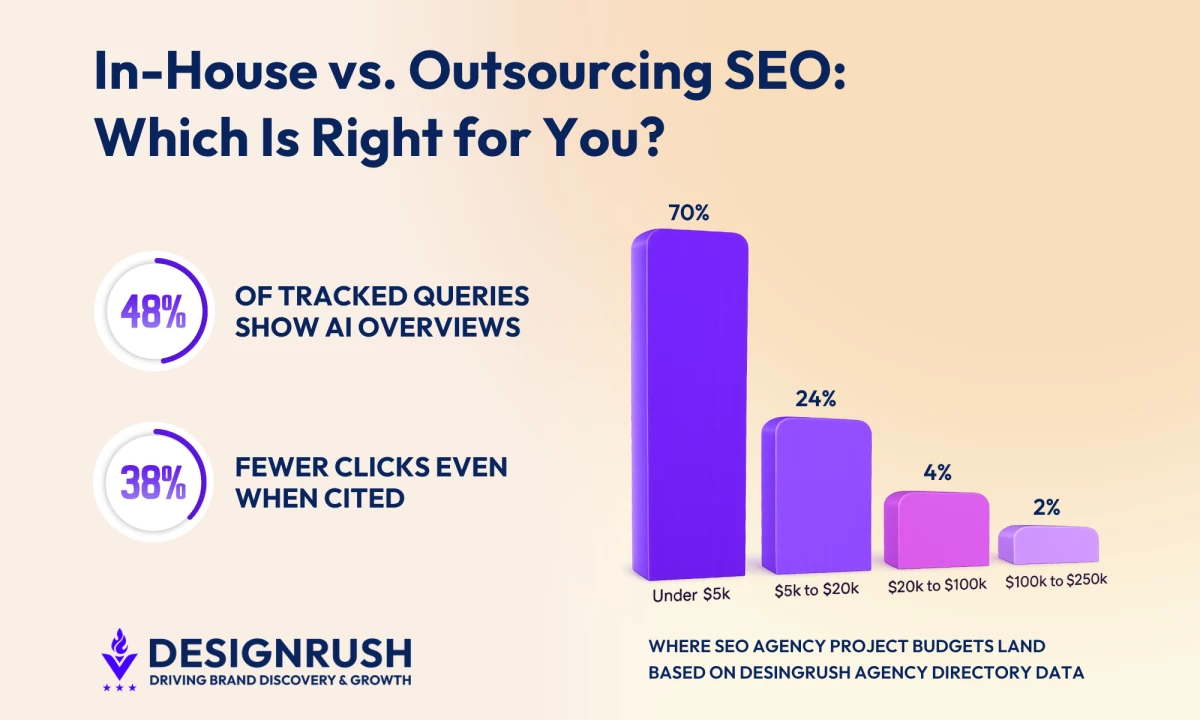
First-party project data from the DesignRush Agency Directory shows that smaller engagements commonly fall below $5,000, while more substantial programs tend to range from $5,000 to $20,000. Broader, long-term projects can reach $20,000 to $100,000 or more.
- 1 to 12 months: Under $5,000
- 4 to 36 months: $5,000 to $20,000
- 12 to 18 months: $20,000 to $100,000
- 12 months: $100,000 to $250,000
Lower budgets are generally associated with shorter or more focused assignments, while ongoing SEO programs and complex scopes command higher fees.
These figures represent total project budgets rather than monthly retainers.
In-House vs. Agency vs. Hybrid SEO: At a Glance
In-house, agency, and hybrid setups produce different results, and the differences show up fastest in the first 90 days.
The table below is what I see each model reliably deliver, and where each one lags.
Area | In-House | Agency | Hybrid |
Technical SEO | Prevents regressions via sprint access | Removes legacy debt with deep audits | Internal prevention plus agency deep-dives |
Content | Voice, ICP fit, SME accuracy | Editorial ops, on-time delivery at volume | Brand-owned strategy, outsourced production |
Authority (links / PR) | Slow but brand-true mentions | Systematic, campaign-based coverage | Internal relationships plus agency scale |
Learning | Institutional memory | Cross-market pattern recognition | Both, if the internal lead captures it |
Speed to first wins | Slower (ramp plus hiring) | Fast (tested playbooks) | Fast on execution, steady on strategy |
Cost predictability | Fixed salaries | Retainer (easy to unwind) | Mixed, depending on scope |
Choose in-house if you're a larger or highly regulated organization, SEO is a long-term core function, and you can reliably assign engineering and content bandwidth every month.
Choose an agency if you're a lean team that needs speed, specialized skills, or content volume you can't staff for, and you want to scale spend up or down.
Chris Raulf, founder and CEO of Boulder SEO Marketing, sees budget, time, and expertise as the main barriers for smaller teams.
“Limited budgets restrict investment in comprehensive campaigns and dedicated teams. Lack of in-house expertise in SEO can be overwhelming.”
Go hybrid if you want to own strategy and brand voice internally while renting technical depth, digital PR, or production capacity. This is where most growing companies eventually settle.
How AI Search Changed the In-House vs. Agency Decision
If you're deciding this year, the terms of the decision have changed.
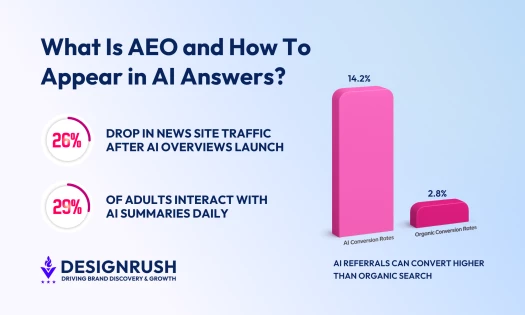
AI-generated answers now sit above the blue links, more searches end without a click, and your operating model matters as much as your strategy, because the fastest-adapting team tends to end up ahead.
Masab Gadit, founder and CEO of Wellows, sees this less as a choice between people and AI than a question of how the two work together.
He argues that humans are strongest at strategy, brand understanding, and creative problem-solving, while AI is better suited to data processing, pattern recognition, and consistent execution.
Whichever SEO model you choose, the advantage comes from building a workflow that combines both.
- Google's AI Overviews reach more than 2.5 billion people every month, a figure Google confirmed at I/O 2026, up from 1.5 billion a year earlier, claimed by Alphabet.
- Conductor's Q1 2026 benchmark across 21.9 million queries found that AI Overviews appeared in nearly 25% of searches, up from roughly 16% in late 2025.
- BrightEdge found that AI Overviews appeared in about 48% of the commercial queries it tracked by early 2026.
- When an AI Overview appears, users click a traditional result only about 8% of the time, versus 15% when no summary is shown, according to Pew Research Center.
- In 2026 cited pages receive roughly 120% more organic clicks per impression than uncited pages for the same query, despite still attracting about 38% fewer clicks than pages ranking on queries without an AI Overview, according to Seer Interactive.
No matter how you look at the numbers or which route you choose, the team needs to do more than rank pages.
AI search now rewards technical SEO, strong content, authority, and citation visibility, so the better choice is the one that gives you those skills consistently, whether that means building them in-house or hiring an agency that already has them.
In-House or Outsourcing: How To Know Which Is Better for You?
In 2026, keeping pace with a SERP that shifts week to week matters more than who writes the blog.
So, make the call that clears your biggest constraint, commit to it for a full year, and hold it to tight agreements and granular tracking. Give it that runway and organic becomes a channel you can rely on. But, if you treat it as a side project, you'll keep losing clicks and pipeline to competitors who move faster.
To help you make a more informed decision, check out our guides on evaluating agencies, setting your budget and goals, and preparing your SEO strategy for AI search.

Our team ranks agencies worldwide to help you find a qualified partner to implement the latest AI solutions. Visit our Agency Directory for the Top SEO Agencies, as well as:
- Top SEO Consultants
- Top Small Business SEO Companies
- Top B2B SEO Agencies
- Top SEO Outsourcing Companies
- Top Boston SEO Companies
SEO In-House vs. Outsourcing: FAQs
1. How do I pressure-test an agency before signing?
Ask who will work on your account, including the strategist, technical lead, and PR lead. Request a 90-day plan that shows what should be delivered by day 60, such as technical fixes, bottom-funnel pages, and initial PR placements. Look for relevant experience in your business model and require access to ticketing, staging, and monthly reporting tied to pipeline rather than rankings alone.
2. What should I budget for the first year of SEO?
Compare total cost of ownership, not salary or fees in isolation, and note the two models are priced differently. A lean two-person in-house team runs roughly $35,500 to $36,500 a month once benefits, tools, and overhead are included. Agency work is usually scoped as a project budget, from under $5,000 for focused assignments to $20,000-$100,000 or more for larger programs. Model each across 12 months and pick what fits your budget and hiring capacity.
3. Should we optimize for AI Overviews?
Treat AI Overviews as another search feature that content can be built to appear in. The aim is to earn visibility when the search ends inside the AI answer while improving click-through rates on high-intent queries through stronger titles, descriptions, and on-page experience. This matters because AI Overviews now reach more than 2.5 billion people each month according to Google I/O 2026.
4. How long does SEO take to show results?
SEO takes several months to gain traction regardless of the delivery model. Technical fixes may show an impact sooner, but content performance and authority usually build over multiple quarters. Agencies are often the better fit when a company needs momentum within a single quarter, while in-house teams tend to ramp more slowly but retain the knowledge internally.
5. What are the red flags when hiring an SEO agency?
Watch for frequent strategist changes, reporting that focuses on impressions and rankings instead of pipeline, unusually low retainers that come with vague scopes, limited access to staging or ticketing, and no clear owner for recovery after an algorithm update.
6. Can I start with a hybrid model and move fully in-house later?
Yes, and many companies follow this path. Use the agency phase to establish the strategy, processes, and quality standards, then have your internal lead document the playbooks and runbooks as the work progresses. Individual workstreams can move in-house as the team gains capacity, provided knowledge transfer is built into the engagement from the start.