Partner with reputable offshore development companies to lower operating costs, access broader IT talent pools, & achieve greater delivery flexibility. Compare companies by expertise & budget to find the right partner.
Organic rankings are determined by five factors: top services, reviews, portfolio, awards/press, and team expertise. Sponsored listings pay for a placement that appears above organic positions. Sponsorship does not affect star ratings or review content - read more on our methodology page.

Groove Jones
Award WinnerRecipient of a Best Design Award for outstanding work.Award-Winning AR / VR / XR / AI / WebGl Experiences
Groove Jones is an innovative technology company that specializes in creating AI/VR/AR software solutions for a wide range of industries, including advertising, entertainment, marketing, health, and training...
Top Services:
- VR/AR
- Software Development
- Mobile App Development
- Web Development
- Web Design
- Show more
- Location
- Dallas, Texas
- Number of Employees
- Under 49
- Average Hourly Rate
- $150/hr
- Minimal Budget
- $50,000 & Up
- Portfolios Count
- 26 Projects Listed
Data sourced from the agency's DesignRush profile, its website, and other relevant accountsGroove Jones Services
Data sourced from the agency's DesignRush profileToyota Amazon MasterCard Intel HP Comcast FX Networks Samsung AT&T Ford
Groove Jones Reviews & Testimonials

VR/AR Review from Sam Rogers
The fine folks at Groove Jones really delivered with this project!See for yourself at https://4-h.org/clover/activities/rockets-to-the-moon/Our organization had worked with them before, but this was my first time...and my first time working with an AR project at all. Giving all the stars in all the categories isn't something I do much of, but in every way Groove Jones earned it.From the beginning, they got the intention and guided us through the choices needed to keep us within our fixed budget and immovable timeline. The team consistently delivered what we needed to get approvals from our internal and external stakeholders, and worked with us when we faced unexpected delays and technical surprises. We're just launched and already looking for the next opportunities to work with Groove Jones again! Totally professional, and totally fun :) They really made our team and our brand look good.

VR/AR Review from Amy Chao, CMP
The client had an exceptionally positive experience with Groove Jones. The agency delved into new technology boosting user experience, ensuring it aligned with the existing environment and was multi-channel compatible. Groove Jones in less than 90 days unveiled an interactive platform that was not only visually captivating but also had a striking impact. Throughout the journey, it remained communicative, promptly addressing modifications and infusing their unique insights. (verified via email)

VR/AR Review from Alan Fletcher
The client collaborated with Groove Jones on a challenging initiative, marked by a lofty yet vague objective and a pressing deadline. Discovered through online research and having no prior association, the collaboration swiftly took off. In merely three months, Groove Jones conceptualized and constructed a 20x16x10 Holodeck for the client's participation in the MWC event in Barcelona. (Verified via email)
Reviews verified by DesignRush and sourced from the agency's profile View All Reviews
Explore Software Development Specializations
- .Net
- Agile Consulting
- AgTech
- ASP.NET
- Automotive
- Banking
- Biotech
- C#
- Cloud Application Development
- CRM Development
- Cryptocurrency
- Data Mining
- DeFi
- Eastern Europe
- Educational
- Enterprise
- Fintech
- Flutter Development
- Foodtech
- for Small Business
- Gaming
- Golang
- Google App Engine
- Government
- Healthcare
- Hospitality
- HR Tech Solution
- Java
- JavaScript Development
- Laravel
- Legal
- Machine Learning
- Manufacturing
- MVP Development
- Nearshore
- Node.js
- Outsourcing
- Performance Testing
- PHP
- Python Django
- Real Estate
- Robotics Process Automation
- SaaS Development
- Salesforce Consulting
- Smart Contracts
- Software Consulting
- Software Maintenance
- Startups
- Unity
Popular Services
Everything You Need to Know Before Hiring a Custom Offshore Software Development Company
What can offshore software development companies do for your business?
An offshore software development company can help expand your business's technology capacity without the cost of building every capability in-house. For many businesses, they offer three main advantages:
Cost efficiency
Many companies use an offshore partner to reduce development and staffing costs while maintaining delivery momentum. As a result, they can scale teams more flexibly, fund innovation initiatives, and explore newer technologies such as AI without significantly increasing internal overhead.
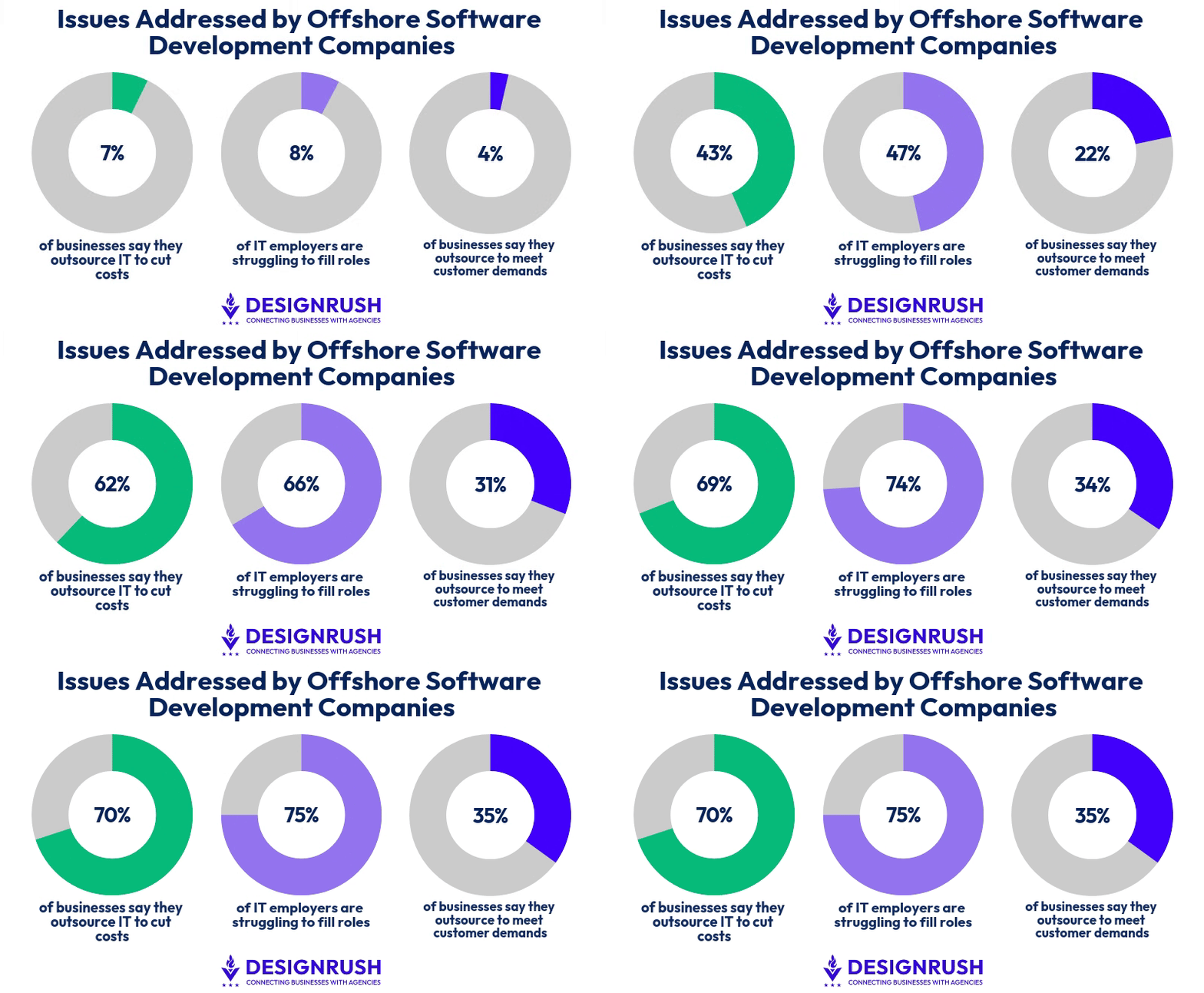
According to an Accelerance study, 70% of businesses report that cost reduction is a primary reason for outsourcing IT, with many experiencing 40%-70% in cost savings through offshore software development companies.
Access to specialized talent
Technical hiring remains difficult across many markets. ManpowerGroup reports that IT is among the hardest-hit sectors for talent shortages, with 75% of IT employers struggling to fill roles.
As a result, offshore development teams can help businesses tap into broader talent pools, especially for in-demand capabilities that are difficult to fill locally.
Resource efficiency
Offshore teams can support internal staff by taking on defined projects, product builds, ongoing development work, or routine technical support. In doing so, internal teams can focus on strategic priorities and security-sensitive work.
Deloitte's Global Outsourcing Survey highlights that businesses increasingly view offshore partners as strategic contributors. In fact, some of the top reasons that they outsource include:
- Meeting increasing customer demands (35%)
- Improving quality and performance (33%)
- Aligning delivery more closely with business strategy (27%)
How long does it take to build custom software with an offshore development company?
Building custom software takes about 3-18 months with an offshore development company. The actual timeline will depend on your technical requirements, priority features and functions, quality assurance and security needs, and feedback process.
Below is an estimated timeline:
| Phase | What to Expect |
| Product discovery and planning (4-8 weeks) | Requirements gathering, tech stack selection, user research, project milestones, and concept validation |
Software design | UI/UX design, technical architecture, wireframing, prototype development, and end-user testing |
| Software engineering (8-40 weeks) | Building the front and back end of the product, including the server-side logic, database management, and systems integration |
| Testing and QA (3-8 weeks) | Performing usability, regression, functional, security, integration, and other relevant tests to ensure the software meets project and industry standards |
| Deployment (1-3 weeks) | Preparing the software for go-live rollout, such as configuring hosting environments |
How to choose the best software development company for your business?
To choose the best software development company for your business, evaluate their expertise, track record, and markers of credibility. Here are some steps to guide you:
- Specify your project requirements, including core features and functions, target users, required platforms and system integrations, security and compliance needs, business goals, performance indicators, and acceptance criteria.
- Research potential regions and consider their software development capabilities, time zone and cultural compatibility, government/political stability, and talent pool quality.
- Shortlist the top providers that have showcased proven expertise in your industry, software type, and specific requirements through their case studies that display their measurable business impact. Look also for certifications, like ISO 27001 and SOC 2 Type II, and HIPAA or PCI-DSS readiness.
- Assess client reviews and testimonies to verify its service reliability, delivery quality, process maturity, strong security policies, and problem-solving capabilities.
- Send a request for proposals to your top candidates and compare based on scope, deliverables, team expertise, and total cost of ownership.
- Schedule in-depth interviews with your top candidates to discuss development processes, project management approach, security and governance frameworks, and other project details.
- Run a pilot project, such as a prototype or a minimum viable product (MVP), to test the agency's capabilities in a real-world scenario before signing a long-term contract.
What questions should you ask before hiring an offshore development firm?
Before hiring an offshore software development firm, ask these questions to confirm business and project fit:
Relevant Background
- What software type and tech stack do you specialize in?
- Can you share examples of projects similar to mine in scope and complexity?
- What is your experience in my specific sector? Can you provide 3-5 client references I can contact?
- Where are your teams located? What is their English proficiency level, and how do you handle secure and smooth collaborations?
Services and Processes
- Can you walk me through your entire software development process?
- Which development methodologies do you primarily use, and why? How structured is your approach when implementing these methodologies?
- Can you describe your quality assurance and testing processes? How do you identify, rectify, and report issues?
- What measures do you have in place for data security and protection of intellectual property across borders?
Related to Your Project
- Who will be on our team, and what are their credentials?
- What is your project management approach? How do you ensure time zone, cultural, and system alignment?
- How do you ensure that you comply with the regulations of my specific country and sector?
- How do you handle urgent issues outside our hours of daily overlap?
What red flags should you avoid?
When evaluating an offshore software development firm, watch for signs that the agency may introduce delivery, security, or governance risks. Common red flags include:
- Vague processes: If a company cannot clearly explain how it handles onboarding, discovery, SDLC execution, quality assurance, change management, and project reporting, the engagement is more likely to suffer from scope creep, delays, and inconsistent delivery quality.
- Weak security and compliance measures: An offshore software development company should be able to explain its approach to access controls, data protection, NDAs, documentation, and any relevant regulatory requirements. Weak security and compliance practices can expose the business to operational, legal, and reputational risk.
- No developer access: If all communication is tightly controlled through a single intermediary (e.g., product manager) and there is little visibility into the actual delivery team, misunderstandings can persist longer, and product alignment may suffer.
- High employee turnover rate: Frequent staff changes can disrupt continuity, slow delivery, and increase knowledge loss across the life of the project. It may also indicate deeper issues with management or team stability.
- Unclear IP ownership: If the contract does not clearly define ownership of source code, designs, documentation, and other deliverables, the business may face legal ambiguity, reuse concerns, or future dependency on the vendor.
- Vendor lock-in: Be cautious if the agency pushes proprietary tools, restrictive terms, or long commitments without explaining the operational benefit. This can make future migration, scaling, or partner changes more difficult.
- Concerning client reviews: A pattern of reviews mentioning missed deadlines, poor communication, poor quality, or lack of transparency should be treated as a serious warning sign rather than an isolated complaint.
Sources
DesignRush sustains a directory of over 40,000 agencies categorized by service category, location, expertise, and reviews. We build our database in two ways:
- Our dedicated team of agency experts actively searches the web for top-performing companies. We then pull information from their websites, online presence, and client testimonials to verify their status and qualifications prior to listing.
- The agencies listed get notified of their profiles on the website and they can choose to claim it or not, which suggests their availability for more collaborations.
Agencies can also reach out to DesignRush and must go through the verification process prior to being listed.

Why companies trust DesignRush
Every agency is independently vetted before it can be listed or ranked
 4.8
4.8 4.8
4.8Some agencies pay for sponsored placement, clearly labeled and held to the same vetting standards.
Frequently Asked Questions About Offshore Software Development Companies
What services does an offshore software development firm typically offer?
Offshore development services typically support the full software development lifecycle, from early planning through post-launch support. Core services include:
- Software consulting and management: Auditing a business's current IT environment, identifying business and technical requirements, and advising on product strategy, platform choices, implementation planning, and delivery oversight.
- Custom software development: Designing and building a software solution tailored to a company's workflows, operational needs, and customer requirements.
- Mobile app development: Developing software solutions for mobile devices as native iOS or Android apps or cross-platform products.
- Web development: Building digital products delivered through the browser, including customer-facing websites, portals, eCommerce experiences, and progressive web apps.
- DevOps and cloud engineering: Configuring CI/CD pipelines, migrating systems to a cloud platform (AWS, Microsoft Azure, Google Cloud), and designing the cloud infrastructure to ensure security and accessibility.
- AI/ML and automation development: Producing applications that run on artificial intelligence, machine learning, or natural language processing models to streamline workflows and augment human teams.
- Systems integration: Connecting the different applications of a business (e.g., CRM, ERP, and eCommerce store), ensuring seamless data exchange and cohesive functionality across systems.
Many offshore software development companies also offer UI/UX design, digital transformation, data engineering and business intelligence, IoT development, cybersecurity and compliance, and staff augmentation.
What is the difference between offshore, nearshore, and onshore development?
The primary difference between offshore, nearshore, and onshore development lies in the team's location in comparison to yours.
| Onshore development | Nearshore development | Offshore development | |
| Where is it located? | Same country as your business | Neighboring country | Distant countries, often in different continents |
| Advantages |
|
|
|
| Considerations |
|
|
|
In practice, the right model depends on your priorities. Companies that value close collaboration may prefer onshore or nearshore teams, while those focused on scalability and cost efficiency often consider an offshore partner.
What are the most popular locations for offshore software development companies?
The best offshore location depends on your company's priorities, including budget, time zone preferences, language fluency, technical expertise, and regulatory needs. That said, several regions are commonly considered leading destinations for offshore outsourcing:
- India: About 54% of American companies outsource to India, and it remains one of the most established offshore outsourcing destinations due to its large talent pool (over 5 million developers), mature vendor ecosystem, and technical capabilities. It is ideal for businesses looking for scalability, cost-efficiency, and long-term delivery capacity.
- Eastern Europe: Countries such as Poland, Romania, and Ukraine are often evaluated for their strong engineering talent, experience with complex software projects, and familiarity with European and global business requirements. Many companies look to this region for high-skill development work and R&D depth.
- China: Quickly becoming a leader in software development, many organizations outsource to China for its advanced technological expertise (AI/ML, IoT, and large-scale product development) and manufacturing capabilities. Businesses turn to China for software-hardware projects, manufacturing support, and embedded systems.
- Southeast Asia: Countries such as Vietnam and the Philippines are frequently considered for their competitive pricing, growing developer ecosystems, and ability to support distributed delivery models. They may be attractive to businesses seeking cost efficiency and scalable team support.
- Latin America: Offering time zone and cultural alignment and cost-effective rates, Latin America is one of the top outsourcing locations for organizations in North America that need real-time collaboration.
How much does an offshore software development firm charge for their services?
Offshore software development services cost $15-$100+ per hour, depending on your project requirements and complexity, and development team location and technical expertise. Below is the approximate hourly rate of each region:
- Southeast Asia (Vietnam, Philippines, Malaysia, Indonesia): $25-$40 per hour, with senior talents charging over $60 per hour
- India and China: $35-$40 per hour, with senior talents charging over $70 per hour
- Africa and the Middle East: $25-$50 per hour, with more experienced teams charging over $70 per hour
- Eastern Europe (Ukraine, Poland, Belarus, Bulgaria, Hungary, and Romania): $30-$60 per hour, but senior talent may charge over $100 per hour
- Latin America (Argentina, Colombia, Mexico, Brazil, and Costa Rica): $35-$65 per hour, with senior talents charging over $100 per hour
- UK: $60-$80 per hour for junior teams or small projects, but more experienced teams charge over $100 per hour
- United States: $75-$150 per hour, with more experienced teams charging $200 per hour
When is offshore development the wrong fit?
You may want to avoid hiring an offshore development company when the delivery model creates more operational risk than strategic value. This is often the case when close day-to-day alignment, strict oversight, or highly controlled environments are essential.
Offshore developers may be a poor fit when:
- Real-time collaboration is critical: If your team depends on frequent live decision-making, rapid feedback loops, or constant cross-functional coordination, limited time zone overlap can slow execution.
- The work involves highly sensitive data or strict regulatory requirements: Projects involving proprietary algorithms, regulated customer data, or data sovereignty obligations may require tighter legal, security, and operational controls.
- Internal technical leadership is limited: Offshore engagements usually work best when the client has experienced product, engineering, or technology leaders who can define priorities, manage delivery, and enforce standards.
- Project scope is unclear: If requirements, goals, or ownership are still vague, an offshore engagement can lead to misalignment, rework, and unnecessary spend.
Latest Trends Related to Offshore Software Development

Software Development
Onshore vs. Offshore Software Development Company: Which One Is a Better Choice?
2,647