
I always write the plan before the program. I’ll share the developer onboarding process and documentation I use to turn day‑one chaos into measurable progress.
Developer Onboarding: Key Points
Developer Onboarding Overview
In the first 10 days with a software development agency, I agree on a one‑page success plan, get access and environments live in hours (not weeks) and release a small, real feature behind an on/off switch with live monitoring.
Here, I’ll explain how.
How I Prevent Stumbles in Month One
The first month is where delivery momentum is won or lost. When developers onboarding takes too long, you burn cash without learning. The usual culprits are simple: unclear goals, slow access, scattered documentation, and an inconsistent cadence.
My playbook fixes key issues on day one so the developer onboarding process turns into actual progress rather than status updates.
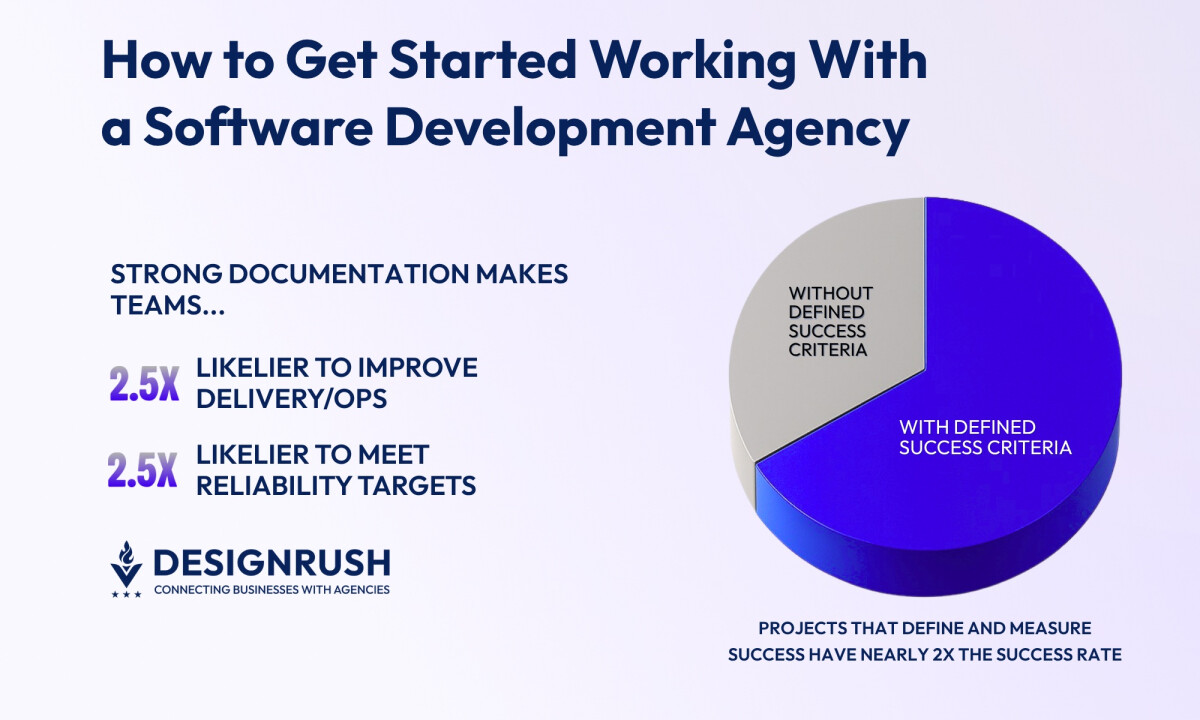
And as a 2025 PMI report found, projects which define success criteria upfront and put a measurement system in place (behaviors we lock in from day one) have nearly double the success rate.
What I establish before any code is written:
- A one‑page Definition of Success with three business outcomes, two guardrails (e.g., regulatory scope, architectural constraints), and the first thin slice we’ll ship.
- Clear ownership: who approves changes, who unblocks access, who accepts releases. No gray zones.
- A weekly executive rhythm you’ll actually attend: 30‑minute steering, 20‑minute demo, two slides of evidence (no adjectives).
What to Gather Before Kickoff (So Onboarding Isn’t Guesswork)
Early in my career, I assumed onboarding delays came from slow developers or tech debt. In reality, it was almost always a lack of usable context. No access to the CI pipeline, no idea where data flows, no clue who owned what.
Now, before any onboarding starts, I treat inputs like a launch checklist. If a new dev can't trace an application programming interface (API) call from local to production (or if they have to Slack five people to find a schema) we’re not ready.
Treat the following as your developer onboarding documentation starter pack:
- Current stack and environments: Diagram of system setup, software versions, hosting model, and deployment process.
- Architecture and integrations: Map of system components, data flow, API details, event agreements, and external dependencies.
- Data and content: Information on data structures, ownership, movement, retention, and handling of personal data.
- Security and compliance: Security features like single sign-on (SSO) and multi-factor authentication (MFA), policies, audit requirements, and data classification.
- Access and tools: Access controls for code repositories, issue trackers, build pipelines, cloud services, and monitoring tools.
- Operating practices: Rules for code changes, release schedules, and task management.
- Runbooks: Guides for deployment, rollback, incident handling, and on-call rotations.
- Evidence of the past: Records of past issues, performance, and risks.
- Glossary: List of terms and acronyms for shared understanding.
If a document doesn’t exist, don’t stall. Capture a lightweight version now and improve it during the first sprint.
Phased Approach to the Developer Onboarding Process
Use these phases to match your pace while keeping clear exits, evidence, and a shippable thin slice at every step. The goal is simple: establish trust, reduce risk, and ship something small to production.
Here’s the flow I run:
- Block 1: Charter and kickoff
- Block 2: Access live everywhere (24-hour rule)
- Block 3: Read, run, and verify the system
- Block 4: Non-functional requirements (NFRs) locked
- Block 5: Delivery rhythm and governance
- Block 6: Ship the thin slice (with telemetry and rollback)
Block 1: Charter & Kickoff
Objective: Align outcomes, guardrails, decision rights, and the first thin slice.
In the kickoff, define the one-page success plan, clarify roles/approvals, and establish escalation paths. Discuss the scope and constraints early to set expectations. Ensure everyone knows who approves changes and who accepts releases.
For example: During a mobile app project, we agreed on "activate 30% of users by month two" as our first goal and set guardrails around performance and security.
Outcomes to aim for:
- Signed definition of success
- Spec for a thin-slice (a small part of the project that can be built and tested quickly)
Block 2: Access Live Everywhere (24-Hour Rule)
Objective: Make credentials and environments a non-event.
Start by provisioning least-privilege access to code repositories, continuous integration and continuous delivery/deployment (CI/CD) pipelines, and cloud accounts. Set up SSO/MFA for security, and establish a break-glass protocol for emergencies.
I always make sure the team has access to the code and CI systems within 24 hours so they can start deploying features without delays and address issues quickly.
For example: If on Friday night errors suddenly spike, the on-call uses the break-glass path, rolls back in minutes, and files a post-mortem before bed.
Outcomes to aim for:
- Access roster with with responsible owners and expiration dates
- Record of login activity and build history
Block 3: Read, Run, and Verify the System
Objective: Replace “tribal knowledge” with runnable truth.
Have the developer run services locally, hit endpoints, and trace a request end-to-end to ensure they understand how the system works. If they encounter any gaps in documentation, address them immediately.
For example: Let's say you're onboarding for a CMS. The developer clones the repo, runs a local build, tests API endpoints, and updates the documentation in real time for future developers. If a newcomer can’t ship or roll back in a day, the docs aren’t good.
Outcomes to aim for:
- Updated setup guide
- Working local run
- List of doc gaps with owners
Block 4: Non-Functional Requirements (NFRs) Locked
Objective: Prevent performance/reliability debt from leaking into prod.
Here you set performance budgets (e.g., API response times, web page load times), reliability targets (e.g., crash-free sessions), and security requirements (e.g., secure data storage). This ensures that the app will meet quality standards before it goes live.
For example: On a cloud-based app project, we’d likely set an API response time target of under 200ms and ensure a 99.9% uptime target for reliability, which is closely monitored during development.
Outcomes to aim for:
- Budget checks in the pipeline
- Visible SLOs/alerts
Block 5: Delivery Rhythm & Governance
Objective: Lightweight cadence that creates decisions and artifacts.
Implement a weekly steering meeting to discuss outcomes, risks, and decisions. Hold sprint demos to show actual progress, and use a RAID log to track risks, actions, issues, and decisions.
For example: When developing an app I’d like to see weekly meetings to finalize key decisions, address at least one risk, and set the next feature’s scope (no status theater).
Outcomes to aim for:
- Calendar invites sent
- RAID live with owners
- Intake template in the repo
Block 6: Ship the Thin Slice (With Telemetry & Rollback)
Objective: Prove the lane end-to-end before scaling scope.
Ship a small, real feature behind a feature flag to test it in production. Monitor its performance with metrics and ensure there’s a rollback plan in case of issues.
For example: When rolling out a search feature for a mobile app, we first deployed it to a small group of beta users, monitored the feature's activation rate and crash-free sessions, and rolled back the feature after ensuring everything worked correctly.
Outcomes to aim for:
- Live slice
- Dashboard link
- Rollback plan exercised
Zero-Drama Kickoff and Week-One Measurement
Run this focused playbook to set intent fast and start measuring what matters in week one.
The 90‑Minute Kickoff Agenda (Built for Busy Leaders)
This meeting sets the tone and eliminates rework later. Keep it tight.
- Outcomes and constraints: Three outcomes, two guardrails, one thin slice.
- Acceptance and decision path: What we call “done,” how we escalate.
- Cadence: Weekly steering + sprint demo + async status (one pager).
- Quality gates: Definition of ready/done, automated checks in CI/CD.
- Risks: Top five risks and a mitigation owner for each.
Pro tip: I like to wrap the meeting by listing the remaining access items with owners and due dates. Nothing stalls developer onboarding faster than “permissions purgatory”.
Measure Progress in Week One (Not After Launch)
If you can’t measure it, you can’t steer it. Set baselines and track a few leading indicators.
- Business signals: Conversion or adoption for the thin slice; support tickets avoided; time‑to‑learn (how quickly we validated an assumption).
- Performance and reliability: TTFB/LCP, availability SLO, error rate; define acceptable ranges and alert thresholds.
- Flow and delivery: Lead time for changes, deployment frequency, change failure rate, mean time to restore. Use these as conversation starters, not weapons.
- Observability: One dashboard leaders can read in 60 seconds; link it in every status update.
Why this matters: In McKinsey’s multi-company rollout of key performance metrics and measurements from the very first week of a project, teams saw 20–30% fewer customer-reported defects, about 20% better employee-experience scores, and roughly a 60-percent lift in customer satisfaction.
Access, Security & Governance: The Zero‑Drama Setup
If we can’t sign in, we can’t ship, so we set up access, security, and light governance in one pass and make it a non-event.
Here’s the combined, week‑one checklist I run to keep developer onboarding fast and predictable.
1. Access and Environments
If my team can’t log in, we can’t get things done, so I make setting up access smooth and quick with automated roles, reliable tools, and environments that pass an initial check right away.
- Identity and access management: Pre-defined roles, minimal access rights, SSO, MFA, and clear processes for removing access.
- Secrets: Sensitive information is securely stored, regularly updated, and audited (never in code or logs).
- Tooling: Systems for tracking issues, hosting code, building and deploying software, managing cloud services, monitoring performance, and controlling feature releases.
- Environment readiness: Make sure all environments (development, testing, staging, and production) are ready, with sample data, test users, and passing initial checks.
- Deploy rights: Define who can push updates to each environment and set approval processes and change schedules.
- Break-glass protocol: Set rules for who can access production systems in emergencies, how this access is logged, and for how long it’s allowed.
2. Security and Compliance
I think safety should come down to a few enforceable basics wired into the pipeline so every change is secure by default.
- Data classification: Identifying what types of data exist (like personal info, financial data, or health records), where it can be stored, and how long it should be kept.
- Software development life cycle (SDLC) controls: Enforcing rules like mandatory code reviews, checking for vulnerabilities in code and dependencies, and signing files to ensure integrity.
- Threat modeling: Identifying the top five risks to the system and planning one solution for each, reviewing this regularly.
- Incident response: Setting up a plan for handling emergencies, with clear severity levels, on-call procedures, and defined targets for recovery (Recovery Time Objective or RTO and Recovery Point Objective or RPO). A practice drill should be done within the first 30 days.
- Audit readiness: Ensuring all changes are documented, showing who approved them and when, with clear records of who has access to production systems.
3. Governance and Communication
Make sure rules and processes don't delay progress. It should actually enable faster decisions. I set clear roles, a short meeting rhythm, and a simple intake path for work.
- RACI in plain English: Clarifies who makes decisions, who carries out tasks, and who needs to be kept informed.
- Standing ceremonies: Regular, brief meetings to identify roadblocks, track progress, and improve how the team works together.
- Steering (weekly, 30 min): A meeting to discuss risks, decisions needed, and the next step in the project.
- Demo (end of sprint): Show working software, not just presentations.
- Retro (team-level): Review two areas for improvement after each sprint to enhance team efficiency.
- Work intake: A standard template that outlines the business problem, the expected value, acceptance criteria, and non-functional requirements (NFR) impact.
- RAID log discipline: A weekly review of risks, actions, issues, and decisions, ensuring unresolved items are addressed or escalated.
Operational Onboarding: Time‑Zones, Failure Fixes, and Docs That Scale
I’ll cover how to build onboarding systems that hold up under pressure across time zones, through setbacks, and with documentation that scales.
- Onboarding New Developers Across Time Zones
- Common Failure Modes (and How I Recover)
- What “Good” Developer Onboarding Documentation Looks Like
1. Onboarding New Developers Across Time Zones
Distributed work is normal. Make handoffs explicit.
- Overlap windows: Set two or three hours of guaranteed overlap; publish it.
- Handover ritual: Each day ends with a short note: what changed, what’s next, what’s blocked.
- Documentation for async: Screenshots, runnable examples, copy‑paste commands; decisions recorded in the repo, not chat.
- Meeting hygiene: Who needs to be present live and who can catch up later; start on time and finish early.
2. Common Failure Modes (and How I Recover)
Things will go sideways. Plan the response before you need it.
- Permissions purgatory: Set a 24‑hour SLA; auto‑escalate to an executive if not met.
- Stale or missing docs: Run “docs‑first spikes” (small time‑boxed tasks to create or correct docs); maintain a doc‑debt burndown.
- Tool sprawl: Standardize the minimum set; set sunset dates for extras.
- Metrics vacuum: Instrument first, then build; treat observability as part of “done.”
- Bus factor risk: Pair on critical paths, rotate code reviews, capture decisions in ADRs (architecture decision records).
- Over‑scoped first slice: Cut scope by half; keep the acceptance criteria; ship behind a feature flag.
As Keith Shields, CEO of Designli, says:
“Focus on building only the features that are essential for launch. Trying to do too much too soon leads to stress, delays, and feature bloat.”
3. What “Good” Developer Onboarding Documentation Looks Like
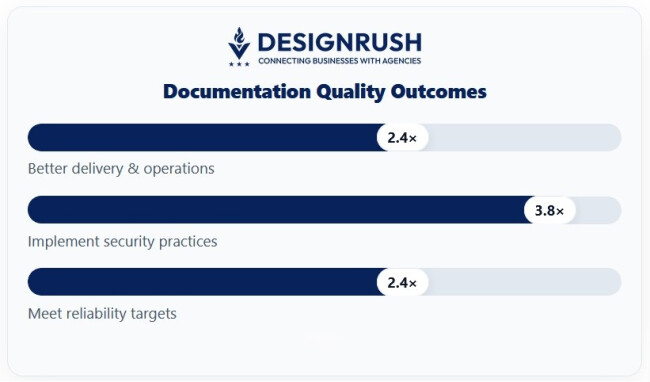
Research from DORA (Google) shows that teams with high-quality documentation are 2.4× more likely to achieve better software delivery and operations performance, 3.8× more likely to implement security practices, and 2.4× more likely to meet reliability targets.
I recommend keeping things simple. If a new engineer can set up, release, and roll back changes within a day, your documentation is working well.
- Read me first: A brief overview of the system, a map of the code repository, instructions for running the code locally, deploying it, and rolling it back.
- Architecture at a glance: A one-page summary showing the system’s services, data storage, data flow, and external dependencies.
- Integration contracts: Details for each API or event — who owns it, versioning, SLAs, and sample requests and responses.
- Data notes: Information about data structures, data migrations, ownership, handling personal data (PII), and data retention rules.
- Runbooks: Step-by-step guides for deploying, rolling back, and responding to incidents, including contact info.
- Environments & branching: Which code branches correspond to which environments (e.g., development, production), and rules for promoting code between them.
- Security practices: How to manage sensitive data, use approved libraries, perform security scans, and handle third-party reviews.
- Decision records: Short records of key architectural decisions, with links to relevant code.
@devleader Onboarding documentation is a huge asset. Helping get new folks onboarded to your project or team can ensure they're on the right path to being an effective contributor. Great documentation can reduce the time to effectiveness dramatically! But... no documentation comes without cost! What would you recommend software engineering teams do to keep their onboarding dicumentation up to date? Check out the full video on my YouTube channel! ---- 🔔 Follow for more software engineering and dotnet topics! 📨 Sign up for my FREE email newsletter by visiting my site (link in profile) 🗣️ Share with your network! #SoftwareEngineers#SoftwareEngineering#Documentation♬ original sound - DevLeader
The One‑Page Developer Onboarding Checklist
Use this to start on Monday.
- Inputs ready: Stack diagram, integrations list, data classification, baselines, glossary.
- Access granted: Code host, issue tracker, CI/CD, artifact registry, cloud, analytics, observability, secret vault.
- Environments verified: Can build, test, and deploy to dev and stage; seeded data; smoke tests pass.
- Quality gates set: Definition of Ready/Done, protected branches, required reviews, CI checks.
- Security wired: SSO/MFA, scanning in CI, vault in use, production access logged.
- Governance live: Steering calendar invites sent, demo cadence set, RAID log created with owners.
- Telemetry visible: Dashboard link in status doc; alerts configured.
- Thin slice defined: Acceptance criteria, feature flag created, rollback plan documented.
Developer Onboarding: Final Words
Define success in one page, provision access in 48 hours, lock non‑functional requirements by mid‑week, and ship a thin slice with telemetry in ten days or less.
That rhythm builds trust, reduces risk, and turns the developer onboarding process into visible progress.
If you adopt only three moves from this guide:
- Set the one‑page Definition of Success before kickoff.
- Provision access and environments with a 24‑hour SLA and a break‑glass protocol.
- Ship a thin slice fast with observability, and use the demo to agree on the next slice.
Find More Agency Hiring Resources:
- Building a Practical Budget for Mobile App Development
- Top Mobile App Development AI Tools
- iOS Game Development Guide

Our team ranks agencies worldwide to help you find a qualified partner. Visit our Agency Directory for the top software development companies, as well as:
- Top Enterprise Software Development Companies
- Top Custom Software Development Companies for Small Business
- Top Mobile App Development Companies
- Top AI Development Companies
- Top Software Testing Companies
Our design experts also recognize the most innovative design projects across the globe. Given the recent uptick in app usage, you'll want to visit our Awards section for the best & latest in app designs.
Developer Onboarding FAQs
1. How do I keep an agency from optimizing for velocity at the expense of outcomes?
Give them a “north-star” metric plus two guardrails (e.g., conversion ↑, but also error rate ≤ X and support tickets ≤ Y). Review these weekly.
If a proposed shortcut harms a guardrail, it needs an explicit, written exception with a rollback plan.
2. We’re mid-project and scope is creeping. How do we reset without a big fight?
Run a 60-minute re-charter: restate goals, rank scope in a MoSCoW list, set a “stop-doing” list, and re-price or de-scope openly. Publish the before/after plan.
If everything is a “must,” introduce a budget/schedule trade-off matrix and decide in the meeting.
3. What does a healthy client–agency weekly rhythm look like?
One 45-min steering check (business outcomes, risks, decisions), one 30-min delivery sync (flow metrics + risk burndown), and async status with links to dashboards and PRs. Cancel meetings that don’t change a decision.